

Build vs. Buy: The AI Platform Decision - Post 7 of 10
There is a moment that arrives in the lifecycle of almost every enterprise AI platform, and it arrives on a predictable schedule: somewhere between six and eighteen months after production deployment, when the system has moved beyond early adopters and into broader organizational use.
A compliance officer asks how the AI determined a particular recommendation that influenced a credit decision. An auditor requests a log of every data access event the AI system produced in the previous quarter. Legal asks which data sources were used to generate a customer-facing output that is now the subject of a complaint. The information security team asks how AI agents are enforcing data access permissions across the twenty-three source systems the platform connects to.
These are not unreasonable questions. They are the questions any responsible organization should be asking about systems that touch sensitive data, inform consequential decisions, and operate at a scale and speed that human review cannot match.
For most internally built AI platforms, these questions reveal the same structural reality: the governance layer was not there. Not absent through negligence, but absent because it was always the next thing to build — phase two, once the platform was stable; a future sprint, after the current roadmap was cleared. By the time the questions arrive, the architecture that would have made them answerable is missing from the foundation.
What follows is not a compliance exercise. It is a re-architecture.
Governance deferred is not governance saved. It is governance converted from an upfront architectural investment into a downstream crisis management programme, with the additional costs of operational disruption, regulatory exposure, and organizational credibility loss.
Why governance cannot be added after the fact
The instinct to defer governance is not irrational. In the early phases of an AI platform build, governance does not produce visible capability. It does not make the AI smarter, faster, or more useful to the end users whose adoption determines whether the initiative succeeds. In a build environment where every sprint is a trade-off between capability and infrastructure, governance loses to capability almost every time.
The consequence of that trade-off only becomes apparent in production, and it manifests in five specific failure modes that are each expensive to remediate precisely because they require changes to decisions made before any code was written.
The audit trail gap. AI systems not designed for comprehensive logging produce outputs without the data lineage and decision trail that regulators, auditors, and risk functions require. This is not a matter of turning on a log file. A complete audit trail for AI operations means capturing what data was accessed, in what combination, interpreted through what context, to produce what output, in response to what query, from which user, at what time, with what authorization. Retrofitting that capability requires re-instrumenting every data access path and every decision point in the system — which means reaching into every layer of the stack to add instrumentation that the original architecture did not account for.
The access control gap. AI agents that query across multiple data sources will, without deliberate governance design, encounter data that the querying user should not see. A sales analyst using an AI system that connects to CRM data, operational data, and financial data may receive AI-generated responses that incorporate information their role-based access controls were designed to prevent them from accessing directly. The access control model designed for human users navigating discrete application interfaces does not automatically translate to AI agents executing cross-system queries. Closing this gap requires redesigning the permissions architecture around AI consumption patterns rather than human navigation patterns — a foundational change, not a configuration update.
The policy enforcement gap. Governance policies enforced by human review operate at human speed. When an AI system processes hundreds or thousands of decisions per day, human policy review becomes a choice between two equally unacceptable outcomes: a bottleneck that destroys the operational efficiency the AI was deployed to create, or a rubber stamp that provides the appearance of oversight without the substance. Neither is governance. Real governance at AI speed requires policies that are enforced at the platform level — automatically, consistently, and without requiring human review of each transaction. That enforcement mechanism must be built into the architecture. It cannot be layered on top of a system that was designed to operate without it.
The model drift gap. AI models do not produce identical outputs indefinitely. As underlying models are updated by vendors, as prompt strategies evolve, and as the data distributions feeding the system shift over time, the behavior of an AI platform changes — sometimes gradually, sometimes abruptly. Without systematic monitoring at the governance level, behavioral drift goes undetected until it produces a consequential error: a recommendation that reflects outdated logic, an output that violates a policy the system was assumed to be following, an action taken on stale context that no longer reflects the current state of the business. Detecting drift requires a monitoring infrastructure that was designed to observe AI behavior as a first-class operational concern, not as an afterthought.
The scope creep gap. AI systems in production attract new use cases. A platform deployed for supply chain optimization gets adopted by the finance team. A customer service AI is asked to handle a new product category. Each expansion carries its own governance requirements — different data access patterns, different policy constraints, different regulatory context. Governance defined for the original deployment scope does not automatically extend to expanded use. Each new use case that falls outside the original governance boundaries either requires a new governance review or operates without one. In most organizations, the review capacity is not scaled to match the expansion rate, which means an increasing proportion of AI operations runs outside any formal governance boundary.
Governance by process versus governance by architecture
These five failure modes share a common cause: they all result from treating governance as a process rather than as architecture.
Governance by process means policies defined in documents and enforced by people. Approval workflows, review cycles, compliance sign-offs, manual audit procedures. This model works adequately for low-volume, high-stakes decisions where human judgment adds value at each step. It does not work for AI systems operating at the throughput of automated workflows, where the decisions are too numerous, too fast, and too interconnected for human review to be both comprehensive and timely.
Governance by architecture means policies enforced at the platform level, not the process level. Every data access generates an audit event automatically — not because someone remembered to log it, but because logging is structural. Every agent action is checked against governance policies before execution — not because a human approved it, but because the enforcement layer is between the agent and the action. Every query is bounded by the access controls appropriate to the requesting user and the data being accessed — not because access controls were configured for this use case, but because access control is a property of the platform itself.
The critical distinction is one of default state. Governance by process is opt-in — it is effective when the process is followed and ineffective when it is not. Governance by architecture is opt-out — it is the default state of every operation, and circumventing it requires deliberate action rather than simple inaction.
At the speed and scale at which AI operates, opt-in governance will always have gaps. Only opt-out governance — architecture-level enforcement — can keep pace with autonomous operation.
The cost of getting governance wrong in regulated environments
The governance gap is costly in any organization. In regulated industries, it is existential.
In financial services, an AI system that cannot produce a complete audit trail of the data and logic underlying a credit decision is not a compliant system. It does not matter how accurate the decisions are or how much operational efficiency the system delivers. Without demonstrable governance, the system cannot operate in the regulatory environment.
In healthcare and life sciences, AI systems touching patient data, clinical decisions, or drug development workflows operate under data governance requirements that have no tolerance for architectural gaps. An audit finding that reveals uncontrolled data access is not an issue to remediate in the next sprint. It is a deployment pause, a remediation programme, and a regulatory conversation that can take quarters to resolve.
In insurance, the combination of state-level regulatory frameworks, actuarial governance requirements, and the consequential nature of underwriting and claims decisions creates a governance environment where a system that cannot explain its outputs is a system that cannot be used for the decisions that matter most.
In each of these industries, the cost of the governance freeze — the operational pause that follows a governance question the architecture cannot answer — is not measured in re-architecture cost alone. It is measured in the business outcomes deferred during remediation, the regulatory exposure accumulated while the gap existed, and the organizational credibility lost when a compliance failure on an AI system becomes a visible event.
The organizations that have avoided these costs did not do so by being more rigorous in their compliance planning. They did so by starting on a platform where governance was structural from the first deployment rather than the tenth.
Governance as architecture: what it looks like in practice
Governance-by-architecture is not an abstract principle. It is a specific set of engineering decisions that, made at the right time, make the five failure modes above structurally impossible rather than merely unlikely.
It means that every data access, every agent action, every query execution, and every model output generates a governance event automatically — as a structural property of the operation, not as a logging procedure someone must remember to execute. The audit trail is not produced by the compliance team. It is produced by the platform as a byproduct of normal operation.
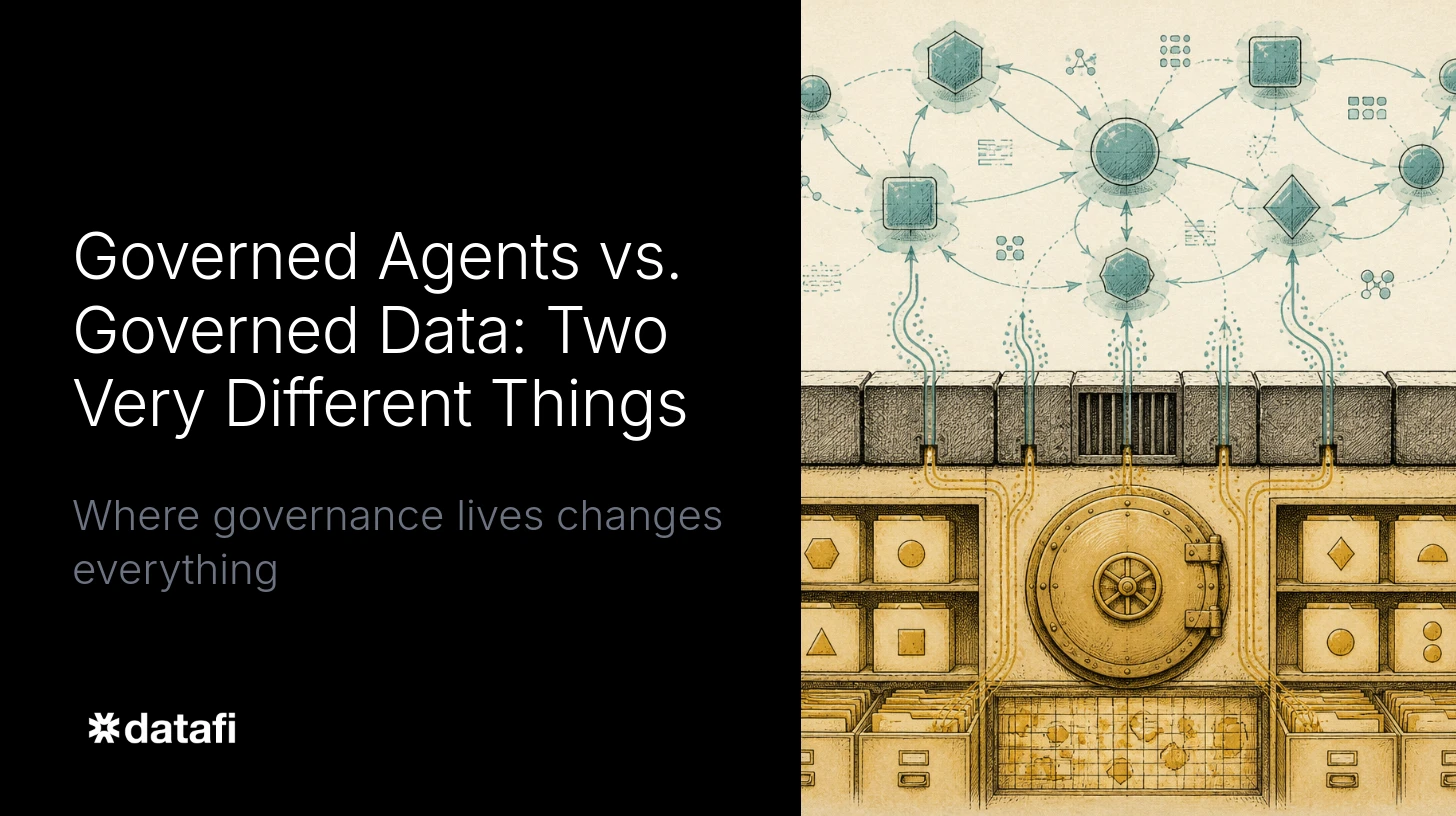
It means that access controls are applied at the data layer, not the application layer — so that AI agents consuming data across multiple source systems encounter the same access boundaries that human users encounter in those systems, enforced consistently regardless of how the query was formulated or which agent submitted it.
It means that governance policies are executable code, not documents — policies that the platform enforces automatically at runtime, that apply to every operation by default, and that can be updated centrally without requiring changes to the systems they govern.
And it means that the governance layer is not a separate system bolted onto the AI platform. It is the layer that every other component of the platform operates within — so that the expansion of AI use cases does not require a new governance review for every new deployment, because the governance architecture was designed to accommodate expansion rather than to govern a fixed scope.
In the Datafi Business AI Operating System, this is the role of the Control Tower. Control Tower is not a compliance module purchased separately or configured after deployment. It is the governance enforcement layer that the entire platform operates within — the mechanism that makes every data access, every agent action, and every model output auditable, bounded, and policy-compliant by default. When an agent takes an action, the Control Tower has already evaluated whether that action falls within the governance boundaries appropriate to the requesting user, the data involved, and the business context. When a query accesses sensitive data, the Control Tower has already applied the access controls that determine what that query is permitted to return. The audit trail is not generated by a logging process. It is a structural output of every operation the platform performs.
The organizations that deploy on Datafi do not encounter the governance moment that arrives for internally built platforms. Not because they are immune to governance questions, but because the questions have answers that are built into the infrastructure rather than absent from it.
What governance failure actually costs
Governance deferred is not governance saved. It is governance converted from an upfront architectural investment into a downstream crisis management programme — with the additional costs of operational disruption, regulatory exposure, and the organizational credibility loss that accompanies a visible AI governance failure.
The organizations that have paid that cost did not pay it because they were careless about compliance. They paid it because they treated governance as the last thing to build, and discovered that it needed to be the first.
Governance cannot be the last thing an enterprise AI platform builds, because it is the thing that determines whether everything else the platform builds can be trusted. Organizations that discover this after deployment do not get to go back. They get to pay for it twice.
Building on a platform where governance was designed in from the start means never paying for it twice.
Post 8 in this series examines the contextual layer in depth — the architectural element that determines whether AI truly understands your business or merely has access to data about it, and why it represents a multi-year infrastructure investment that no internal team will replicate on a single-initiative budget.
Datafi is a Business AI Operating System designed for mid-enterprise organizations that need the full power of an integrated AI platform without the cost, risk, and timeline of building one. Learn more at datafi.co.
Series: Build vs. Buy - The AI Platform Decision
Part 1 - Awareness: Framing The Question
Post 1: The Hidden Cost of Building Your Own Enterprise AI Platform
Post 2: Why Most Enterprise AI Projects Stall Before They Scale
Post 3: The Seven Layers Most AI Builders Forget to Budget For
Post 4: AI That Answers Questions vs. AI That Solves Problems
Part 2 - Consideration: Evaluating The Tradeoffs
Post 5: Build vs. Buy - A Scoring Framework for Mid-Enterprise AI Decisions
Post 6: What Palantir’s Deployment Model Teaches Us About the Wrong Way to Scale AI
Post 7: Governance Is Not a Feature - It Is the Foundation
Post 8: The Contextual Layer - Why Your Internal Team Cannot Build the Moat That Matters
Part 3 - Decision: The Alternative Path
Post 9: From Pilot to Production in 90 Days - What “Buy” Actually Looks Like With Datafi
Post 10: The AI Operating System - Why the Future of Enterprise AI Is a Platform, Not a Project