



Build vs. Buy: The AI Platform Decision — Post 1 of 10
There is a moment in almost every enterprise AI vendor conversation that follows a predictable script. The demo wraps up. The numbers are on the table. And then someone in the room, usually the most technically credible person in the room, leans back and says the six words that have derailed more AI initiatives than any technology failure ever could:
“Why don’t we just build it?”
The instinct is reasonable. Your engineers are talented. You understand your data better than any outside vendor. You have control over your development roadmap. Building sounds like platform ownership, and ownership sounds like strategy.
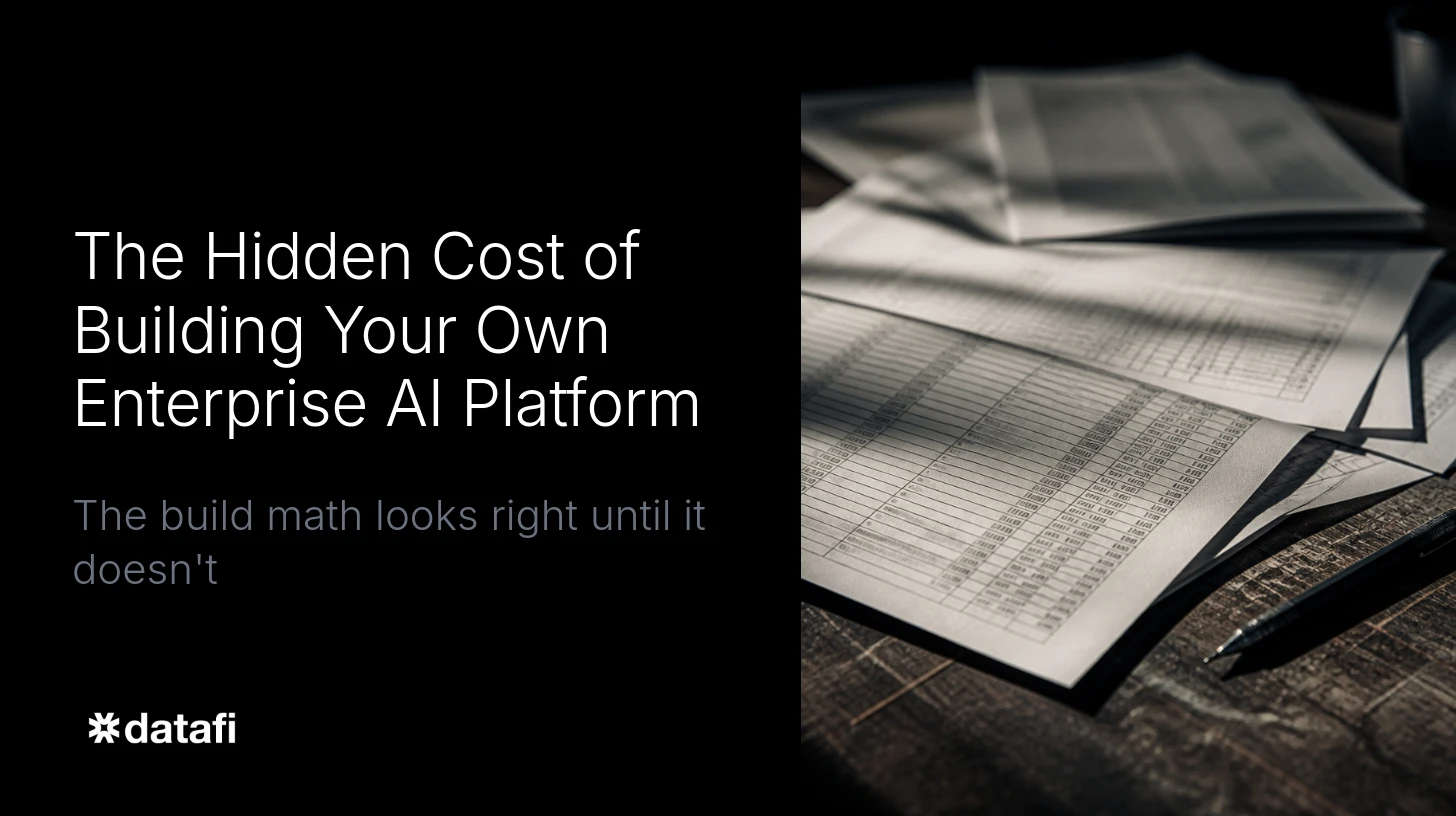
The problem is not the instinct. The problem is the spreadsheet that follows it.
The gap between the budget-slide build cost and the realistic total cost of an internal enterprise AI platform is not a rounding error. A realistic three-year TCO typically lands between three and seven times the initial estimate, driven by costs that never appear on the original spreadsheet.
What the budget slide shows
The internal build case typically rests on a clean three-line model: engineering headcount, cloud infrastructure, and a timeline. Three to five senior engineers. AWS or Azure at a predictable monthly run rate. Twelve months to something useful in production.
It looks compelling. Against an enterprise software contract with six-figure annual fees, the build math often wins on paper, especially when the engineers are already on payroll.
But that model is not wrong because the numbers are wrong. It is wrong because of the numbers it never includes.
The five cost categories that never appear on the build spreadsheet
1. Talent attrition and the knowledge cliff
Senior AI/ML engineers are among the most in-demand professionals in the current labor market. The fully-loaded annual cost of a single senior ML engineer in a mid-market US tech hub, salary, benefits, equity, recruiting costs, and management time, routinely runs between $400,000 and $700,000. That number is significant. What is more significant is what happens when one of your three platform engineers gets a competing offer eighteen months into the build.
All custom AI development carries concentrated knowledge risk. The architecture decisions, the pipeline logic, the governance workarounds, the tribal knowledge about why a particular design choice was made, this lives in people, not documentation. When the internal development team turns over, which at current attrition rates in AI talent markets is a near-certainty over a three-to-five-year horizon, the rebuild cost does not appear on any spreadsheet. It appears in delayed roadmaps and institutional knowledge gaps that take years to close.
2. The governance and compliance layer that never gets built
The initial build scope almost always includes data access, model integration, and a user interface. It almost never includes the governance infrastructure stack that a production enterprise AI platform actually requires: data lineage, access management, audit trails, policy enforcement, model monitoring, and the organizational workflows that sit around all of it.
This is not an oversight. It is rational prioritization. In the early phases of an internal AI build, governance feels like phase two. The problem is that phase two requires re-architecting decisions that were made in phase one. By the time the compliance team asks for an audit log of every AI-generated decision that touched a customer record, you are not adding a feature, you are reconstructing the foundation.
The cost of retrofitting governance into a platform that was not designed for it is, conservatively, as expensive as building the platform a second time. This is where technical debt becomes a real budget line item.
3. Data quality and pipeline maintenance: the bill that never stops
Enterprise data is not clean. It was not clean before AI and it is not cleaner because AI is consuming it. Internal build teams consistently underestimate the ongoing engineering investment required to maintain data pipelines at the quality level that AI applications require.
A customer-facing AI application that produces confident wrong answers because the underlying data was stale, duplicated, or inconsistently formatted is not a technology failure, it is a trust failure. Rebuilding enterprise trust after a visible AI error is a business cost that does not appear on any infrastructure invoice.
Pipeline maintenance is not a launch cost. It is a permanent operating cost, and it scales with the number of data sources, the diversity of formats, and the organizational complexity of your data governance structure. For a mid-enterprise organization with dozens of data sources and multiple business units, this is a material recurring expense that belongs in any honest build calculus.
4. Ongoing model management and drift
The AI models your internal team integrates today will not be the AI models your organization needs in eighteen months. The pace of change in foundation models is compressing competitive cycles in ways that make enterprise software upgrade cycles look glacial by comparison.
Managing model versions, evaluating new capabilities against your existing use cases, re-testing integrations, retraining fine-tuned components, and communicating changes to business users, this is a function, not a project. It requires dedicated engineering attention on a continuous basis. Most internal build teams budget for a launch. Almost none budget for the AI operation discipline that follows it. This is core to the AI development lifecycle that most build plans ignore.
5. Opportunity cost: the business outcomes that wait
This is the cost that finance teams find hardest to quantify and the one that ultimately matters most.
Every month your internal AI platform spends in development is a month your organization is not realizing the business outcomes it was designed to produce. That is not an abstraction. It is the supply chain efficiency you are not capturing. The customer retention signal you are not acting on. The operational savings you are not capturing. The revenue acceleration you are leaving on the table.
The average internal enterprise AI build takes eighteen to thirty-six months to reach production at any meaningful scale. The organizations that are successfully deploying AI against business outcomes right now are not waiting for their internal platform to mature. They are operating on top of infrastructure that already exists.
The competitive cost of that gap is real, it is compounding, and it belongs in the build model.
The platform problem: you are not building a feature
The most consequential misunderstanding in the “why don’t we build it” conversation is the assumption about what is actually being built.
A production-grade enterprise AI platform is not a feature. It is not an integration. It is not a chatbot with a clean API behind it. It is a vertically integrated infrastructure stack that spans at minimum six distinct technical layers: data ingestion and quality, security framework, access management, governance and compliance, model orchestration and agent capability, user experience for non-technical users, and the contextual layer that gives AI genuine understanding of your business rather than just surface-level query capability.
Each of those layers represents years of engineering investment, failure modes discovered in production, and design decisions informed by deploying the same patterns across dozens of organizational contexts. The teams that have built this infrastructure well did not do it in twelve months. They did not do it with three engineers. And they are not finished building it.
When an organization decides to build its own enterprise AI platform, it is not deciding to build a product. It is deciding to become, in part, an AI infrastructure company, while simultaneously trying to remain the kind of company it actually is.
That is not impossible. But it is materially more expensive than the spreadsheet suggests and it creates technology debt that compounds across every sprint.
What “building” actually costs when you add it all up
A realistic three-year TCO model for an internal mid-enterprise AI platform build, inclusive of the cost categories above, typically lands between three and seven times the initial budget estimate. The range is wide because organizational context matters, attrition rates vary, governance complexity varies, and data freshness vary significantly.
But the directional conclusion is consistent: the gap between the budget-slide build cost and the realistic total cost is not a rounding error. It is the difference between a strategic investment and a budget commitment that quietly consumes engineering capacity for years without producing the business outcomes it was supposed to accelerate.
A simple illustrative comparison for a mid-enterprise organization:
| Budget-slide estimate | Realistic 3-year total | |
|---|---|---|
| Engineering headcount | $1.5M | $4.2M (attrition, backfill, expanded team) |
| Infrastructure | $360K | $720K (scaling, redundancy, monitoring) |
| Governance and compliance | $0 | $800K (retrofitting or dedicated build) |
| Data pipeline maintenance | $0 | $600K (ongoing operational cost) |
| Model management | $0 | $400K (versioning, evaluation, retraining) |
| Total | $1.86M | $6.72M |
These are illustrative estimates, not benchmarks. Your organization’s numbers will differ. The exercise worth doing is not plugging in precise figures, it is asking whether the categories in the right column appear anywhere in your current build plan.
If they do not, the spreadsheet is not a budget. It is a down payment.
The question to ask before your next AI budget conversation
The instinct to build is not wrong. There are organizations for which building proprietary AI infrastructure is a genuine strategic differentiator, where the AI capability itself is the product, where the data moat is deep enough to justify the investment, and where the engineering organization has the scale and stability to sustain a multi-year platform build alongside everything else it is responsible for.
For most mid-enterprise organizations, that is not the situation. The AI advantage does not come from infrastructure ownership. It comes from applying it, faster, more broadly, and with better governance than competitors who are still debating whether to build or buy.
The right question is not “are we capable of building this?” Most capable engineering teams are. The right question is: “Is building this the best use of what engineering productivity can achieve?”
In almost every honest analysis of that question, the answer points to the same conclusion: the organizations winning with AI right now are not the ones that built the most infrastructure. They are the ones that stopped building infrastructure and started solving business problems.
In Post 2 of this series, we examine why most enterprise AI projects stall before they scale, and the organizational, not technical, reasons that derail them.
Datafi is a Business AI Operating System designed for mid-enterprise organizations that need the full power of an integrated AI platform without the cost, risk, and timeline of building one. Learn more at datafi.co.
Series: Build vs. Buy — The AI Platform Decision
Part 1 — Awareness: Framing The Question
Post 1: Hidden Cost of Building Your Own AI Platform: Build vs Buy
Post 2: Why Most Enterprise AI Projects Stall Before They Scale
Post 3: The Seven Layers Most AI Builders Forget to Budget For
Post 4: AI That Answers Questions vs. AI That Solves Problems
Part 2 — Consideration: Evaluating The Tradeoffs
Post 5: Build vs. Buy - A Scoring Framework for Mid-Enterprise AI Decisions
Post 6: What Palantir’s Deployment Model Teaches Us About the Wrong Way to Scale AI
Post 7: Governance Is Not a Feature - It Is the Foundation
Post 8: The Contextual Layer - Why Your Internal Team Cannot Build the Moat That Matters
Part 3 — Decision: The Alternative Path
Post 9: From Pilot to Production in 90 Days - What “Buy” Actually Looks Like With Datafi
Post 10: The AI Operating System - Why the Future of Enterprise AI Is a Platform, Not a Project