


Build vs. Buy: The AI Platform Decision - Post 6 of 10
Any honest examination of enterprise AI has to begin with an acknowledgment: Palantir built something real.
The Foundry platform, the Ontology layer, and more recently AIP represent a genuine and serious contribution to enterprise AI infrastructure. Palantir’s deployments with defense agencies, intelligence services, and large industrial enterprises have produced documented operational outcomes at a scale and complexity that most enterprise software never approaches. Their AIP Bootcamp model — intensive, hands-on sessions designed to transfer builder skills to customer teams — reflects a deployment philosophy built on real learning about how AI value gets created in organizations. The company’s technical depth is not in question.
This post is not an argument that Palantir doesn’t work. It works, consistently, for the organizations it was designed to serve.
The question this series is asking is different: what does Palantir’s deployment model reveal about the broader challenge of scaling AI in mid-enterprise organizations — and what can organizations that are not Fortune 100 defense contractors learn from watching how that model performs outside its design envelope?
Palantir’s deployment model gates platform value behind a substantial builder investment. For mid-enterprise organizations without large embedded technical teams, this means the real cost of Palantir is never fully visible in the contract.
The third path nobody talks about
The build vs. buy framing this series has been developing since Post 1 positions the decision as a choice between two options: invest in building your own AI infrastructure internally, or deploy on a platform that provides that infrastructure as a finished capability.
Palantir does not fit cleanly into either category, and that is precisely what makes it instructive.
When an organization signs a Palantir contract, they are buying access to sophisticated infrastructure: a data integration layer, a powerful ontology-based semantic model, a workflow development environment, and an increasingly capable agentic AI toolkit. In that sense, it is clearly a buy decision.
But realizing value from that infrastructure is not a matter of turning it on. It requires building within it. The customer organization — or an implementation partner working alongside them — must configure the Ontology to reflect the specific entities, relationships, and business vocabulary of their operation. They must develop applications in Workflow Builder. They must construct agentic workflows using AIP tooling. They must maintain and evolve the solutions they have built as the business changes and as Palantir’s platform capabilities advance.
Palantir’s own materials are clear-eyed about this. The AIP Bootcamp methodology is explicitly designed to develop builders within the customer organization — people who can engineer value on the platform. The Ontology SDK is a development tool for engineers. The documentation assumes technical sophistication as a baseline.
This is neither build nor buy in the conventional sense. It is a third path: a platform investment that gates its value behind a builder investment. The contract buys the infrastructure. The implementation team builds the capability. The resulting solution lives in the customer organization, not with Palantir.
Where Palantir’s model works
Understanding where this model succeeds is essential before examining where it breaks down — and the success is genuine.
For large organizations with substantial technical capacity, the Palantir model has real advantages. A federal defense agency with hundreds of data scientists, engineers, and domain experts can fully leverage the depth of Foundry’s capabilities. A global financial institution with a mature data platform team can configure the Ontology precisely to reflect the complexity of their instruments, counterparties, and risk frameworks. An industrial enterprise running complex multi-site operations with dedicated OT/IT integration expertise can build on AIP in ways that produce operationally meaningful AI systems.
In these organizations, the builder investment is available. The implementation timeline is acceptable — when you are deploying AI to support mission-critical defense operations or billion-dollar risk management, a twelve-month implementation horizon is not a problem. The depth of capability Palantir’s platform offers is genuinely required for the complexity of the problems being solved. And the concentration of value in well-defined, high-investment use cases rather than broad organizational deployment is an acceptable trade-off when those use cases are consequential enough.
Palantir was designed for these organizations. Its pricing reflects them, its deployment methodology is calibrated for them, and its documented success stories come overwhelmingly from them. That is not a criticism. It is a description of a platform that knows its customer.
Where the model structurally breaks down
The problem emerges when organizations that do not fit this profile — mid-enterprise businesses without large embedded technical teams, with competitive time-to-value pressures, and with AI adoption goals that span broad business functions rather than narrow high-investment use cases — attempt to deploy via the same model.
The builder dependency does not scale down gracefully.
A manufacturing company with $2B in annual revenue and a technology team of sixty engineers — a capable organization by any reasonable measure — does not have the available capacity to staff a Palantir implementation at the depth the model requires. Configuring the Ontology for a complex multi-system environment, building production-grade applications in Foundry, and developing the agentic workflows that connect AI to operational decisions requires engineers whose full attention is on the platform. In a mid-enterprise organization, those engineers are also responsible for everything else the business depends on.
The typical resolution is an implementation partner: a Palantir-certified consultancy that provides the builder capacity the customer organization cannot. This resolves the immediate deployment problem and introduces a different one. The implementation partner brings the technical skills. They also carry the institutional knowledge about how the solution was built, why specific design choices were made, and how to maintain the system when things change. When the engagement ends, that knowledge leaves with them.
The result is a solution that lives in the customer’s Palantir environment but whose ongoing management depends on either re-engaging the implementation partner or rebuilding the internal expertise that was never developed in the first place. It is a dependency structure that looks like a buy decision and behaves like a build decision — with the costs of both and the organizational resilience of neither.
The hidden cost the contract does not show
This is the analytical gap that most Palantir evaluations miss, and it is the one most consequential for the organizations making the decision.
The Palantir contract covers platform access. It does not cover the cost of deploying it.
A complete accounting of a Palantir implementation for a mid-enterprise organization includes the platform license, the implementation partner engagement (typically measured in months and in hundreds of thousands to millions of dollars for meaningful scope), the internal engineering time diverted from other priorities to support the implementation, the training investment required to develop internal builders, and the ongoing maintenance cost of solutions that require Palantir-specific expertise to evolve.
Set that against the deployment model on the other side of the evaluation: a platform where the capability is deployed rather than built, where business users can access AI directly without engineering intermediaries, and where the time-to-value is measured in weeks rather than implementation cycles.
The comparison that matters is not Palantir contract value versus alternative contract value. It is total deployment cost versus total deployment cost — which puts the builder investment firmly in the numerator of the Palantir calculation.
For the organizations for which Palantir was designed, this calculus still makes sense. The depth of capability justifies the depth of investment. For mid-enterprise organizations, the math is less forgiving.
The scale problem: deep versus broad
There is a second structural limitation that surfaces once deployment is complete, and it concerns the shape of AI adoption rather than its cost.
Palantir’s deployment model optimizes for depth. A well-implemented Palantir solution in a specific operational domain — supply chain risk management, claims processing, production planning — can be genuinely impressive in that domain. The ontology accurately reflects the entities and relationships relevant to that problem. The applications built for that workflow surface the right information at the right moment. The AI understands the specific context it was configured to understand.
What it does not do automatically is extend to the next domain, or the one after that.
Each new use case within Palantir requires the same kind of implementation investment that produced the first one. A new business unit that wants AI access to their operational data needs the Ontology extended to cover their entities. A new workflow automation requires application development. A new agent capability requires builders who understand both the platform and the new domain.
The result is an AI deployment that becomes deeply capable in a small number of well-resourced use cases and broadly inaccessible to the rest of the organization. The supply chain team uses Palantir. Everyone else uses whatever they used before.
For mid-enterprise organizations with AI adoption goals that span finance, operations, customer service, procurement, and HR, the builder-gated model produces a deployment shape that does not match the deployment ambition. The technology can theoretically reach everyone. The implementation capacity ensures it practically does not.
What the lesson is
Palantir’s deployment model teaches something important that has nothing to do with Palantir specifically.
It teaches that the gap between a platform’s theoretical capability and its operational reality in a given organization is filled by implementation investment — and that the organizations for which a platform was designed are the ones best equipped to make that investment.
When a mid-enterprise organization evaluates Palantir and discovers that the deployment model requires more builder capacity than they have, they are not discovering a flaw in Palantir. They are discovering that the platform was designed for a customer profile they do not match. That is useful information, and it points clearly toward a different evaluation question: not “is this platform powerful enough?” but “is this deployment model compatible with our organizational capacity and our timeline?”
The organizations that are scaling AI broadly across mid-enterprise operations right now are not doing it through builder-intensive deployment models. They are deploying on platforms where the contextual understanding, the governance architecture, and the agentic capability are delivered as operational infrastructure rather than as builder responsibilities — where a finance analyst can access AI with the same depth of business context that an engineer spent months configuring, because the platform was designed for business users, not for builders.
That design distinction — AI infrastructure that business users can operate versus AI infrastructure that engineers must build — is not a question of capability. Palantir’s platform is more capable in specific domains than most organizations will ever need. It is a question of accessibility, deployment model, and organizational fit.
Palantir’s lesson for mid-enterprise organizations is not that sophisticated AI infrastructure is the wrong investment. It is that sophisticated AI infrastructure deployed through a builder-dependent model concentrates value in the organizations with the capacity to build — and leaves the majority waiting for an implementation cycle that never quite ends.
Datafi was designed for the majority.
Post 7 in this series examines the governance layer in depth — the architectural element that Palantir and most other platforms treat as a configuration responsibility and that Datafi treats as load-bearing infrastructure. The distinction determines whether AI governance scales with your deployment or creates a bottleneck at every step.
Datafi is a Business AI Operating System designed for mid-enterprise organizations that need the full power of an integrated AI platform without the cost, risk, and timeline of building one. Learn more at datafi.co.
Series: Build vs. Buy - The AI Platform Decision
Part 1 - Awareness: Framing The Question
Post 1: The Hidden Cost of Building Your Own Enterprise AI Platform
Post 2: Why Most Enterprise AI Projects Stall Before They Scale
Post 3: The Seven Layers Most AI Builders Forget to Budget For
Post 4: AI That Answers Questions vs. AI That Solves Problems
Part 2 - Consideration: Evaluating The Tradeoffs
Post 5: Build vs. Buy - A Scoring Framework for Mid-Enterprise AI Decisions
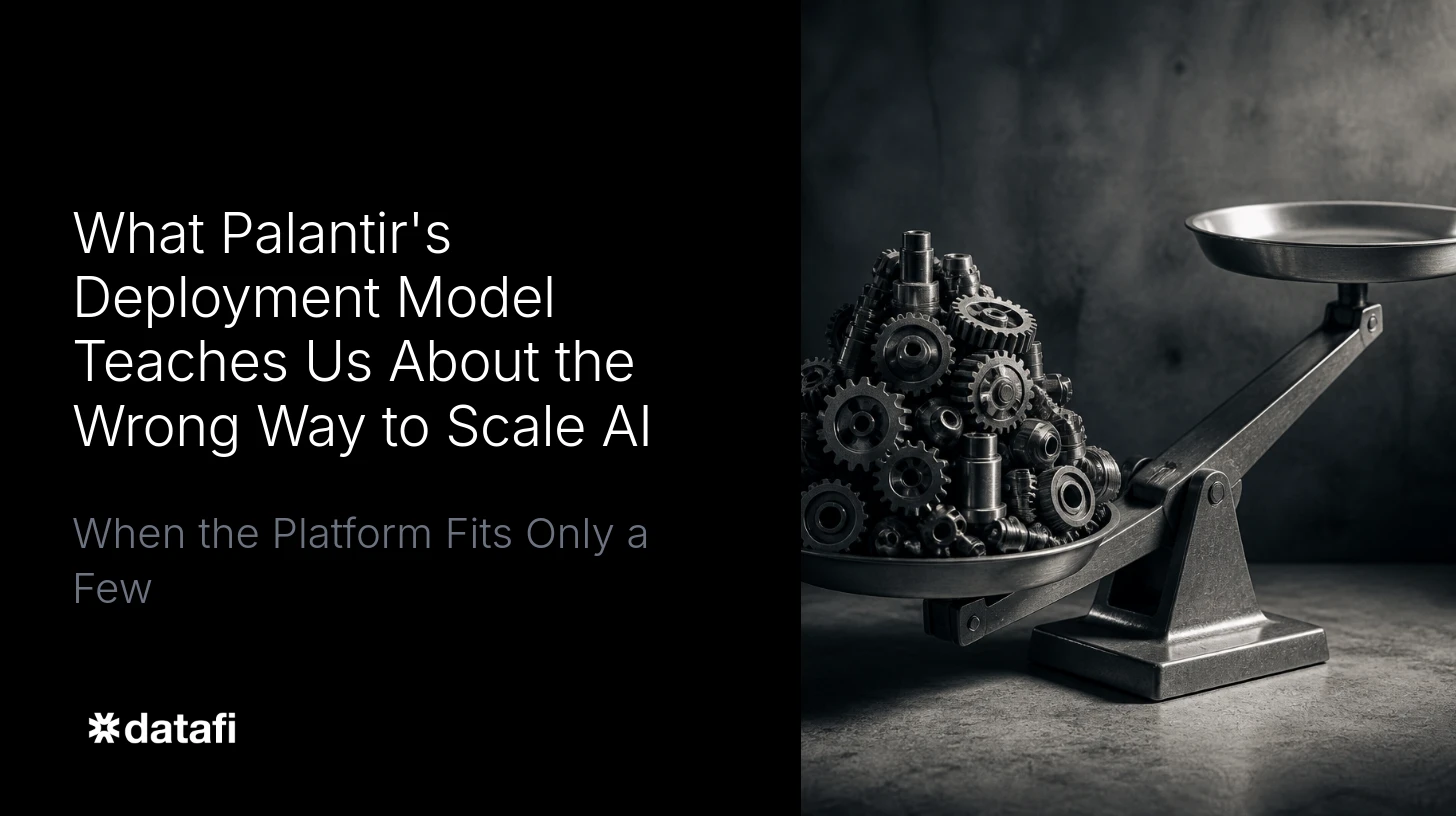
Post 6: What Palantir’s Deployment Model Teaches Us About the Wrong Way to Scale AI
Post 7: Governance Is Not a Feature - It Is the Foundation
Post 8: The Contextual Layer - Why Your Internal Team Cannot Build the Moat That Matters
Part 3 - Decision: The Alternative Path
Post 9: From Pilot to Production in 90 Days - What “Buy” Actually Looks Like With Datafi
Post 10: The AI Operating System - Why the Future of Enterprise AI Is a Platform, Not a Project