


The Global Contextual Layer is the Intelligence Backbone for the AI-Native Enterprise
Every enterprise sits on decades of accumulated institutional knowledge. It lives in the heads of veteran operators, in the tribal logic behind spreadsheet macros, in the unwritten rules that govern how a supply chain actually runs versus how the org chart says it runs. This knowledge is the single most valuable and most fragile asset any organization owns. People retire. Tribal knowledge walks out the door. And the systems left behind were never designed to capture the full picture.
The promise of artificial intelligence was supposed to change this. But for most organizations, AI tools have delivered answers to questions rather than solutions to problems. Chatbots summarize documents. Dashboards surface trends. Copilots draft emails. None of this is transformation. Transformation requires AI systems that understand the full operational context of the business, reason across every data source the organization touches, and act autonomously within governed boundaries to solve hard, cross-functional problems.
This is the thesis behind the global contextual layer, and it is central to everything we are building at Datafi.
The gap between AI that answers questions and AI that solves problems is not model capability; it is context. Without a unified global contextual layer connecting every data source, policy, and workflow, even the most advanced LLM operates with one hand tied behind its back.
From Fragmented Data to Unified Context
The typical enterprise runs dozens of business systems. ERP, CRM, HRIS, supply chain management, asset tracking, financial planning, customer experience platforms, and more. Each system captures a slice of reality. None captures the whole. Without a unified data platform, the result is a fragmented landscape where every team operates with partial information, every analyst spends more time assembling data than analyzing it, and every executive decision carries the risk of blind spots no one can see.
Traditional approaches to this problem have focused on moving data: extract it from source systems, transform it, load it into a warehouse or lake, and build reporting layers on top. This pipeline-centric model has dominated for three decades, and it has produced enormous infrastructure costs, long development cycles, and a persistent gap between the data that exists and the context that decision-makers actually need.
The global contextual layer takes a fundamentally different approach. Rather than moving and copying data into yet another repository, it creates a unified intelligence fabric that connects to every system of record, understands the relationships between data across those systems, and maintains a living representation of how the business actually operates. It is, in effect, a digital version of the institutional knowledge that currently exists only in the collective memory of your workforce.
Why Context Is the Prerequisite for Agentic AI
The industry is moving rapidly toward agentic AI: autonomous systems that do not just respond to prompts but plan, execute, and iterate on complex workflows without human intervention at every step. This shift represents the most significant leap in enterprise productivity since the introduction of enterprise software itself. But there is a prerequisite that most organizations have not addressed.
Large language models are remarkably capable, but they are only as effective as the context they receive. An LLM with access to a single database can answer queries about that database. An LLM with access to the full context of the business, every data source, every policy, every workflow pattern, every historical decision and its outcome, can do something far more powerful. It can reason. It can identify problems before they surface. It can synthesize information across functional boundaries. It can act.
This is the difference between AI that answers questions and AI that solves problems.
At Datafi, we see this distinction playing out with customers every day. Organizations are no longer satisfied with chatbots and summarization tools. They want AI systems in critical thinking roles: workflow automation, predictive maintenance, operations optimization, strategic planning, financial analysis, and passenger or customer experience design. These are not simple retrieval tasks. They require the AI to hold the full operational picture in mind, apply business logic and governance rules, and execute multi-step workflows that span departments and data sources.
Without a global contextual layer, these use cases remain out of reach. The AI lacks the foundation it needs to operate autonomously, safely, and effectively.
The Architecture of the Contextual Layer
The global contextual layer is not a single technology. It is an architectural pattern that Datafi has built into the core of its Business AI Operating System, and it delivers several essential capabilities.
First, it provides complete context across both company data and user activities, turning the data platform into a system that learns from how the business actually runs. Every interaction, every query, every workflow execution enriches the layer. The system learns not just what data exists but how people use it, what questions they ask, what decisions follow, and what outcomes result. This creates a feedback loop that makes the data analysis AI progressively more capable over time.
Second, it embeds data governance and access controls at the foundation. In any enterprise deployment, the question is never just “can the AI access this data?” but “should this user, in this role, at this moment, with this intent, have access to this data through this agent?” The contextual layer enforces these policies natively. Governance is not an afterthought or a bolt-on. It is woven into every interaction, every query, and every autonomous action the system takes. This is essential for regulated industries and critical for any organization that takes data security seriously.
Third, it enables seamless integration with Datafi workflow agents. Because the contextual layer understands the full topology of the business, agents built on top of it can orchestrate complex workflows that span multiple systems without custom integration work for each connection. An agent managing predictive maintenance, for example, can pull sensor data from IoT platforms, cross-reference it with maintenance history from the ERP, check spare parts inventory, evaluate vendor lead times, and schedule a work order, all within a single governed workflow.
Fourth, it allows organizations to synthesize public data into their private contextual layer. Market intelligence, regulatory updates, competitor analysis, macroeconomic indicators, and industry benchmarks can be woven into the same fabric that holds internal operational data. This gives AI agents the ability to reason about the business within the broader context of its operating environment, not in isolation.
Enabling the Future Robotic Workforce
The global contextual layer is not just an infrastructure play. It is the enabling foundation for what comes next: a robotic workforce that operates alongside human teams, handling the analytical, repetitive, and data-intensive work that currently consumes the majority of knowledge workers’ time.
This is not a distant future. Organizations of any size can already achieve unified data experiences and workflow efficiencies for every employee through the contextual layer. AI agents and workflows are reducing costs and improving efficiencies today in areas like predictive maintenance and asset management, operations optimization, passenger and customer experience, strategic planning, regulatory compliance, and financial forecasting. Each of these domains requires the same thing: an AI system with enough context to operate with the judgment and awareness that the task demands.
Consider a mid-sized manufacturing company running predictive maintenance today. Without the contextual layer, an AI system might flag that a motor is showing early vibration anomalies. With the contextual layer, that same system understands the motor’s full maintenance history, knows the production schedule for the next 72 hours, recognizes that a shutdown during peak output would cost six figures in delayed shipments, identifies an alternative maintenance window that minimizes impact, checks parts availability, and generates a work order with the appropriate approvals routed to the right team. That is the distance between answering a question and solving a problem.
The contextual layer is the compounding asset. Every data source connected, every governance policy encoded, every workflow executed, every outcome recorded adds to its depth and utility. Over years, this becomes an unassailable strategic advantage that cannot be replicated by purchasing a model API or licensing a point solution.
As large language models continue to advance, the organizations that have built their contextual layer will be positioned to deploy increasingly autonomous agents into increasingly complex roles. Those that have not will find themselves stuck in the same loop: impressive demos, limited production value, and a growing gap between AI capability and AI impact.
Why Vertical Integration Matters
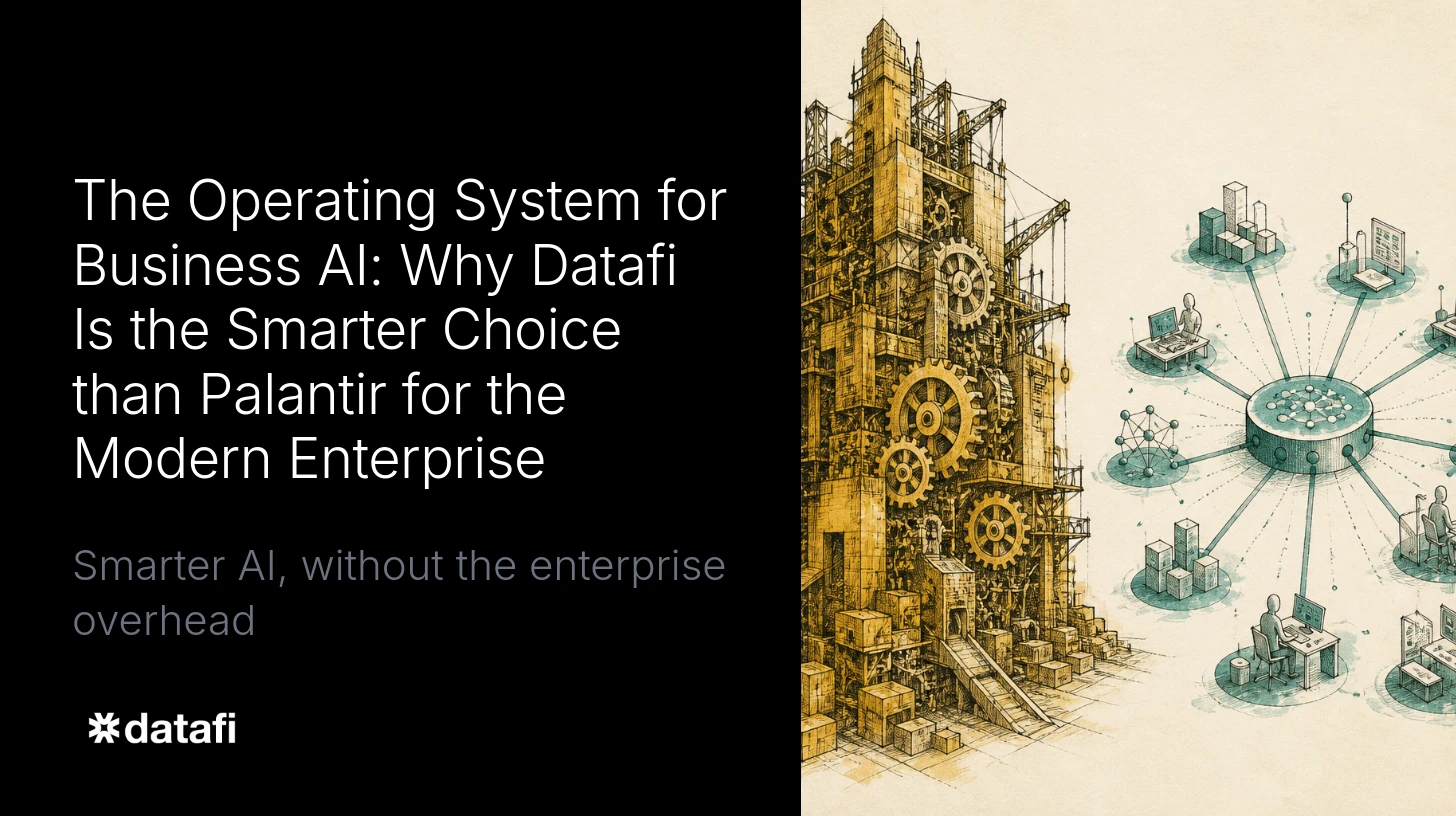
We believe a vertically integrated data and AI technology stack is required to deliver on this vision. The fragmented approach, where organizations assemble best-of-breed AI tools for ingestion, transformation, storage, governance, orchestration, and AI, creates the very silos the contextual layer is designed to eliminate. Every integration boundary is a point of context loss. Every handoff between systems is an opportunity for governance to break down. And every additional vendor in the stack adds cost, complexity, and risk that compounds over time.
LLMs will need to know the full context of the business, have access to the complete data ecosystem, and function in fully autonomous roles to learn and solve hard business problems. This demands a platform where the data layer, the governance layer, the orchestration layer, and the AI layer are not separate products stitched together but a single, coherent system designed from the ground up to share context seamlessly.
Datafi’s operating system for business AI brings the full stack together on a single data platform: data connectivity, governance, orchestration, agentic workflows, and a Chat UI designed for non-technical users, all built on a unified foundation. This is not about vendor lock-in. It is about ensuring that the contextual layer has seamless, governed access to the complete data ecosystem without the latency, fragility, and cost of maintaining dozens of point-to-point integrations.
The Chat UI is a critical piece of this architecture. If the contextual layer is the brain, the Chat UI is the interface that makes it accessible to the entire organization. Business users should not need to write SQL, build dashboards, or navigate complex analytics tools to benefit from AI. They should be able to ask questions, trigger workflows, and receive insights in natural language, with the full context of the business powering every response. Datafi Chat is designed with this principle at its core.
The Strategic Imperative
Having spent years working directly with data and AI, I have developed a clear perspective on what is required to move from answering questions to solving problems. The gap is not in model capability. The models are extraordinarily powerful. The gap is in context. Without the full picture of the business, the richness of its data ecosystem, the nuance of its policies, and the history of its operations, even the most advanced LLM is operating with one hand tied behind its back.
The organizations that recognize this and invest in building their global contextual layer now will define the next era of enterprise performance. They will deploy AI agents that operate with the full authority and awareness of experienced human operators. They will reduce costs, accelerate decisions, and unlock capabilities that were previously impossible. They will create a digital twin of their institutional knowledge that grows more valuable with every passing day, immune to the fragility of human memory and organizational turnover.
This is the opportunity Datafi was built to capture. Not to build another dashboard. Not to wrap another LLM in a chat interface. But to provide the foundational data platform and operating system that makes AI tools genuinely capable of transforming how organizations operate, one contextual layer at a time.
The future of enterprise AI is not about smarter models. It is about deeper context. And the organizations that build that context first will lead the industries they serve.
Datafi is building the Operating System for Business AI. Learn more at datafi.co.