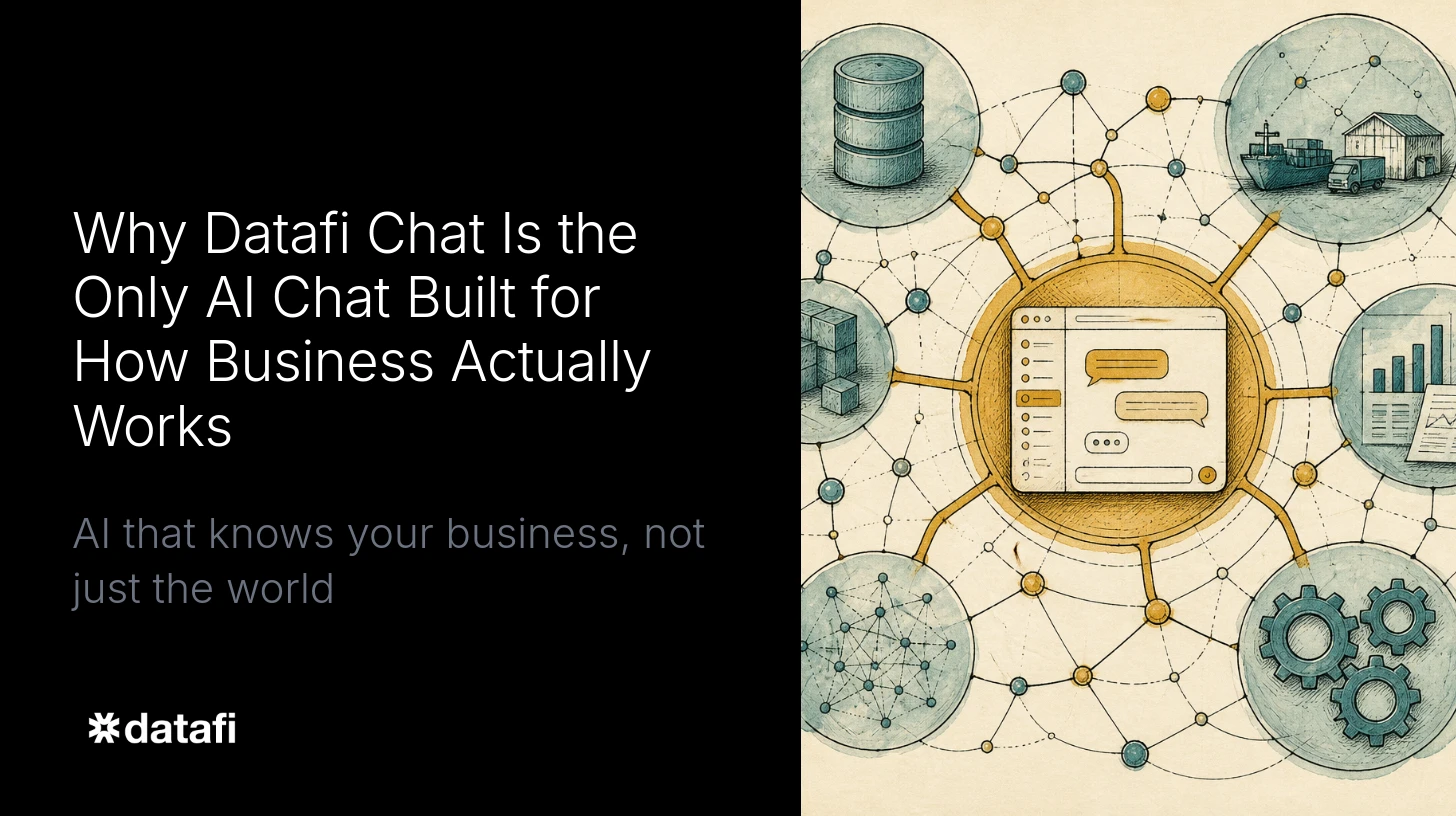



Most AI chat tools were built for individuals. Datafi Chat was built for enterprises.
There is a moment that anyone who has worked seriously with data inside a large organization will recognize. You ask an AI assistant a question about your business, and the answer comes back fluent, confident, and completely disconnected from reality. It does not know your customers. It has no idea what happened in Q3. It cannot see the inventory numbers from this morning. It is reasoning from the outside in, constructing a plausible-sounding response from general knowledge rather than the specific, messy, living truth of your organization.
That gap, between what AI promises and what it actually delivers inside the enterprise, is the problem Datafi was built to close.
Datafi Chat is purpose-built on a Business AI Operating System, a vertically integrated stack that gives every employee a single intelligent interface into the full context of their organization, complete with governance, agentic capability, and institutional memory built in from the foundation.
Datafi Chat is not another wrapper on a large language model. It is a chat experience purpose-built on a Business AI Operating System: a vertically integrated data and AI technology stack that gives every employee, from the frontline operator to the executive team, a single intelligent interface into the full context of their organization. And that distinction changes everything about what AI can actually do for you.
The Fundamental Problem with Consumer AI Chat at Work
ChatGPT, Copilot, and similar tools have genuinely impressed the world. They are remarkable at generating content, explaining concepts, and assisting with discrete tasks. But when organizations deploy them as enterprise tools, they run into a structural ceiling almost immediately.
The problem is context. These tools know the world, but they do not know your world. They cannot see your ERP. They have no access to your customer contracts, your maintenance logs, your supply chain status, or the sales pipeline update from this morning. Without that context, they are not reasoning about your business. They are performing a sophisticated impression of reasoning about it.
Worse, when organizations try to solve this by connecting data sources, they encounter the second problem: governance. Enterprise data is not flat. It is layered with permissions, policies, sensitivity classifications, and access controls that reflect real legal obligations, competitive sensitivities, and regulatory requirements. A chat tool that can access everything, or that asks everyone to figure out their own data security posture, is not a business tool. It is a liability.
Datafi Chat solves both problems at the foundation, not as an afterthought.
Complete Context: The Company and the User
Datafi Chat operates on top of Datafi’s data federation layer, which means it connects to your data ecosystem without requiring you to move or duplicate your data. Your ERP, your CRM, your operational databases, your data warehouse, your third-party SaaS applications: all of it becomes part of the context available to every conversation.
But context at Datafi is not just company-wide. It is also personal. Every user’s activity history, previous conversations, project work, and workflow interactions contribute to a dynamic understanding of what that individual needs. The result is a chat experience that does not start from scratch every time someone opens a new session. It knows what you have been working on. It understands the decisions you are navigating. It connects today’s question to yesterday’s analysis.
This is the difference between a search engine and a thinking partner. A search engine retrieves. A thinking partner that knows your context reasons with you.
And because Datafi Chat can also reach out to public data sources, you are never limited to internal information alone. Competitive intelligence, market signals, regulatory updates, industry benchmarks: all of it can flow into the same conversation with your internal data, giving every employee the kind of comprehensive situational awareness that used to require a team of analysts.
Governance First, Not Governance Bolted On
Data governance is not a feature you add to an AI tool. It is either the foundation or it is theater.
Datafi’s Business AI Operating System is built with governance at its core. Access controls, data policies, sensitivity classifications, and role-based permissions are not layers applied over a chat interface. They are the conditions under which every query, every response, and every agent action operates. When a frontline employee asks a question, they see answers shaped by what they are authorized to see. When an executive asks the same question, they see answers shaped by their context. No configuration gymnastics. No risk of an employee accidentally surfacing data they should not have access to.
This architecture makes it possible to deploy AI broadly across an organization without creating new governance surface area. In fact, it reduces risk compared to current practice, where employees are often finding their own ways to bring AI into their work, with no visibility, no controls, and no audit trail.
AI Observability and Audit: Accountability at Scale
When AI moves from answering questions to participating in decisions and driving workflows, accountability becomes non-negotiable.
Datafi Chat includes built-in AI observability and audit capabilities that give organizations complete visibility into how AI is being used across the enterprise. Every query, every response, and every agent action is logged, traceable, and reviewable. Compliance teams can verify that AI-assisted decisions met policy requirements. Operations teams can identify where AI is adding value and where it needs refinement. Leadership can understand the return on their AI investment with actual usage data rather than anecdotes.
This is not just a compliance feature. It is the foundation for continuous improvement. Organizations that can see how their AI is performing can make it better. Organizations flying blind are locked into whatever capability they deployed on day one.
Seamless Integration with Workflow Agents
Datafi Chat is not just a retrieval interface. It is the front door to Datafi’s full agentic capability.
From within a chat session, users can invoke workflow agents that take autonomous action inside business processes. A supply chain manager can ask Datafi Chat to investigate a delivery anomaly and trigger a workflow that queries multiple systems, identifies the root cause, generates a recommended resolution, and routes it to the right team, all from a single conversation. A financial analyst can initiate a scenario planning workflow that pulls data across systems, runs projections, and returns a structured analysis ready for executive review.
This integration between conversational AI and autonomous agents is what moves AI from question-answering to problem-solving. The chat interface is the natural language layer on top of a system that can actually do things, not just describe them. And because users can select custom agent tools within their chat sessions, teams can build specialized workflows tailored to their domain and deploy them to the people who need them without requiring technical expertise to access them.
This is particularly powerful for use cases like predictive maintenance and asset management, where AI agents can continuously monitor equipment data, identify anomaly patterns, and surface alerts or work orders through the same chat interface a technician uses every day. Or in operations optimization, where workflow agents can analyze throughput, flag bottlenecks, and recommend adjustments in real time. Or in passenger and customer experience contexts, where AI can surface relevant history, predict needs, and enable personalized responses at scale.
Collaboration, Project Folders, and Institutional Memory
Enterprise work is team work. Yet most AI chat tools treat every session as a silo, invisible to everyone else, carrying no memory forward.
Datafi Chat is designed for how enterprise teams actually operate. Users can save conversations to project folders, building a structured record of the AI-assisted work happening inside a project, account, initiative, or business unit. Coworkers can collaborate within shared sessions, bringing multiple perspectives to a problem while maintaining a coherent thread.
Institutional memory does not form from wiki pages no one updates. It forms from the living record of questions asked, analyses performed, and decisions made. Datafi Chat turns that record into something the entire organization can use.
This is how institutional memory actually forms. Not from enterprise wiki pages that no one updates, but from the living record of questions asked, analyses performed, decisions made, and workflows run. Datafi Chat makes that record accessible, searchable, and actionable, turning organizational knowledge from something that exists in people’s heads into something the organization itself can use.
Built for Every Employee, Not Just Technical Users
The transformative potential of enterprise AI is not in the hands of the data science team. It is in the hands of every employee who makes decisions, manages processes, or serves customers.
That means the AI interface has to work for people who are not data analysts. It cannot require SQL. It cannot require users to understand how data pipelines work. It cannot punish non-technical users with interfaces designed for technical ones.
Datafi Chat was designed for exactly this population. Natural language is the interface. The complexity of the data architecture underneath is invisible. A warehouse supervisor, a customer success manager, a regional operations lead: all of them get the same quality of AI-assisted insight that used to require a dedicated analyst to produce, delivered through a conversation they can have in the flow of their normal workday.
This is the lever that moves enterprise AI from a productivity tool for a few to a competitive capability for the entire organization.
Why the Operating System Matters
Every feature described here is possible because Datafi Chat sits on top of a purpose-built Business AI Operating System, not a general-purpose LLM with plugins and workarounds.
The vertically integrated architecture means that data access, governance, agentic capability, observability, and user experience are not separate products stitched together. They are a single coherent system where each layer is designed to work with every other layer. That coherence is what makes it possible for AI to function in fully autonomous roles inside complex enterprise workflows, with access to the complete data ecosystem, operating within policy constraints, and building the contextual understanding required to learn and solve hard problems over time.
This is the direction enterprise AI has to go. LLMs that can only answer questions are impressive demonstrations. LLMs that know the full context of your business, operate within your governance framework, take autonomous action inside your workflows, and continuously develop deeper understanding of your specific operating environment, those are transformations.
The question for enterprise leaders is not whether AI will play this role in their organizations. It is whether they will build the infrastructure required to make it possible, or continue trying to retrofit general-purpose tools into a context they were never designed to serve.
At Datafi, we built the Operating System for Business AI. Datafi Chat is what that operating system looks like from the seat of every employee who uses it.
The context is there. The controls are there. The agents are there. Intelligence is connected to work.
That is what better looks like.
Learn more about Datafi’s Business AI Operating System at datafi.co