


Governance has become one of the defining differentiators in enterprise AI. As organizations move beyond pilots and into production, the question is no longer whether AI can produce useful outputs. It is whether the organization can trust those outputs, explain them to regulators, trace them back to their data sources, and ensure that they are operating within the boundaries the business has established.
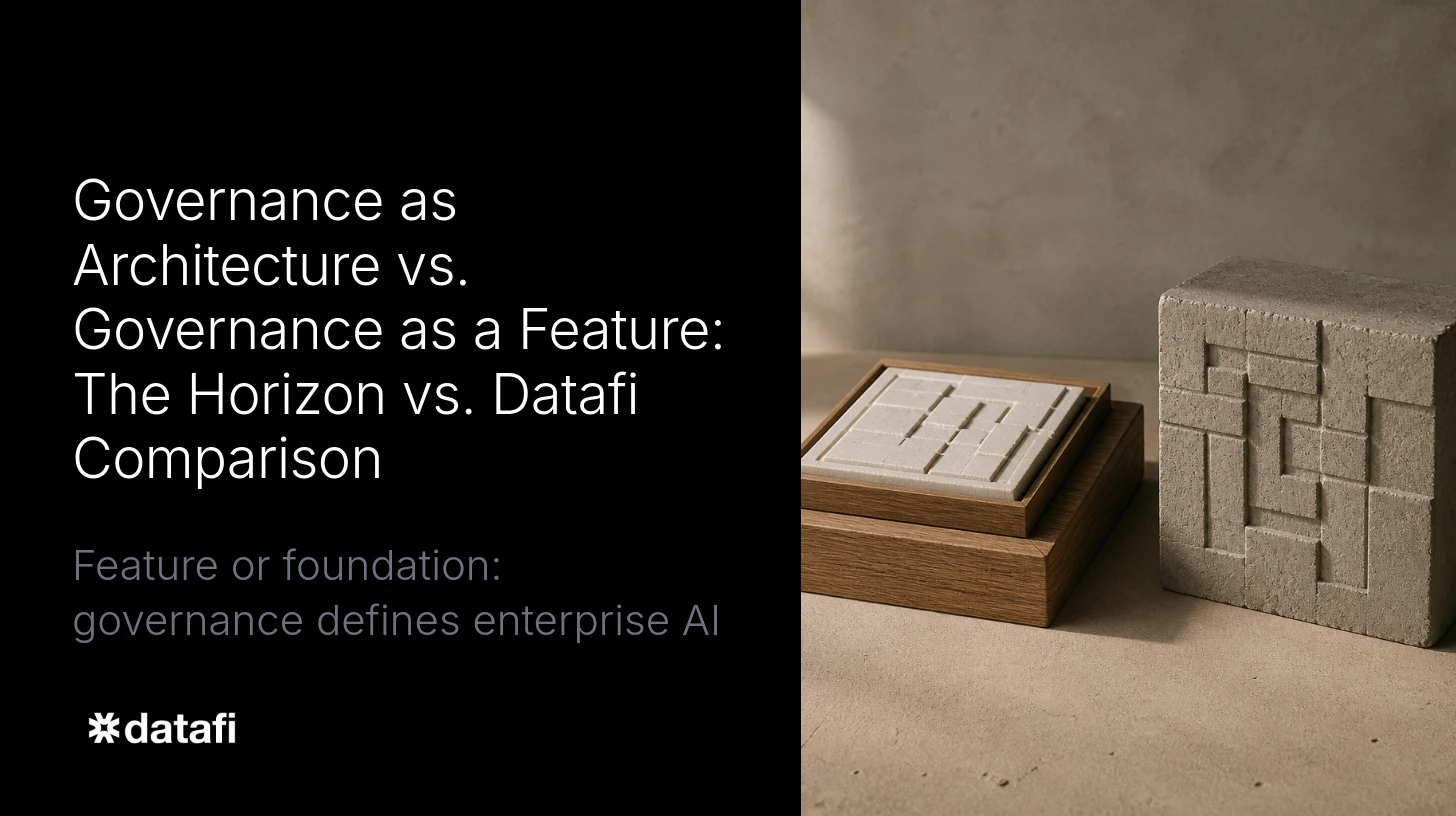
The critical distinction in enterprise AI governance is not how robust your data platform’s controls are, but whether governance is a configurable feature layered on top of AI or a structural principle baked into the architecture itself. Only architecture-level governance can satisfy the contextual, role-aware accountability that regulated industries require.
Snowflake’s answer to this challenge is Horizon, a governance layer built into the Snowflake platform that provides data lineage, access controls, privacy management, and compliance visibility across the Snowflake environment. It is a genuine product capability and it represents a meaningful step forward for organizations that have struggled to govern their data estate.
Datafi’s answer is different in kind, not just in degree. And understanding the difference matters for any organization making a long-term bet on where AI governance needs to live.
Two Models of Governance
The first model is governance as a feature. In this model, governance is a capability you configure on top of a platform. You define who can access what data. You set policies for how data can be used. You establish lineage tracking so you can trace where a piece of data came from and how it moved through the system. You layer compliance controls on top of the workflows that already exist.
This is the model that Snowflake Horizon represents. It is comprehensive within the Snowflake ecosystem. Horizon provides visibility into data classification, access policies, lineage, and compliance status across the data that lives in Snowflake. For organizations that have centralized their data in Snowflake and need to govern access to it, Horizon delivers real value.
The second model is governance as architecture. In this model, governance is not a layer you add. It is a property of the system itself, encoded into the foundation that every AI agent, every user interaction, and every data flow operates within from the first moment of deployment.
This is the model that Datafi was designed around. Governance is not configured after the system is built. It is the structural principle the system is built on.
Why the Distinction Matters at the AI Layer
The governance challenge for data at rest is well understood. Who can query this table? Who can see this column? These are access control problems with established solutions. Snowflake Horizon handles them well.
The governance challenge for AI in operation is a different and harder problem.
When an AI agent is making decisions, recommending actions, surfacing insights, triggering workflows, generating responses for business users, governance has to be present at the moment of inference, not just at the moment of data access. The agent needs to know not only whether it has permission to access a piece of data, but whether it is appropriate to surface that data to this user, in this context, for this decision, in this way.
That is a contextual governance problem. It requires the governance model to understand the business, including roles, responsibilities, workflows, exception policies, regulatory constraints, and the relationships between them. It cannot be resolved by a lineage graph or an access policy table, however well constructed.
Datafi encodes this contextual governance into the global contextual layer. When an AI agent operates within Datafi, it is not checking whether it has access to data as a separate step. It is operating within a system where what it can see, what it can recommend, and what actions it can take are all bounded by the business context it understands. Governance is not a constraint applied to the agent. It is built into the agent’s understanding of the world it operates in.
The Compliance Consequence
For organizations in regulated industries, including financial services, healthcare, life sciences, insurance, and energy, this distinction is not theoretical. It has direct consequences for compliance posture and regulatory risk.
A governance layer that tracks data lineage in a warehouse tells you where the data came from. It does not tell you whether the AI system that used that data made a recommendation it should not have made, or whether a business user acted on an AI-generated insight in a way that violated a policy the system did not know about.
When a regulator asks how an AI system arrived at a particular recommendation, the answer cannot be “we have lineage on the underlying data.” The answer has to be a complete account of the context the system was operating in, the constraints it was working within, and the reasoning path that led to the output.
That kind of explainability requires governance to be embedded in the intelligence layer, not just the data layer. It requires the system to have been designed with accountability as a first principle, not added as a compliance checkbox after the architecture was already set.
Datafi was built for regulated industries. The governance-by-architecture model exists specifically because the organizations that need AI the most are often the ones that face the most stringent compliance environments. An AI system that cannot be fully explained and audited is not a system those organizations can use.
The Human Factor
There is another dimension of governance that data platform tooling tends to underweight: the human layer.
Data governance tools manage what systems can do with data. Business AI governance also has to manage what people can do with AI. In a real enterprise deployment, this means understanding that different roles have different levels of authority to act on AI recommendations. It means ensuring that certain classes of decisions require human confirmation before an agent can execute. It means creating audit trails that capture not just data access but the decisions that were made and by whom.
Datafi’s governance model extends to the full interaction surface, from the data layer through the AI layer to the user layer. Every interaction in Datafi Chat, every workflow an agent participates in, every recommendation that is surfaced and acted on exists within a governed environment where accountability is traceable end to end.
This is what governance means for a Business AI OS. It is not a feature. It is the architecture.
Horizon Is Not the Problem
To be precise: Snowflake Horizon is a strong governance solution for the problem it was designed to solve. If your challenge is governing data access, managing data quality, and maintaining compliance visibility across a large Snowflake environment, Horizon is a real answer.
The problem it was not designed to solve is governing AI operations across an enterprise, including the contextual, role-aware, policy-embedded, interaction-level governance that determines whether business users can actually trust and rely on AI in the way that transforms how work gets done.
That problem requires a system where governance is not a feature you configure. It is the architecture you build on.
What This Means for Enterprise AI Strategy
Organizations evaluating AI infrastructure in 2025 and 2026 face a meaningful strategic choice. They can invest in making their data platforms more AI-capable, adding agentic features, extending governance layers, building natural language interfaces on top of existing data architecture. This is a reasonable path and it produces incremental value.
Or they can make a parallel investment in a Business AI OS that operates above the data layer, connecting to existing infrastructure, including Snowflake, and providing the contextual intelligence, user-facing AI, and architecture-level governance that turns data into operational outcomes.
These are not mutually exclusive. Datafi is not a replacement for your data platform. It is the layer that makes your data platform useful for the people in your organization who need to act on what it knows.
The question is not whether you need governance in your AI strategy. Every serious organization does. The question is whether you want governance to be a feature you configure or an architecture you operate within.
For enterprise AI that earns trust at scale, the answer is architecture.
This is Part 3 of the Snowflake vs. Datafi series. Part 4 challenges the premise that text-to-SQL represents a meaningful business AI strategy, and makes the case for the difference between answering questions and solving problems.
Learn more about how Datafi works alongside your existing data infrastructure at datafi.co.
Next in the Series: Text-to-SQL Is Not a Business AI Strategy