


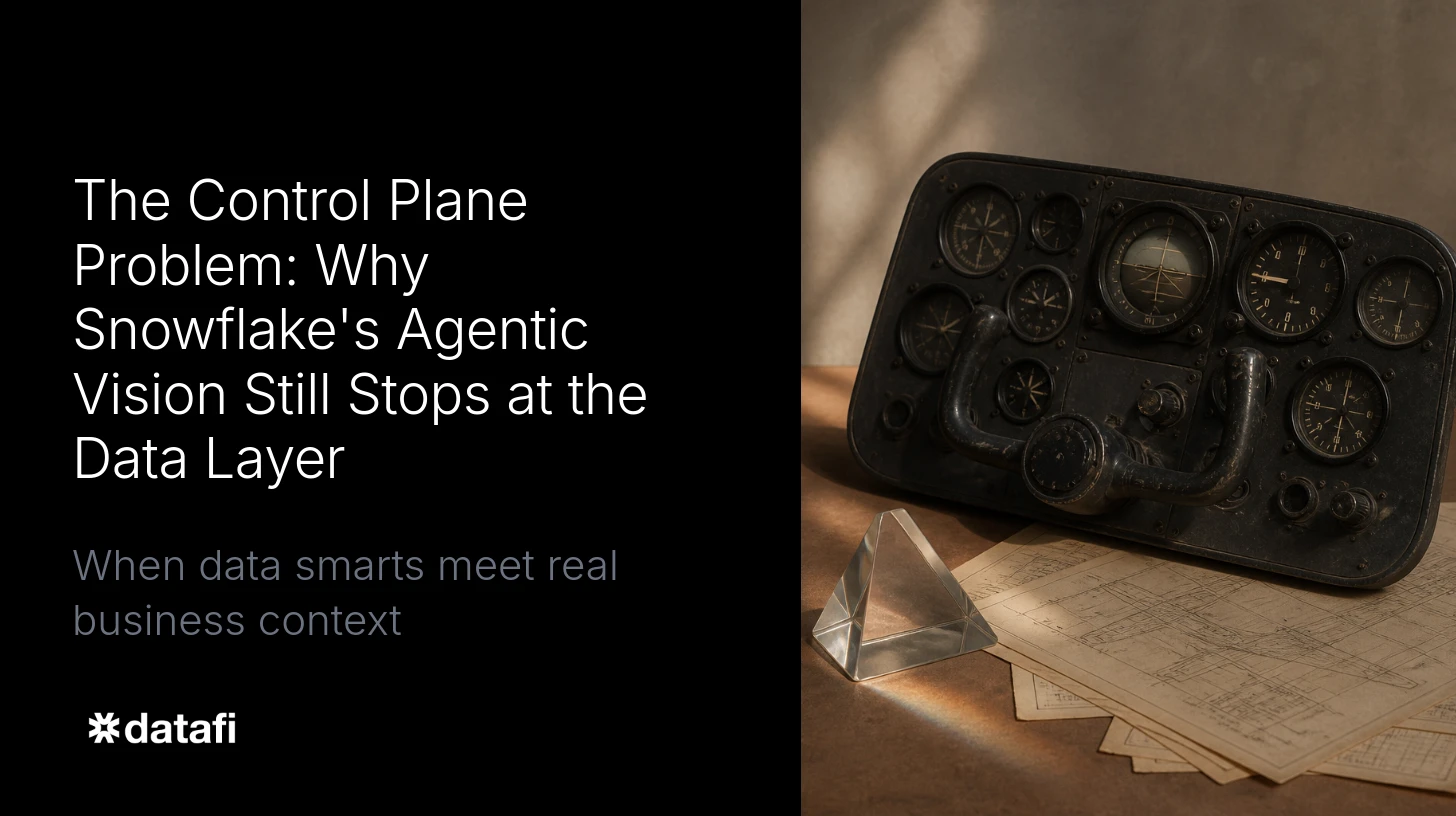
Snowflake has made its strategic ambition clear. The company is no longer positioning itself as a cloud data warehouse. It is positioning itself as the control plane for the agentic enterprise, the central layer where data, models, and applications converge to power autonomous AI that acts across business workflows.
It is an ambitious and intellectually coherent vision. And it reveals, more than anything Snowflake’s competitors could argue, exactly where the category falls short.
Because a control plane built on top of a data platform is a fundamentally different thing from an operating system built for business AI. One starts with data and works outward toward action. The other starts with the business and works inward to connect whatever data and models are needed.
That difference is not cosmetic. It determines what AI can do inside your organization, how fast it can be deployed, and whether it will actually be used by the people who need it most.
A control plane that manages data flows and model execution is not the same as a system that understands how a business operates. The starting architecture determines whether AI agents are grounded in data or grounded in the business, and that distinction has profound consequences for real-world deployment.
What a “Control Plane” Assumes
The concept of a control plane comes from infrastructure engineering. It is the layer that manages and coordinates a system, in networking, it is what routes traffic; in cloud platforms, it is what orchestrates compute. When Snowflake uses the term, it is describing a layer that coordinates data, AI models, and enterprise applications inside a unified governed environment.
This is a meaningful step forward from a pure data warehouse. It is not the same thing as understanding how a business operates.
A control plane that manages data flows and model execution does not know that your logistics team has a standing exception process for high-value shipments under carrier dispute. It does not know that your underwriting team treats a particular risk category differently during Q4 because of seasonal exposure patterns. It does not know that your clinical operations team escalates specific metrics to a department head rather than a regional director when the metric crosses a particular threshold on a weekend.
That knowledge is not in the data. It is not in the model. It is in the business. And the system that translates business knowledge into machine-executable context is not a data platform, however well it orchestrates.
The Retrofit Problem
Snowflake’s evolution toward agentic AI is genuine and technically impressive. Snowflake Intelligence gives business users a natural language interface grounded in governed enterprise data. Cortex Code helps builders accelerate from idea to production. The Horizon governance layer provides visibility into data lineage and compliance. These are real product capabilities.
But they are being assembled from the outside in, on top of an architecture that was designed to answer questions about data, not to participate in the operational life of a business.
The result is what we might call the retrofit problem. When you build agentic capability onto a data platform, your agents are grounded in data. When you build a Business AI OS from the ground up, your agents are grounded in the business, and data is one of the inputs.
The distinction sounds subtle. The operational consequences are significant.
Agents grounded in data can tell you what the data shows. They can surface anomalies, generate summaries, produce forecasts. They can trigger actions when thresholds are crossed, if someone has taken the time to define those thresholds explicitly in a pipeline.
Agents grounded in a business context can understand why an anomaly matters, who needs to know about it, what the right response is given current operational conditions, and how to execute that response within the workflows the organization has established. They can do this for every employee in the company, across every function, without requiring an engineer to build a bespoke pipeline for each use case.
That is not a question of which platform has better AI. It is a question of where the intelligence lives.
Why the Starting Point Matters
Every technology platform is shaped by its founding architecture. Those architectural choices define what is natural to build on top of the platform and what requires significant effort to force into the model.
Snowflake was founded on the insight that separating storage from compute was the right architecture for cloud-scale data processing. That insight is correct and it powered one of the most successful software businesses of the last decade. But it means that Snowflake’s architecture begins with the question: how do we manage data efficiently at scale?
Datafi was founded on a different question: what does an AI system need to understand about a business in order to solve real problems rather than just answer questions? That question produces a different architecture, one built around a global contextual layer that encodes business rules, operational workflows, organizational structure, data relationships, and governance policies into the intelligence layer that every AI agent and every user interaction operates within.
These two starting points converge in interesting ways when viewed from a distance. Both involve data, governance, AI, and enterprise users. But the systems they produce are designed to do different things. Trying to build one from the other is possible. It is just not the same as having built the right thing from the beginning.
The 30-Day Test
One of the most practical ways to understand the difference between these architectures is deployment speed.
Snowflake’s agentic AI capabilities require data to be in Snowflake, pipelines to be built and governed, agents to be configured against specific data structures, and interfaces to be deployed to the users who need them. For organizations that are already deeply embedded in the Snowflake ecosystem, this can accelerate over time. For organizations standing it up from scratch, the timeline is measured in months.
Datafi connects to your existing data sources, including Snowflake, and deploys a working Business AI OS in 30 days. The reason this is possible is not engineering velocity alone. It is architectural design. Because Datafi was built to work with enterprise data as it exists, not as it needs to be restructured, the onboarding process is additive rather than transformative.
This matters for the business case. AI that is generating value in 30 days has a fundamentally different ROI profile than AI that is generating value in 18 months. And organizations that are evaluating their AI infrastructure investments in 2025 and 2026 are making decisions that will compound for years.
A Different Definition of Agentic
The word “agentic” is being used to describe a wide range of AI behaviors, from simple automation to genuinely autonomous decision-making. It is worth being precise about what agentic AI needs in order to be useful in an enterprise context.
An AI agent that can query data, generate a summary, and send a notification is automation. It is valuable. It is not agentic in the meaningful sense.
An AI agent that understands the operational state of a business function, recognizes when that state crosses a threshold that requires a specific kind of response, knows which person or system should receive that response, understands the constraints and policies that govern the action, and can execute or recommend that action within the appropriate workflow, that is agentic AI operating at the level enterprises actually need.
Delivering genuine autonomous capability requires business context to be built into the system at the architecture level. It cannot be configured query by query or pipeline by pipeline. It has to be the foundation.
That is what Datafi was built to be. Not a competitor to Snowflake’s data capabilities. A complement to them, and the layer that turns those capabilities into operational intelligence.
This is Part 2 of the Snowflake vs. Datafi series. Part 3 examines governance, specifically why Snowflake’s Horizon layer and Datafi’s governance-by-architecture model represent fundamentally different approaches to trust in enterprise AI.
Learn more about how Datafi works alongside your existing data infrastructure at datafi.co.
Next in the Series: Governance as Architecture vs. Governance as a Feature: The Horizon vs. Datafi Comparison