


It is a compelling demo. A business user types a question in plain English. The system generates SQL, executes it against a data warehouse, and returns an answer. No analyst required. No waiting. No ticket.
Snowflake’s Cortex Analyst makes this possible directly inside the Snowflake environment. The technology is genuine. The accuracy claims are real — Cortex Analyst reports 90%+ SQL accuracy on well-defined semantic models. For organizations that have invested in building those models, it is a meaningful capability.
It is not, however, a Business AI strategy. And the difference between those two things is precisely where most enterprise AI investments are currently failing to deliver.
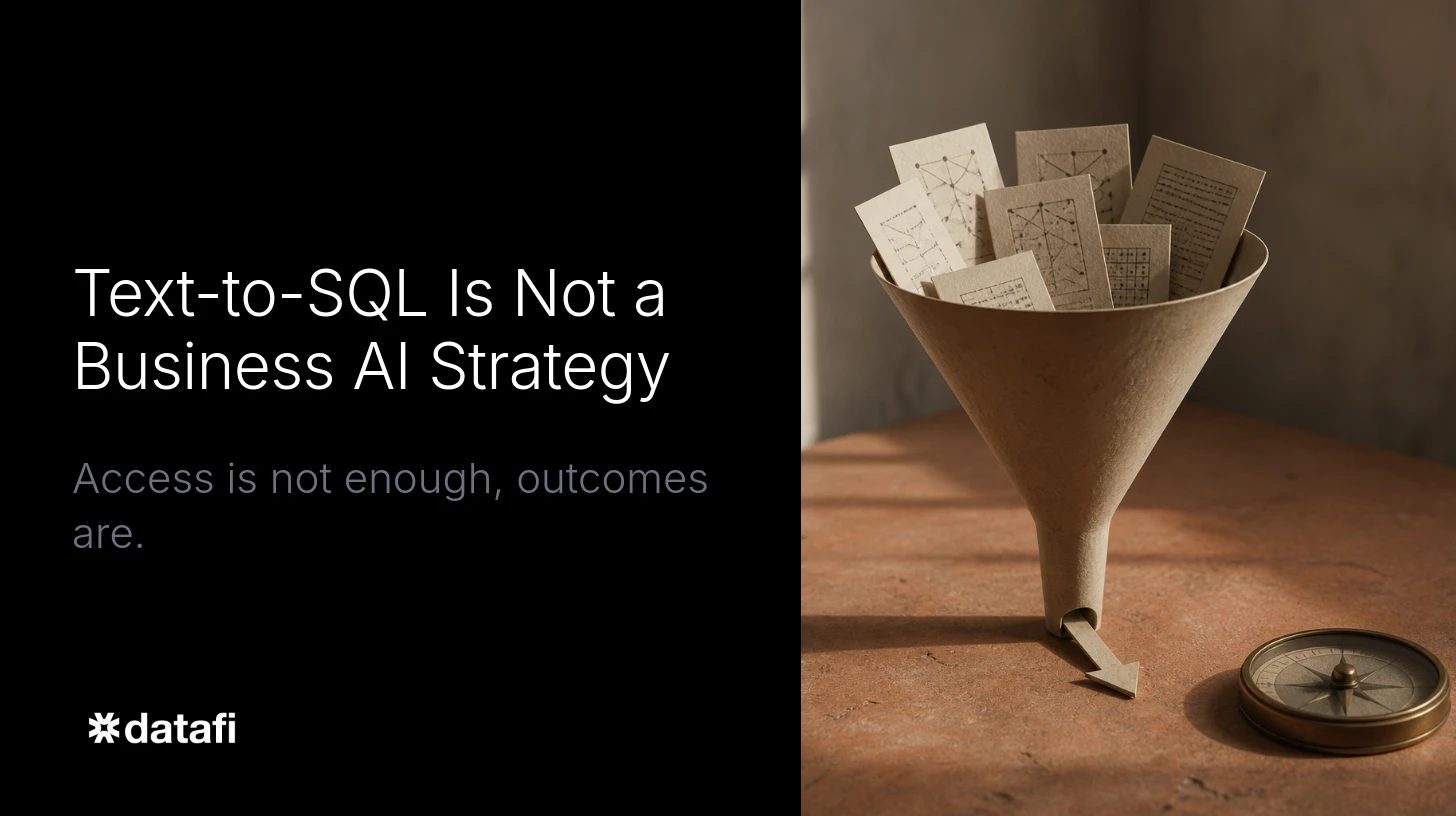
Text-to-SQL solves the data access problem, but the real enterprise AI challenge is the gap between information and outcome. Retrieving data faster does not connect the answer to the workflow where it needs to be acted on, and that second gap remains entirely intact.
What Text-to-SQL Actually Does
To understand the limitation, it helps to be precise about what text-to-SQL solves and what it leaves untouched.
Text-to-SQL solves the access problem. It removes the requirement for business users to know SQL in order to retrieve data from a warehouse. That is valuable. In many organizations, the bottleneck between a business question and a data answer has been the analyst — or the wait for one. Removing that bottleneck accelerates the retrieval side of intelligence.
What text-to-SQL does not solve is the action problem. Retrieving data faster does not make that data more meaningful. It does not connect the answer to the workflow where it needs to be acted on. It does not tell the person asking the question what to do with what they just learned. It does not prevent the same question from being asked again next week because the answer was not embedded in the process that generates the problem.
The access problem is real. But it is not the enterprise AI problem. The enterprise AI problem is the distance between information and outcome — the gap between knowing something and doing something about it. Text-to-SQL narrows the first gap and leaves the second entirely intact.
The 90% Accuracy Problem
There is another dimension to text-to-SQL that deserves honest examination: what happens in the other 10%.
Independent analysis of enterprise text-to-SQL deployments makes the accuracy picture more complex than benchmark numbers suggest. Production systems that achieve 70 to 85% reliability typically do so by exposing only five to ten curated views rather than raw warehouse tables, and by forcing queries against predefined metrics rather than raw SQL. Without a comprehensive semantic layer, the model guesses. The SQL executes. The number looks reasonable. It is just wrong.
Snowflake’s 90%+ accuracy benchmark applies to Cortex Analyst operating on a well-constructed semantic model. The key phrase is well-constructed. Building that model requires multi-month investment in semantic modeling that explicitly captures business logic, terminology, and relationships between data structures. The model needs to know what “Daily Active Users” means in your organization — not what it means generically.
That upfront investment is not a criticism of the technology. It is a structural observation about where the intelligence has to live. If the semantic model has to be built to encode business meaning before the system can answer questions accurately, the real work is in encoding business context — and text-to-SQL is the interface layer on top of it, not the intelligence itself.
Answering Questions vs. Solving Problems
The distinction Datafi was built around is worth stating plainly here, because it is the axis on which this comparison turns.
Answering a question means retrieving a fact. What was our revenue in the Northeast last quarter? What is the current inventory level at this facility? Which accounts are overdue?
Solving a problem means understanding a situation, determining the appropriate response, and participating in the execution of that response. Revenue in the Northeast is down 18% versus plan and has been declining for three consecutive periods — here is the causal pattern, here is the customer cohort driving it, here are the three actions available to the regional VP, and here is the recommended one given current margin constraints and pipeline coverage.
Text-to-SQL produces answers. A Business AI OS produces solutions.
The difference is not a matter of AI model quality. It is a matter of what the system understands. A text-to-SQL interface, however accurate, is grounded in data structures. It knows what is in the tables. It does not know what those tables mean to the people running the business — their priorities, their constraints, their decision rights, their operational context.
Datafi’s global contextual layer is where that knowledge lives. It is the layer that transforms accurate data retrieval into operational intelligence. When a logistics manager asks a question in Datafi Chat, the response is not the result of a SQL query dressed up in natural language. It is a contextually grounded answer that understands the operational state of that manager’s domain, the thresholds and policies that govern decisions in that domain, and the actions available to that manager given what the data shows.
The Business User Problem
There is a practical dimension to this that enterprise AI leaders encounter repeatedly but rarely articulate directly: business users do not want to ask better questions. They want the system to understand their job.
Text-to-SQL requires the user to formulate a question precisely enough for the system to generate the right query. In practice, this means users learn which questions the system handles well and stop asking the ones it does not. The system shapes the inquiry rather than serving it. Analysts who understand the data model get the most value. Frontline workers, operations managers, and executives who need intelligence the most tend to get the least.
This is not a failure of the technology. It is a fundamental constraint of a query-based intelligence model. The system serves those who know how to query it.
A Business AI OS inverts this relationship. The system understands the user’s role, responsibilities, and context. The user does not need to ask a precise question. They can ask the question they actually have — and the system can understand what they mean, what data is relevant, and what kind of answer will actually be useful given their situation.
This is the difference between democratizing data access and democratizing business intelligence. Text-to-SQL does the former. Datafi was built to do the latter.
The Role Text-to-SQL Plays in a Complete Architecture
None of this is an argument against text-to-SQL as a capability. Natural language interfaces to data are a genuine improvement over requiring every business user to write SQL or wait for an analyst. In a complete enterprise AI architecture, that kind of access layer has a place.
The argument is against text-to-SQL as a strategy — against the premise that giving business users natural language access to a data warehouse is equivalent to giving them AI that makes them more effective at their jobs.
For organizations evaluating their AI infrastructure investments in 2026, the question to ask is not whether the system can answer questions. It is whether the system can help the people running the business make better decisions and take better actions, at the pace the business requires.
Text-to-SQL is a data access tool with a natural language interface. A Business AI OS is a system that understands how your business works and helps every employee operate within it more intelligently.
These are different products. And the organizations that treat them as equivalent will spend the next several years wondering why their AI investments are not producing the outcomes they were promised.
This is Part 4 of the Snowflake vs. Datafi series. Part 5 examines the cost dimension — specifically why the CFO conversation about Snowflake and Datafi is not a platform comparison but a value realization question.
Learn more about how Datafi works alongside your existing data infrastructure at datafi.co.
Next in the Series: Snowflake Sells Infrastructure. Datafi Sells Outcomes. Here Is Why That Difference Matters to the CFO.