


Every CFO evaluating enterprise AI in 2026 is navigating the same tension: significant investment, uncertain returns, and a growing impatience with the gap between what was promised and what the business is actually experiencing.
The tension is not surprising. Enterprise AI spending is accelerating — global generative AI investment is projected to reach $2.5 billion in 2026, a fourfold increase over 2025. And yet independent research consistently finds that only 29% of organizations see significant ROI from that investment. Forty-eight percent of enterprise AI deployments are being called a massive disappointment by the executives overseeing them.
This is not primarily a technology problem. The models are capable. The infrastructure is mature. The failure point is almost always the distance between what the technology can do and what the business actually needs it to deliver.
Understanding why requires looking at what enterprise AI platforms are actually selling — and whether that matches what finance leaders actually need to justify.
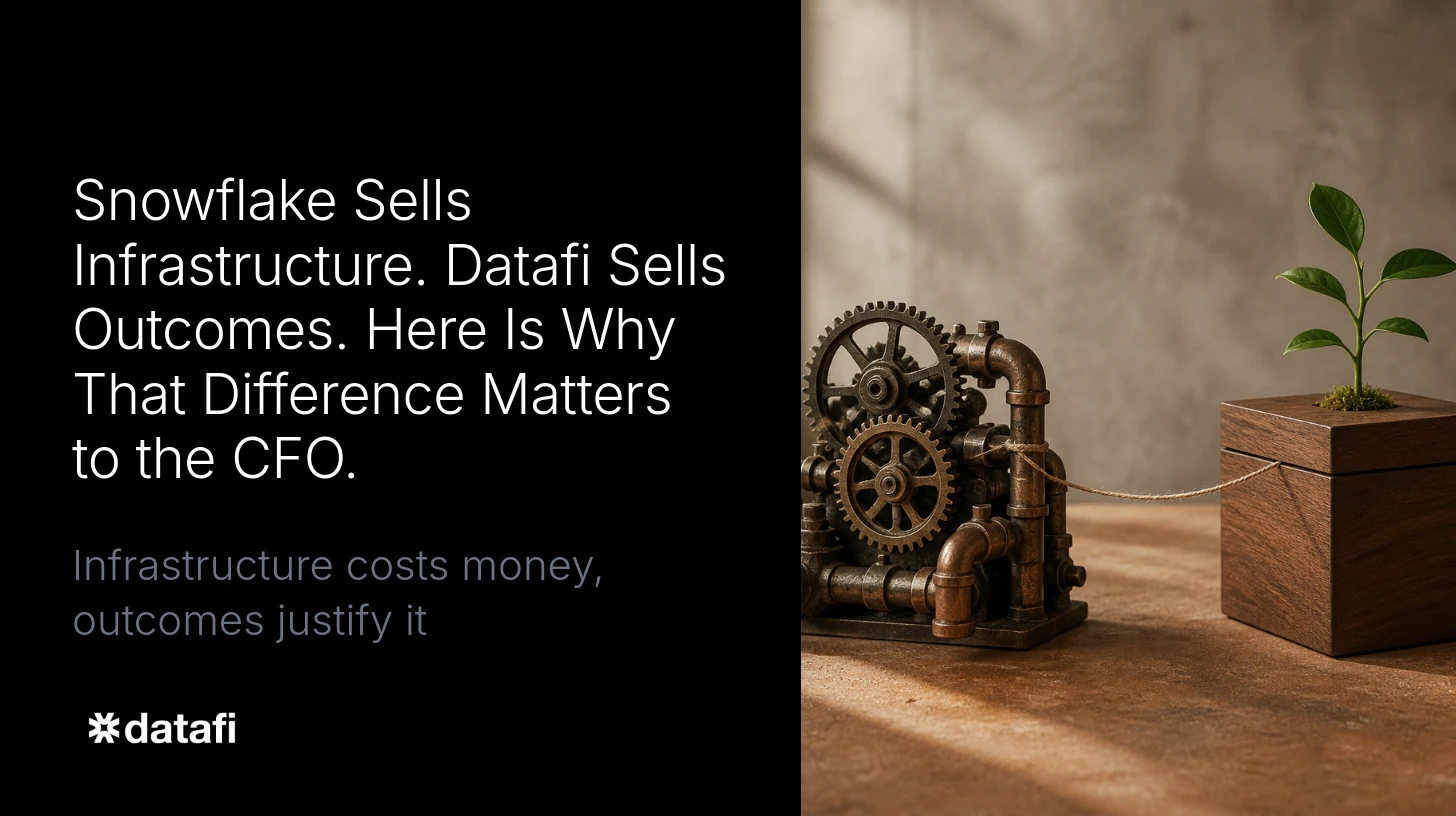
The core difference between Snowflake and Datafi is not features or ecosystem size — it is what each platform actually sells. Snowflake sells input-side infrastructure value; Datafi sells output-side business outcomes. For a CFO, that distinction determines whether AI spending appears in a post-mortem or a success story.
Two Different Value Propositions
Snowflake’s value proposition to the CFO is infrastructure efficiency and data consolidation. By centralizing data in the Snowflake platform, organizations reduce the cost and complexity of operating fragmented data systems. By enabling analytics and AI workloads on a single governed platform, they eliminate integration overhead and reduce the time between data and insight.
This is a genuine and quantifiable value proposition. Snowflake’s consumption-based pricing model means organizations pay for what they use, and the consolidation benefits of moving from multiple siloed data systems to a unified cloud environment are real and measurable.
The limitation from a CFO’s perspective is structural. Snowflake’s pricing is consumption-based — credits consumed for compute, storage billed per terabyte, AI inference priced per token. This model creates flexibility, but it also creates volatility. In periods of expanding use, costs grow faster than expected. In periods of optimization, customers can reduce spend quickly — a dynamic that introduces uncertainty in both directions. More significantly, the value Snowflake delivers is input-side value: better data infrastructure, faster queries, more governed access. What it does not directly measure or price is output-side value: decisions made, problems solved, outcomes improved.
Datafi’s value proposition starts on the other side of that equation. The measure of a Business AI OS is not compute consumed or queries executed. It is business outcomes produced — operational decisions accelerated, workflows transformed, problems solved that were previously solved slowly, expensively, or not at all.
That is a different conversation with a CFO. And in 2026, it is the right conversation to be having.
The ROI Calculation That Actually Closes
The traditional software ROI calculation — cost of platform versus cost savings or productivity gains — has always been imprecise in enterprise technology. It becomes particularly strained for AI platforms, because the costs are metered and the benefits are distributed across thousands of individual decisions made by hundreds of employees over time.
Snowflake’s ROI model requires the organization to build the capability that delivers value on top of the platform. Infrastructure costs are clear. But the cost of the data engineering required to make that infrastructure useful, the cost of the semantic modeling required to make natural language interfaces accurate, the cost of the integration work required to bring AI outputs into business workflows — these are costs that sit outside the Snowflake invoice and frequently dwarf it.
Analysis of Snowflake TCO consistently surfaces this pattern. The platform itself is one input among several. Production AI deployments built on Snowflake typically require multi-month semantic modeling investments, significant data engineering overhead to maintain quality and governance, and ongoing optimization work to manage credit consumption as usage scales. Early adopters of Cortex AI have reported single-query costs reaching thousands of dollars on large document workloads — a pattern that emerged because consumption-based AI inference pricing at scale behaves differently than traditional query costs.
Datafi’s deployment model is designed around a different economic logic. Deployment in 30 days means the value timeline begins 30 days in, not 18 months in. Connecting to existing data sources — including Snowflake — means the infrastructure investment already made continues to compound rather than being superseded. The cost structure is subscription-based, which means finance leaders can plan against it with confidence rather than monitoring credit consumption to prevent overruns.
And the value is measured where business outcomes are produced: in operational decisions accelerated, in employee hours reclaimed from manual data work, in problems that were previously escalated or deferred now being resolved in the flow of daily work.
What the 30-Day Deployment Really Means to Finance
The deployment timeline difference between Snowflake’s agentic AI buildout and a Datafi implementation is not just an engineering metric. It is a financial one.
A capability that begins delivering value in 30 days has a fundamentally different ROI profile than one that begins delivering value in 12 to 18 months. The net present value of near-term returns is higher. The organizational risk of a long implementation with uncertain outcomes is lower. The ability to demonstrate business impact quickly — to a board, to a budget committee, to the employees whose adoption will determine whether the investment pays off — is entirely different.
Research shows that 95% of generative AI pilots fail to move beyond the experimental phase. The most common reason is not that the technology does not work. It is that the deployment timeline and complexity required to make it work at enterprise scale exceeds the organizational patience and budget tolerance available for an unproven investment.
A 30-day deployment is not just faster. It is a different category of risk — moving AI from a capital bet on a future state to an operational investment with measurable near-term returns.
The Hidden Cost of Building on Top
There is a cost dimension that rarely appears in platform comparison analyses but consistently appears in CFO post-mortems: the cost of the talent required to build value on top of an infrastructure platform.
Snowflake is a developer platform. Extracting maximum value from it requires data engineers who understand the platform deeply, analytics engineers who can build and maintain semantic models, AI engineers who can configure and optimize Cortex deployments, and operations staff who can manage credit consumption and governance at scale.
This is not a criticism of Snowflake. It is an accurate description of what a sophisticated data platform requires. The talent is available. It is expensive, in high demand, and not the talent profile most business units can absorb into their own teams.
Datafi was designed to be operated by the business, not by a dedicated data engineering team. The Business AI OS provides the infrastructure, the governance, and the intelligence layer. What the business provides is knowledge of itself — its processes, its priorities, its decision context. That knowledge transfer happens during onboarding, not through years of platform customization.
The implication for the CFO is that the total cost of a Datafi deployment is closer to the invoice than the total cost of a Snowflake AI buildout. And the value it produces — operational AI in the hands of every employee in the organization — is broader than what a platform requiring deep technical expertise to configure and maintain can realistically deliver.
The Right Question for the Budget Meeting
When a CFO is presented with competing investments in enterprise AI infrastructure, the right question is not which platform has the most features or the largest ecosystem. It is: what does this investment produce, for whom, on what timeline, and at what fully-loaded cost?
Snowflake produces world-class data infrastructure. On that dimension, it is exceptional. The cost of producing business outcomes from that infrastructure is the implementation, integration, semantic modeling, and ongoing engineering investment that sits on top of the platform.
Datafi produces operational business intelligence for every employee in the organization, connected to your existing data infrastructure, deployed in 30 days, measured in outcomes rather than compute credits.
These are not competing line items in a technology budget. They are answers to different questions. And the CFO who understands the difference will make a materially better investment decision — for the technology portfolio and for the business that depends on it.
This is Part 5 of the Snowflake vs. Datafi series. Part 6 examines the missing layer — why enterprises need a Business AI OS between their data and their AI models, and what happens to organizations that build without it.
Learn more about how Datafi works alongside your existing data infrastructure at datafi.co.
Next in the Series: The Missing Layer: Why Enterprises Need an OS Between Their Data and Their AI