


The enterprise AI story of the last several years has been told as a story about models and data. Get the right model. Get the data into the right place. Connect them. Value follows.
It is a compelling narrative. It has produced extraordinary investment in foundation models, in data platforms, in cloud infrastructure, in tooling to connect all of the above. And it has produced a persistent and widening gap between what organizations have invested and what they are actually experiencing.
Seventy-nine percent of organizations report challenges in adopting AI despite significant investment. Only 29% see meaningful ROI. Forty-eight percent describe their AI deployments as a disappointment. These are not fringe findings. They are the consensus of independent research across thousands of enterprises.
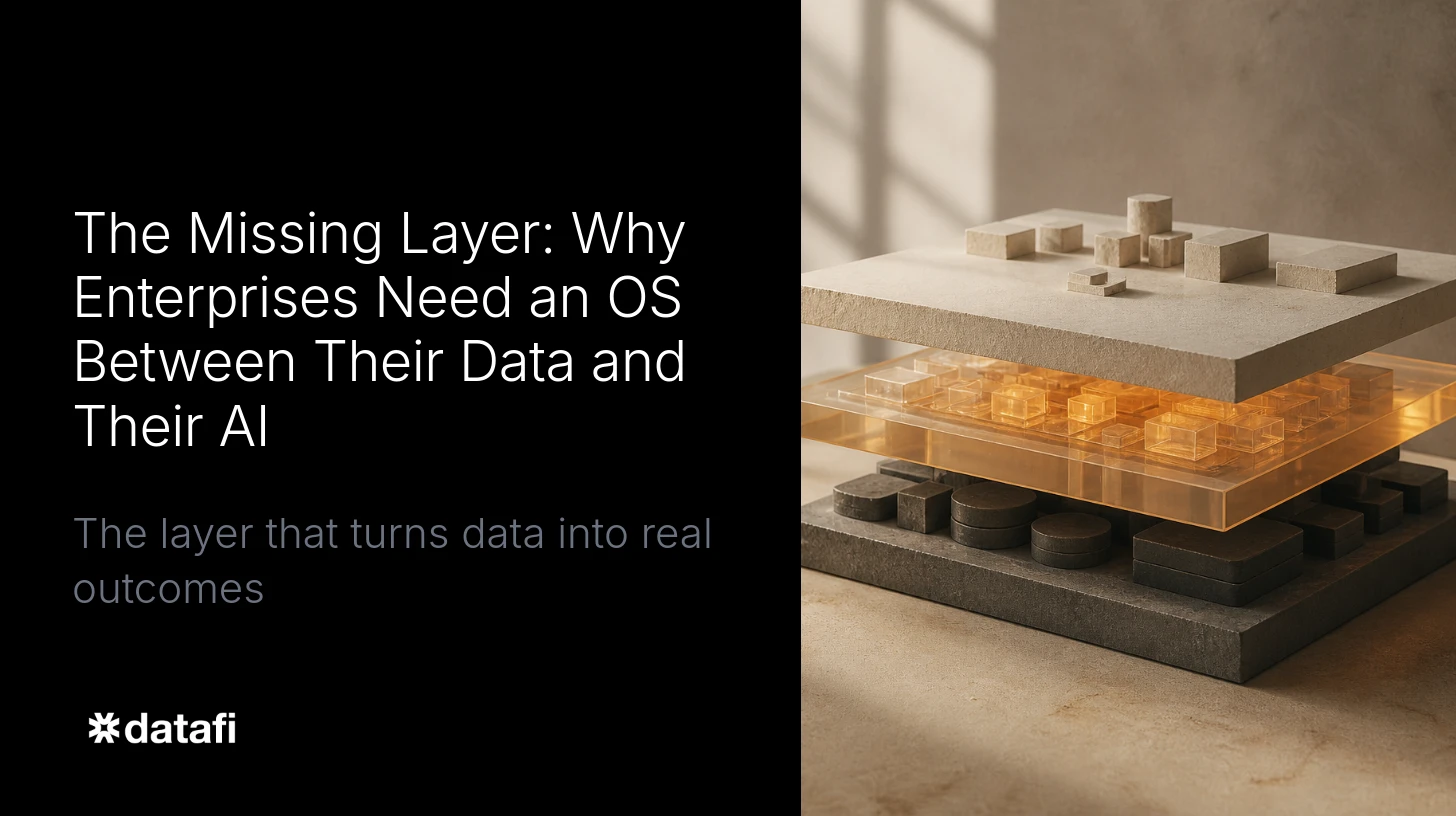
The enterprise AI gap is not a model problem or a data problem. It is an architecture problem. The missing layer, a Business AI Operating System, is what translates raw data and powerful models into operational intelligence that every employee can act on.
The gap is not a model problem. GPT-4, Claude, Llama, Snowflake Arctic, the models available to enterprises today are capable of extraordinary things. The gap is not a data problem. Snowflake, Databricks, BigQuery, enterprise data has never been more centralized, governed, or accessible.
The gap is an architecture problem. And the architecture that is missing is the Business AI Operating System, the layer that lives between data and AI models on one side, and business users and business outcomes on the other.
Why Data + Models Is Not Enough
Consider what an AI model actually receives when it is connected to an enterprise data warehouse without a mediating layer.
It receives tables. Columns. Values. Relationships between data structures. With a good semantic layer, it also receives business terminology and metric definitions, what “revenue” means, how “churn” is calculated, what the relationship is between accounts and orders.
What it does not receive is understanding. It does not know that the VP of Operations and the VP of Finance look at the same revenue number through fundamentally different lenses and need to be told different things about the same data. It does not know that a 15% variance in this particular metric is a routine seasonal pattern that has appeared every Q3 for five years. It does not know that the right response to a logistics anomaly in this region is to notify the carrier relations team, not the regional dispatch manager, because of an exception process established after a carrier dispute three years ago.
This is operational context. It is the knowledge that the people running a business carry in their heads and apply constantly, invisibly, in the course of doing their jobs. It is the difference between a system that can answer questions about data and a system that understands how a business works.
No data platform encodes this context. No AI model infers it from table schemas. It has to be built into the intelligence layer deliberately, as a first-order design principle.
That is the missing layer. And its absence explains why so much enterprise AI investment has produced so little enterprise transformation.
What an Operating System Does
The analogy to an operating system is worth developing, because it is precise rather than metaphorical.
An operating system does not do the work of the applications that run on top of it. It provides the environment, the resource management, the security model, the abstraction layer, the communication protocols, within which applications can operate reliably and at scale. An application does not need to manage memory directly, or handle hardware interrupts, or implement its own security model. It operates within the OS and inherits those capabilities.
A Business AI OS does the same thing for enterprise intelligence. It provides the environment within which AI agents, business users, and data sources can interact in a way that is governed, contextually grounded, and operationally meaningful. The individual AI interaction does not need to independently discover the business rules, roles, and constraints that govern it. It operates within the OS and inherits that understanding.
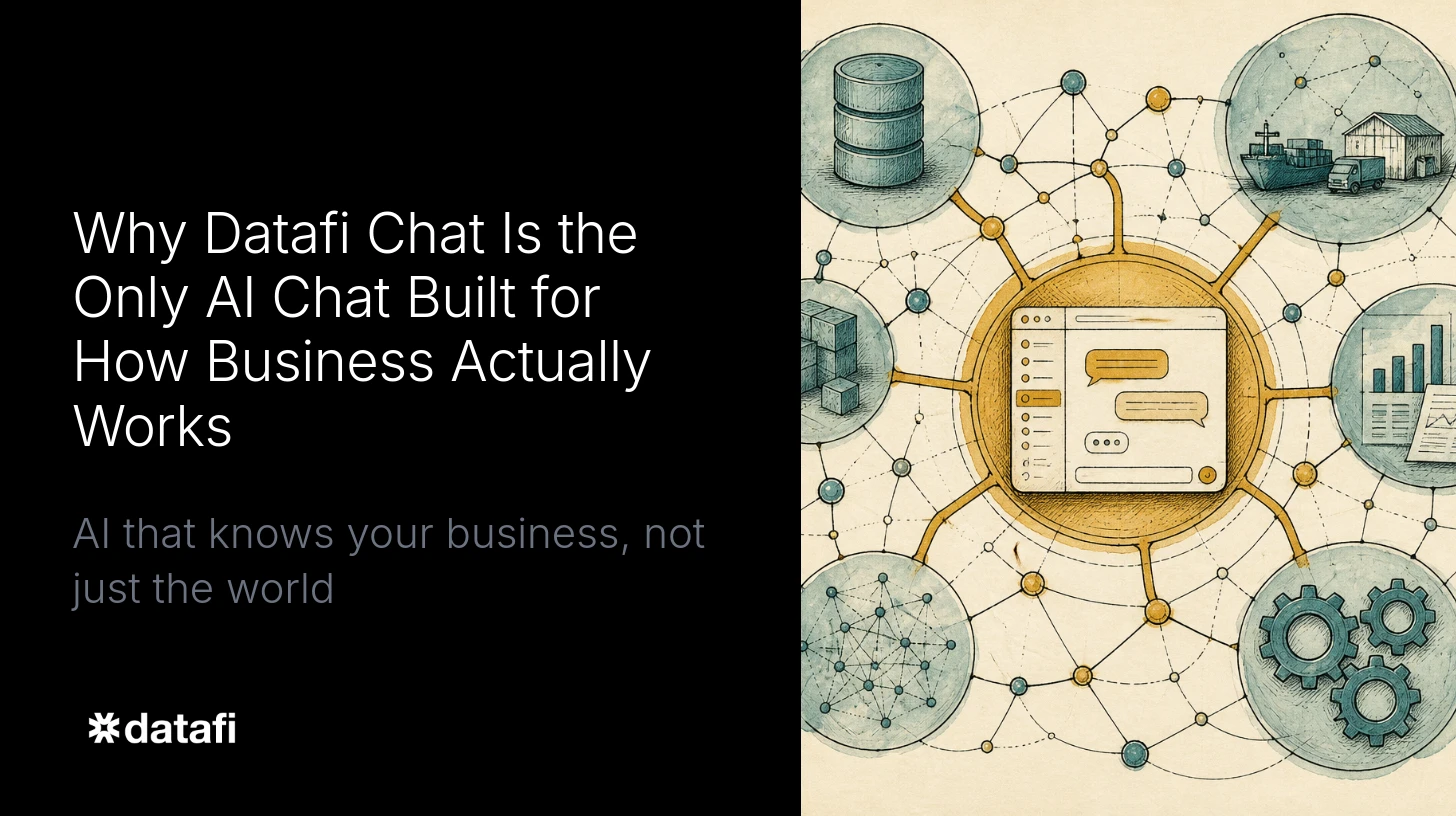
The Business AI OS is not a tool that runs on top of your infrastructure. It is the environment, the global contextual layer that gives every interaction, every agent, and every data flow the business understanding it needs to produce outcomes rather than answers.
This is why Datafi describes itself as the OS for Business AI rather than as an AI analytics tool, a chat interface, or an agentic automation platform. Those are things that run within the OS. The OS itself is the environment, the global contextual layer that gives every interaction, every agent, and every data flow the business understanding it needs to produce outcomes rather than answers.
What the Missing Layer Enables
When the Business AI OS layer is present, several things that have previously been difficult or impossible become straightforward.
Every employee can access intelligence that is relevant to their role. Not query results. Not dashboard summaries. Actual operational intelligence, grounded in the current state of the business, filtered by what is relevant to this person’s responsibilities, connected to the actions they have the authority and capability to take. The logistics coordinator, the claims adjuster, the account manager, the clinical operations director, each of them interacts with an AI system that understands what they do and what they need.
AI agents can operate across workflows without needing to be individually programmed for each use case. Because the global contextual layer encodes the business model, the agents operating within it inherit that understanding. An agent that knows the business knows how to behave appropriately in a new situation without requiring a custom pipeline for every scenario.
Governance is consistent and automatic. Because the business rules, access policies, and compliance constraints are built into the OS layer, they apply to every interaction without needing to be separately configured for each agent, each user, or each data source. The governance model scales with the deployment rather than requiring proportional engineering investment to maintain.
And perhaps most importantly: AI stops being a tool that experts use and starts being infrastructure that everyone works within. The barrier to adoption drops from “can this person learn to use this product” to “can this person interact with a system that already understands their job.” That is a different adoption curve, and it is the one that produces the organization-wide transformation that enterprise AI has been promising but rarely delivering.
What Happens to Organizations That Build Without It
The pattern for organizations that invest in data platforms and AI models without building the Business AI OS layer is predictable by now, because it is the pattern that has produced the disappointing adoption statistics that define enterprise AI in 2025 and 2026.
The investment is made. The infrastructure is excellent. Pilots are run with technically sophisticated teams who can work with the platform directly. The pilots succeed. The decision is made to scale.
Scaling to the broader organization requires bridging the gap between the technical environment and the business users who were not in the pilots. That bridging requires custom development, interfaces, integrations, semantic modeling, governance configuration, that was not fully scoped in the original investment case. The timeline extends. The budget expands. The business units that were promised AI capabilities wait.
Meanwhile, the 5% of employees who are technically sophisticated enough to work with the platform directly pull further ahead of the 95% who cannot. AI becomes a tool that creates a two-tier organization rather than a capability that lifts everyone.
This is not a failure of ambition. It is a failure of architecture. The organizations that avoid this pattern are the ones that start with the Business AI OS layer rather than trying to retrofit it after the fact.
The Path Forward
The enterprise AI investments that will produce transformative outcomes over the next several years will share a common architectural principle: intelligence lives closer to the business than to the data.
Data platforms are essential. AI models are essential. But the layer that gives those capabilities meaning, that translates infrastructure into operational intelligence, that brings the business context that turns answers into actions, that makes AI accessible to every employee rather than just the engineers who can configure it, is the Business AI OS.
Snowflake is building toward this vision from the data layer outward. It is genuine progress and it will continue. The constraint is architectural: a system designed to manage data at scale is not, by its nature, a system designed to understand how a business works.
Datafi was designed from the other direction. The business is the starting point. Data is the fuel. AI is the engine. And the OS is the system that makes all three work together in a way that produces outcomes rather than infrastructure.
For organizations evaluating where to invest their enterprise AI budgets in 2026 and beyond, the missing layer is no longer a gap in the market. It exists. The question is whether you build your AI strategy around it.
This is Part 6 of the Snowflake vs. Datafi series. To learn how Datafi works alongside your existing data infrastructure, including Snowflake, visit datafi.co or schedule a conversation with our team.