


Build vs. Buy: The AI Platform Decision - Post 8 of 10
There is a question that arrives in every enterprise AI deployment, and it arrives at the worst possible moment: right after the first production failure.
The AI was given access to the right data. The model is capable. The query was reasonable. And the output was wrong - not obviously wrong, not syntactically wrong, but operationally wrong in a way that only someone who deeply understands the business would immediately recognize.
The supply chain analyst asks about inventory coverage for the Northeast region in Q3 and receives a confident, fluent, internally coherent answer that does not account for the fact that “Northeast region” in the distribution database maps to a different set of facilities than “Northeast region” in the sales reporting system. The AI used one definition. The business runs on the other.
The underwriter asks about exposure concentration for a specific industry segment and receives a summary that excludes a material portfolio of policies because they were classified under a legacy taxonomy the AI was not told to reconcile with the current one.
The operations director asks about the status of a supplier relationship and receives information accurate as of the last warehouse refresh, which was fourteen hours ago, during which time a credit hold was placed that the AI has no knowledge of.
These are not model failures. The models are performing exactly as designed. They are context failures - the consequence of AI that has access to enterprise data but lacks understanding of what that data means, how it relates to other data, and what the specific operational constraints of this business are.
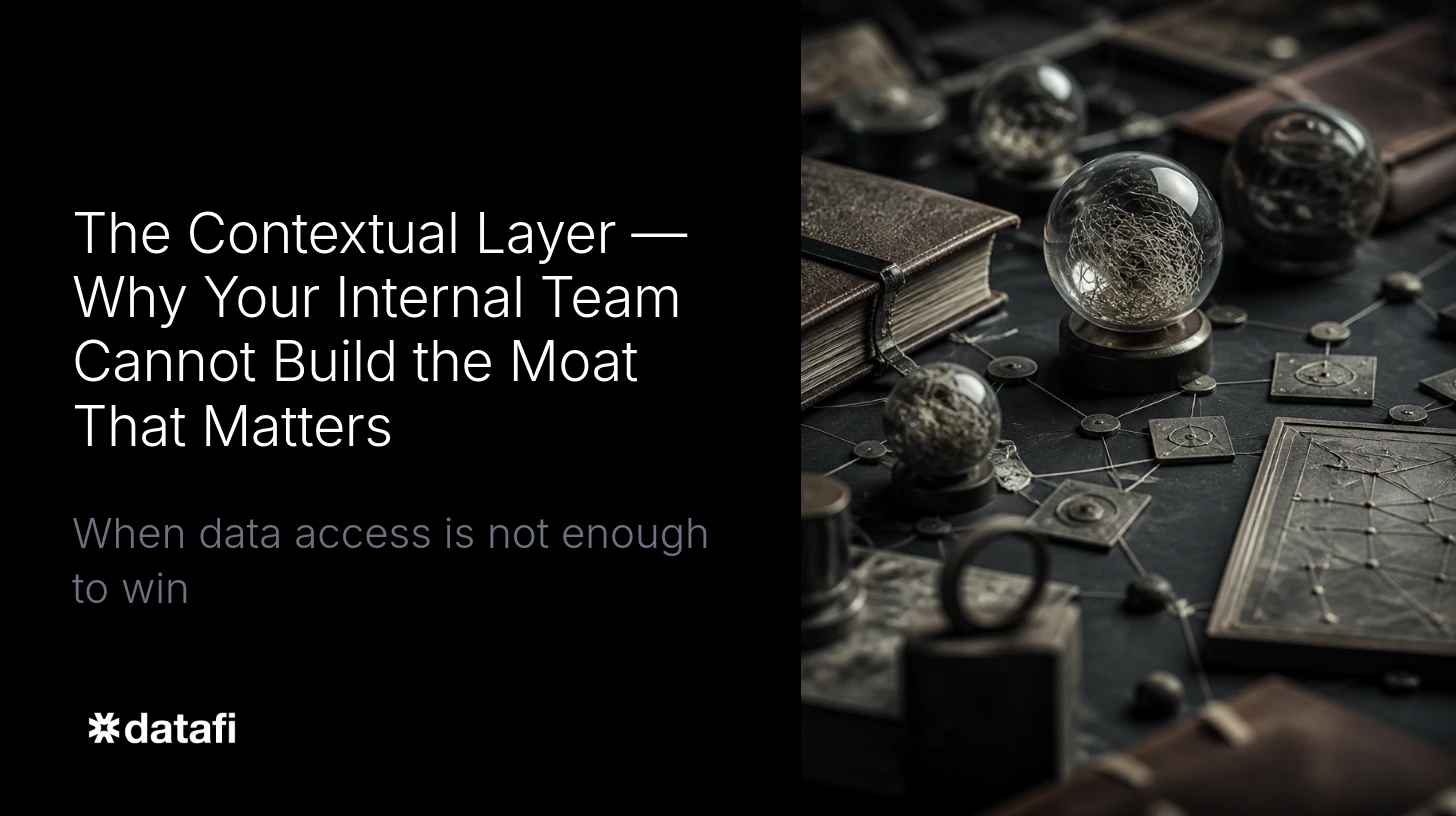
The gap between data access and business understanding is the contextual layer. It is the single architectural element that most determines whether enterprise AI produces transformative outcomes or expensive analysis. And it is the element that internal build teams most consistently underestimate, misscope, and fail to complete.
Data access is not the same as business understanding. The contextual layer, comprising entity models, semantic resolution, bidirectional operational access, and continuous enrichment, is the foundational infrastructure that separates AI which retrieves information from AI which reasons reliably about your business.
What data access cannot do
Most enterprise AI evaluations focus on two questions: does the AI have access to the right data, and is the underlying model capable of reasoning about it? These are necessary conditions. They are not sufficient ones.
A language model with access to your enterprise data systems is a powerful reasoning engine operating in an unfamiliar environment. It knows nothing about the specific ways your organization has named things, structured things, or related things across the systems that accumulated over decades of software investment. It does not know that your CRM calls them customers, your finance system calls them clients, your operational database calls them accounts, and your partnership agreements call them partners. It does not know that your fiscal Q3 ends in September, not December. It does not know that “Northeast region” in distribution covers eight states and “Northeast region” in sales covers six different ones.
Without that knowledge, the AI reasons on the surface of your data rather than within the operational reality of your business. It produces outputs that are linguistically accurate and contextually wrong - and in a business environment where AI-generated outputs inform consequential decisions, contextually wrong is a category of failure that compounds in ways that are difficult to detect and expensive to remediate.
Context is not a prompt. You cannot solve this problem by writing a more detailed system instruction or appending a business glossary to every query. The depth of business context required to make AI genuinely reliable across the full breadth of enterprise operations - not just in a single well-configured use case - is structural. It requires infrastructure. And that infrastructure is the contextual layer.
What a genuine contextual layer actually contains
The contextual layer is not a single component. It is four distinct capabilities that must work together to give AI genuine understanding of a business rather than surface familiarity with its data.
The entity model. A structured representation of the business’s core objects - customers, products, locations, suppliers, contracts, organizational units, transactions - and the relationships between them. Not a data schema, which describes how information is stored. An entity model describes what information means: that a customer entity has relationships to contract entities, purchase history entities, support history entities, and credit entities, and that the AI reasoning about that customer needs to understand those relationships to produce operationally useful outputs.
The entity model is what allows AI to answer a question like “which of our top twenty customers by revenue have open support escalations and contract renewals in the next sixty days?” correctly - because it understands that “top twenty by revenue” requires traversing purchase history, that “open support escalations” live in a different system than revenue data, and that contract renewal dates require joining to a contract management system, and it knows how those systems’ entities relate to each other by business meaning rather than by database key.
The semantic and vocabulary layer. Resolution of the vocabulary inconsistencies that exist in every enterprise data ecosystem. These inconsistencies are not bugs. They are the natural result of software systems being built by different teams, at different times, for different purposes, each developing their own vocabulary for the concepts they manage.
The semantic layer encodes the translation rules that allow AI to understand that “client” in the finance system refers to the same entity as “customer” in the CRM and “account” in the operations platform. It encodes that “coverage” means something specific in an insurance context that differs from its usage in supply chain. It encodes that “active” status in one system means something different from “active” in another. Without this layer, an AI operating across multiple systems will either pick one vocabulary and miss data described in others, or attempt to reconcile inconsistencies through inference and produce outputs that are confidently incorrect.
Bidirectional operational access. A contextual layer that provides read-only access to historical data in a warehouse is, at best, a well-informed analysis system. Transformative AI requires access to the systems where business actually happens - in real time, with the ability to not just read from those systems but write back to them when action is required.
This is the architectural distinction between AI that produces a report recommending a supplier substitution and AI that evaluates the substitution against current inventory, available alternatives, contract terms, and delivery windows, and then initiates the purchase order, updates the inventory projection, notifies the affected production schedule, and logs the decision with a complete governance trail. The second capability requires that the AI has live, bidirectional access to the operational systems involved - not a copy of their data from last night’s batch run.
The continuous enrichment mechanism. A contextual layer built once and left static degrades over time. Businesses change. New systems are added. New product lines create new entity types. Acquisitions introduce entirely new vocabularies that must be reconciled with the existing semantic model. Organizational restructuring changes what “Northeast region” means.
A production-grade contextual layer requires a continuous enrichment mechanism: a system that updates the entity model and semantic layer as the business evolves, incorporating feedback from agent interactions that surface inconsistencies, human corrections that refine vocabulary resolution, and new data source connections that expand the scope of what the AI can reason about. Without continuous enrichment, the contextual layer that was accurate at deployment becomes progressively less accurate as the business it was built to represent changes around it.
Why internal teams consistently underestimate what building this requires
Each of the four components above presents a surface that feels tractable in a project plan. The full depth of each one only becomes apparent in production.
Entity modeling appears to be a data modeling project. It is more. A data model describes structure. An entity model must encode meaning - the business significance of relationships, the rules that govern how entities interact, the operational constraints that determine what questions can be answered by traversing those relationships. Building it correctly requires deep domain knowledge of the business, expertise in ontological modeling that sits outside the skill set of most enterprise data engineering teams, and iteration against production failures that only become visible when the AI starts reasoning about real queries from real users.
Semantic resolution appears to be a configuration task. It is more. Resolving vocabulary inconsistencies across a mid-enterprise data ecosystem - typically spanning fifteen to forty source systems accumulated over ten to twenty years - requires not just cataloging the inconsistencies but encoding the translation logic at a level of precision that AI can apply reliably. The inconsistencies that cause the most consequential failures are not the obvious ones. They are the cases where the same term means something slightly different in two systems in ways that only emerge in specific query contexts, and where the wrong resolution produces a plausible-sounding answer that is operationally incorrect.
Bidirectional operational integration appears to be a connector development project. It is more. Read access to operational systems is a solved problem. Write-back access - the ability for AI agents to initiate actions in production systems - requires connector development, write-back governance logic that prevents AI from taking actions outside its authorized scope, operational safety controls that handle partial failures across multi-system transactions, and audit infrastructure that creates a complete trail of every action taken. Each of those is infrastructure-grade engineering work, not feature work, and each one carries its own failure modes that only become apparent in production.
Continuous enrichment appears to be a maintenance commitment. It is more. Building a system that can detect and incorporate changes to the entity model and semantic layer as the business evolves - without human intervention for routine changes and with reliable escalation for changes that require judgment - requires a monitoring and update infrastructure that is itself a significant engineering investment. Most internal build plans scope for building the contextual layer. Very few scope for maintaining it across the full lifecycle of the business it represents.
The cumulative investment across all four components, built to production-grade quality, for a mid-enterprise organization with a moderately complex data ecosystem, is measured in years. The teams that have done it well did not do it as a component of an AI initiative. They did it as a foundational infrastructure investment, often before the current generation of AI capabilities existed, because they understood that context is what makes any intelligent system capable of operating reliably inside a business.
What shallow context produces in practice
The difference between AI with data access and AI with genuine business understanding is not theoretical. It is visible in every interaction where the query requires more than surface retrieval.
Consider a procurement scenario. An AI system is asked to identify suppliers at risk of delivery disruption over the next quarter, and to recommend mitigation actions for the top five.
A system with data access but shallow context queries the supplier database, finds suppliers with recent late deliveries, and generates a list with a recommendation to contact each one about delivery schedule confirmation. It is responsive. It is not useful. It does not account for the fact that two of the five suppliers on the list are subsidiaries of a third supplier that has a master agreement covering all three. It does not know that one of the listed suppliers is currently under a credit review that procurement already knows about. It does not distinguish between suppliers whose delivery risk reflects a systemic capacity problem and suppliers whose recent delays reflect a one-time logistics issue. And it cannot do anything about what it has identified - its output stops at the analysis.
A system with a genuine contextual layer queries the same data but reasons about it differently. It understands the corporate relationship between the three related suppliers and aggregates their risk profile rather than treating them independently. It knows the credit review status because that information exists in the financial system and the entity model connects supplier entities to their financial relationship records. It applies the business’s own risk classification logic - encoded in the semantic layer - to distinguish systemic from incidental delay patterns. And it does not stop at the analysis: it drafts the communication to the at-risk suppliers, identifies alternative sources already approved in the supplier management system, and surfaces the mitigation options with enough context for the procurement manager to take action immediately.
The gap between those two outputs is not a model capability gap. The same model could power both systems. It is a context gap: the difference between AI reasoning about a business it has access to and AI reasoning about a business it understands.
Why this is the moat - and why the gap compounds
The contextual layer argument is not just that it is hard to build. It is that it is the kind of infrastructure investment that creates durable advantage precisely because it compounds over time in ways that a later-starting build cannot easily replicate.
Every deployment that refines the entity model improves the AI’s ability to reason about the business. Every agent interaction that surfaces a vocabulary inconsistency and is corrected enriches the semantic layer. Every workflow that maps business process to operational data expands the scope of what AI can understand and act on. Every new data source that is connected and reconciled extends the range of questions the AI can answer reliably.
This compounding is why the gap between an organization operating on a mature contextual layer and an organization that just started building one does not close on a linear timeline. The mature layer gets better every day through use. The new build starts from zero, encounters the same failure modes and edge cases that shaped the production layer years earlier, and resolves them one at a time as they surface in production - years after those problems were already solved elsewhere.
Datafi’s global business contextual layer is not a feature built on top of the platform. It is the foundation the platform was built around - a persistent, structured representation of what a business knows about itself, continuously enriched through every agent interaction, every human feedback loop, and every workflow outcome. It represents years of foundational investment, refined across enterprise deployments that each added to the accumulated understanding of what production-grade business context requires.
It is what separates AI that has access to your data from AI that understands your business. And it is the moat that no single-initiative internal build will replicate on the timeline the competitive environment allows.
Post 9 in this series moves from architecture to timeline: what deploying on a platform with the contextual layer already built actually looks like in practice, and the 90-day path from decision to production that defines the buy alternative.
Datafi is a Business AI Operating System designed for mid-enterprise organizations that need the full power of an integrated AI platform without the cost, risk, and timeline of building one. Learn more at datafi.co.
Series: Build vs. Buy - The AI Platform Decision
Part 1 - Awareness: Framing The Question
Post 1: The Hidden Cost of Building Your Own Enterprise AI Platform
Post 2: Why Most Enterprise AI Projects Stall Before They Scale
Post 3: The Seven Layers Most AI Builders Forget to Budget For
Post 4: AI That Answers Questions vs. AI That Solves Problems
Part 2 - Consideration: Evaluating The Tradeoffs
Post 5: Build vs. Buy - A Scoring Framework for Mid-Enterprise AI Decisions
Post 6: What Palantir’s Deployment Model Teaches Us About the Wrong Way to Scale AI
Post 7: Governance Is Not a Feature - It Is the Foundation
Post 8: The Contextual Layer - Why Your Internal Team Cannot Build the Moat That Matters
Part 3 - Decision: The Alternative Path
Post 9: From Pilot to Production in 90 Days - What “Buy” Actually Looks Like With Datafi
Post 10: The AI Operating System - Why the Future of Enterprise AI Is a Platform, Not a Project