


Series: Salesforce Agentforce vs. Datafi | Part 1 of 6
There is a moment that arrives for almost every enterprise that deploys Salesforce Agentforce. The demos were compelling. The initial results were real. Sales teams got smarter follow-up prompts, service agents deflected tickets more efficiently, and leadership started asking what else AI could do.
Then someone asked a question the system could not answer.
Not because the model was inadequate. Not because the prompt was poorly written. But because the data that would have answered the question did not live in Salesforce. It lived in an ERP, a supply chain system, a financial ledger, a manufacturing sensor feed, or a claims processing platform. It lived, in other words, in the business.
This is the CRM trap. And understanding it is the first step toward building AI that actually transforms how your organization operates.
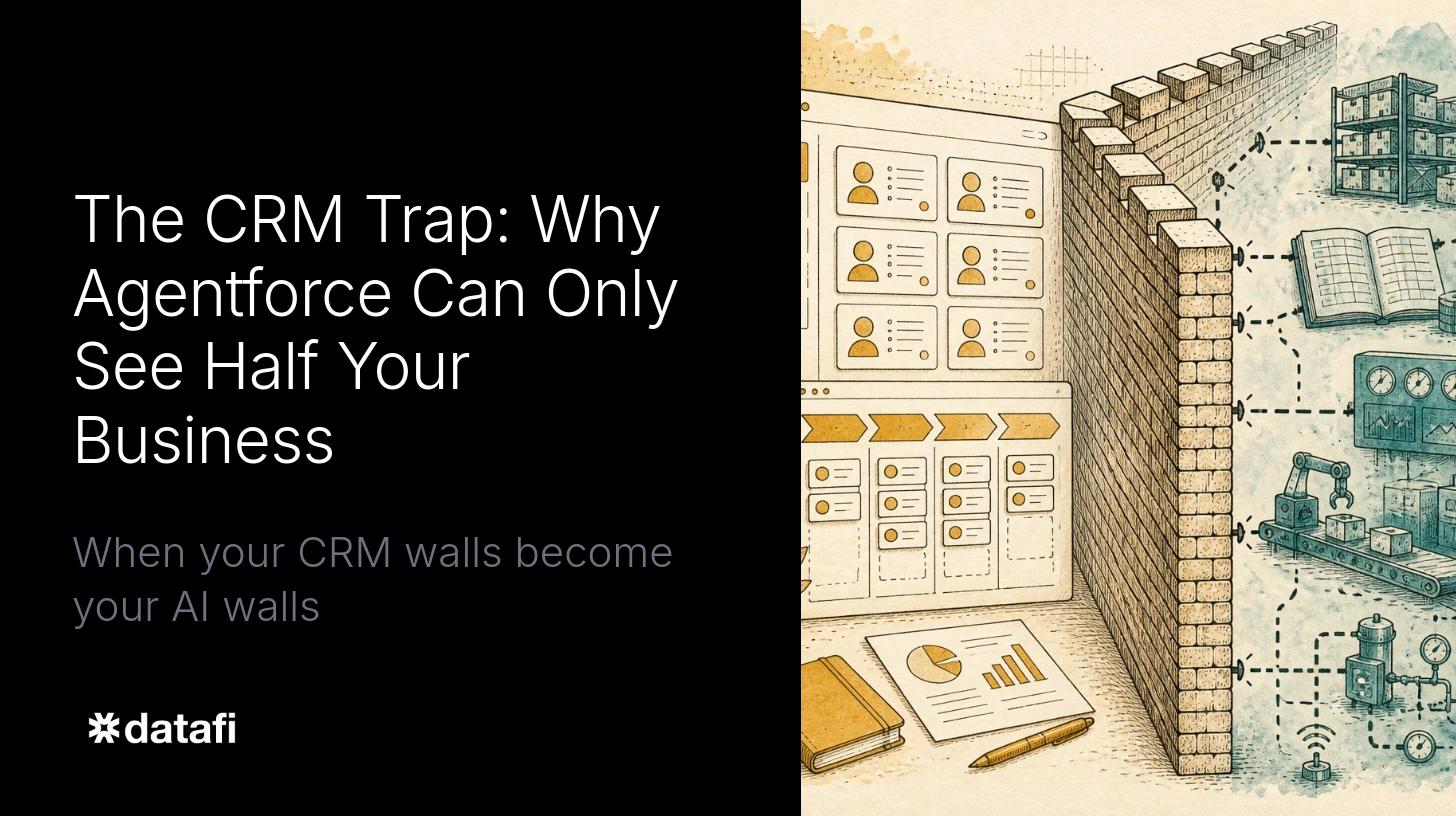
Agentforce is powerful within Salesforce, but most enterprise decisions depend on data that lives outside the CRM. The architectural boundary of your CRM becomes the boundary of your AI, unless you build on a unified data foundation from the start.
“The question is not whether Agentforce is powerful. The question is what it is powerful over.”
What Agentforce Was Built to Do
Agentforce is a genuinely impressive platform. It brings autonomous AI agents into the Salesforce ecosystem, enabling capabilities that go well beyond traditional CRM automation. Agents can qualify leads, resolve service tickets, update pipeline records, recommend next best actions, and now, through Slack integration, operate as a coordination layer across sales and service teams.
Salesforce has invested heavily in governance too, building trust layer controls that limit where agents can act and ensuring enterprise security requirements are respected. For organizations whose work lives inside Salesforce, this represents a meaningful step forward.
The operative phrase is: organizations whose work lives inside Salesforce.
The Boundary Problem
Most mid-to-large enterprises run between 50 and 200 software systems. Salesforce is one of them. It holds customer relationship data, opportunity pipelines, service case histories, and marketing engagement records. That is genuinely valuable context.
But it does not hold inventory levels, production schedules, financial forecasts, regulatory compliance records, logistics status, workforce capacity, or operational sensor data. It does not hold the data that determines whether a promise made in the CRM can actually be kept by the rest of the business.
When an Agentforce agent recommends a discount to close a deal, it has no visibility into whether margin thresholds have already been compressed by supply chain cost increases. When it flags a service escalation, it cannot see that the field technician workforce in that region is already at capacity. When it surfaces an upsell opportunity, it has no awareness of an open regulatory review that should pause that conversation entirely.
These are not edge cases. They are the normal operating conditions of a complex business. And they represent the half of the business that Agentforce cannot see.
“AI that can only see your customer data is not a business AI. It is a CRM with a better interface.”
Why This Is an Architecture Problem, Not a Feature Gap
The natural response to this framing is to ask whether integrations solve it. Can you not connect Agentforce to your ERP? Can you not build flows that pull in data from other systems?
You can. Salesforce has invested in connectivity, and the platform does support integrations. But there is a difference between connecting data sources and building AI on a unified data foundation.
Integration in the Agentforce context means passing data points across to answer a specific question in a specific workflow. A unified data foundation means AI that can reason across your complete data ecosystem simultaneously, apply governance policies consistently across all sources, and take action across systems as a coordinated whole.
The first approach extends the walls of the CRM outward. The second eliminates the walls entirely.
Datafi was built on the second premise. The platform functions as an operating system for business AI because it starts with the entire data ecosystem and builds intelligence on top of that foundation. The Datafi contextual layer assembles full business context across structured data, unstructured documents, operational systems, and real-time feeds. Datafi Sentinel enforces governance at the data layer itself, not at the agent behavior layer. And the Datafi Chat UI delivers that intelligence to every employee across every function, not just the ones who live in a CRM.
The Practical Consequence
Consider what this architectural difference means in practice.
Scenario A: A sales leader asks why a major account churned. Agentforce can surface the service ticket history, the last email exchange, the opportunity notes. It cannot surface the three late shipments, the invoice dispute that sat unresolved for 47 days, or the product quality flag that came through a returns system that has no Salesforce integration. The AI produces a partial answer. The sales leader draws the wrong conclusion.
Scenario B: An operations manager asks whether the business can fulfill a large new order given current inventory and production capacity. Agentforce knows the order exists as an opportunity. It has no access to the warehouse management system, the production schedule, or the supplier lead time data. The AI cannot answer the question at all.
Scenario C: A CFO asks for a complete picture of customer profitability across the portfolio. Agentforce knows revenue and deal history. It has no access to the cost-to-serve data that lives in finance systems, the operational overhead data in ERP, or the support cost data spread across ticketing and field service platforms. The AI produces a revenue report, not a profitability analysis.
In each case, the limitation is not the AI model. It is the data boundary the platform was designed around.
What the Business AI Operating System Changes
Datafi approaches this differently because the platform was not designed as a CRM add-on. It was designed from the premise that enterprise AI requires access to the complete operating reality of the business.
That means connecting every data source, not just the ones that already live in Salesforce. It means enforcing governance and policy controls at the data layer so that every agent, every workflow, and every user interaction operates within the organization’s compliance boundaries. And it means delivering intelligence through a unified interface that serves every employee, not just the ones whose workflows are already Salesforce-native.
The result is AI that can answer the questions in scenarios A, B, and C above. AI that can see both the customer relationship and the operational reality behind it. AI that does not just inform decisions but has the context required to help execute them.
“The half of your business that Agentforce cannot see is often the half that determines whether the half it can see actually works.”
The Right Question to Ask
When evaluating enterprise AI platforms, the most important question is not which platform has the most impressive agent capabilities. The most important question is: what data can the AI actually see, and what can it do with that data across the entire organization?
For organizations that have made Salesforce central to their customer-facing operations, Agentforce will continue to deliver value in that domain. However, for organizations that need AI to transform how the entire business operates, not just the CRM, the architecture matters as much as the capability.
The CRM trap is not a failure of Salesforce. It is an architectural boundary. And the question every enterprise should be asking is whether the walls of their CRM are also the walls of their AI ambition.
Datafi is the operating system for business AI. Connect your complete data ecosystem, deploy governed AI agents, and deliver intelligence to every employee across every function. Learn more at datafi.co
Next in this series: Governed Agents vs. Governed Data: Two Very Different Things