


Series: Salesforce Agentforce vs. Datafi | Part 5 of 6
Every enterprise AI platform makes a claim about accessibility. The demos show business users asking questions in plain language and receiving useful answers. The marketing materials feature operations managers, financial analysts, and executives interacting with AI as naturally as they would with a knowledgeable colleague.
Then the implementation begins. And the gap between the demo and the deployment becomes visible.
The gap is not always about technology. More often it is about who the platform was actually designed for, and how deep that design assumption runs.
The most important accessibility question is not whether your AI platform is technically accessible, it is whether it is accessible to the people who most understand the business problems it needs to solve.
The Salesforce Professional Requirement
Agentforce is a powerful platform for organizations with skilled Salesforce professionals. Configuring agents, building topics and actions, designing flows, and extending capability through Apex classes and Lightning Web Components requires people who understand the Salesforce architecture deeply.
Salesforce has worked to make this more accessible. Low-code and no-code tools have expanded who can participate in configuration. Natural language interfaces have simplified some of the interaction surfaces. And Salesforce’s AI-assisted development tools help admins and developers build faster.
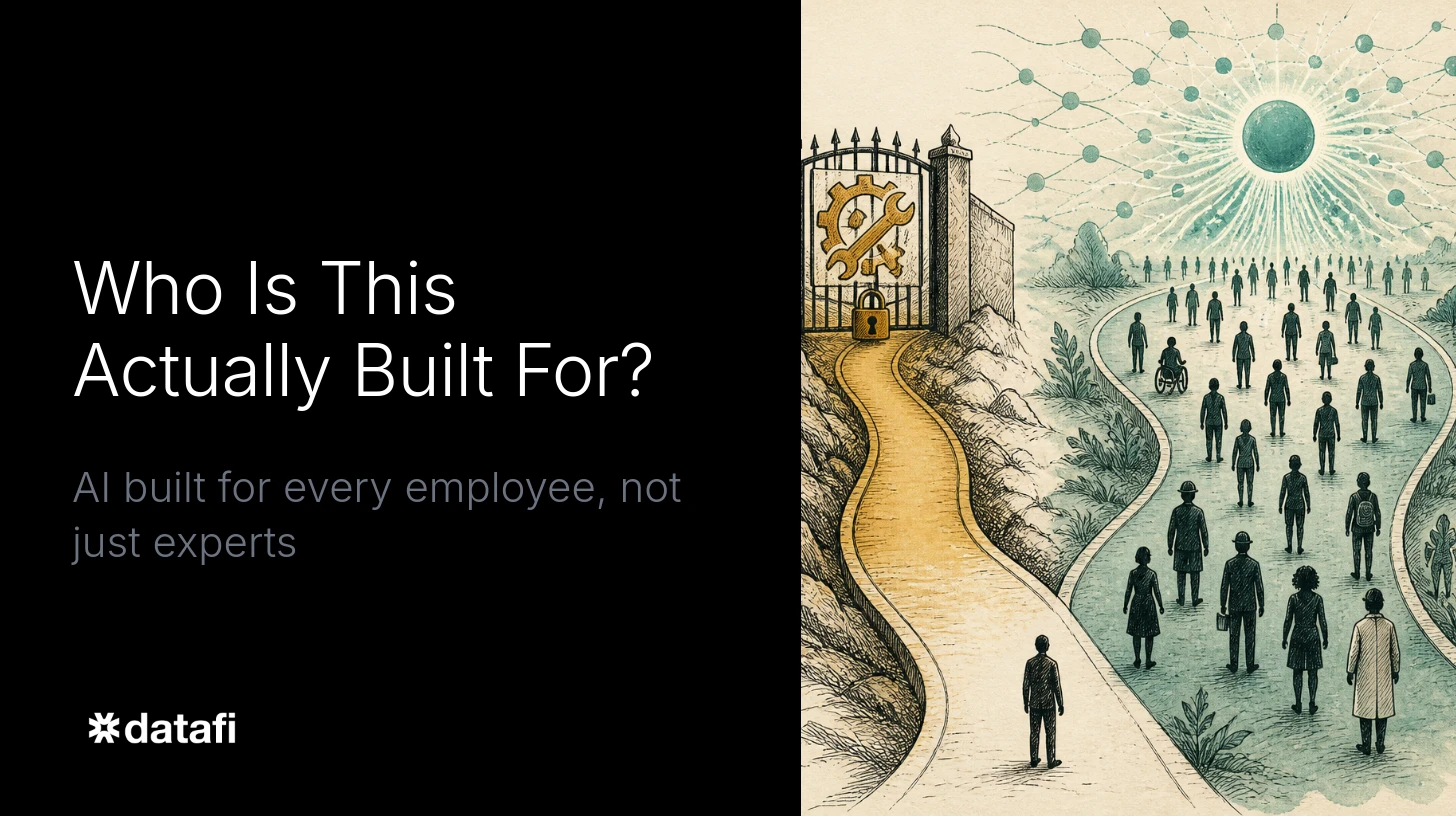
But the underlying design assumption remains: someone technically fluent in Salesforce is needed to build, configure, and maintain the intelligence layer. The business user who will ultimately benefit from the AI is the end point of a value chain that starts with a Salesforce-trained professional.
For organizations with strong Salesforce practices and certified administrators, this is manageable. For the majority of mid-market enterprises that have Salesforce in production but limited internal Salesforce expertise, it means the capability is perpetually gated behind a technical resource constraint.
“When the people who can use AI are not the people who understand the business, the AI serves the configuration, not the problem.”
The Configuration Bottleneck
There is a fundamental tension in platform-native AI that rarely surfaces in vendor conversations. The people with the deepest understanding of a business problem are almost never the people with the deepest understanding of the platform required to address it.
A claims director at an insurance company knows exactly which data patterns predict fraud escalation. She does not know how to configure an Agentforce topic, design an Apex trigger, or structure a flow that queries the right combination of Salesforce and external data to surface that pattern.
A logistics operations manager knows that dwell time at specific transfer points correlates with downstream delivery failure. He does not know how to build the Salesforce integration that would bring that data into Agentforce or how to design the agent that would act on it.
A CFO knows which combinations of metrics signal deteriorating customer economics before they show up in revenue. She does not know how to design the Salesforce pipeline that would assemble that view.
In each case, the business expertise and the platform expertise live in different people. The AI ends up configured to answer the questions that platform experts know how to ask, not the questions that business experts need answered. This is not a failure of intent. It is a structural consequence of designing AI as a feature of a technical platform rather than as a tool for the people who run the business.
What Datafi Chat Was Designed to Do
Datafi Chat was designed from a different premise. The interface was built for the claims director, the logistics manager, and the CFO. Not as a simplified version of a more powerful tool that exists behind it, but as the full expression of the platform’s intelligence delivered through an interface that requires no technical training to use effectively.
This is possible because the intelligence layer is separated from the interface layer in Datafi’s architecture. The complexity of connecting data sources, enforcing governance, assembling context, and executing workflows is handled by the platform beneath the surface. The user interacts with a natural language interface that has access to the complete business intelligence layer, not a subset of it configured by a Salesforce administrator.
The implications for organizational reach are significant. Datafi Chat is not designed for knowledge workers who already use Salesforce. It is designed for every employee who makes decisions that affect business outcomes: frontline staff, field operations teams, finance analysts, supply chain planners, clinical staff in healthcare, underwriters in insurance, and executives who need strategic intelligence rather than dashboard summaries.
“The organizations that will extract the most value from AI are those that make it accessible to everyone who understands the business, not just everyone who understands the platform.”
The Expertise Gap Has a Cost
Organizations often underestimate the compounding cost of the configuration bottleneck.
The direct cost is the time and expense of Salesforce-certified professionals required to build and maintain the AI layer. In a constrained talent market, this is not a theoretical concern. Salesforce administrator and developer capacity is a genuine constraint for most mid-market organizations.
The indirect cost is the opportunity gap. Every business question that the AI could answer but does not because no one has built the configuration to enable it represents a decision made with less information than was available. These gaps accumulate. Over months and years, the difference between an organization whose AI serves the full range of business intelligence needs and one whose AI serves only the questions that have been formally configured becomes a meaningful operational and competitive difference.
The deepest cost is cultural. When AI capability is gated behind technical expertise, the people closest to the business problems stop expecting AI to help them. They route around it. They build workarounds. They continue making decisions the way they always have, while the organization’s AI investment serves a narrowing circle of users who happen to be fluent in the platform.
The Vertical Dimension of Accessibility
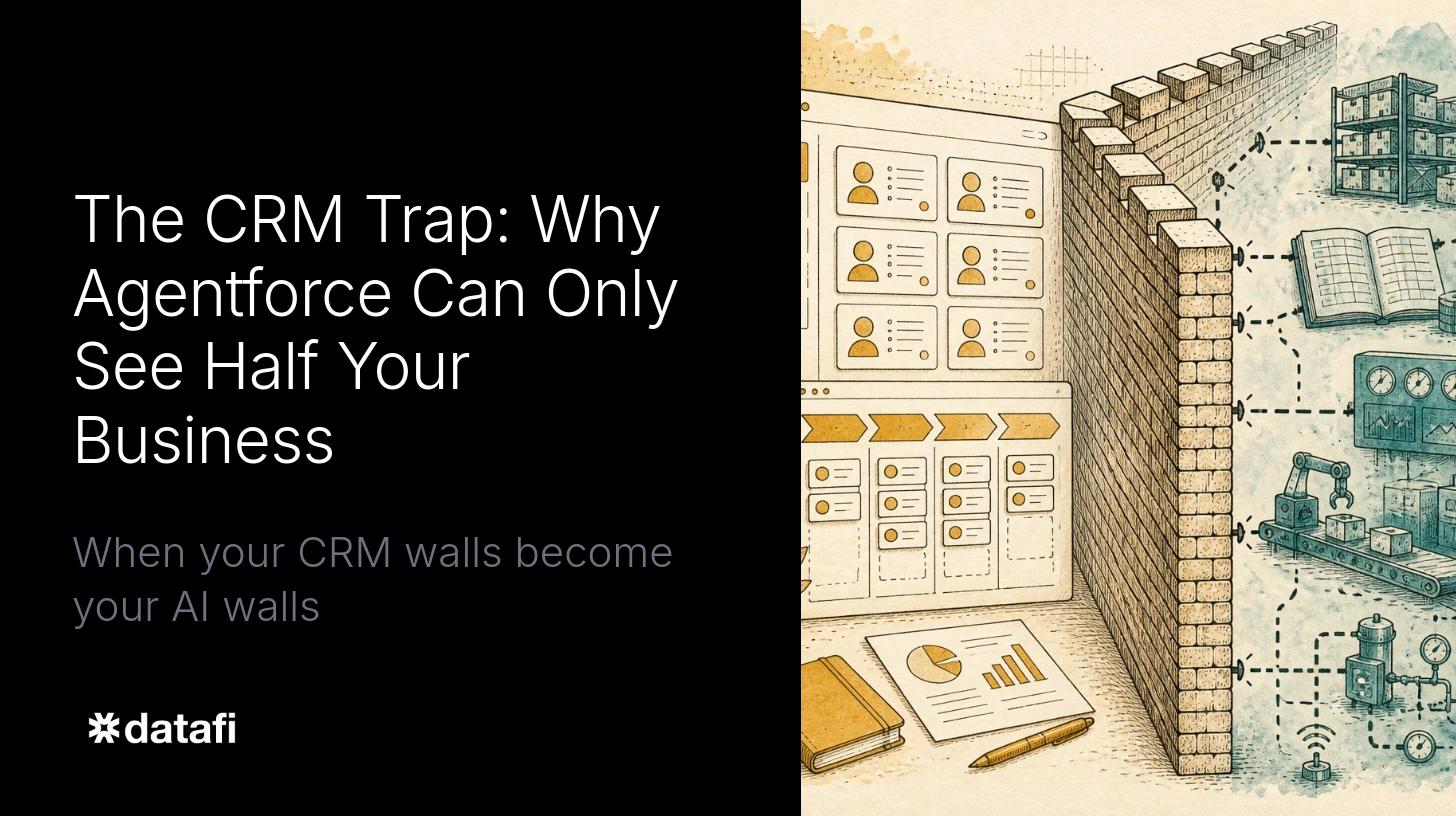
There is another dimension of the accessibility question that rarely surfaces in platform comparisons. Most enterprise AI tools are designed for horizontal functions: sales, service, marketing, IT. These are the functions that live inside CRM and collaboration platforms, and they are where platform-native AI concentrates its capability.
But the most valuable intelligence in many industries lives in vertical functions. In insurance, it is underwriting and claims. In manufacturing, it is production planning and quality management. In healthcare, it is clinical operations and patient flow. In logistics, it is network optimization and capacity planning. In financial services, it is risk exposure and portfolio management.
These functions rarely live in Salesforce. Their data does not live in Salesforce. And the people who run them are not looking for a better CRM interface. They are looking for AI that understands the specific operational reality of their industry and their role.
Datafi is designed to serve these functions because the platform connects to the data sources these functions depend on, regardless of whether those sources have any relationship to Salesforce. The intelligence layer speaks the language of the business function, not the language of the platform.
Accessibility as Competitive Advantage
The organizations that will develop the most durable AI advantage over the next several years are not those with the most sophisticated AI technology. They are those that make AI genuinely accessible to the people who understand the problems well enough to use it effectively.
Platform-native AI creates a ceiling on that accessibility. The ceiling is set by the intersection of what the platform knows and what technically trained users can configure. That is a meaningful space, but it is a fraction of the intelligence opportunity available to an enterprise.
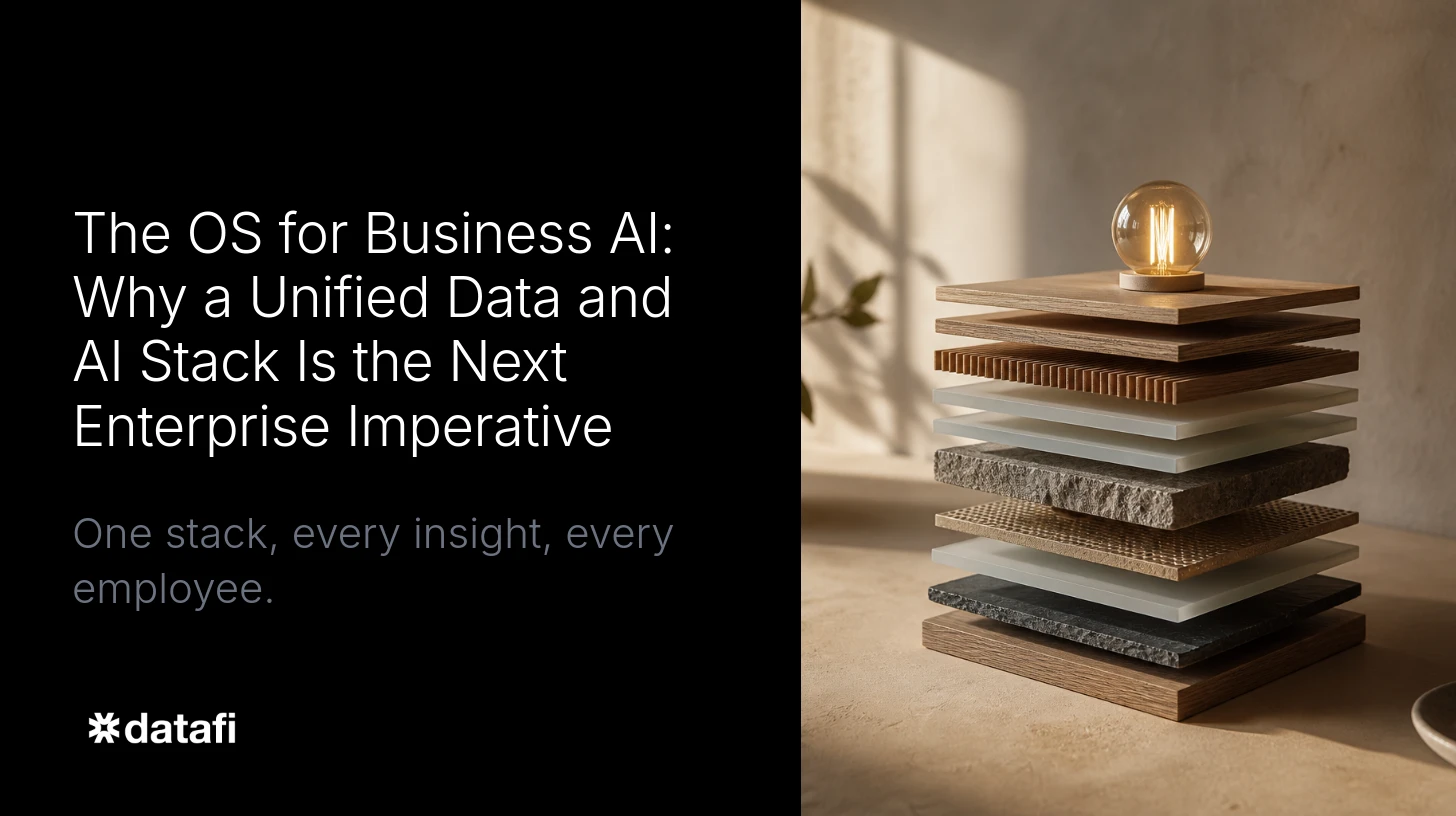
A business AI operating system removes that ceiling. When every employee can interact with AI that has access to the complete data reality of the business, in an interface designed for their role and their questions rather than for platform administrators, the intelligence opportunity becomes as broad as the organization itself.
That is the accessibility difference. And over time, it compounds.
“The question is not whether your AI is accessible. The question is whether it is accessible to the people who most need it.”
Datafi Chat delivers the full intelligence of the Business AI Operating System through an interface designed for every employee across every function, with no Salesforce expertise required. Learn more at datafi.co
Next in this series: The Real Total Cost of Intelligence: Agentforce Add-Ons vs. Datafi’s Unified Stack