



Build vs. Buy: The AI Platform Decision - Post 4 of 10
Ask ten enterprise technology leaders what they want from AI, and nine of them will describe some version of the same thing: AI that understands their business, operates inside their processes, and produces outcomes rather than outputs. AI that does not just surface an insight but acts on it. AI that changes the operation, not just the analysis.
Then ask those same ten leaders what their organization has actually deployed.
The answers are different. They describe summarization tools and chatbots. Report generators and search assistants. Systems that make analysts more productive, knowledge workers marginally faster, and executives slightly better informed. Systems that answer questions well.
The gap between what organizations want from AI and what they have actually deployed is not a gap in AI capability. The models available today are capable of far more than the average enterprise deployment asks of them. It is a gap in architectural intention — and it is the gap that determines whether AI in your organization is a productivity investment or a transformative one.
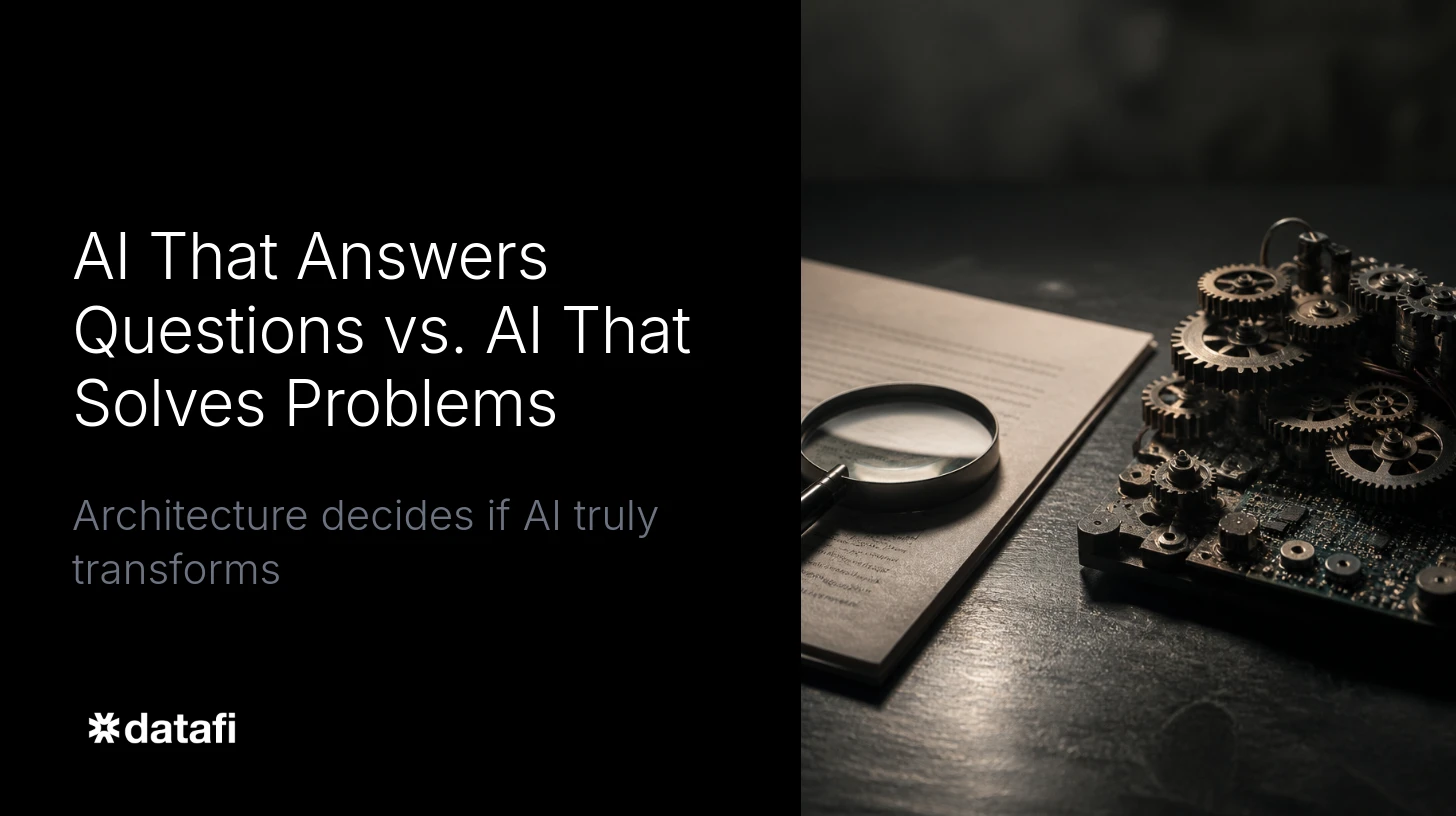
The gap between AI that answers questions and AI that solves problems is not a model problem. It is an architecture problem, and the decisions that determine which one you build are made early and are hard to reverse.
What “answering questions” means in practice
It is worth being precise about what AI that answers questions does, because it is genuinely useful and the argument is not that it is worthless.
An AI system built to answer questions produces outputs: summaries, analyses, recommendations, drafted documents, synthesized reports. It accelerates the work of making information useful. A legal analyst who previously spent four hours reviewing a contract now spends forty minutes. A supply chain manager who previously pulled data from five systems to assess inventory coverage now asks a question and receives a structured answer in seconds. These are real productivity gains. They are not nothing.
But trace what happens after the output is produced, and a consistent pattern emerges. The analyst reads the AI-generated contract summary and decides which clauses require negotiation. The supply chain manager reviews the inventory coverage report and determines which exceptions require action. The AI produced the analysis. A human read it, interpreted it, exercised judgment about what it meant for their situation, identified the right system or person to act with, and executed the action manually.
At every consequential juncture — the decision, the workflow step, the business state change — a human was still required. The AI accelerated the time between “question asked” and “answer in hand.” It did not change what happens between “answer in hand” and “problem resolved.”
That is not a criticism of those AI systems. It is a description of what they were designed to do. The issue arises when organizations deploy question-answering AI expecting transformative outcomes, because transformative outcomes require something architecturally different.
What “solving problems” requires
Consider a specific scenario: a flagged inventory exception in a distribution operation.
A shipment of high-velocity product has been delayed at a regional distribution center. Coverage for two downstream retail clusters will fall below the replenishment threshold in approximately seventy-two hours. The exception has been logged in the inventory management system.
Here is what an AI system designed to answer questions does with this problem.
It detects the exception. It generates a summary: the affected SKUs, the coverage shortfall, the downstream locations at risk, the estimated impact on availability. It surfaces this in a dashboard or sends an alert to the inventory planning team. The planning team reviews the alert, evaluates the options, contacts alternative suppliers or redirects inbound stock from another distribution center, updates the purchase order or transfer order in the relevant system, and notifies the affected retail clusters. Total resolution time: somewhere between two hours and two days, depending on the planner’s workload, the availability of supplier contacts, and the complexity of the redistribution logic.
Here is what an AI system designed to solve problems does.
It detects the same exception. It assesses the shortfall against the business’s contextual understanding of those SKUs — their velocity profile, their margin contribution, their substitutability, the promotional calendar for the affected locations. It evaluates available resolution paths: the open purchase order that could be expedited, the transfer stock at a neighboring distribution center, the alternative supplier with current inventory. It checks each option against governance rules — authorization thresholds, approved supplier lists, transfer cost limits — and identifies the resolution path that falls within autonomous action boundaries. It executes that resolution: triggers the expedite request, raises the transfer order, sends confirmation to the affected locations, and logs the action with a complete audit trail.
If the resolution falls outside autonomous action boundaries — the cost exceeds the authorization threshold, the supplier is not on the approved list, the situation requires judgment that governance has designated as human-required — it escalates with full context, a recommended resolution, and everything the human decision-maker needs to act immediately.
Total resolution time: minutes for cases within autonomous boundaries. The human decision-maker’s time is reserved for cases that genuinely require it.
The difference between these two scenarios is not a difference in AI model capability. Both systems might use the same underlying language model. The difference is in what surrounds that model — the contextual layer that gives the AI genuine understanding of those SKUs, those locations, and those suppliers in the context of this business; the governance layer that defines what autonomous action is permissible; the agent runtime that executes multi-step resolution processes rather than generating multi-step resolution summaries; and the data infrastructure that provides the current, accurate operational picture the AI needs to act with confidence.
Why most AI builds are architected for the wrong outcome
The three preceding posts in this series examined the financial cost of building enterprise AI internally, the organizational patterns that cause those builds to stall, and the seven technical layers a production platform requires. Viewed through the lens of this post’s distinction, those arguments converge on a single observation.
Most internal AI builds are scoped, designed, and funded to produce question-answering systems. The budget slide includes a data connector, an LLM integration, and a user interface — the architecture of a system designed to surface information. The pilot success criteria are about output quality: does the AI produce accurate summaries, relevant recommendations, coherent responses? The organizational patterns that cause stalls — insight without action foremost among them — are the symptoms of deploying a question-answering system in a context that needed a problem-solving one.
The missing layers identified in Post 3 are not missing because they were overlooked. They are missing because they are not required for a question-answering system. A contextual layer is not necessary if the AI is only going to generate text about what it finds in the data — it only becomes mandatory when the AI needs to understand what that data means in order to act on it correctly. Embedded governance is not necessary if every AI output is reviewed by a human before anything happens — it only becomes mandatory when the AI is taking actions that need to be bounded by policy without requiring human review of each transaction. The agent runtime is not necessary if the AI’s job ends at the insight — it only becomes necessary when the AI is responsible for completing the process.
The architectural choices that determine whether an AI system answers questions or solves problems are made early, and they are hard to reverse. Organizations that build for question-answering do not naturally evolve toward problem-solving capability. They accumulate a question-answering system with increasing layers of complexity, and the architectural gap between what they have and what they need grows wider over time rather than narrower.
The design choice that determines which AI you build
The distinction between AI that answers questions and AI that solves problems is not made when the model is selected or when the user interface is designed. It is made in the architecture decisions that precede both.
Specifically, it is made in three places.
The first is the contextual layer. An AI system designed to answer questions needs access to data. An AI system designed to solve problems needs understanding of the business that data represents — the entity relationships, the operational definitions, the domain vocabulary, the rules and constraints that determine what a correct action looks like in context. Building that contextual layer, or deploying on a platform that already has it, is the foundational decision that determines what the AI is capable of doing.
The second is the governance architecture. Autonomous AI action requires boundaries — not as a constraint on capability, but as the condition that makes autonomous action organizationally safe. When governance is embedded in the platform at the architecture level, AI can act autonomously within defined boundaries and escalate when it cannot. When governance is an afterthought or a human review process, every AI output requires human interpretation before action, and the gap between insight and resolution remains.
The third is the agent runtime. Answering a question is a single-step operation. Solving a problem is a multi-step process: assess the situation, identify the options, evaluate them against constraints, select the appropriate resolution, execute it, confirm the outcome, log the action. The runtime infrastructure for that sequence — the orchestration layer, the tool use framework, the state management across steps, the escalation logic — is what converts an AI that generates good analysis into an AI that completes business processes.
Datafi was designed from the start around the second category. The Business AI Operating System is not a productivity layer applied to existing tools. It is vertically integrated infrastructure built specifically for AI that needs to understand a business deeply enough to operate inside it — autonomously, accurately, and within the governance boundaries that make autonomous operation something an organization can trust.
The contextual layer is not an optional module. It is load-bearing architecture. Sentinel, Datafi’s governance framework, is not a compliance add-on. It is the mechanism that makes autonomous action permissible. The Orchestrate runtime is not a chatbot with memory. It is the execution environment for AI agents that complete multi-step business processes rather than generate multi-step business summaries.
The question worth asking before the next AI investment
The organizations that are deploying AI with measurable operational impact right now are not doing it through better models or more ambitious prompting. They are doing it because they made a different architectural choice at the outset — a choice to build for action rather than insight, for problem resolution rather than question response, for an AI that changes what the business does rather than one that changes how quickly people learn what is happening.
Before the next AI initiative is scoped, before the next budget slide is built, the most productive question an organization can ask is not “what should our AI be able to tell us?” It is: “what should our AI be able to do?”
The answers to those two questions produce fundamentally different architectures. And the architecture, not the model, is what determines whether AI in your organization earns the word transformation.
Post 5 in this series moves from philosophy to decision: a practical scoring framework for mid-enterprise organizations evaluating whether to build an AI platform internally or deploy on one that already exists. The criteria, the weights, and the honest conditions under which building wins.
Datafi is a Business AI Operating System designed for mid-enterprise organizations that need the full power of an integrated AI platform without the cost, risk, and timeline of building one. Learn more at datafi.co.
Series: Build vs. Buy - The AI Platform Decision
Part 1 - Awareness: Framing The Question
Post 1: The Hidden Cost of Building Your Own Enterprise AI Platform
Post 2: Why Most Enterprise AI Projects Stall Before They Scale
Post 3: The Seven Layers Most AI Builders Forget to Budget For
Post 4: AI That Answers Questions vs. AI That Solves Problems
Part 2 - Consideration: Evaluating The Tradeoffs
Post 5: Build vs. Buy - A Scoring Framework for Mid-Enterprise AI Decisions
Post 6: What Palantir’s Deployment Model Teaches Us About the Wrong Way to Scale AI
Post 7: Governance Is Not a Feature - It Is the Foundation
Post 8: The Contextual Layer - Why Your Internal Team Cannot Build the Moat That Matters
Part 3 - Decision: The Alternative Path
Post 9: From Pilot to Production in 90 Days - What “Buy” Actually Looks Like With Datafi
Post 10: The AI Operating System - Why the Future of Enterprise AI Is a Platform, Not a Project