


Why the next wave of value belongs to organizations that redesign how work gets done, not just make it faster
The first wave of enterprise AI adoption has been almost entirely about efficiency. Draft this email faster. Summarize this document quicker. Answer this question sooner. The productivity gains are real, and they feel good. But a recent McKinsey Global Institute conversation with Senior Partner Tanguy Catlin lands on a question every leader should be sitting with right now: what happens when everyone else, using the same tools, is experiencing the same improvements? Where does competitive advantage come from then?
The answer McKinsey arrives at is uncomfortable for anyone who has framed their AI strategy around productivity. When a general purpose technology becomes ubiquitous, the surplus value it creates does not stay with the companies deploying it. It flows to customers and to the providers who help implement it. Every competitor has access to the same models. Every competitor pursues the same efficiencies. And so, as Catlin puts it, very little general value accrues to any single company. The productivity trap is that the thing everyone can do easily is, almost by definition, not a source of advantage.
The real AI advantage does not come from access to a model, because everyone has that. It comes from the architecture around the model: full business context, a complete and governed data ecosystem, and the ability to act autonomously within safe boundaries.
At Datafi, this is the exact divide we built our company to address. The difference is not between companies that adopt AI and companies that do not. It is between AI systems that answer questions when asked and AI systems that understand the business deeply enough to solve its hardest problems. That distinction is where the real advantage lives, and it is worth walking through carefully, because it changes what a leader should actually be building.
Beyond productivity: the instinct to fix, not to redesign
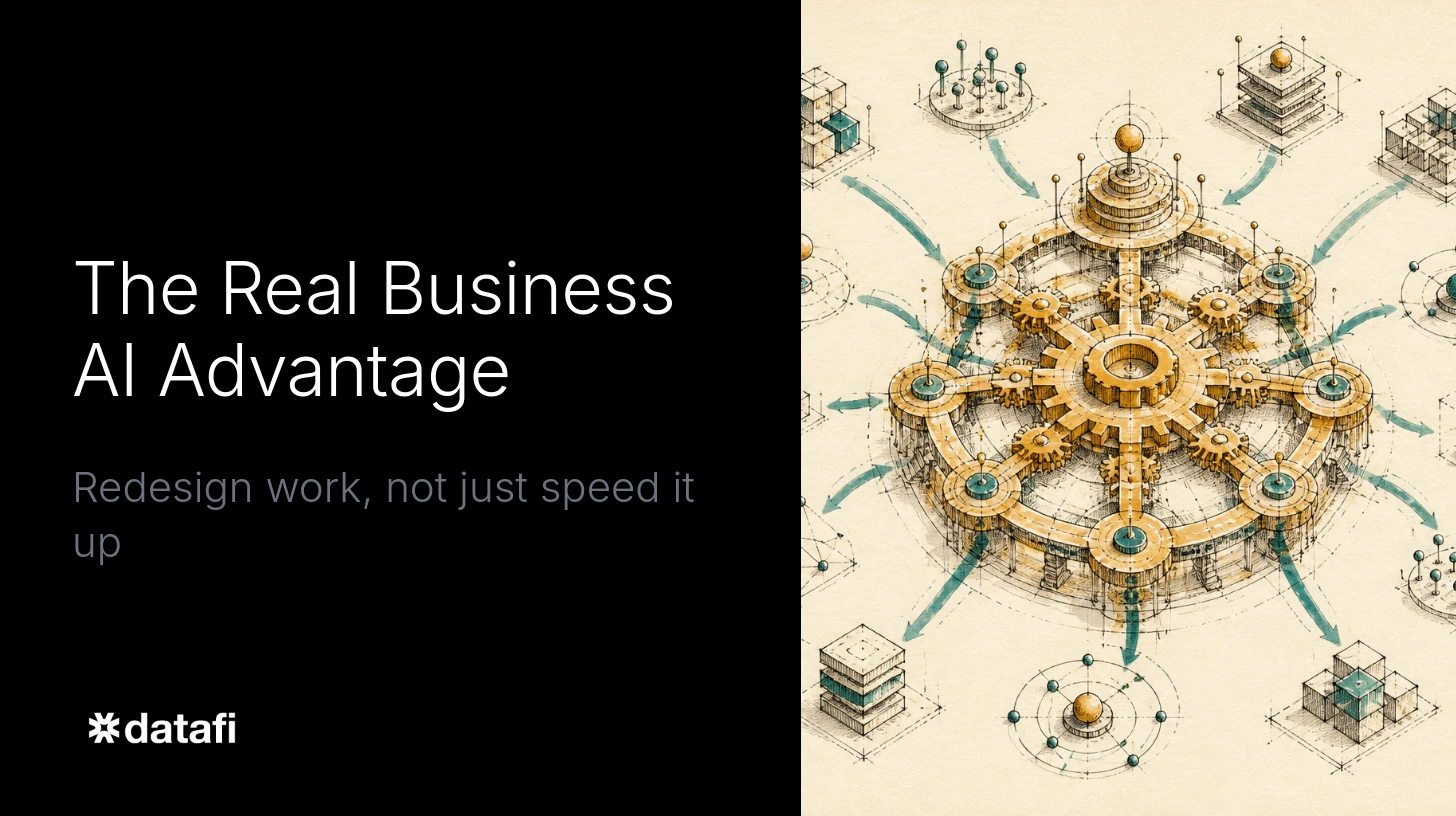
Catlin describes the natural leadership reflex with precision. You get a new technology, and your instinct is to deploy it on top of your existing processes. Same work, done better, faster, cheaper. It is the wrong instinct, and it has been the wrong instinct through every major technology shift, from electricity to mobile. The value does not come from layering the new tool onto the old process. It comes from pausing to ask a harder question: how do I redesign the process itself, and what I offer to the customer, now that this technology exists?
This is the heart of what we mean when we say Datafi is an operating system for business AI rather than another AI tool. A tool sits on top of a process and makes one step of it faster. An operating system changes what the process can be. The moment an organization stops asking AI to speed up the analysis a person was already doing, and starts asking AI to run the analysis, reason across the full context, and take the next action, the shape of the work changes. The friction that defined the old process, the toggling between systems, the waiting on the data team, the manual handoffs, simply falls away.
McKinsey frames much of the coming disruption as the removal of friction. Whole industries are built on it. Customers compare options, gather information, navigate incompatible systems, and absorb coordination costs that exist only because the alternative used to be impossible. AI removes that friction, and Catlin’s counsel is blunt: presume that someone, somewhere, will use the technology to eliminate the friction in your customer’s experience. Ask whether you benefit from that change. If the answer is no, you had better be the one doing the disrupting.
The friction is inside the enterprise, too
Most conversations about AI removing friction focus on the customer. But the same dynamic is playing out inside the walls of every organization, and this is where Datafi customers see the most immediate transformation. The friction that slows an enterprise down is data friction. Information exists somewhere, but reaching it requires specialized expertise, a ticket to the data team, or the patience to toggle across a dozen platforms and reconcile incompatible formats. Access to information should not require any of that. Every person in an organization, from the warehouse floor to the executive suite, deserves direct, governed access to the data that shapes their work.
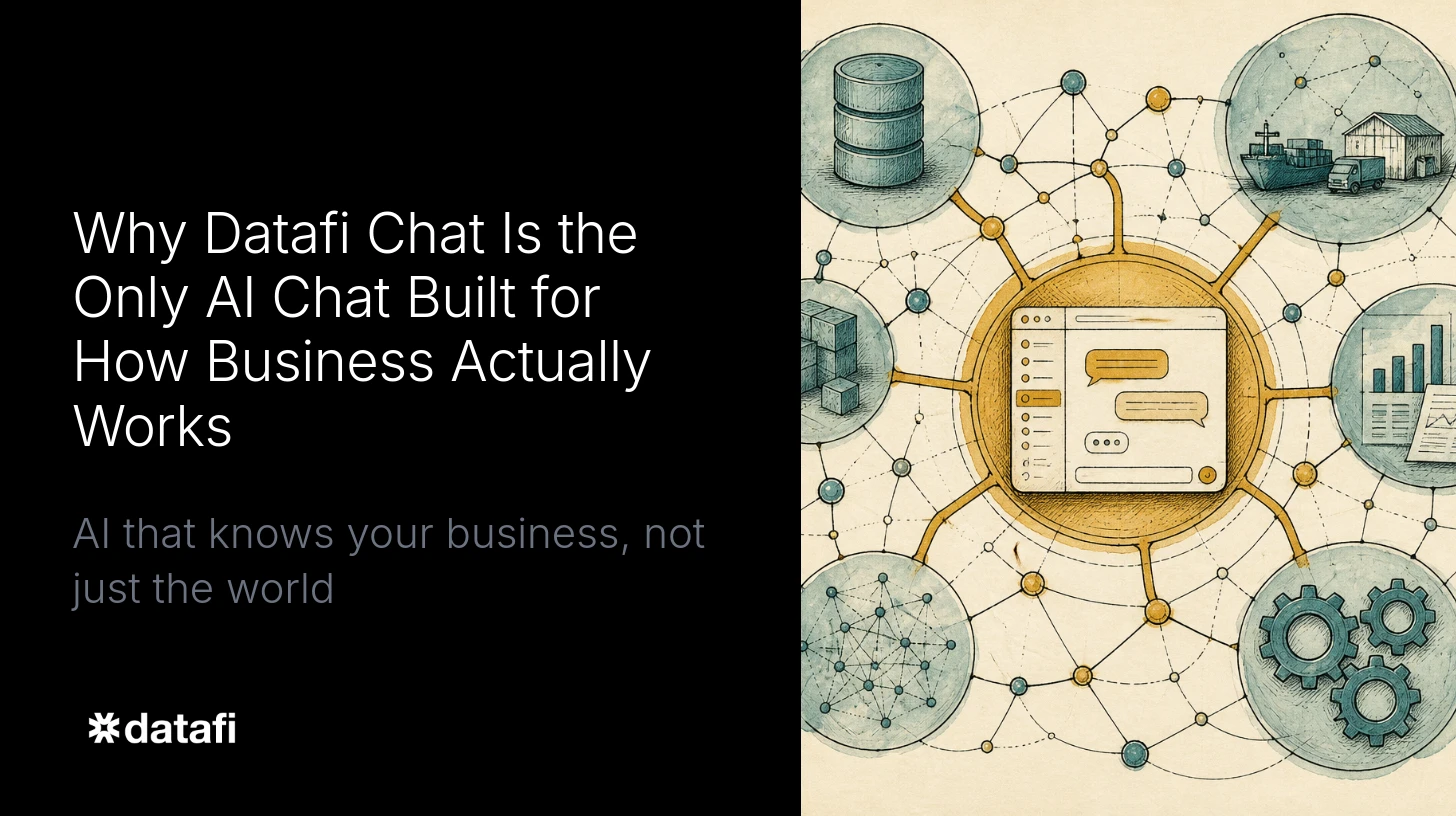
This is why we built Datafi around a vertically integrated data and AI stack rather than a point solution. In enterprise AI infrastructure, vertical integration has a precise meaning: the components required to deliver an outcome, data connectivity, access governance, AI reasoning, and the user experience, are designed together rather than assembled from separate products. A retrieval tool answers questions from a bounded set of documents. It is a very good library. But the enterprise does not need a better library. It needs a system that reasons across the full data ecosystem, wherever that data lives, whether it sits in Snowflake, Salesforce, Sharepoint, email, or an operational system of record, structured or unstructured. When AI is given the complete operational reality of the business, it stops answering questions and starts solving problems.
From answering questions to solving problems
The distinction between answering and solving is not rhetorical. It is architectural, and it maps directly onto what McKinsey identifies as the emerging sources of competitive advantage.
Catlin points to a coming world of agentic systems, where organizations pivot from being knowledge based to being outcome based. You stop tasking people with steps and start tasking agents with outcomes. To deliver those outcomes, you combine human judgment and AI agents into a workflow that runs end to end. This is precisely the shift we see in our own customers. They are no longer content to use AI for drafting or summarizing. They want AI in the critical thinking roles, the analytical work, the workflow automation that used to require a chain of people and a week of coordination.
That ambition only becomes safe and real when the AI has three things. It needs the full context of the business. It needs access to the complete data ecosystem. And it needs to function autonomously within defined boundaries so it can learn and act, not just respond. These three requirements are why a contextual layer matters more than any single model or data lake. The contextual layer is the intelligence backbone. It is what lets an agent understand not just the data, but how the business actually runs, so it can reason toward an outcome rather than retrieve a fact. LLMs, on their own, are strangers to your business. Give them the full context, the ecosystem, and a governed mandate to act, and they become something closer to a colleague.
McKinsey reinforces this from the value side. AI makes predictions cheap, so predictions will be everywhere. But cheap predictions raise the value of two scarce things: proprietary data and human judgment. Quality data becomes a genuine competitive moat, because the prediction is only as good as the data behind it, and the data you keep for yourself is the data no competitor can replicate. Judgment becomes the scarce human skill, because when you are bombarded with predictions, someone has to choose wisely among them and place the right value behind outcomes. An operating system for business AI is what lets an organization act on both. It protects and activates proprietary data, and it keeps humans in control of the decisions that matter, with the AI doing the heavy lifting underneath.
Governance is not a feature. It is the prerequisite.
There is a reason so many enterprise AI initiatives stall after an impressive proof of concept. The demo answered a bounded question beautifully. Then the questions that mattered started arriving, the ones that required the AI to touch customer records, financial data, or regulated information, and the legal and compliance teams said no. They were right to. Organizations do not extend AI into sensitive operational data unless they have genuine confidence in the control layer.
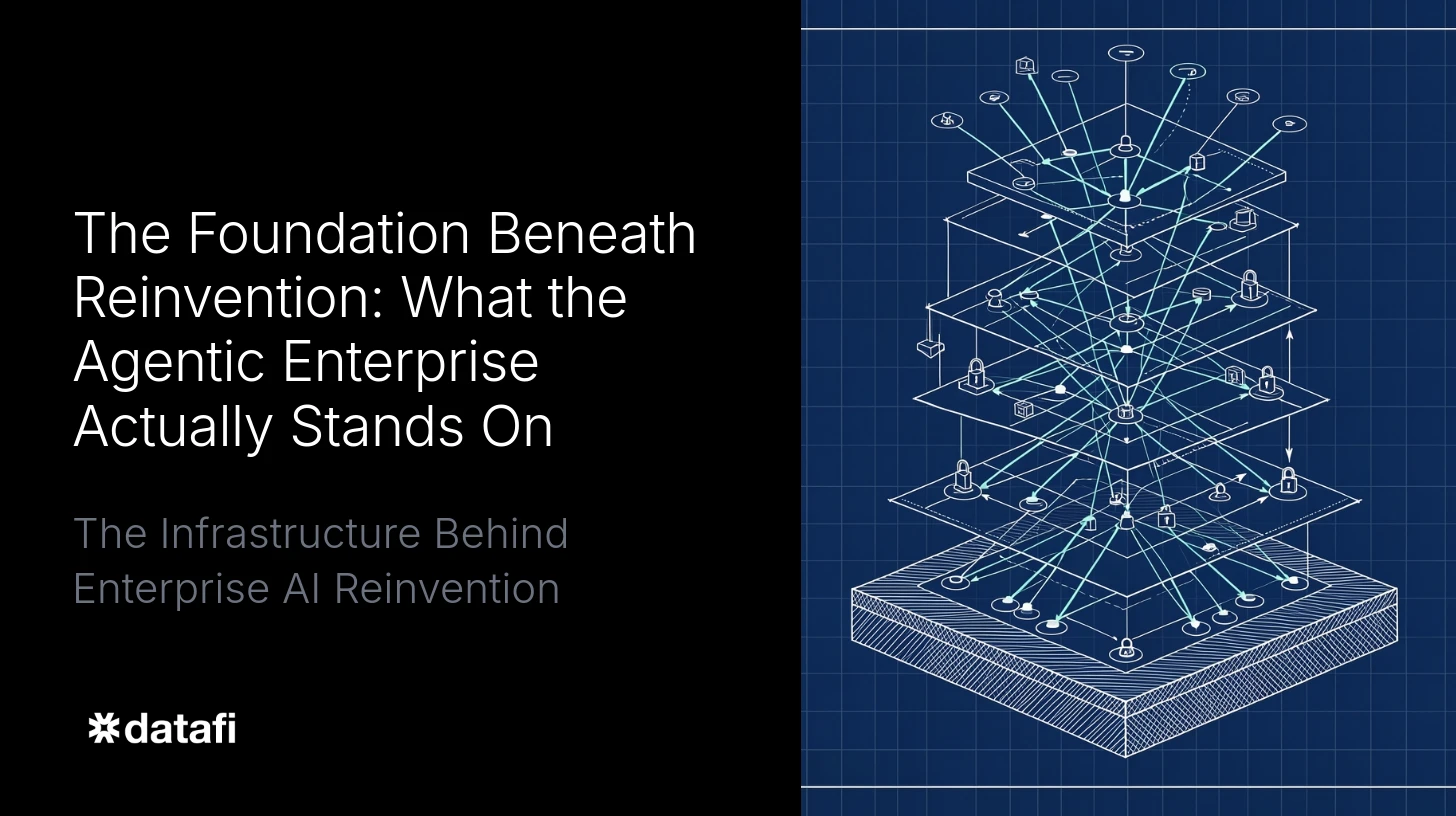
This is where the case for a unified stack becomes undeniable, and it aligns with a point Catlin makes about how competitive advantage compounds. When governance is applied only at the moment data is ingested, it assumes the boundary of permissible information is static and well understood. Enterprise data environments are neither. That assumption creates real compliance exposure the instant AI access expands. Datafi enforces policy dynamically, at the point of use, so every agent inherits access policies, every runtime action passes through risk controls before it executes, and every decision leaves an immutable audit trail. Governance, security, and observability are not bolted on after deployment. They are woven into every agent, every workflow, every interaction.
The strategic payoff is what McKinsey calls the compounding of advantage. When each new use case builds on the same trusted foundation, with no new integration and no new control gap, an organization can start with one high impact workflow and extend it across the enterprise without rebuilding. This is exactly the scaling logic McKinsey draws from its own research: find a domain, do not deploy the technology on top of existing processes, redesign those processes to capture value, and do it in a way that scales to other domains over time. A patchwork of point solutions cannot compose like this. Each one carries its own access model, its own audit trail, its own security posture, and its own gap. An operating system compounds. A collection of tools accumulates risk.
The metabolic rate of learning
Ask Catlin what will separate the winners from the losers five years out, and he does not name data or distribution alone, though both matter. He names something harder to copy: the metabolic rate of learning, the ability to build a self reinforcing system where technology lets you experiment better, learn faster, and pivot before your competitors even see the change coming. Advancement, he notes, will never again be as slow as it is today. Winning the future means having an operating model adaptable enough to keep up.
This reframes what an AI investment is actually for. It is not primarily a cost reduction. It is the infrastructure for organizational learning at speed. An organization that can stand up a new agent, connect it to governed data, test it against a real workflow, measure the outcome, and refine it, all in weeks rather than quarters, learns at a rate its competitors cannot match. That capacity to experiment safely and continuously is the operating model advantage. It is also, not coincidentally, what a unified data and AI operating system is designed to deliver: not a single clever agent, but the ability to keep producing new ones on a foundation that already understands the business and already enforces the rules.
McKinsey is candid that the hardest part of this is not the technology. It is the organizational change. Give employees AI tools without training them, and outcomes get worse, not better. The pivot from a knowledge based to an outcome based organization is a human challenge, requiring a workforce confident in the value of change, upskilled to pursue it, and led by people who reward experimentation rather than punish failure. No platform solves that for you. But the right platform lowers the barrier dramatically. When the AI meets people where they already work, in a chat interface designed for non technical users, speaking business language rather than query syntax, the upskilling curve flattens. Adoption stops being a fight. The domain expert who knows the process, the analyst, the operator on the floor, becomes the person building and directing the AI, because the system was designed for them, not for a data scientist.
The advantage is architectural
The through line from McKinsey’s research to what we build at Datafi is this: the real AI advantage is not a faster version of the work you already do. It is a redesigned version of what your organization is capable of. That advantage does not come from access to a model, because everyone has that. It comes from the architecture around the model: the full business context, the complete and governed data ecosystem, the ability to act autonomously within safe boundaries, and an experience that puts this capability in the hands of every employee.
My own experience working across data and AI has convinced me that this is the part most organizations underestimate. The excitement lands on the model. The value lands on everything around it. AI that is merely enabled to answer questions will make your people modestly more productive, along with everyone else’s. AI that is enabled to action data, to solve problems rather than just respond to prompts, is what transforms outcomes. That is the difference between a curiosity and operational infrastructure. It is the difference between reacting to problems and preventing them.
The organizations that win the next wave will be the ones that stop asking AI to do the old work faster and start asking it to do work that was never possible before.
The organizations that win the next wave will be the ones that stop asking AI to do the old work faster and start asking it to do work that was never possible before. That shift requires a foundation. Building it is the real advantage.
Datafi is an applied AI software company building the vertically integrated data and AI operating system for the enterprise. To learn how Datafi enables governed, agentic AI across your complete data ecosystem, visit datafi.co.