


Ask ten enterprise software vendors whether their product is an agent, and ten will say yes. The word has become the default label for anything that involves a language model and a text box. A search assistant is an agent. A document summarizer is an agent. A chatbot that retrieves a policy and rephrases it in friendly prose is, apparently, also an agent. When a word describes everything, it describes nothing, and the enterprises trying to make serious investment decisions are the ones who pay for the confusion.
A real agent changes the state of your business, within policy, without a human doing the real work afterward. Everything else, no matter how conversational or impressive in a demo, is a chatbot with better marketing.
At Datafi, we give enterprise teams the ability to access and action their entire data ecosystem through governed autonomous agents, natural language chat, and workflow execution built into one integrated stack. That is what an agent is: a system that changes the state of your business, within policy, without a human doing the real work afterward. Everything else is a chatbot with better marketing.
The premise worth questioning
It is worth steelmanning the loose usage before challenging it, because the people using the word this way are not being careless for its own sake. There is a reasonable argument that any system exhibiting goal-directed behavior in response to a prompt deserves the label. A chatbot that decides which knowledge base to query, chooses how to phrase an answer, and adapts to follow-up questions is, in a narrow technical sense, doing something more than a static lookup. It is making choices. And in the academic lineage of the term, an agent is simply something that perceives an environment and acts upon it. By that definition, a well-built conversational assistant clears the bar.
That definition is not wrong. It is just not useful to a business leader deciding where to put a transformation budget. The academic framing was built to describe a spectrum of software behaviors, not to help a Chief Operating Officer distinguish a tool that answers questions from a system that runs a workflow. When the term collapses that distinction, it stops carrying the one piece of information the buyer actually needs.
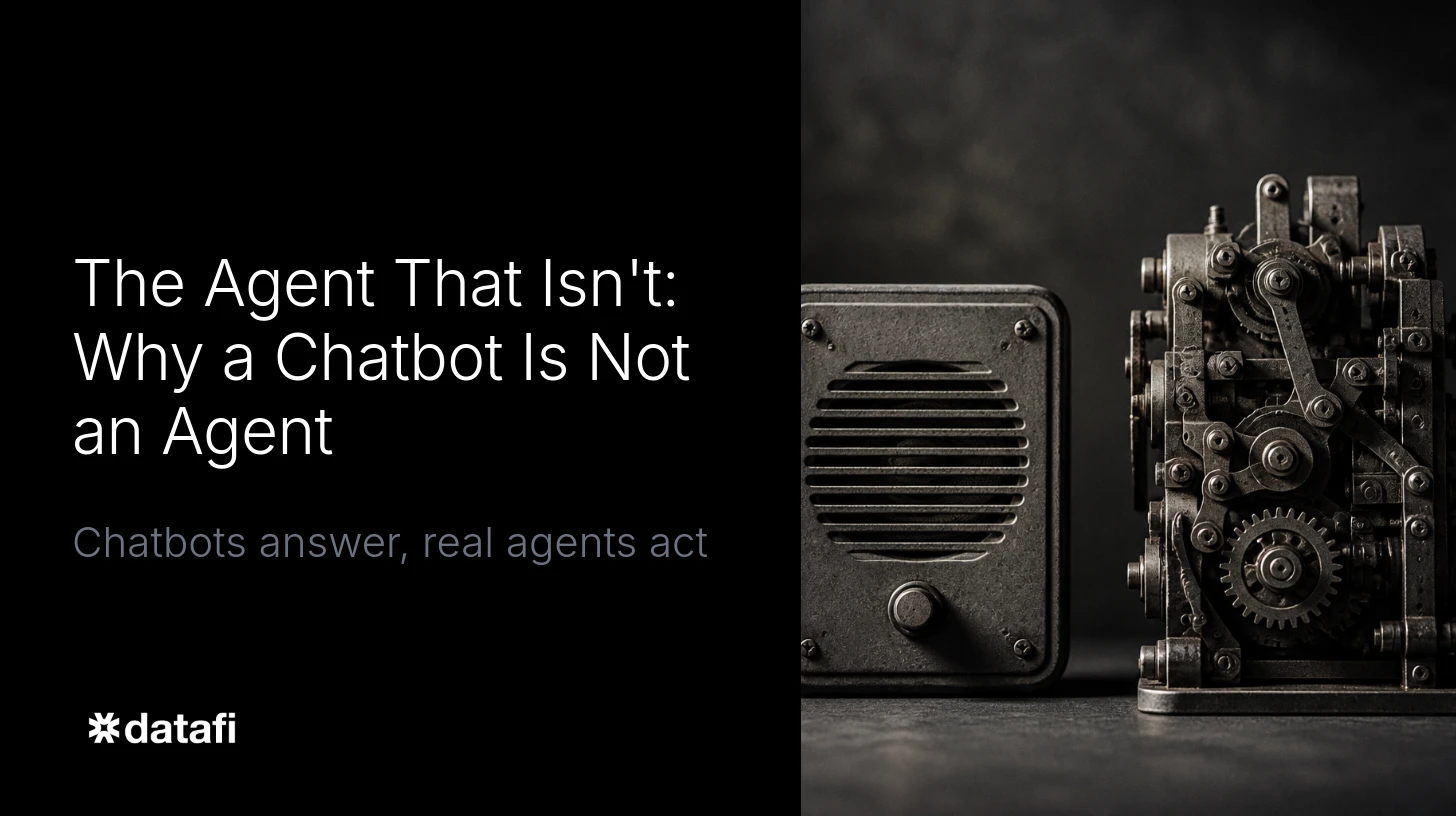
Here is the distinction that matters in practice. A chatbot answers. An agent acts. A chatbot’s output is words on a screen that a human must then read, judge, and act on. An agent’s output is a change in the operational state of the business: a record updated, a work order created, a shipment rerouted, a claim escalated, a decision executed within policy. The chatbot ends its work at the moment it produces language. The agent begins its work there.
Four things a real agent does that a chatbot cannot
The gap is not a matter of degree. It is architectural, and it shows up along four dimensions.
The first is acting on the world, not describing it. A chatbot that tells a procurement director which supplier has the best lead time has produced a helpful sentence. An agent that checks live inventory, confirms the contract terms, generates the purchase order, and routes it for approval has changed something. The first requires a human to do all the actual work after reading the answer. The second does the work. This is the difference between a technology that makes people slightly faster at their existing jobs and one that removes the job from their plate entirely.
The second is operating over the live data ecosystem, not a snapshot. A chatbot answers from whatever it was handed at query time, usually a curated document set or an indexed knowledge base that reflects the world as it was when it was last refreshed. An agent operating in a real workflow must reason over the current state of the business: the inventory level right now, the technician’s schedule right now, the claim status right now. A recommendation built on stale data is not merely less useful than one built on live data. In an operational role it is a liability, because the human who acts on it assumes it reflects reality.
The third is governed autonomy, not unbounded suggestion. A chatbot that suggests an action carries no risk, because a human is always the one who decides whether to take it. An agent that takes actions must be bounded by the same policy and compliance framework that governs the humans doing the same work. This is not a constraint that limits what an agent can be. It is the precondition for letting an agent act at all. Autonomy without governance is not autonomy; it is an uncontrolled system that no serious enterprise will deploy in a role that matters. The reason so many “agents” never leave the pilot stage is that they were built to suggest, and suggestion does not require governance. The moment you ask them to act, the missing governance becomes the wall they cannot climb.
The fourth is carrying a multi-step task to completion, not automating the easy first step. The workflows where AI creates real value are chains of reasoning, data access, decision, and action that unfold across multiple systems. A chatbot can reliably execute step one, the part that involves producing language, and then hand off to a human for steps two through five. That is not solving the workflow. It is automating the easiest part of it and calling the result an agent. Genuine agentic capability means the system carries the task through to the end, escalating to a human only when the situation falls outside the boundaries it is authorized to act within.
A system that requires a human at every consequential decision point has not achieved autonomy. It has automated the first, easiest step and left the highest-value, highest-risk decisions exactly where they were. Most enterprise “agents” are chatbots wearing the word.
Why the distinction is expensive to get wrong
This is not a debate about terminology for its own sake. The conflation has real consequences for how organizations invest.
When an enterprise buys a “chatbot that is really an agent,” it budgets and staffs for transformation and receives a productivity tool. The demonstrations are impressive because chatbots demonstrate beautifully. The failure comes later, in production, when the tool that answered questions on a whiteboard cannot execute the workflow it was purchased to run. This is why the industry statistics on agentic AI are so consistently disappointing. A large majority of enterprises have experimented with agents, and only a small fraction have scaled them into anything that delivers durable value. The gap is not caused by weak models. It is caused by buying chatbots and expecting agents.
The tell is almost always the same. The system was built to produce language, and the architecture underneath it was designed for retrieval and response, not for action, governance, and live operational integration. You cannot bolt those onto a chatbot after the fact. They have to be there from the foundation.
What actually makes an agent an agent
At Datafi, we see this every time we talk to a customer who wants to move AI beyond the help-desk. They do not want another assistant that answers questions. They want AI in the critical-thinking, analytical, and workflow-automation roles where the hard business problems live. And what that requires is not a better chatbot. It is a different foundation.
An agent that acts on the world needs access to the complete data ecosystem, not a curated subset, integrated as it actually exists rather than as a formal model requires it to be represented. It needs a contextual layer that tells the model what the data means in the specific context of the business: how entities relate, what the operational constraints are, what the downstream consequences of a decision look like. It needs governance and policy enforced at the data access layer, so that every action the agent takes is bounded by the same compliance framework that governs the humans doing the same work, without a separate configuration for every new workflow. And it needs a Chat UI designed for the non-technical business user, because the operations manager who has to trust and occasionally overrule the agent needs to understand it in the language of their domain, not the language of data engineering.
Those requirements are not independently optional. They are interdependent, which is why a vertically integrated data and AI stack, one where data access, context, governance, workflow execution, and the user interface are designed together, is the prerequisite for AI that operates in broad roles across the enterprise. A Chat UI without a contextual layer is a toy. A contextual layer without live data access is a fiction. An agent without governance is a liability. The integration is what makes the agent real.
This is the standard the enterprise should hold. Not “does it respond conversationally,” but “can it change the state of my business, correctly, within policy, without a human doing the real work afterward.” By that standard, most of what the market calls an agent today is a chatbot. And the organizations that learn to tell the difference are the ones that will deploy AI that solves problems rather than merely answers questions.
Datafi is the operating system for business AI, built for full data context, native governance, and autonomous agents that act across your complete data ecosystem. Learn more at datafi.co.