


Three Horizons of AI Transformation - Part 3 of 3
Only eleven percent of organizations have reached McKinsey’s reinvention horizon, and they capture the most value by far. The instinct is to treat this as a leadership and culture story. It is that. It is also, underneath, an infrastructure story, and the two are not separable.
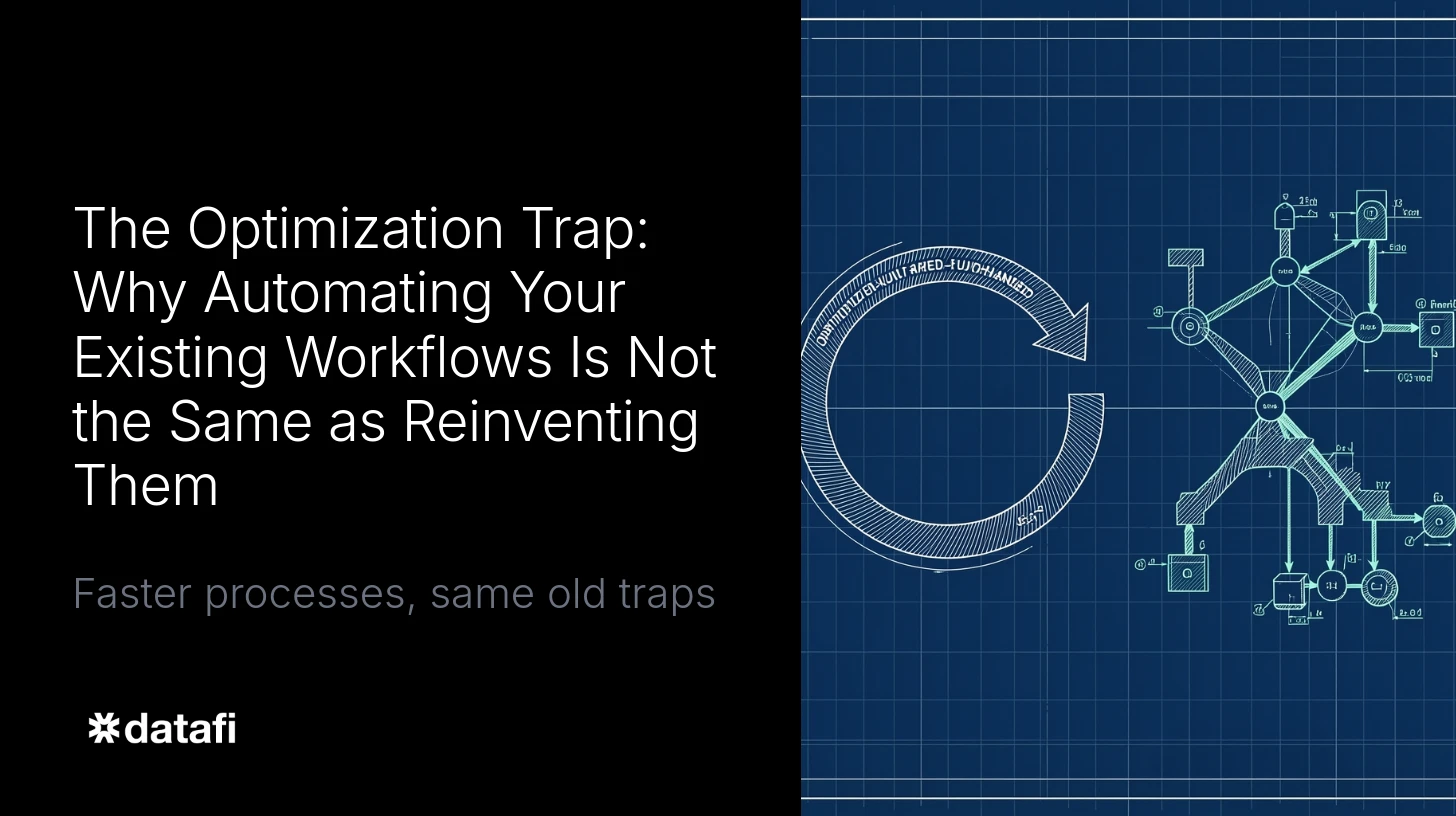
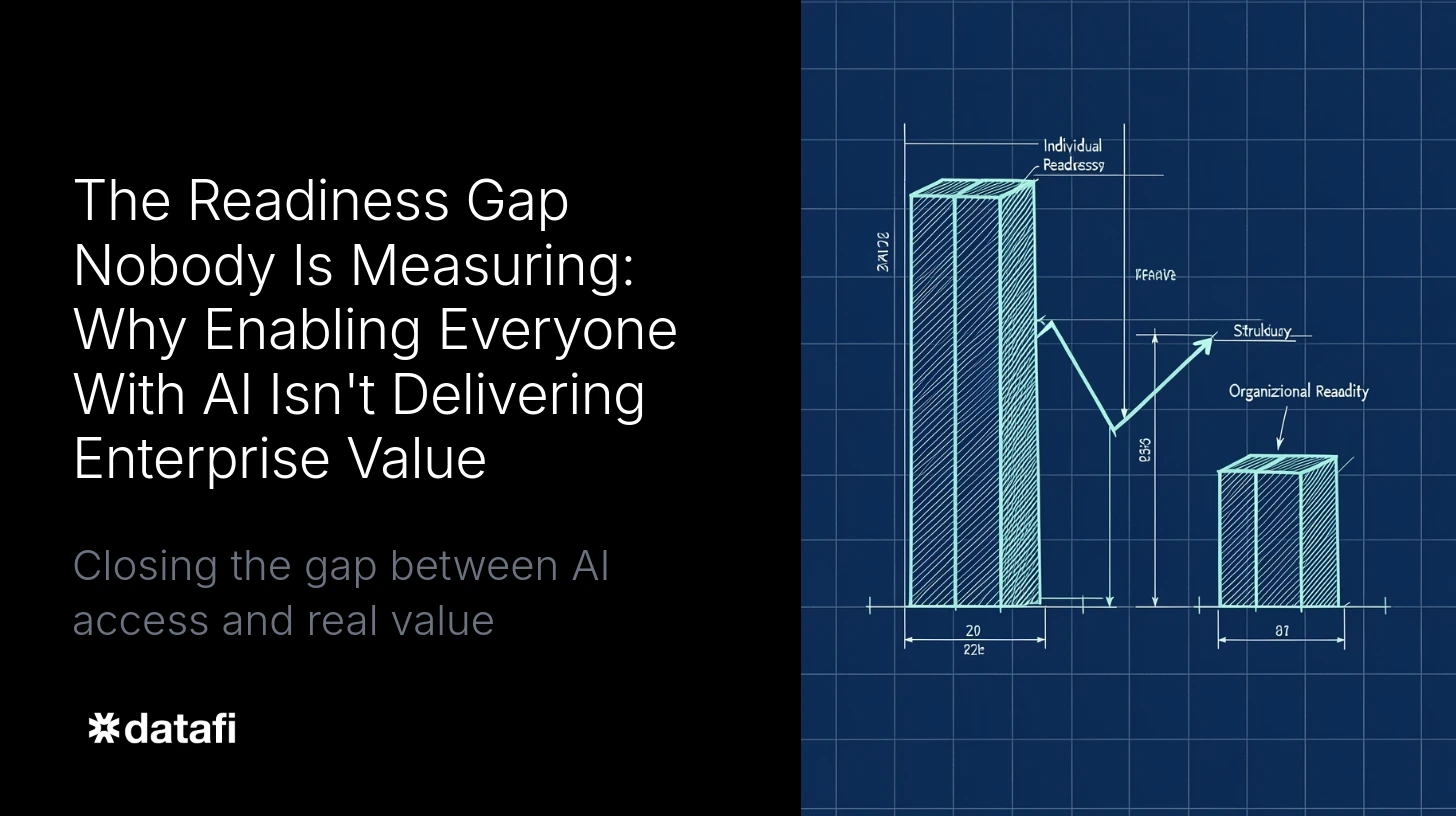
This series has followed McKinsey’s three horizons of AI maturity from the ground up. In the first post, we saw why enablement, giving every employee a capable tool, does not compound into enterprise value on its own. In the second, we saw why automation stalls when organizations optimize their existing processes instead of reimagining them. Each horizon hit a ceiling that turned out to be architectural rather than a matter of effort or intelligence.
Now we reach the top of the framework, and the numbers change character. In McKinsey’s third horizon, reinvention, organizations have stopped starting with the current state and automating it. They are redesigning work, roles, workflows, and operating models from scratch. Only eleven percent of organizations are here. And forty-eight percent of the leaders in this group report capturing enterprise value, compared with twenty-four percent in automation and thirteen percent in enablement.
Reinvention is where the value is. It is also, by a wide margin, the hardest place to reach. The interesting question is what actually stands between an organization and this horizon, because the honest answer has two halves that most analyses keep separate.
Reinvention is genuinely a human transformation: McKinsey found behavior shifts and trust are what predict value capture in this horizon. But culture becomes the binding constraint only for organizations that have already solved the infrastructure problem underneath it. Redesigning work from a blank slate around AI presupposes AI that can operate across the entire business, autonomously and under governance. Without that foundation, the vision has nothing to stand on.
The premise worth questioning
The dominant reading of McKinsey’s reinvention data is that this is a human problem. And there is strong evidence for that reading, which deserves to be taken seriously rather than waved past.
The study is emphatic that reinvention is a story of human change. In this horizon, organizations are not just evolving individual employee behaviors; they are shifting collective, organizational behaviors, the cultural norms that define how leaders run the place. McKinsey found that behavior shifts at the organizational level are the most important factor associated with value capture in this horizon, alongside trust at the personal level, which emerged as critical across all three. The constraint, the study says plainly, is increasingly leaders’ ability to creatively reimagine how work gets done with AI.
None of that is wrong, and a vendor that told you technology alone gets you to reinvention would be selling you something. Culture, trust, leadership fluency, and the willingness to redesign roles are real and load-bearing. An organization that buys the best infrastructure and refuses to change how it works will not reinvent anything.
But there is a quiet assumption buried in the purely human reading, and it is worth surfacing. It assumes the infrastructure is a given, that if leaders simply had the will and the vision, reinvention would follow. That assumption does not survive contact with what reinvention actually requires. You cannot redesign work from a blank slate around AI if the AI cannot operate at the level a blank-slate design demands. Will without capability is just frustration. The reason the human factors become the visible constraint in this horizon is that only the eleven percent who already solved the infrastructure problem ever get far enough to discover that culture is the next wall.
What reinvention demands of the architecture
Consider what it actually means to redesign a workflow from scratch around AI rather than automating the one you have. It means the AI is not a step in the process. It is a participant in it, monitoring continuously, reasoning across the full operational picture, and acting without waiting to be asked. McKinsey describes the reinvention frontier as autonomous action: not AI that responds when prompted, but AI that monitors, reasons, and acts as a continuous participant in operational workflows.
That is a categorically different demand than anything in the first two horizons. An agent that participates in a reinvented workflow needs governed, continuous, simultaneous access to every data source the workflow touches. An agent that can only see part of the picture does not produce cautious partial recommendations. It produces recommendations that are confidently wrong, which is worse than useless in a workflow the business depends on.
So reinvention imposes three architectural requirements that enablement and automation could get away with ignoring. Agents require context, which means sustained governed access to the complete data ecosystem, not a snapshot. Workflows require coordination, which means a layer that manages the handoffs between AI actions, human decisions, and system integrations, tracking state and enforcing permissions at every step. And autonomy requires trust, which means every autonomous action operates within defined guardrails, produces an audit trail, and remains open to human intervention.
Each of these is an infrastructure property. None of them can be supplied by a more capable model or a more determined leadership team. They are either built into the foundation or they are absent, and where they are absent, reinvention cannot begin no matter how much will the organization brings to it.
Why governance and autonomy are the same decision
There is a piece of McKinsey’s data that looks, at first, like it belongs entirely to the human column. Trust in the organization was the strongest personal readiness factor in the reinvention horizon, with fifty-five percent of high-trust leaders capturing value against seventeen percent of low-trust leaders. It reads as a pure culture finding.
But trust in a reinvented, agentic organization is not only interpersonal. It is also architectural. An organization will only allow AI to take autonomous action in high-stakes workflows when it can verify that the system operated within its guardrails, that its reasoning can be audited, and that a human can step in. Take that verification away and no amount of cultural goodwill will authorize an agent to act autonomously across the business, because the leaders accountable for the outcome have no way to answer for it.
Governance and autonomy are not opposites to be balanced. They are prerequisites for each other. The organizations that deploy the most autonomous AI are precisely the ones with the most rigorous governance, because governance is what makes autonomy authorizable.
This is why governance and autonomy are not opposites to be balanced. They are prerequisites for each other. The organizations that deploy the most autonomous AI are precisely the ones with the most rigorous governance, because governance is what makes autonomy authorizable. An agentic enterprise without governance at the infrastructure level is not a bold organization. It is an ungovernable one, and it will be stopped by its own risk function long before it reinvents anything.
The foundation the eleven percent stand on
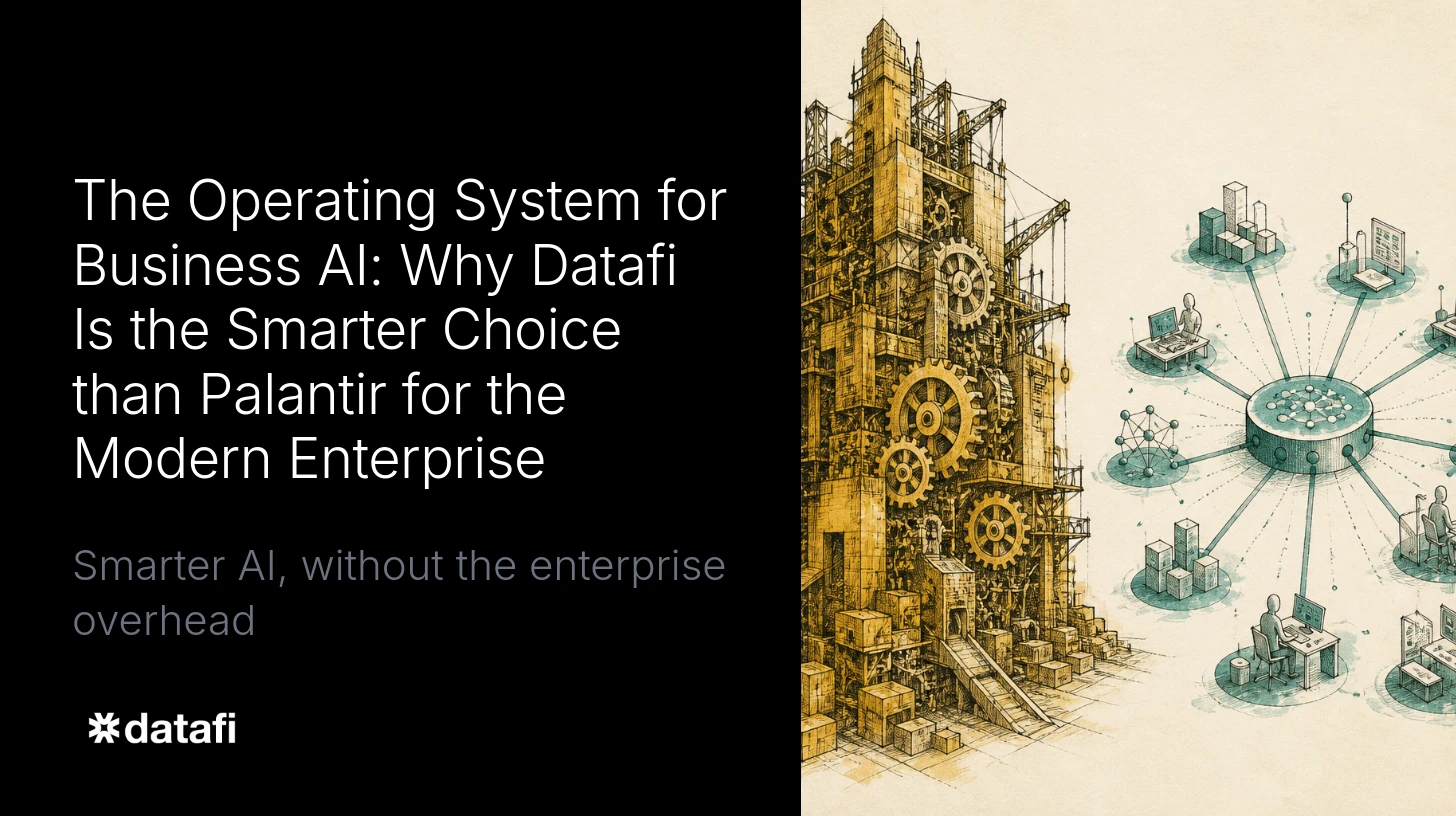
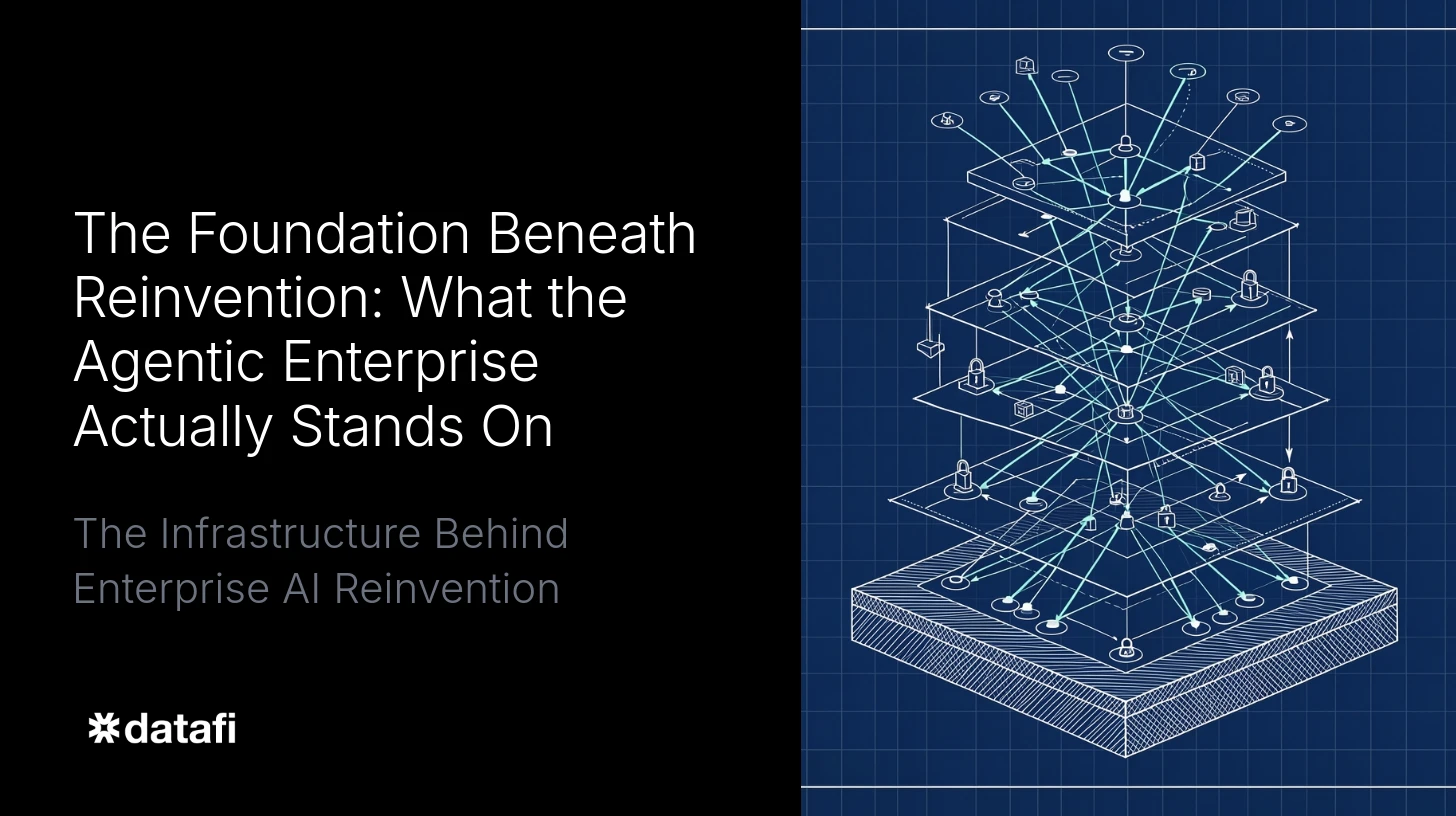
This is the work Datafi was built for, and reinvention is where the design premise pays off most completely. Datafi functions as an operating system for business AI: a vertically integrated data and AI stack that connects the organization’s complete data ecosystem, enforces governance at the infrastructure level, and enables autonomous agents to operate across the business rather than within a single function.
Each of reinvention’s three demands maps to a property of that foundation. Context comes from a global business contextual layer that gives AI sustained, governed, semantic access to the full data ecosystem, and that gets meaningfully better at an organization’s specific problems over time rather than resetting with every query. Coordination comes from an architecture built to manage multi-step, cross-system workflows as first-class operations, not as brittle scripts. And trust comes from governance enforced at the infrastructure level, so that every autonomous action an agent takes across every connected system carries an audit trail and respects the organization’s policies automatically.
The reason this matters for reinvention specifically is compounding. A contextual foundation is not a one-time integration. It is a living connection to the operational reality of the business that deepens over time, which means the organizations that build it first accumulate an advantage that widens rather than narrows. The eleven percent are not ahead because they had more will. They are ahead because they built the foundation that let their will translate into autonomous, reinvented work, and every month that foundation makes their AI more capable of the reinvention the other horizons cannot reach.
The two halves were always one
McKinsey is right that reinvention is a human transformation. The culture, the trust, the leadership fluency, the willingness to redesign roles from scratch, all of it is real and none of it is optional. But the human transformation and the infrastructure transformation are not two separate projects that happen to co-occur in the eleven percent. They are one project seen from two sides.
Leaders cannot build a systems-level vision for reinvented work if the architecture cannot execute it. Employees cannot trust an agentic organization whose agents cannot be audited. The will to reinvent and the capacity to reinvent rise and fall together, and the organizations at the top of McKinsey’s framework are the ones that stopped treating them as separable.
That is the throughline of all three horizons. Enablement stalls without the contextual foundation that lets tools do organizational work. Automation stalls without the connective architecture that lets organizations reimagine across silos rather than optimize within them. And reinvention, the horizon where the value actually lives, stands on both, plus the governance that makes autonomy authorizable and the culture that makes it worthwhile. AI creates the potential. But it is the foundation beneath it, and the people willing to build on that foundation, that turn potential into transformation.
The window McKinsey describes is real, and it is now. The organizations that will lead their industries are not the ones with the most AI talent or the largest budgets. They are the ones building the right foundation while the rest are still layering tools on top of processes they have not reconsidered. Reinvention is where the value is. The foundation is how you get there.
This concludes our three-part series on McKinsey’s horizons of AI transformation. If your organization is working to move from adoption to genuine impact, the place to start is the foundation everything else stands on.
Datafi provides a unified data operating system that enables enterprise organizations to deploy AI securely and at scale across all business functions. To learn more about how Datafi can accelerate your organization’s AI transformation, visit datafi.co.
Three Horizons of AI Transformation
Part 1: The Readiness Gap Nobody Is Measuring
Part 2: Automation and the Trap of Optimizing the Old Process
Part 3: Reinvention and the Infrastructure the Agentic Enterprise Actually Stands On