


Three Horizons of AI Transformation — Part 1 of 3
A new McKinsey study found that seventy percent of employees feel ready for AI while only twenty-seven percent of organizations are. The gap is not a training problem. It is an architecture problem.
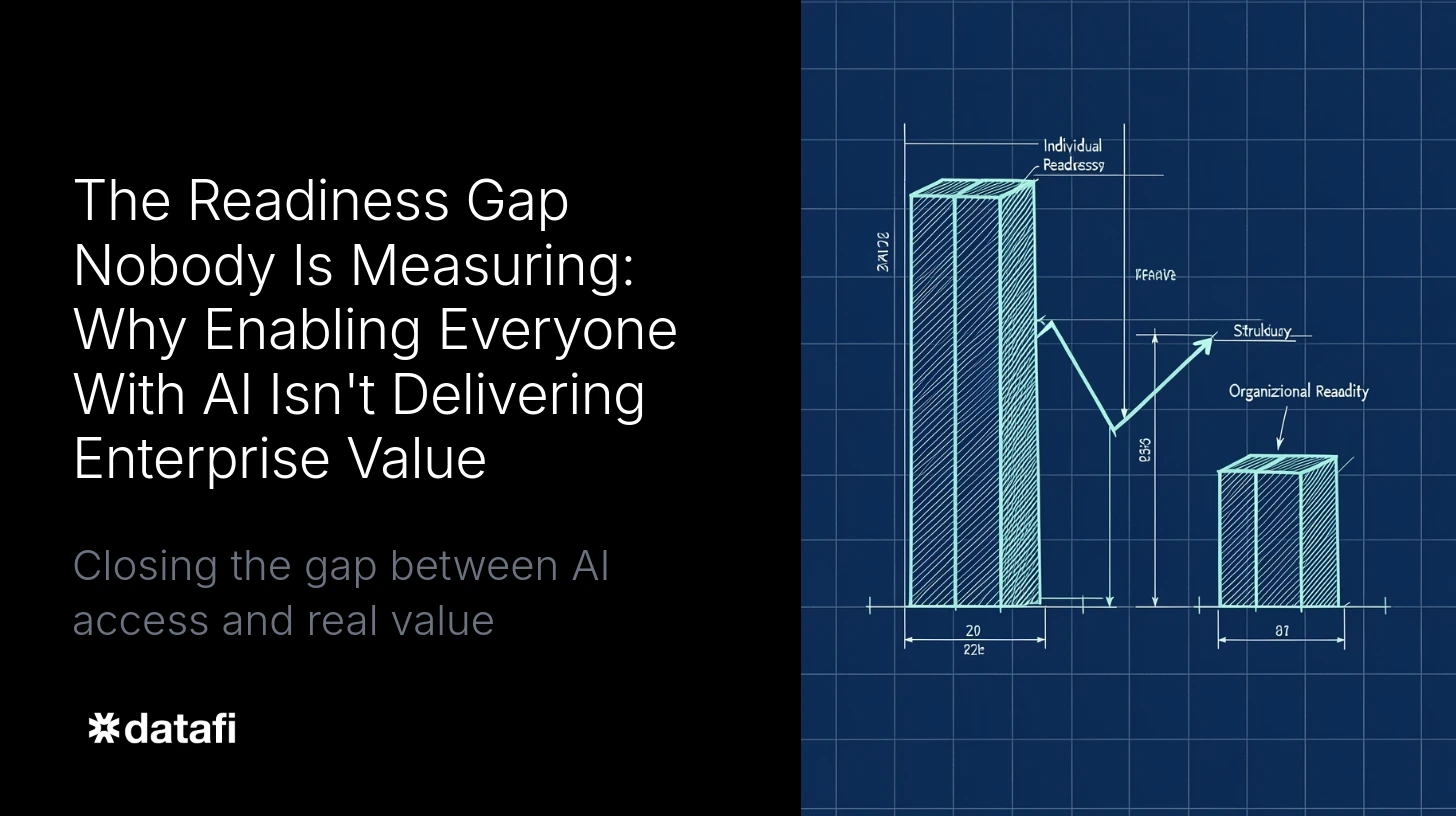
There is a number in McKinsey’s July 2026 study from adoption to impact that deserves more attention than it has received. Seventy percent of employees across job levels say they feel personally ready to adopt and use AI. Only twenty-seven percent of leaders believe their organizations are ready to make the shifts an agentic future requires. Employees have moved. The institutions around them have not.
The instinct, when a gap like this appears, is to close it from the side that looks behind. If organizations are lagging, the reasoning goes, then organizations need more tools, more pilots, more access. Put a capable model in front of every employee and let productivity compound upward into enterprise value.
It is a reasonable instinct. It is also, according to the same research, largely wrong.
The readiness gap between employees and organizations is not closed by giving more people access to more tools. McKinsey found that organizational readiness accounts for nearly twice as much of the difference between companies that capture value from AI and those that do not. The constraint is not adoption. It is the architecture the adoption runs on.
The premise worth questioning
Start by giving the enablement instinct its due, because it is not foolish. Getting general-purpose AI into the hands of employees is a genuine and necessary first step. It builds fluency. It surfaces use cases that no central planning function would have predicted. It creates the baseline comfort that any deeper transformation depends on. McKinsey places this at the foundation of its framework for a reason, calling it the first of three horizons of AI maturity: enablement, where organizations offer individual employees access to general-purpose AI tools that assist with parts of their existing jobs.
Nearly half of the organizations McKinsey surveyed sit in this horizon. That is not a failure. It is where the journey starts.
The problem is that most organizations mistake the starting line for the destination. They deploy the tools, watch individuals get faster at drafting emails and summarizing meetings, and expect the enterprise to transform as a natural consequence. It does not happen. And the study is unusually specific about why.
Individual productivity gains, McKinsey found, rarely translate into lasting advantage when the organization around them stays the same. Employees gain personal efficiency, but their freed-up capacity does not necessarily become business impact. They spend the recovered time on personally interesting work that is not always tied to enterprise priorities. The tool got faster. The business did not change.
What the data actually says the constraint is
McKinsey ran the numbers on what separates leaders who report capturing enterprise value from those who do not. Organizational readiness, an organization’s ability to evolve its workflows, operating model, leadership behaviors, and culture, accounts for forty-eight percent of that difference. Personal readiness accounts for twenty-five percent. Organizational capacity to change is nearly twice as decisive as individual capacity to adopt.
The single most telling finding sits inside the enablement horizon itself. Leaders were 5.3 times more likely to report enterprise value capture when workflows were redesigned than when they remained unchanged. Thirty-two percent captured value where work was redesigned. Six percent captured it where the tools were simply layered on top of existing processes.
The same AI, the same employees, the same enablement effort. The only variable is whether the work itself was rearchitected around what the technology makes possible. That variable moves value capture by more than five times.
This is why enablement so often produces the illusion of progress. The dashboards look more sophisticated. The demos impress. Individuals are visibly faster. And the hard problems, the ones that determine whether a business grows faster or operates leaner or serves customers better, remain untouched. The tools were disconnected from the operational fabric where value is actually created.
Why the tools stay disconnected
There is a reason the layering-on approach hits a ceiling, and it is worth being precise about it. A general-purpose language model is a brilliant generalist with no knowledge of your business. It is fluent, but fluency is not intelligence. It can produce a coherent response about almost any topic while knowing nothing about what your data actually says, what your rules are, what your history contains, or what problem is actually being solved.
An employee prompting that model gets a faster way to do their individual task. What they do not get is a system that understands the business well enough to change how the business runs. The model cannot see the operational systems where work happens. It cannot read from the ERP, the CRM, the supply chain platform, the maintenance records, and it certainly cannot act on them. It answers the question it was handed and then forgets the business the moment the conversation ends.
This is the enablement ceiling. McKinsey frames the challenge for organizations in this horizon precisely this way: moving employees beyond experimentation to sustained use, and rewiring the aspects of work that can be performed differently. Both halves require infrastructure the tools alone do not supply.
The foundation enablement is missing
The organizations that broke past six percent to thirty-two percent did something the others did not. They redesigned the workflow. But redesigning a workflow around AI is only possible if the AI can reach into the workflow, which means the AI needs governed, sustained access to the complete data ecosystem the workflow runs on. That access does not come from a better prompt or a more capable model. It comes from a different foundation.
This is the work Datafi was built for. Rather than applying an AI layer on top of existing tools, Datafi functions as an operating system for business AI, a vertically integrated data and AI stack that connects an organization’s complete data ecosystem, enforces governance at the infrastructure level, and gives every employee governed access to the full intelligence of the business.
The distinction matters most at exactly the point where enablement stalls. When a language model is given sustained access to the full context of the business, it stops functioning as a question-answering tool and starts functioning as something that can genuinely participate in a workflow. The warehouse manager asking about inventory gets an answer grounded in live operational data rather than a plausible-sounding guess. The customer service representative gets the full context of a relationship before the call, not a summary of whatever documents happened to be pasted in. The redesigned workflow becomes possible because the AI can finally see and act on the business it is supposed to be transforming.
Enablement distributes capability. It does not, on its own, build the contextual foundation that lets capability compound into enterprise value. That foundation, a global business contextual layer connecting AI reasoning to live operational data across the enterprise, is what separates the organizations capturing value from the ones running impressive demonstrations that disappoint in production.
The gap was never about the employees
Return to the number this started with. Seventy percent of employees are ready. The people are not the bottleneck. They have adapted faster than the institutions they work in, and no amount of additional tooling changes that math, because the constraint was never on the adoption side. It was on the side of whether the organization built an architecture that lets adopted tools do organizational work.
Closing the readiness gap is not a matter of pushing more AI toward already-ready employees. It is a matter of giving the AI the operational context, the governed access, and the connection to real workflows that turn individual speed into enterprise capability. That is an infrastructure decision, not a training initiative. And it is the decision that determines whether an organization spends the next several years accumulating faster individual workers or actually transforming how work gets done.
Enablement is where the journey begins. It is not where value is captured. The organizations that understand the difference are the ones building the foundation now.
In the next post in this series, we turn to McKinsey’s second horizon, automation, and the trap that keeps organizations optimizing yesterday’s processes when the real prize is reimagining them.
Datafi provides a unified data operating system that enables enterprise organizations to deploy AI securely and at scale across all business functions. To learn more about how Datafi can accelerate your organization’s AI transformation, visit datafi.co.
Three Horizons of AI Transformation
Part 1: The Readiness Gap Nobody Is Measuring
Part 2: Automation and the Trap of Optimizing the Old Process
Part 3: Reinvention and the Infrastructure the Agentic Enterprise Actually Stands On