


Three Horizons of AI Transformation — Part 2 of 3
Organizations in McKinsey’s second horizon are automating end-to-end processes at scale. Most of them are stuck. The reason is not the automation. It is what they chose to automate.
In the first post of this series, we looked at why enablement, giving every employee a capable AI tool, does not compound into enterprise value on its own. The organizations that broke through were the ones that redesigned the workflow rather than layering AI on top of it. McKinsey found they captured value 5.3 times more often for doing so.
That naturally raises the next question. If redesigning workflows is the unlock, what happens when an organization commits to it at scale? McKinsey’s framework has an answer, and it is the second of the three horizons: automation, where companies use AI to automate and improve existing cross-functional workflows across the business.
Roughly forty-three percent of the organizations McKinsey surveyed have reached this horizon. They have moved past distributing tools to individuals. They are now using AI to transform end-to-end processes that cut across functional and structural silos, routing customer requests, generating responses, escalating complex cases to humans. This is real progress, and it is harder than it looks.
And yet the study is blunt about where these organizations get stuck. Only twenty-four percent of leaders in the automation horizon report capturing enterprise value. The majority have automated real workflows and still have not moved the business. To understand why, you have to look closely at one sentence in the research.
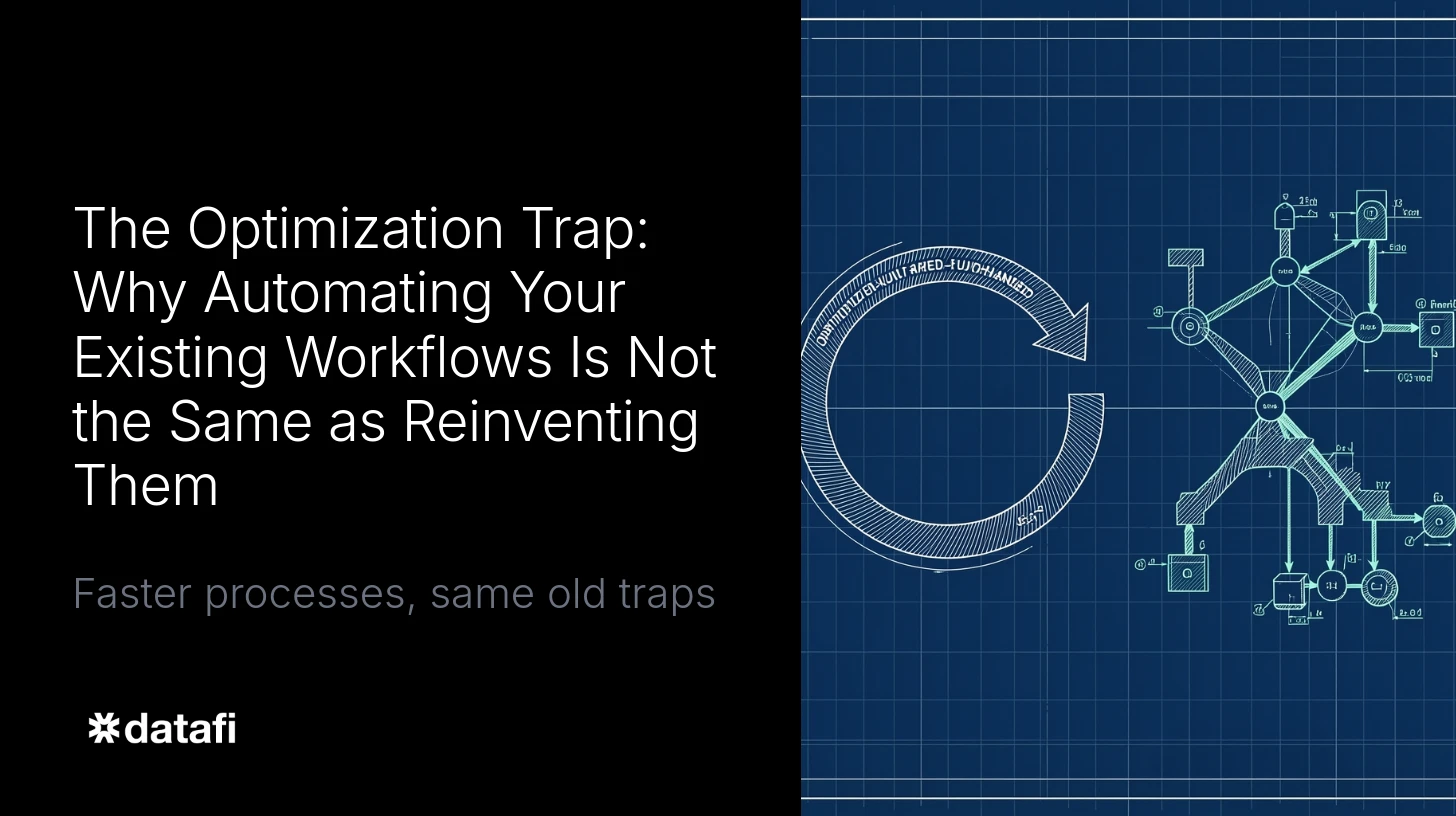
Automating an existing workflow makes yesterday’s process faster. It does not ask whether yesterday’s process is the right one. McKinsey found that organizations in the automation horizon stall precisely because they start with the current state and optimize it rather than reimagining from a blank slate. The value ceiling is not a technology limit. It is a starting-point limit, and the starting point is determined by the architecture the automation runs on.
The premise worth questioning
Give the automation horizon its due first, because reaching it is a genuine achievement. Automating a cross-functional process is orders of magnitude harder than handing an employee a chatbot. It requires the AI to operate across systems that were never designed to talk to each other, to manage handoffs between machine actions and human decisions, and to do all of it reliably enough that the business can depend on the result. Organizations that get here have done serious work.
They have also, in most cases, made a subtle and costly choice without realizing it was a choice.
Here is how McKinsey describes the ceiling. Organizations in this horizon are not just automating workflows; they are optimizing and improving them. What keeps them from advancing is that they are still starting with the current state and optimizing it, rather than reimagining with a blank slate.
Read that slowly, because it is the entire trap. Automation, done the way most organizations do it, takes the existing process as given and makes it faster. The customer request still flows through the same five steps it always did. AI just executes those steps more quickly and with fewer humans in the loop. The process got more efficient. The process did not get reconsidered.
This feels like transformation because the before-and-after is dramatic. Work that took days now takes minutes. But efficiency at the level of an existing process is a fundamentally different thing from asking whether that process should exist in its current form at all. The organizations that automate their current state have locked in the assumptions of that current state, only now those assumptions run faster and are harder to change.
What actually predicts value in this horizon
McKinsey identified what separates the automation-horizon leaders who capture value from those who do not, and the answer is not a better automation engine. It is a set of organizational and architectural capabilities.
At the organizational level, leaders were 3.9 times more likely to report enterprise value capture when their leadership teams demonstrated high AI fluency, thirty-five percent versus nine percent. The top drivers the study names are establishing a systems-level vision for redesigning the organization, creating a road map anchored in business value, actively reallocating resources, and changing the organization’s structure and formal roles to take advantage of the process changes.
Notice what every one of those has in common. They are all about redesign at the level of the system, not optimization at the level of a task. The leaders capturing value are not the ones who automated the most processes. They are the ones who used automation as an occasion to rethink how the whole thing should work, and then had the architecture to act on that rethinking across silos.
That last clause is where most organizations quietly fail. You cannot reimagine a cross-functional process from a blank slate if your AI can only reach one function at a time.
The whiteboard arrow problem
Picture the architecture diagram every enterprise AI initiative eventually draws on a whiteboard. There is a box for the data warehouse. A box for the model. A box for the CRM, the ERP, the ticketing system, the workflow engine. And between all of them, a set of confident arrows.
The boxes are the easy part. Any of them can be bought or stood up. The hard part, the part that determines whether a cross-functional workflow actually works, lives in the arrows: the connective architecture between the components, where data has to move bidirectionally, in real time, under governance, so that an action in one system correctly triggers the right response in the next.
This is why so many automation efforts optimize within a silo but never reimagine across silos. Reimagining across silos requires the arrows to be real. It requires an AI agent that can read from the CRM and the ERP and the supply chain platform simultaneously, reason across all of it, and write back to trigger the next step, escalate an exception, or update a record. When the connective architecture is a set of brittle point-to-point integrations, each one custom-built and separately maintained, the organization has no choice but to automate the process it already has. Reimagining would mean rebuilding every arrow. So it optimizes the current state instead, and calls it transformation.
McKinsey’s own finding lands exactly here. The leaders who captured value were the ones who could establish a systems-level vision and actually reallocate resources and roles against it. That is only possible on an architecture where the connective layer is a solved problem rather than a permanent construction project.
What solves it
This is the problem Datafi was built around. Rather than treating integration as a series of one-time projects that produce brittle arrows between boxes, Datafi functions as an operating system for business AI, a vertically integrated data and AI stack in which the connective layer is the foundation, not an afterthought.
The mechanism that matters here is direct, bidirectional connection to the systems where the business actually runs. AI agents read from ERP systems, CRMs, supply chain platforms, and operational records in real time, not from stale copies sitting in a warehouse. More importantly, they write back, updating records, triggering workflows, escalating exceptions, and closing the loop between analysis and action. The arrows on the whiteboard become a governed, living connection layer rather than a maintenance liability.
When the connective architecture is solved at the infrastructure level, the constraint that forces optimization-in-place disappears. An organization is no longer limited to making its existing process faster, because the AI can see and act across the entire process at once. It becomes possible to ask the question the automation horizon usually cannot afford to ask: not how do we speed up these five steps, but should this be five steps at all?
And because governance is enforced at that same infrastructure level rather than bolted on per integration, the cross-functional autonomy that cross-functional reimagining requires becomes deployable rather than reckless. Every action an agent takes across those connected systems carries an audit trail. Every access respects the organization’s data policies automatically. The reason most organizations will not let an agent act autonomously across five systems is that they cannot verify what it did in each one. Governance at the infrastructure level is what removes that objection, which is why it is an enabler of ambitious automation, not a brake on it.
Optimizing faster is not the same as being ahead
The organizations stuck at twenty-four percent value capture are not doing automation wrong in any obvious sense. Their processes are genuinely faster. Their metrics genuinely improved. That is exactly what makes the trap so effective. The improvements are real enough to feel like the destination, and dramatic enough to obscure the fact that the underlying process was never reconsidered.
Making the current state faster locks the current state in. The organizations that break through to real value treat automation not as the goal but as the moment to reimagine.
McKinsey’s data is a warning to anyone in this horizon who mistakes optimization for reinvention. Making the current state faster locks the current state in. The organizations that break through to real value are the ones that treat automation not as the goal but as the moment to reimagine, and they can only do that if their architecture lets them act across the whole system rather than one silo at a time.
The difference between the automation horizon and the one beyond it is not effort or intelligence. It is whether the connective architecture is solid enough to reimagine on. That is an infrastructure question, and it is the one that decides whether an organization spends the next several years running yesterday’s processes at higher speed or finally building the ones the business actually needs.
In the final post of this series, we reach McKinsey’s third horizon, reinvention, where only eleven percent of organizations operate and where the most value is captured. We examine why reinvention cannot run on layered-on AI, and what the agentic enterprise actually stands on.
Datafi provides a unified data operating system that enables enterprise organizations to deploy AI securely and at scale across all business functions. To learn more about how Datafi can accelerate your organization’s AI transformation, visit datafi.co.
Three Horizons of AI Transformation
Part 1: The Readiness Gap Nobody Is Measuring
Part 2: Automation and the Trap of Optimizing the Old Process
Part 3: Reinvention and the Infrastructure the Agentic Enterprise Actually Stands On