


Every enterprise AI investment eventually faces the same question: what did we get for this? The answer to that question depends entirely on what you set out to get. And the most important decision most organizations are making in enterprise AI right now is not which platform to buy. It is which question to ask.
Ask “how much time did AI save our employees?” and you will get an answer measured in hours, headcount productivity, and reduced search time. The ROI calculation is tractable, the before-and-after comparison is legible, and the business case is defensible in a budget review.
Ask “how did AI change what our business is capable of doing?” and you will get a different answer entirely. Measured not in hours saved, but in decisions made with better context, exceptions caught before they became costs, operational processes that now run without requiring human execution at every step, and a structural cost and capability position that did not exist before.
These two questions correspond to two different categories of AI platform, two different architectures, and two different investment theses. The organizations that treat them as the same question are likely to get the first answer when they were hoping for the second.
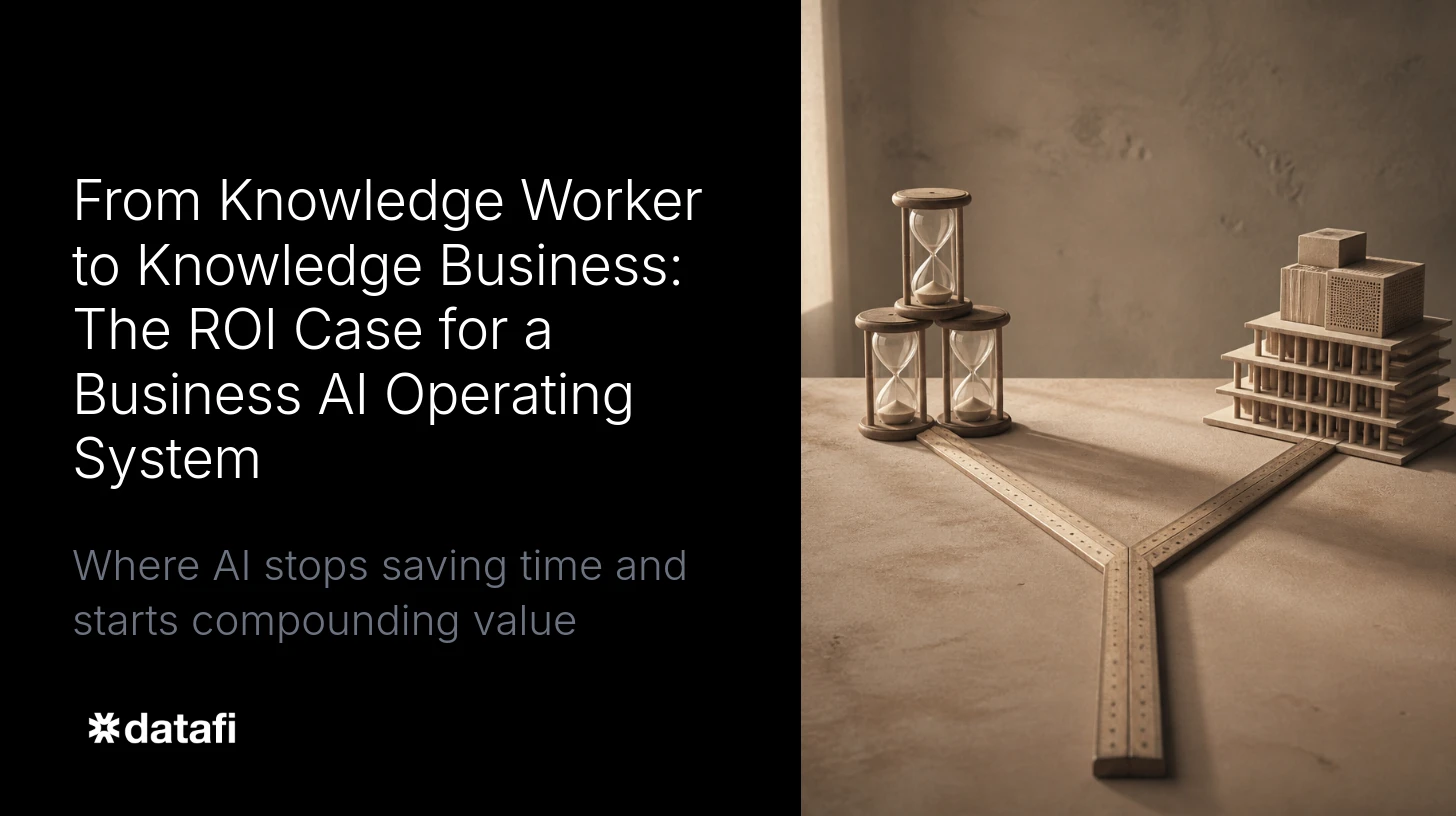
The most consequential AI investment decision is not which platform to buy, but which question to ask: “how much time did AI save us?” versus “how did AI change what our business is capable of doing?” These two questions lead to fundamentally different architectures, ROI models, and long-term competitive positions.
The Productivity ROI Model: Real, and Bounded
Enterprise search platforms have built a compelling productivity ROI story. The numbers cited in the market are consistent: significant hours saved per user annually from reduced search time, faster onboarding for new hires who can access institutional knowledge through a queryable interface rather than asking colleagues, reduced duplication of effort as existing documents and decisions become discoverable.
These benefits are real. For large organizations with complex tool stacks, the hours saved per employee across a year can be significant in aggregate. Studies commissioned by leading enterprise search vendors document material productivity gains at well-governed deployments with high adoption rates.
The ceiling on this model is also real, and it is worth naming clearly.
Productivity ROI scales with headcount. More employees using the search platform means more hours saved across the organization. But the fundamental nature of the work has not changed. The same decisions are being made, just faster. The same processes are being executed, just with less time spent on the information-gathering steps. The same organizational structure is in place, with AI accelerating the knowledge workers within it.
This is valuable. It is not transformative. And it is subject to a specific ceiling: the ceiling of how much time can be saved per employee before further search improvements deliver diminishing returns. An employee who has gone from spending four hours a week searching for information to spending two hours a week searching for information can, at best, be reduced to spending zero hours. The remaining two hours of weekly productivity gain represents the maximum possible return on search optimization, per employee.
There is no such ceiling on transformation ROI.
The Transformation ROI Model: Structural and Compounding
Transformation ROI is fundamentally different in kind, not just in degree. It does not accrue by making the same processes faster. It accrues by changing which processes exist, which decisions require human time, and what the organizational capability is at a structural level.
The clearest way to see this is through specific operational examples that illustrate what changes when AI moves from information retrieval to operational execution.
Claims processing in insurance. A search-optimized AI helps adjusters find relevant policy documents, claim history, and coverage terms faster. The adjuster still reads the synthesized information, applies their judgment, and manually executes the workflow: updating case status, calculating payments, triggering notifications, documenting decisions. The work has been made faster. It has not been fundamentally restructured.
A Business AI Operating System changes the structure of the work. Routine claims that meet clearly defined criteria are evaluated, approved, and processed by AI agents operating within governed authority boundaries. The adjuster’s time is no longer spent on information gathering and workflow execution for standard cases. It is spent on the cases that genuinely require human judgment: coverage disputes, fraud indicators, complex multi-party situations, and regulatory edge cases. The total claims processing capacity of the organization increases without proportional headcount growth. The accuracy of routine processing improves because the AI applies policy consistently without the variance that comes from human judgment on high-volume, low-complexity decisions.
Supply chain operations in manufacturing or logistics. A search-optimized AI helps operations managers find relevant information about carrier performance, inventory positions, and outstanding commitments. They can ask better questions and get more synthesized answers. The exception-handling process still requires a human to review the exception, assess the options, and manually initiate the rerouting, escalation, or reorder.
A Business AI Operating System monitors operational state continuously. Exceptions that fall within defined parameters are resolved autonomously, before they become customer-facing problems, at any hour. The operations manager’s attention is directed to the exceptions that genuinely require human judgment: novel situations, high-stakes decisions with significant financial or relationship implications, and cases where the AI’s confidence in the right course of action falls below the threshold defined by governance policy. The operational resilience of the business improves because AI is working on the exception queue at all times, not waiting for a human to start their day.
How These ROI Models Compound Differently
The compounding dynamic of these two models is where the long-term competitive divergence emerges most clearly.
Productivity ROI from search improvement compounds modestly. As adoption increases, more employees benefit. As the index grows, more information becomes accessible. As the AI improves, answers become more accurate. The organization gets incrementally better at finding and synthesizing information.
Transformation ROI from operational AI compounds structurally. Each process that moves from human execution to governed AI execution frees human capacity for higher-value work, which itself can then be supported and accelerated by AI. The organizational capability that results is not just “employees who are faster at their existing jobs.” It is a fundamentally different operating model where human judgment is concentrated on the decisions where it creates the most value, and AI is handling the volume, routine, and continuous monitoring that previously required proportional human scaling.
The organization that has been accumulating transformation ROI for three years has not just saved more employee hours. It has built a structurally different business with a structurally lower cost-to-operate and a structurally higher ceiling on what it can do with a given amount of human capital.
The Investment Thesis Decision
The decision between productivity AI and transformation AI is, at its core, an investment thesis decision. It requires clarity about what the organization is trying to build, not just what problem it is trying to solve in the near term.
For organizations whose primary AI challenge is knowledge accessibility, whose information is fragmented across many tools and hard to find, and whose employees spend material time on search and synthesis, a productivity-first investment makes sense as a starting point. The ROI is real, the deployment is relatively fast, and the capability compounds incrementally.
For organizations that are serious about what AI can do for their operational model, and who are asking not just “how do we find information faster” but “how do we build a business that operates differently because of AI,” the investment thesis has to start from a different place. The architecture has to be built around the operating layer, not the retrieval layer. The governance model has to be designed for action, not just access. The measure of success has to be operational outcomes, not hours saved.
These are not mutually exclusive choices. The Datafi platform delivers the productivity benefits of unified information access as a component of a larger system. But it delivers those benefits as a feature of a Business AI Operating System, not as the primary value proposition of the investment.
The difference matters because the organizations that invest in a search platform first and try to add operational AI later will face an architectural transition that their initial investment did not prepare them for. The organizations that invest in the operating layer from the start will find that productivity benefits accrue as a natural consequence of having done so, while the transformation benefits compound on top of them.
A Different Measure of Success
The metric that best captures the difference between these two investment models is not hours saved per employee. It is how much of your operational capacity is being run by humans doing work that AI could do, versus humans doing work that genuinely requires human judgment, creativity, and accountability.
In most enterprises today, that ratio is heavily skewed toward the former. The combination of information fragmentation, disconnected systems, and AI tools designed primarily for retrieval means that an enormous share of organizational human capacity is spent on tasks that are well within the capability of a well-governed AI system: gathering and synthesizing information, executing routine workflows, monitoring systems for exceptions that follow predictable patterns, and producing outputs that are more about applying consistent rules than exercising genuine judgment.
Every hour of that capacity that moves to AI is an hour of human capacity available for work that AI cannot do: building relationships, exercising judgment on genuinely ambiguous situations, driving strategic decisions that require contextual wisdom, and doing the creative and innovative work that determines where the organization goes next.
The knowledge business is not one where knowledge workers work faster. It is one where human knowledge is concentrated where it creates the most value, supported and amplified by AI systems that handle everything else. That is the ROI that compounds. And that is the investment case for a Business AI Operating System.
Datafi is the Business AI Operating System for the modern enterprise. To understand how the transformation ROI model applies to your industry and your operations, visit datafi.co
Next in the Series: Choosing Your Enterprise AI Operating System: A Framework for the Decision You Cannot Afford to Get Wrong