


There is a version of the enterprise AI story that goes like this: employees spend too much time searching for information across too many disconnected tools, so the answer is a unified search layer that brings everything together in one place. Find the right information faster. Answer questions more quickly. Move on.
It is a compelling story because it addresses something real. Information sprawl is a genuine problem. The average knowledge worker does spend hours each week navigating between systems, re-asking questions that have been answered before, and waiting for someone with data access to tell them what they need to know. Solving that problem has real value.
But it is not transformation. It is acceleration of the status quo.
The deeper problem in enterprise AI is not that people cannot find answers. It is that finding the answer is rarely the hard part of the work. The hard part is what happens next. The decision. The action. The workflow that has to change because of what the answer implies. The system that needs to be updated. The exception that needs to be escalated. The prediction that needs to be acted on before it becomes a crisis.
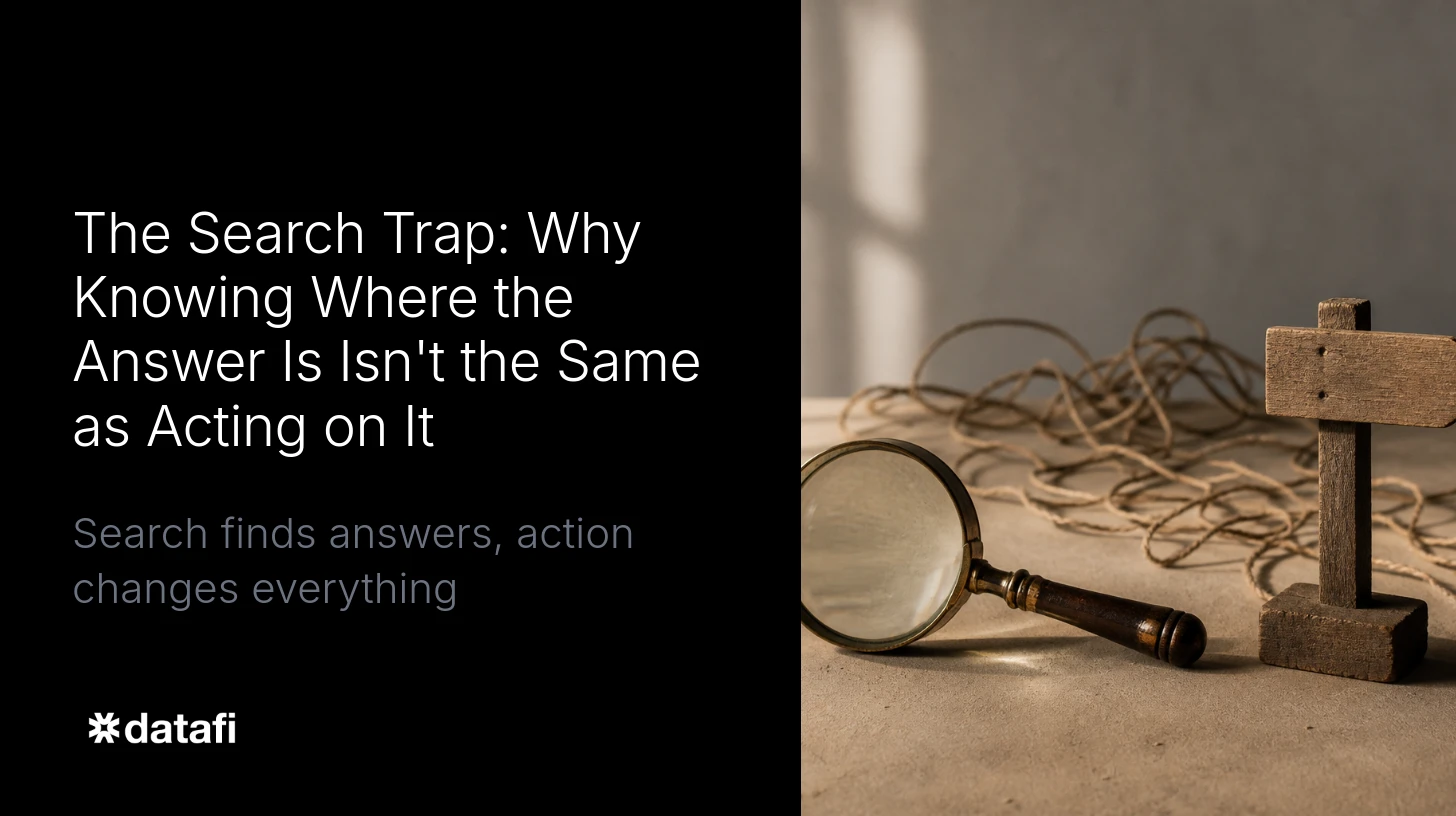
This is the search trap: investing in AI that makes you faster at finding information, while the gap between finding and doing remains exactly as wide as it was before.
The real enterprise AI bottleneck is not finding information faster; it is closing the gap between finding an answer and acting on it. Search-first platforms accelerate the status quo, but transformation requires AI that can reason, decide, and execute across live business context.
What Search-First AI Gets Right
It would be unfair to dismiss the value of enterprise search platforms. They solve a genuinely painful problem, and the best of them solve it well.
When an organization deploys a unified search tool across its SaaS estate, the immediate benefits are real. Employees stop re-creating documents that already exist. Onboarding new team members becomes faster because institutional knowledge is more accessible. Questions that previously required a meeting to answer can be resolved in seconds. For knowledge-intensive organizations where finding the right precedent, policy, or piece of context is itself the bottleneck, search-first AI delivers measurable productivity gains.
The architectural foundation is also serious. Building a knowledge graph across dozens of enterprise systems, maintaining permissions and data governance in a unified index, and delivering semantically relevant results rather than keyword matches — these are hard problems, and solving them requires genuine engineering investment.
None of this is wrong. The question is whether it is enough.
Where the Story Ends
The moment you move from “finding information” to “doing something with it,” search-first AI runs out of runway.
Consider what a mid-level operations manager at a logistics company actually needs from an AI system on a given morning. They need to know that a carrier has flagged a delay on a key lane. They need that information connected to the customer commitments that are now at risk. They need the system to have already identified the alternative routing options available. They need a recommendation, not a search result. And they need the ability to trigger the re-routing workflow directly, without opening five separate systems, copying data between them, and manually escalating to the carrier account team.
A search layer can tell the operations manager that the delay flag exists. It may even surface the relevant customer commitments in the same interface. But the connection between those two facts, and the action that follows from them, requires something fundamentally different from a search index.
It requires an AI system that understands what the data means in operational context, can reason across multiple domains simultaneously, and is connected to the systems and workflows where action actually happens.
This is not a feature gap. It is an architectural one.
The Retrieval vs. Reasoning Divide
Enterprise AI platforms that start from a search foundation face a structural constraint that is worth naming directly. Search is a retrieval problem. Retrieval is about finding the most relevant existing information in response to a query. It is inherently reactive, and it is inherently backward-looking: it returns what exists, in response to what was asked.
Business transformation requires something different. It requires AI that can reason forward from current data to what should happen next. It requires a system that is not waiting to be asked, but is continuously monitoring operational state and surfacing the exceptions, opportunities, and risks that matter. It requires agents that can be trusted to take action within defined boundaries, not assistants that surface options and wait for a human to do the work.
The difference is not about the intelligence of the underlying model. Given the same language model, a system built on retrieval architecture will still face the constraint that its AI can only reason about information that was retrieved in response to a specific query. A system built on a live business context layer can give that same model access to the full operational state of the organization, enabling reasoning that is impossible when the context is assembled from search results.
Given the same language model, retrieval architecture limits AI to reasoning about what was asked. A live business context layer enables reasoning about everything that is happening, making transformation possible where search only makes retrieval faster.
The Contextual Layer: What Changes Everything
At Datafi, our core architectural insight is this: LLMs do not lack intelligence. They lack context. Specifically, they lack the full, live, governed business context that would allow them to reason about what is happening in an organization and what should be done about it.
Building that context is not a matter of indexing more documents. It is a matter of creating a semantic layer that represents the meaning of data across all of an organization’s systems, maintains live awareness of operational state, understands the relationships between entities, and can be queried by AI agents and language models in ways that produce grounded, actionable, governed responses.
This is the global business contextual layer. It is not a search index. It is not a knowledge graph in the traditional sense. It is a live representation of the business itself, built from the full data ecosystem, accessible to every AI system and every agent without requiring data movement or replication.
When a Datafi agent is working on a supply chain exception, it is not retrieving documents about the exception. It is operating within a live understanding of what the business is doing, what it has committed to, what the current operational constraints are, and what the available options for resolution look like. It can act, not just retrieve.
Two Definitions of Value
Enterprise software buyers are increasingly sophisticated about the difference between productivity tools and transformation platforms. The question is not which one provides more value in absolute terms. The question is which one matches the ambition you have for what AI should do in your organization.
If the goal is to reduce the time your knowledge workers spend searching for information, a search-first platform can deliver that. The ROI story is real and measurable: hours saved per employee, reduced duplication of effort, faster onboarding, better knowledge retention.
If the goal is to transform how your business operates by deploying AI that can monitor, reason, and act across your entire data ecosystem, the architecture has to start from a different place. The ROI story is also real, but it is measured in outcomes: claims processed more accurately, supply chain exceptions resolved before they become customer escalations, underwriting decisions made faster with better risk context, operational costs reduced through autonomous workflow execution rather than human-in-the-loop retrieval.
These are not competing claims about the same product. They are genuinely different products solving genuinely different problems.
Choosing the Right Foundation
The organizations that will extract the most value from AI over the next several years are the ones that resist the temptation to optimize for the nearest, most legible problem. Making search better is legible. The cost of poor findability is measurable. The ROI of improving it is easy to calculate and easy to communicate.
The cost of being unable to act on what you find is harder to quantify, but it is orders of magnitude larger. Every insight that does not trigger action is waste. Every exception that is identified but not resolved autonomously is a manual process that did not need to be. Every decision that is made with partial context because the AI could not reason across the full data ecosystem is a decision that could have been better.
The search trap is not a failure of the tools that fall into it. It is a failure of ambition about what enterprise AI can be. The organizations that avoid it are the ones that start by asking not “how can AI help us find information faster?” but “how can AI help us solve problems we have not yet thought to solve?”
That is a different question. And it requires a fundamentally different answer.
Datafi is the Business AI Operating System for the modern enterprise. To learn how Datafi replaces fragmented search and retrieval tools with an integrated platform that connects, reasons, and acts across your full data ecosystem, visit datafi.co or schedule a demo.
Next in the Series: Context Is Not Enough: Why Enterprise Knowledge Graphs Still Leave Decisions Half-Made