


There is a concept at the center of the modern enterprise search argument that sounds, on the surface, like it should be the answer to everything: the knowledge graph.
The idea is intuitively appealing. Your organization generates enormous volumes of data across dozens of systems. Documents, conversations, records, decisions, customer interactions, operational transactions. If you could map all of that, understand who created what, which systems are connected to which, and how all of it relates to a query someone is asking right now, you would have something genuinely useful. You would have a unified map of organizational knowledge.
The leading enterprise search platforms have invested heavily in building exactly this. The result is a significant capability: AI-assisted search that understands intent, respects permissions, surfaces related content intelligently, and can answer questions that would previously have required a manual process to resolve.
And yet, organizations that deploy these platforms find themselves in the same position six months later. They are finding information faster. But the decisions those findings are supposed to inform are still slow, still dependent on human interpretation, still divorced from the operational systems where action actually happens.
This is the knowledge graph ceiling. And understanding why it exists is essential to understanding what enterprise AI actually needs to deliver on its most important promises.
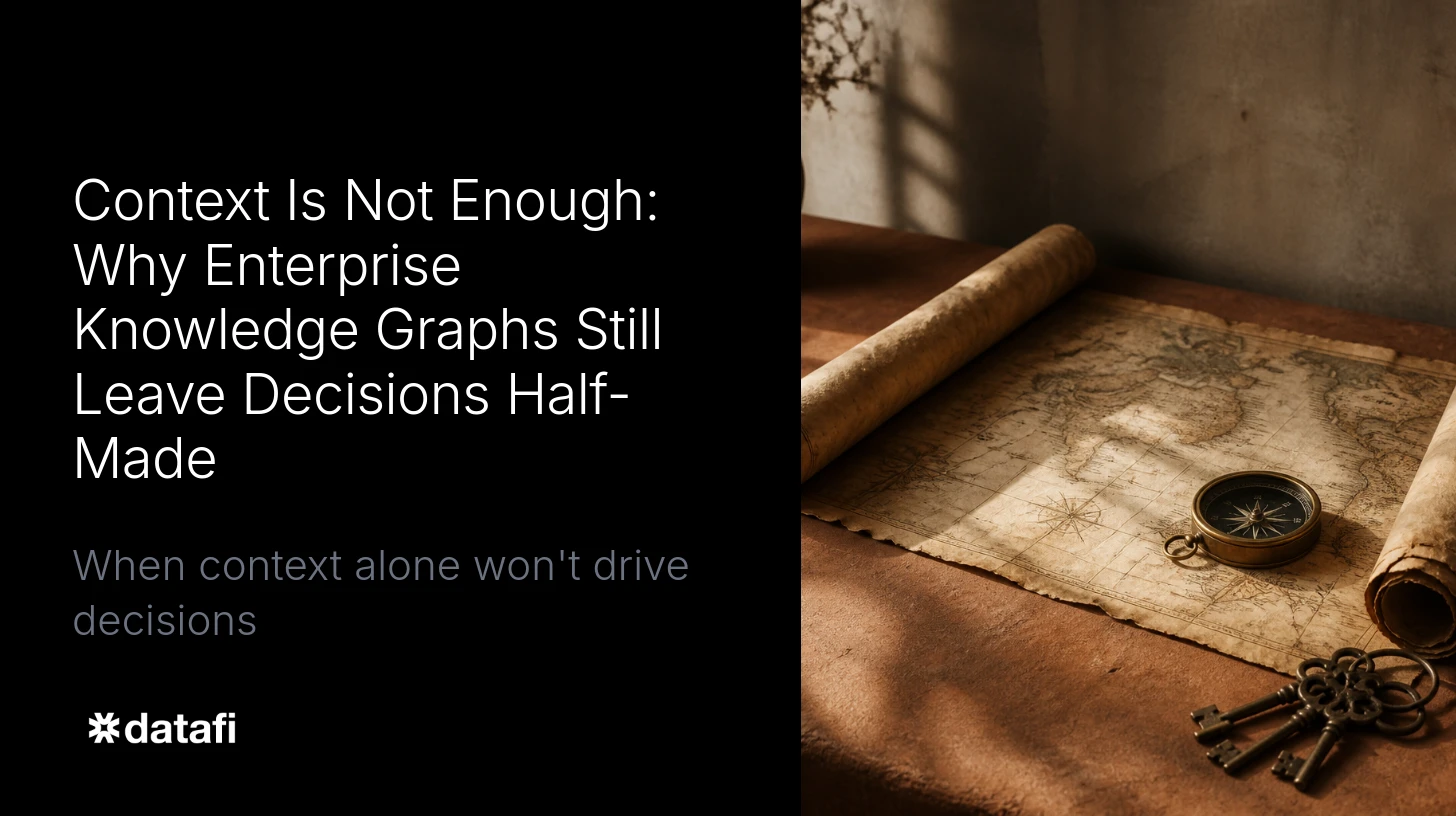
A knowledge graph maps what information exists and how it is connected, but enterprise AI needs a live, semantic layer of operational business context to move from insight to action. Context is the foundation, not the destination.
What a Knowledge Graph Does Well
To be precise about the limitation, it is worth first being precise about the capability.
An enterprise knowledge graph, at its best, is a structured representation of the relationships between information assets in an organization. It knows that a particular document was authored by a particular person, belongs to a particular project, was referenced in a particular meeting, and is related to a particular set of customer accounts. It can use those relationships to rank search results more intelligently, to surface related content proactively, and to give an AI assistant the ability to answer questions with more relevant context than a raw search index could provide.
This is genuinely more powerful than keyword search. It represents a material step forward in how enterprise information becomes accessible. The semantic layer on top of that graph, which allows a language model to reason about the relationships and produce synthesized answers rather than a list of links, adds further value.
For knowledge-intensive workflows, the value is real. Research tasks that previously required hours of document review can be completed in minutes. Onboarding processes that relied on institutional memory can be replaced with queryable systems. Questions with clear factual answers become far more accessible.
The Three Things a Knowledge Graph Cannot Do
The limitations emerge clearly when you examine what enterprise AI actually needs to do in order to transform how a business operates. A knowledge graph, however sophisticated, runs into structural constraints in three specific areas.
It maps what has been, not what is.
A knowledge graph is built from indexed content. It represents what has been created, stored, and connected. But business operations exist in a state of continuous change. Inventory levels shift. Customer commitments evolve. Carrier status updates arrive. Claims move through processing stages. The gap between an organization’s live operational state and the indexed representation of it in a knowledge graph is not a minor limitation. It is the difference between an AI system that can reason about what is happening right now versus one that can only reason about what was true when the index was last refreshed.
For operational decisions, this is not a small gap. The operations manager who needs to know whether a supply chain commitment is still achievable given what changed in the last two hours is not well served by a system whose operational awareness is a snapshot from this morning.
It understands relationships between documents, not relationships between operational realities.
A knowledge graph can tell you that a customer contract document and a production schedule document were both associated with the same account team. What it cannot tell you is that the production schedule is now incompatible with the delivery commitment in the contract, because the inventory drawdown triggered by a different customer order has reduced the available manufacturing capacity below what the commitment requires.
That kind of reasoning requires not just a map of documents but a live semantic model of operational state. It requires AI that understands what the numbers in those documents mean in relation to each other, not just that the documents are related. Document-level knowledge graphs are extraordinarily good at the former. They are architecturally limited when it comes to the latter.
It surfaces insights but cannot initiate action.
Even the most sophisticated knowledge graph, paired with the most capable language model, produces an output that ends at the boundary of the interface. It returns an answer. It may return a remarkably good answer. But the action that answer implies still requires a human to carry it across the gap between the AI interface and the operational system where the action needs to happen.
This boundary is invisible in demos and apparent in production. The moment an organization asks its AI system to do something rather than say something, the knowledge graph architecture reveals its limits. Triggering a reorder. Updating a case status. Rerouting a shipment. Escalating an exception to a specific team with the right context attached. These are actions that require connection to operational systems, governance over who can initiate what, and agents capable of executing multi-step workflows, not returning formatted text.
The Missing Layer: Operational Business Context
What enterprise AI needs, and what distinguishes a Business AI Operating System from an enterprise search platform, is a layer that is qualitatively different from a knowledge graph.
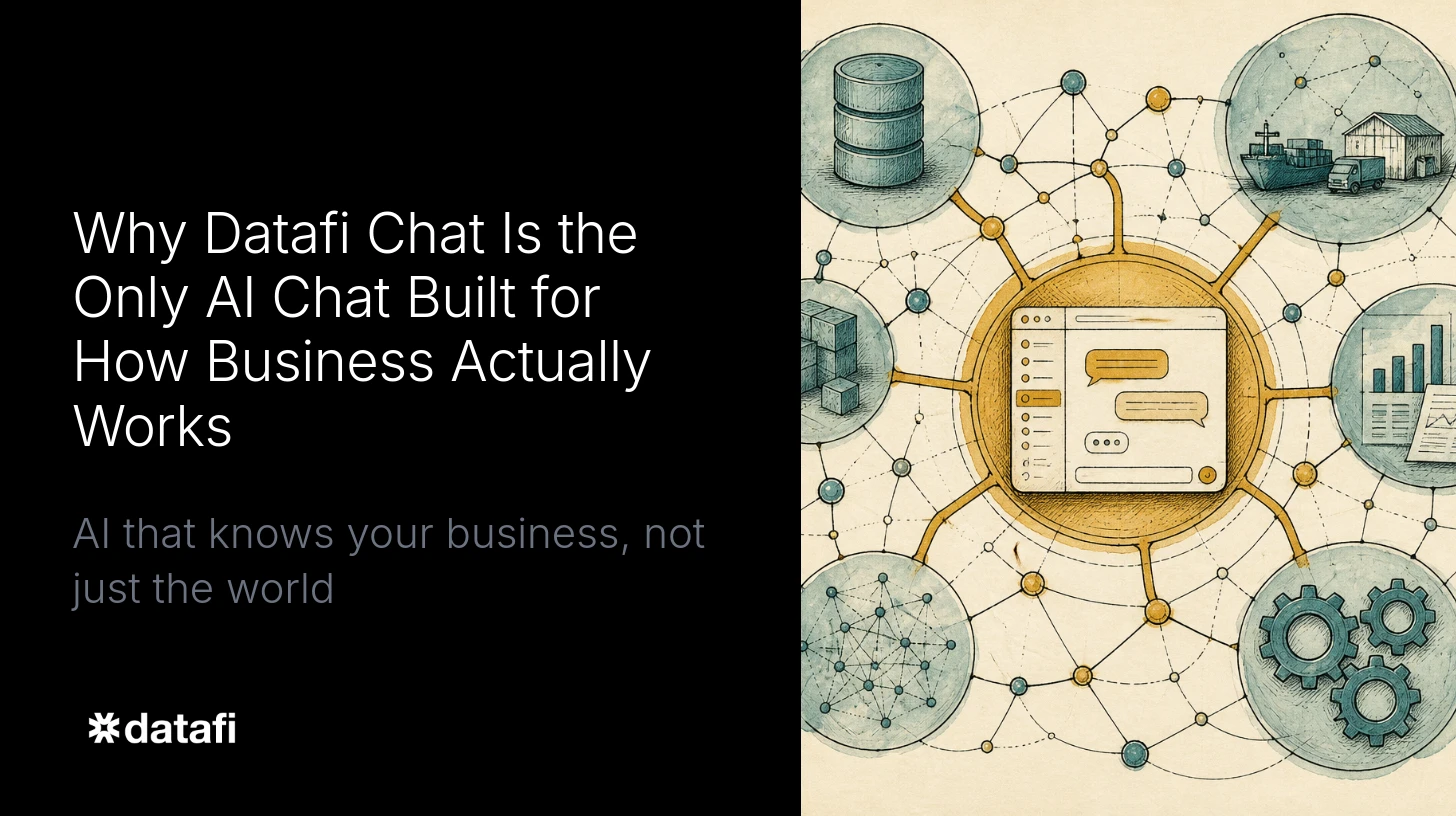
This layer is not a map of what information exists and how it is related. It is a live, semantic representation of what the business is doing, what it has committed to, what its constraints are, and what its data means in operational terms. We call this the global business contextual layer.
The distinction matters architecturally. A knowledge graph answers the question: what information do we have and how is it connected? The global business contextual layer answers a different question: what is true about our business right now, and what does that mean for what should happen next?
Building this layer requires more than indexing. It requires connecting to data at the source, without moving it, and building semantic models that represent what that data means in business terms. It requires maintaining live awareness of operational state across every connected system. It requires a governance model that knows not just who can access what information, but who can authorize what action in what context.
And critically, it requires AI agents that are built to operate within this layer, not to query an index. Agents that monitor operational state continuously, surface the exceptions that matter before they are asked about them, and execute the workflows that follow from what they discover.
The Gap in Practice
The knowledge graph ceiling becomes visible most clearly in specific operational scenarios, and it is worth walking through one in concrete terms.
An insurance company has deployed an enterprise search platform across its claims, policy, and billing systems. A claims adjuster can now query across all three systems in a single interface and get synthesized answers about a claimant’s history, policy terms, and prior claim activity. This is genuinely useful. It has reduced the time the adjuster spends gathering information before making a decision.
But the decision itself, and the workflow that follows from it, is still entirely manual. The adjuster reads the synthesized information. Applies their judgment. Opens the claims management system. Updates the case status. Triggers the payment workflow. Notifies the claimant. Documents the decision rationale. Each of these steps happens in a separate system, initiated manually by the adjuster, with no connection between the AI-synthesized insight and the operational systems where the consequence of that insight needs to be recorded and acted upon.
In a Business AI Operating System, the architecture is different from the ground up. The AI agent has live access to the claims data, the policy data, and the billing data simultaneously. It can evaluate coverage eligibility, payment thresholds, and fraud indicators in a single reasoning pass. It can initiate the appropriate workflow for claims that meet defined criteria, escalate the ones that require human review with the relevant context pre-assembled, and document the decision rationale automatically. The adjuster’s role shifts from information gatherer and form filler to judgment-exerciser on the cases that genuinely need human expertise.
The difference is not better search. It is a fundamentally different architecture.
Context Is a Foundation, Not a Destination
None of this diminishes the real progress that enterprise knowledge graphs represent. They are a meaningful step beyond the chaos of completely disconnected systems, and for organizations whose primary challenge is knowledge accessibility, they address a real and painful problem.
But the organizations that are thinking seriously about what AI can do for their operations over the next five years need to think about context differently. Not as the destination, but as the foundation for something larger.
Context is what makes AI capable of reasoning. But reasoning without action is analysis without consequence. The organizations that will build durable AI advantage are the ones that close the loop between context and action, not just the gap between searching and finding.
A knowledge graph is the map. A Business AI Operating System is the vehicle. Both have their place. But if you are trying to get somewhere, what matters is the vehicle.
Datafi is the Business AI Operating System for the modern enterprise. To learn how the global business contextual layer transforms enterprise AI from search and retrieval into operational intelligence, visit datafi.co or schedule a demo.
Next in the Series: The Coworker Illusion: AI Assistants vs. AI Agents That Actually Execute