


The idea of an AI coworker is one of the most seductive framings in enterprise technology right now. The image it conjures is powerful: an AI that knows your role, understands your team’s priorities, anticipates what you need before you ask, and does real work on your behalf. Not a chatbot. Not a search interface. A genuine intelligent colleague.
This framing is doing a lot of persuasive work in the enterprise AI market. And some of it is earned. The best AI assistant products today are meaningfully more useful than they were two years ago. They can synthesize across longer contexts, maintain more coherent awareness of ongoing work, and surface relevant information with enough precision that the experience sometimes does feel like working with a knowledgeable colleague.
But there is a distinction buried inside the coworker framing that rarely gets surfaced clearly, and it is a distinction with significant consequences for how organizations evaluate and deploy AI.
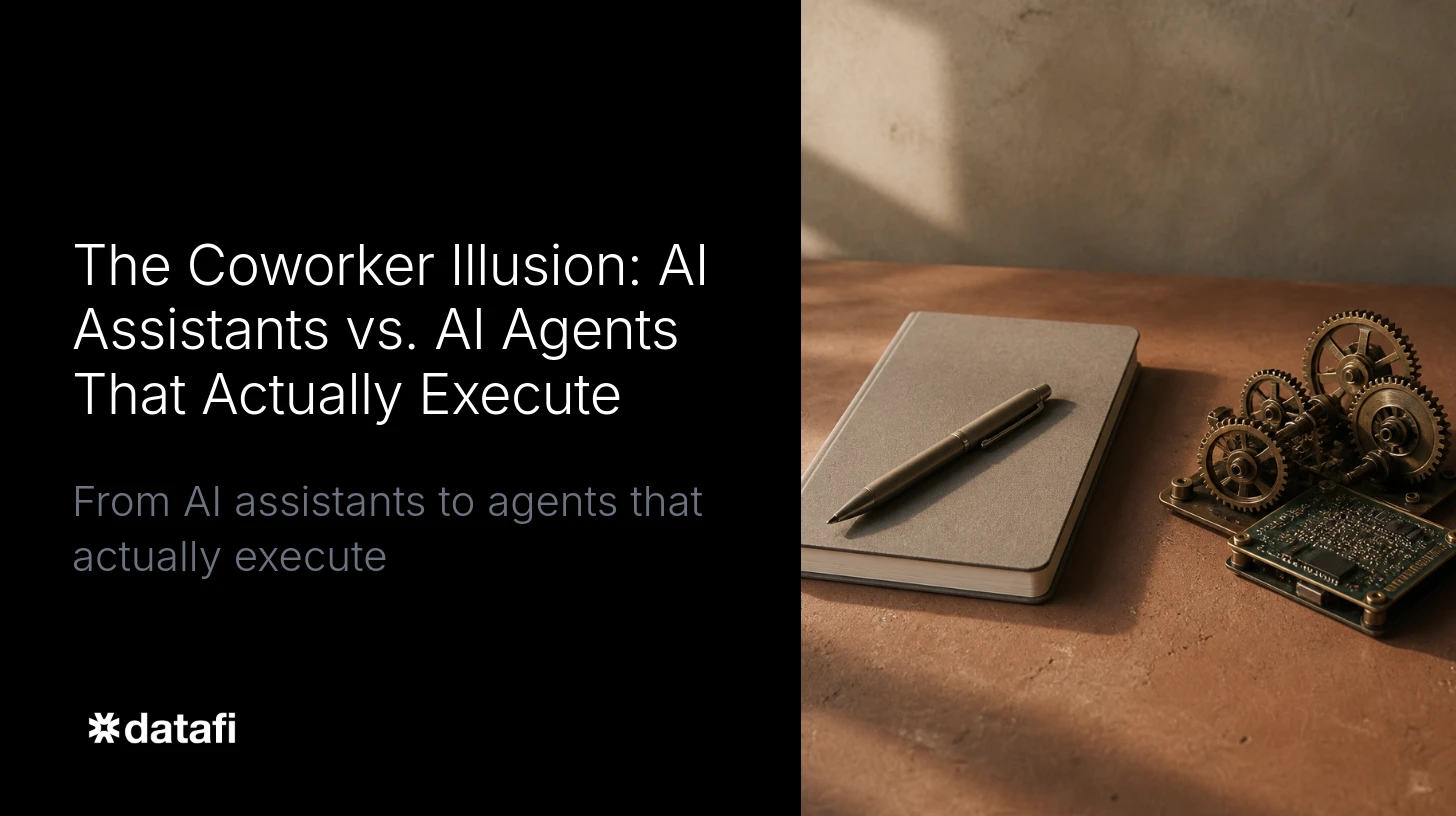
An AI that helps you work better is not the same as an AI that works. The first produces better-informed humans doing the same work. The second changes what the work actually is.
The Proactive Assistant: Genuinely Useful, Genuinely Limited
To understand the limitation, it is worth taking the proactive assistant model seriously on its own terms.
An AI assistant that has access to your calendar, your email, your project management tools, your documents, and your communication history can do things that feel genuinely impressive. It can tell you that the meeting you are about to join has an open action item from three weeks ago that was never closed, and that the person who owns it is presenting on a different project right now. It can flag that a document you are referencing has been updated since you last read it. It can draft a first pass of a status update based on what it knows about what the team has been working on.
These are real capabilities that create real time savings. The knowledge worker who has access to a well-configured AI assistant of this type does operate more effectively. They spend less time gathering context, less time on rote drafting tasks, less time tracking down information that exists somewhere in the organization but is not immediately accessible.
The limit is precisely the word “pass” in “first pass.” The assistant is a draft-generator, a surface-er, a synthesizer. Every output it produces requires a human to evaluate it, decide what to do with it, and then carry that decision across the gap between the AI interface and the operational systems where the consequence of the decision needs to be recorded and acted upon.
The human is still doing the work. The AI is making the human faster at some of the preparatory steps.
The Action Gap
The action gap is the distance between what an AI system produces and what the system of record needs to reflect. In most enterprise AI deployments today, this gap is bridged entirely by human effort.
The AI surfaces the insight. The human reads the insight. The human judges what to do. The human opens the relevant system. The human enters the data, updates the record, triggers the workflow, sends the communication, escalates the exception. At each step, the human is the integration point between the AI and the operational reality of the business.
This is not a design failure in the assistant model. It is a design feature. AI assistants are explicitly designed to support and augment human decision-making, not to replace it. They operate as inputs to human judgment, not as actors in operational systems.
The design choice reflects a genuine and reasonable set of concerns: accuracy, accountability, governance, and the appropriate scope of AI authority in enterprise operations. These concerns are valid.
But they should not be confused with a claim that the action gap is unavoidable. The question is not whether AI can be trusted to act in enterprise systems. The question is under what conditions, with what governance, and within what boundaries AI can be trusted to act. An AI that cannot be trusted to take any action without human approval is not a coworker. It is a very sophisticated research assistant.
What Autonomous Action Actually Requires
The organizations that move beyond the action gap do so not by deploying more capable assistants but by deploying a fundamentally different kind of system: autonomous agents operating within a governed, context-aware AI operating layer.
This distinction has three important dimensions.
Governance by architecture, not by oversight.
An AI assistant that requires human approval for every action is safe in the same way that a car with the speed limiter set to five miles per hour is safe: technically true, but not particularly useful. The organizations that want to deploy AI that actually executes need a governance model that allows action within defined boundaries without requiring a human in the loop for every step.
This means governance embedded in the architecture: access controls that define what each agent can do in what system under what conditions, audit trails that record what was done and why, escalation logic that routes the exceptions requiring human judgment without routing everything. Governance that is bolted on top of an assistant model as a manual override is not governance for autonomous action. It is a brake on capability.
Full operational context, not document context.
An agent that is reasoning from a knowledge graph or a set of retrieved documents is reasoning from a static representation of what exists. An agent that has live access to the operational state of the business, through a federated data layer that connects directly to every relevant system without requiring data movement, is reasoning from what is actually true right now.
The difference matters enormously for any action that depends on current state. An agent that updates an inventory record based on a document that was indexed this morning may be working with information that was already outdated when the index was built. An agent that reads directly from the inventory system at the moment of action is working with current reality.
Action execution, not action suggestion.
The output of a truly autonomous agent is not a recommendation that a human then acts on. It is a completed workflow, a triggered process, an updated record, an escalated exception with context attached. The agent is not a smarter version of the interface through which humans interact with systems. It is itself an actor in those systems, operating within the boundaries that governance has defined.
This requires deep integration with operational systems, not just the ability to retrieve from them. It requires an architecture where agents have the same ability to write, trigger, and update that they have to read and retrieve, subject to the governance policies that define appropriate authority.
The Coworker Test
There is a simple test for whether an AI system is genuinely functioning as a coworker or as a sophisticated assistant: when you leave for the night, does it keep working?
A proactive assistant that surfaces relevant information and drafts first passes is, by definition, waiting for you to be present and to initiate. It may proactively surface things when you open your inbox, but it is not monitoring your supply chain for exceptions at 3 AM and resolving the ones that fall within its governance boundaries before they become problems that arrive on your desk in the morning.
An autonomous agent operating within a Business AI Operating System is working continuously. It is monitoring the operational state of the business, processing the exceptions that fall within its authority, escalating the ones that require human judgment, and maintaining a live, audited record of what it has done and why. When you arrive in the morning, the work it could do has been done. What remains is the work that genuinely needs you.
This is a materially different value proposition. Not AI that makes your day more efficient. AI that changes what your day is.
The Productivity Trap
The enterprise AI market has a productivity framing problem. Because productivity gains are easy to measure and easy to communicate, they dominate the ROI conversation. Hours saved per employee. Reduction in search time. Faster first drafts. These are real numbers that are easy to put in a business case.
The transformation ROI, the value of AI that actually executes, is harder to quantify in advance but far larger in practice. The claims exception that was caught and resolved autonomously before it became a regulatory finding. The supply chain disruption that was rerouted at 2 AM before the customer commitment was missed. The underwriting decision that was made with complete risk context rather than the partial picture that was available before the system was connected.
These outcomes do not appear in a “hours saved” calculation. They appear in loss ratios, customer retention rates, operational cost structures, and competitive positioning. They are the outcomes that separate organizations that deployed AI to make their existing processes faster from organizations that deployed AI to build structurally different operations.
The coworker framing is aspirational. The question is whether the architecture behind it is built to deliver on the aspiration, or whether it will deliver a better assistant and leave the actual work, the execution, the action, the transformation, still sitting on the human side of the action gap.
Datafi is the Business AI Operating System for the modern enterprise. To see how autonomous agents operating within a governed, context-aware AI platform transform enterprise operations, visit datafi.co or schedule a demo.
Next in the Series: Governed by Architecture vs. Governed by Policy: A Fundamental Difference in Enterprise AI Safety