


Series: Salesforce Agentforce vs. Datafi | Part 2 of 6
Governance has become one of the most frequently used words in enterprise AI conversations. Every major platform claims to have it. Analyst reports demand it. Procurement teams include it in evaluation criteria. Legal and compliance teams insist on it before any deployment reaches production.
But governance is not a single thing. And the difference between how Salesforce Agentforce implements governance and how Datafi implements governance is not a difference of degree. It is a difference of architectural philosophy, and it has significant consequences for enterprise risk.
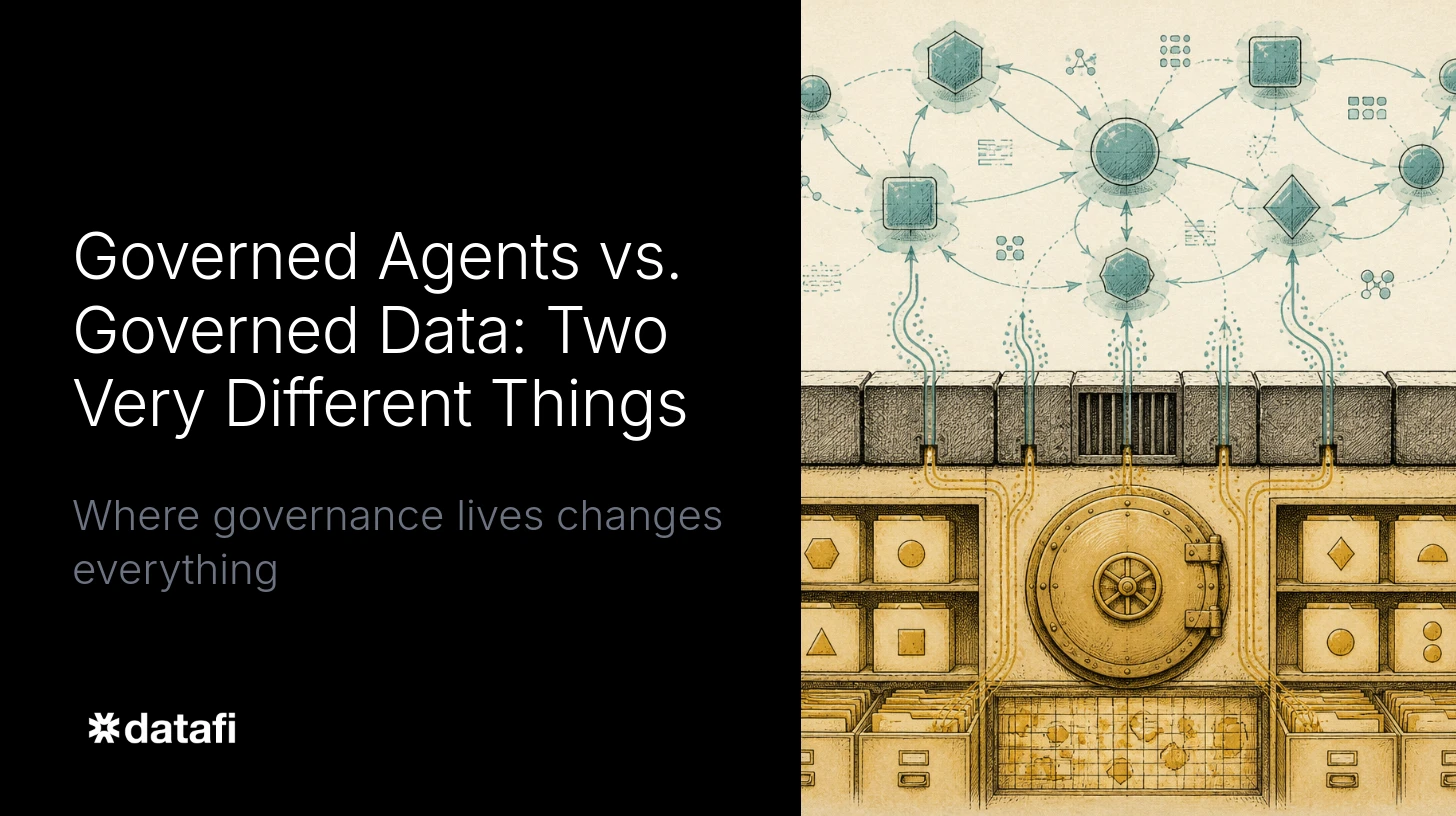
Agent-layer governance controls what AI is allowed to do. Data-layer governance controls what AI is allowed to see. For enterprise compliance teams, the second question must come first, because access controls that arrive after data retrieval arrive too late.
What Agentforce Means by Governance
Salesforce has made genuine investments in trust and safety for Agentforce. The platform includes what Salesforce calls the Trust Layer, a set of controls designed to ensure that agents behave predictably and within defined boundaries.
In practice, this means controlling what actions an agent is permitted to take. Limits on where agents can improvise. Guardrails on autonomous decision-making to ensure critical actions follow defined, predictable paths. Audit logging of agent activity. Role-based access controls that mirror the permission structures already in place in Salesforce.
This is agent-level governance. It answers the question: what is the AI allowed to do?
That is a meaningful and necessary question. But it is not the only governance question that matters. And for many enterprise risk and compliance teams, it is not even the first one.
“Controlling what the AI does is important. Controlling what the AI can see is fundamental.”
What Enterprise Risk Teams Actually Worry About
When security, compliance, and risk teams evaluate AI deployments, their first concern is rarely agent behavior. Their first concern is data exposure.
Who can access what data? Under what conditions? Can an AI surface a customer’s financial history to an employee who should not have access to it? Can a prompt from a sales rep cause an agent to return information from a regulated dataset that carries legal restrictions on its use? Can a well-meaning query create a compliance violation because the underlying data has classification controls the agent does not respect?
These are data governance questions. And they require data-layer answers, not agent-layer answers.
Agent-layer governance operates after data has already been retrieved. It controls what the agent does with information once it has access to that information. But if the wrong data reached the agent in the first place, the governance control arrived too late.
Where Datafi Sentinel Operates
Datafi Sentinel is the governance, policy, and security layer embedded in the Datafi platform. Its design premise is different from agent-level guardrails because it operates at the data layer itself, before data reaches any agent, any workflow, or any user-facing interface.
This means that access policies, data classification controls, role-based permissions, and compliance rules are enforced at the point of data access, not at the point of agent action. An agent running on the Datafi platform cannot retrieve data that the governance layer has determined the requesting user or workflow should not see. The restriction is structural, not behavioral.
The practical consequences are significant. A regulated dataset carries its access controls with it regardless of which agent queries it, which workflow invokes it, or which user initiates the interaction. Sensitive customer information respects the permission boundaries of the employee who initiated the session, enforced at the data layer rather than as a downstream behavioral constraint. Compliance policies that apply to specific data categories are enforced consistently across every AI interaction, without relying on agents to interpret and apply those policies correctly.
The Compounding Risk of Agent-Layer Governance
There is a deeper problem with relying on agent-layer governance as the primary risk control mechanism. Agents are reasoning systems. They interpret context, draw inferences, and generate outputs based on the information available to them. When the governance objective is to prevent unauthorized information disclosure, a reasoning system is a fragile control surface.
Even carefully constrained agents can surface sensitive information indirectly. An agent that has retrieved a confidential dataset to answer one part of a query may incorporate elements of that data into an adjacent response in ways that were not anticipated by the guardrail design. An agent operating across multiple data sources may synthesize information in ways that create new exposures that none of the source-level restrictions contemplated.
This is not a theoretical risk. It is a well-documented challenge in AI systems operating across complex data environments. The mitigation is not smarter agent guardrails. The mitigation is ensuring that the data the agent can access in the first place has already been filtered, classified, and governed according to the organization’s policy framework.
Two Governance Models, Two Risk Postures
The contrast between these two approaches becomes clearest when considered from an audit perspective.
Agent-layer governance produces audit trails of agent actions. It can demonstrate that the agent followed its behavioral constraints. It can show that approved workflows were executed. What it cannot always demonstrate is that the data retrieved to produce those outputs was appropriate for the requesting user, in compliance with classification policies, or consistent with regulatory access controls.
Data-layer governance produces audit trails at the point of data access. It can demonstrate that every piece of information that reached an agent or a user was governed by the organization’s policy framework before it was returned. The audit is not of agent behavior. It is of data access itself, which is where compliance obligations almost always attach.
For organizations operating in regulated industries, this distinction is not academic. In insurance, financial services, healthcare, and life sciences, data access controls are regulatory requirements, not best practices. Governance that operates at the agent layer may satisfy a product demo. Governance that operates at the data layer satisfies a compliance audit.
The Unified Stack Advantage
Datafi’s ability to enforce governance at the data layer is a direct consequence of the platform’s architecture. Because Datafi functions as a unified operating system across the complete data ecosystem, governance policies can be applied consistently regardless of which data source is being accessed, which agent is running, or which user is interacting with the system.
In contrast, governance in a CRM-native architecture like Agentforce must be reimplemented for each data source that gets connected, each integration that gets built, and each workflow that touches data outside the native platform. The consistency of governance degrades as the surface area expands.
This is not a criticism of Salesforce’s engineering. It is a consequence of building governance as a feature of a specific platform rather than as a foundational layer beneath all AI operations.
What This Means for Enterprise Buyers
When evaluating enterprise AI platforms for governed deployments, the questions to ask are not limited to what controls the agent respects. The more fundamental questions are:
Where does data governance enforcement occur? At the data access layer, or at the agent behavior layer?
What happens when data with classification controls is accessed by a workflow the governance designers did not anticipate? Are the controls structural, or are they behavioral?
What does your audit trail actually demonstrate? Agent compliance, or data access compliance?
How does governance scale as the data environment grows? Is it consistent across all sources, or does it require reimplementation for each new integration?
The answers to these questions determine whether your AI governance posture will hold in production, at scale, under regulatory scrutiny, and in the complex data conditions that every real enterprise operates in.
Datafi enforces governance at the data layer across your complete enterprise data ecosystem, ensuring that every AI agent, workflow, and user interaction operates within your organization’s policy and compliance framework. Learn more at datafi.co
Next in this series: Salesforce-Native Is a Feature and a Ceiling