


Series: Salesforce Agentforce vs. Datafi | Part 6 of 6
Enterprise AI purchasing decisions are rarely made on total cost. They are made on initial price, which is almost always lower than total cost, and on the assumption that value will scale proportionally with investment. Both assumptions deserve scrutiny.
The Salesforce Agentforce pricing model is built on a logic that made sense for traditional software: capability is modular, and you pay for what you use. Each function has its own add-on. Each integration requires its own license. Each expansion of scope requires a new procurement conversation.
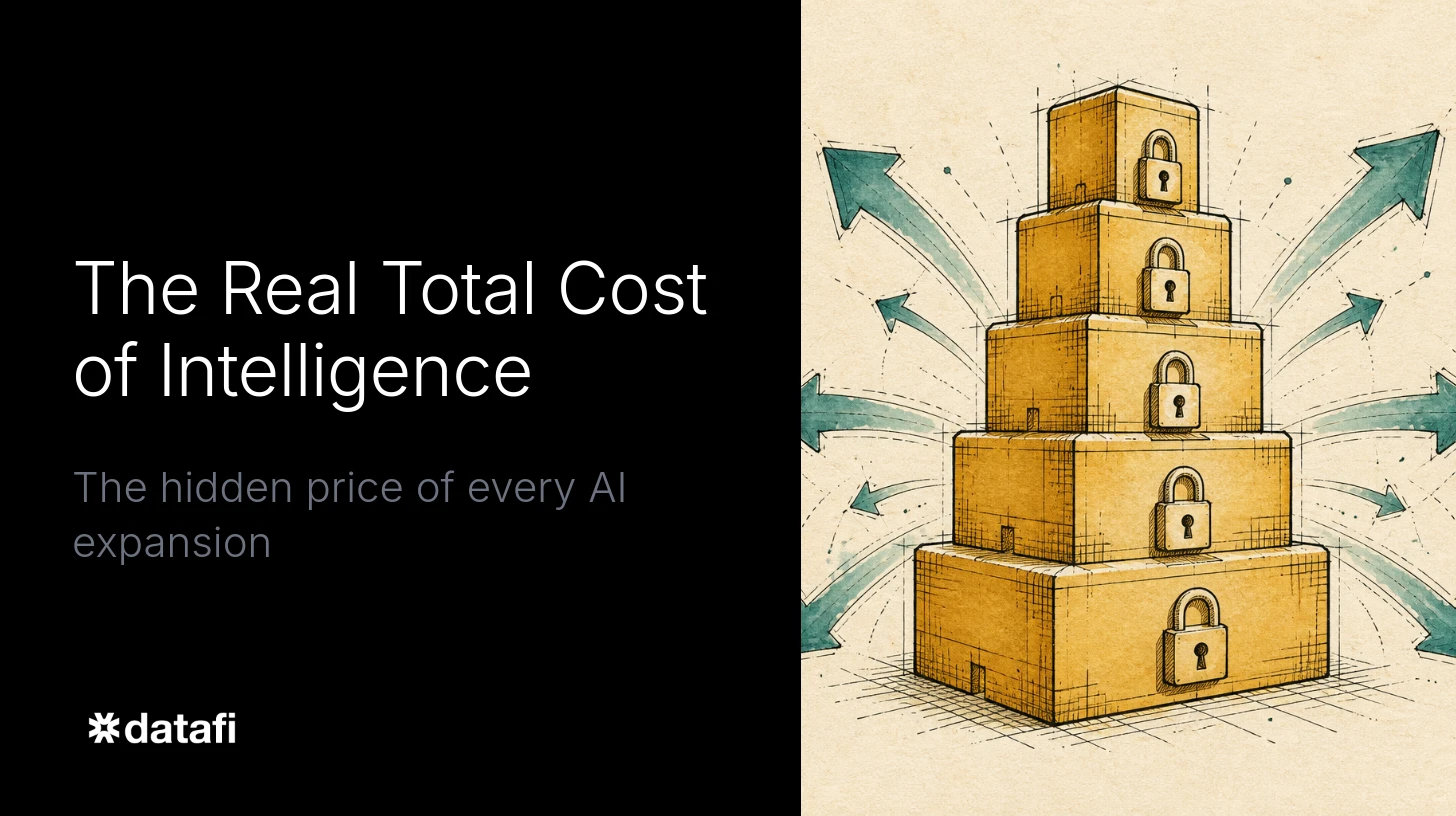
This model has an important property that is rarely discussed in vendor conversations. Cost does not scale with value. It scales with scope. And for organizations whose business problems span multiple functions, multiple data sources, and multiple user populations, scope and cost grow together in ways that initial pricing conversations do not reveal.
In a modular AI stack, cost does not scale with value. It scales with scope. Every expansion of function, data, or users triggers a new procurement cycle, making the total cost of intelligence far higher than any initial proposal reveals.
How Agentforce Pricing Actually Works
Agentforce is not a single product. It is an ecosystem of capabilities, each with its own licensing requirements. Agentforce for Sales, Agentforce for Service, Agentforce for Marketing, Agentforce for Commerce, and the emerging function-specific modules each carry separate pricing. Connecting Agentforce to external intelligence surfaces, such as ChatGPT Enterprise, requires additional licenses from additional vendors. Extending capability through Slack requires Slack licensing at the appropriate tier.
Below the product layer, the consumption model adds another dimension. Agentforce charges by conversation, by agent action, and by data volume in various configurations depending on the specific capability. Organizations that deploy AI broadly, which is the stated goal of any enterprise AI strategy, will see consumption costs scale with usage in ways that fixed-fee pricing does not.
The integration layer adds a third cost dimension. Connecting Agentforce to the non-Salesforce data sources that the earlier articles in this series identified as essential to complete business context requires either Salesforce’s own integration tools, third-party connectors, or custom development. Each of these carries cost, implementation time, and ongoing maintenance burden.
The Scope Tax
There is a concept worth naming that does not appear in any vendor pricing sheet: the scope tax. It is the incremental cost, time, and complexity that accrues each time you try to extend platform-native AI beyond the boundaries it was designed for.
In the Agentforce model, the scope tax manifests in several ways.
Functional expansion: Each new business function you want to serve with AI requires a new Agentforce module, a new implementation engagement, and a new configuration effort. Sales to Service is one procurement cycle. Adding Marketing is another. Adding Commerce is another. The cost of serving the full organization compounds with each addition.
Data expansion: Each non-Salesforce data source you need to incorporate requires integration work. Some of this can be done with Salesforce’s native connectors. Some requires custom development. All of it requires ongoing maintenance as source systems change. The cost of complete data context is not a one-time integration cost. It is a recurring infrastructure cost.
User expansion: Agentforce licensing is seat-based for many of its capabilities. Extending AI to every employee who could benefit, which is the genuine value opportunity, requires licensing every seat. For mid-to-large enterprises, the user population that could derive value from AI is substantially larger than the Salesforce-licensed population. The gap between those two numbers is the scope tax on accessibility.
Expertise expansion: Every capability extension requires Salesforce expertise to implement and maintain. Whether that expertise is internal or sourced from an SI partner, it carries cost. And because Salesforce expertise is genuinely scarce relative to demand, it carries premium cost.
The Hidden Cost of Partial Answers
There is a cost category that never appears in technology procurement models but that dwarfs most line items in the actual return calculation: the cost of decisions made on incomplete information.
The earlier articles in this series documented the specific ways that Agentforce’s data boundary produces partial answers. Partial answers to business questions do not produce half the value of complete answers. They frequently produce negative value, because they create false confidence and lead to action based on incomplete understanding.
The sales leader who concludes that territory underperformance is a pipeline problem when the real issue is a fulfillment failure will invest in the wrong intervention. The CFO who sees a revenue analysis where she needed a profitability analysis will make capital allocation decisions on incorrect premises. The operations manager who gets a CRM-centric view of a supply chain problem will focus effort in the wrong place.
None of these costs appear in the Agentforce contract. All of them are real. And they scale with the gap between the data the AI can see and the data the problem actually requires.
What a Unified Stack Changes About the Cost Model
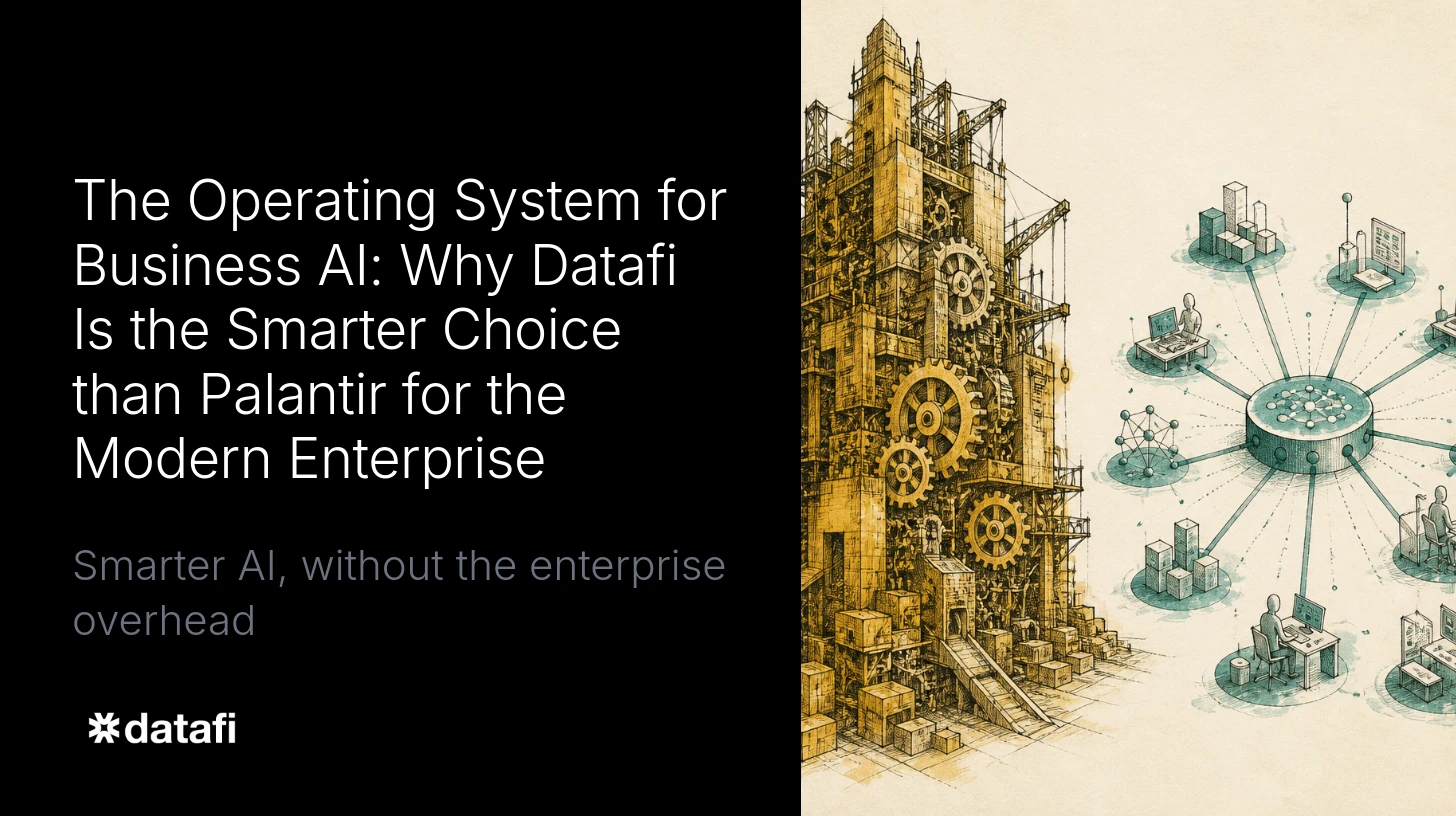
Datafi’s pricing model reflects a different architectural premise. Because the platform is a unified operating system rather than a collection of function-specific modules, the cost structure does not compound with scope.
Connecting an additional data source does not require a new module procurement. Serving a new user population does not require a new licensing tier. Extending AI capability to a new business function does not require a new implementation engagement. The platform was designed to span the complete data ecosystem, serve every user population, and support every business function as a single operating system, and the pricing reflects that design.
This has a specific consequence for the total cost calculation. As scope expands, the incremental cost in a unified stack model approaches zero, because the capability to serve that scope was built into the architecture from the beginning. In a modular stack model, the incremental cost of each expansion is the full cost of that module, plus integration, plus expertise.
For organizations with a genuinely enterprise-wide AI ambition, this difference is not marginal. Across a three-to-five year horizon, the total cost of intelligence in a modular model grows substantially faster than the value it delivers, because the scope tax compounds at every expansion point.
The Implementation Timeline Dimension
Total cost of intelligence is not only a licensing and maintenance calculation. It includes the cost of time.
The implementation timeline for Agentforce varies significantly by scope. A focused deployment within a single Salesforce cloud, with an existing Salesforce foundation, an experienced internal admin team, and a bounded use case, can deliver initial value relatively quickly. Expanding to multiple clouds, integrating non-Salesforce data sources, and building toward the complete business context that genuine problem-solving requires extends the timeline substantially.
Organizations that have deployed enterprise AI broadly know that the cost of time is not trivial. Every month of implementation time is a month of decisions made without AI support, a month of competitive exposure to organizations that have already deployed, and a month of ROI deferral on the initial investment.
Datafi’s architecture compresses the implementation timeline because the platform does not require function-by-function deployment. Data sources are connected to a single operating layer. Governance is configured once and applies consistently. The intelligence layer serves every function from a shared foundation. The expansion from an initial use case to enterprise-wide deployment is a data connection and governance configuration exercise, not a re-implementation.
Asking the Right Questions Before the Proposal
The procurement conversations that produce the most accurate total cost picture are those that begin with scope rather than price. Before evaluating any enterprise AI platform, the questions that reveal the real cost structure are:
What is the all-in cost to serve every employee who would benefit from AI, not just the ones in the initial use case? This surfaces the user expansion cost.
What does it cost to incorporate each additional data source we need, including integration, maintenance, and refresh? This surfaces the data expansion cost.
What is the cost of the Salesforce or platform expertise required to build, maintain, and extend the AI layer? This surfaces the expertise cost, which is often the largest line item that does not appear in vendor pricing.
What is the cost of the decisions made on incomplete information while we wait for the full scope to be implemented? This is the hardest to quantify and the most important to acknowledge.
The answers to these questions, compared against the total cost of a unified operating system approach, tend to produce a different conversation than the one that starts with per-seat licensing.
The Compounding Advantage
This series has explored six dimensions of the architectural difference between Salesforce Agentforce and Datafi: data boundary, governance model, platform lock-in, autonomy ceiling, user accessibility, and total cost of intelligence. Each dimension is meaningful on its own. Together, they describe a compounding advantage that grows over time.
Organizations that build AI on a unified data operating system gain access to insights that platform-native AI cannot produce, make decisions from complete context rather than partial views, extend AI to every employee rather than every Salesforce user, maintain governance that scales with capability rather than degrading under it, and pay for scope once rather than at every expansion point.
These advantages do not announce themselves in a single deployment. They accumulate over quarters and years, as the organization that chose architecture over convenience finds itself operating with a fundamentally different quality of intelligence than the organization that chose the fastest path to a CRM-native AI demo.
Enterprise AI is not a feature decision. It is an architectural one. And architectural decisions made today will determine what is possible in three years in ways that are very difficult to reverse.
The organizations that will lead with AI are not those that deployed the most features. They are those that built the right foundation.
Datafi is the operating system for business AI. A unified data foundation, structural governance, autonomous agents, and a business user interface that serves every employee, priced as a single platform rather than an expanding collection of modules. Learn more at datafi.co