


Owning Your AI Future, Post 3 of 6
There is one form of AI vendor lock-in that nearly every enterprise worries about, and it is the one that matters least.
Ask a technology leader what makes them nervous about committing to an AI platform, and the model comes up first. Which large language model are we betting on? What if we pick the one that falls behind? What happens when something better ships next quarter? The questions are reasonable, and the anxiety behind them is real. But the anxiety is pointed at the wrong layer.
In the previous post we mapped the five places lock-in actually accumulates, embeddings, orchestration, governance, egress, and context, and noted that none of them is the model. This post explains why. The model is the most visible part of the stack and the least durable place to build an advantage, and a strategy that treats it as the foundation has an expiration date already printed on it.
Models are converging into commodities that reset every few months. Welding your architecture to one does not buy you an edge; it makes you inherit that provider’s pricing, deprecation schedule, and roadmap, and it leaves you unable to adopt the better model the day it arrives.
The premise worth questioning
The conventional logic runs like this: the model is the intelligence, the intelligence is the product, therefore choosing the right model is the decision that matters most. Get it right and you have a competitive edge. Get it wrong and you are behind.
It is worth pausing on that, because it describes a world that briefly existed and no longer does. There was a moment, not long ago, when the gap between the best model and the next-best was wide enough to be a genuine strategic variable. Choosing well meant access to capability your competitors could not match. In that world, betting on a model made sense, because the bet could pay off.
That world is closing. The frontier is converging. Capable models now ship from multiple providers on a cycle measured in months, each leapfrogging the last, each narrowing the distance to the rest. The thing that was once a durable differentiator has become a fast-moving commodity, and you cannot build a lasting advantage on a commodity that resets every quarter. The premise that the model is the moat made sense in a world that is already gone.
What betting on one model actually costs
When an organization welds its architecture to a single model provider, it does not just choose an intelligence. It inherits everything attached to that provider, and the inheritance is the part the decision tends to ignore.
You inherit the provider’s pricing, and the changes to it you do not control. You inherit its latency and its rate limits. You inherit its deprecation schedule, the day it retires the version your workflows were tuned against, on its timeline, not yours. You inherit its roadmap, its priorities, its outages, its policy decisions about what the model will and will not do. None of these were what you thought you were buying. All of them come with the bet.
And here is the trap that makes it worse: the model is rarely locked in by itself. It is locked in through the layers around it. Your orchestration logic is written against this model’s behavior. Your prompts are tuned to its quirks. Your context is shaped to its window. So when a better model ships, the very event you were anxious about, you discover you cannot actually adopt it, because adopting it means reworking everything built on top of the one you have. The anxiety was correct. The defense was backwards. You did not protect yourself by choosing carefully. You trapped yourself by building rigidly.
The real differentiator was never the model
If the model is not the moat, what is?
The answer is everything the model touches but does not own. Your data, connected and governed. The business context that tells a model what your entities mean, how your operations actually run, what a correct action looks like in your specific enterprise. The orchestration that turns raw capability into reliable behavior inside your workflows. The governance that makes any of it safe to deploy at scale. These are the assets that compound over time, that competitors cannot copy because they are built from your business, and that do not reset when a new model ships.
A model is a general-purpose reasoning engine available to anyone with a contract. Your context is yours alone. That is the asymmetry that actually matters, and it is the inverse of where most enterprises focus their attention.
They agonize over the interchangeable part and take the durable part for granted.
This is the distinction that runs through everything Datafi builds. AI that answers questions can run on any capable model, because answering is largely a function of the model’s general intelligence. AI that solves your problems depends on the layers underneath, the context, the governance, the connection to where your business runs, and those are precisely the layers a single-model bet does nothing to build. Choosing a model is choosing an engine. The vehicle is everything else, and the vehicle is what carries you.
Interchangeability as an architectural requirement
Once you see the model as a commodity rather than a moat, the design implication is direct: model interchangeability should be a first-class requirement of your architecture, not an afterthought.
That means the layers that hold your real value, context, orchestration, governance, the connection to your systems, must sit above the model rather than inside it, written against a stable foundation you own rather than against one provider’s runtime. When the model is a component you can swap rather than a foundation you are anchored to, the quarterly leapfrogging of the frontier stops being a threat and becomes an advantage. A better model ships, you adopt it, your accumulated context and governance carry over unchanged, and you capture the improvement without rebuilding anything beneath it.
This is the posture Datafi was built around. The global business contextual layer, the orchestration, and the governance framework are model-independent by design. Models connect to the operating system; the operating system is not welded to any of them. The intelligence underneath your AI, the part that is genuinely yours, persists across model generations rather than being held hostage to a single one. You get to treat the frontier the way you should: as a supply of improving components you select from, not a vendor you are married to.
The result inverts the original anxiety. The leader who asked “what if we bet on the wrong model” was asking the right question from the wrong stance. The correct answer is not to bet more carefully. It is to build so that the bet does not matter, so that any model can be the right model, because none of them is load-bearing.
The bet you should actually be making
There is a bet worth making in enterprise AI, but it is not on a model.
The bet worth making is on the layers that compound: that your data, your context, and your governance will be worth more next year than this year, accumulated on a foundation you control. That bet pays off regardless of which provider leads the frontier in any given quarter, because it was never staked on the frontier in the first place. It was staked on the part of the system that is unambiguously yours.
The enterprises that win the next few years of AI will not be the ones that picked the best model. The model they picked will have been surpassed three times over by the time it matters. They will be the ones that built so the best model is always one swap away, and so the value that makes their AI genuinely lives somewhere a model release can never reset.
The model is not the moat. It was never going to be. The moat is everything you were taking for granted while you worried about the model.
Post 4 in this series turns to the layer that should worry compliance leaders most: why governance implemented inside a vendor’s proprietary framework is lock-in disguised as safety, and what it means for governance to be architecture that travels with your data rather than a control plane you would have to rebuild from zero to leave.
Datafi is a Business AI Operating System designed for mid-enterprise organizations that need the full power of an integrated AI platform without surrendering ownership of the data, context, and governance that make AI worth adopting. Learn more at datafi.co.
Series: Owning Your AI Future
Part 1, The Trap: Rethinking the Premise
Post 1: The Hidden Cost of The All-In-One AI Platform
Post 2: Five Ways AI Vendor Lock-In Shows Up in Your Data Layer
Part 2, The Tradeoffs: An Honest Accounting
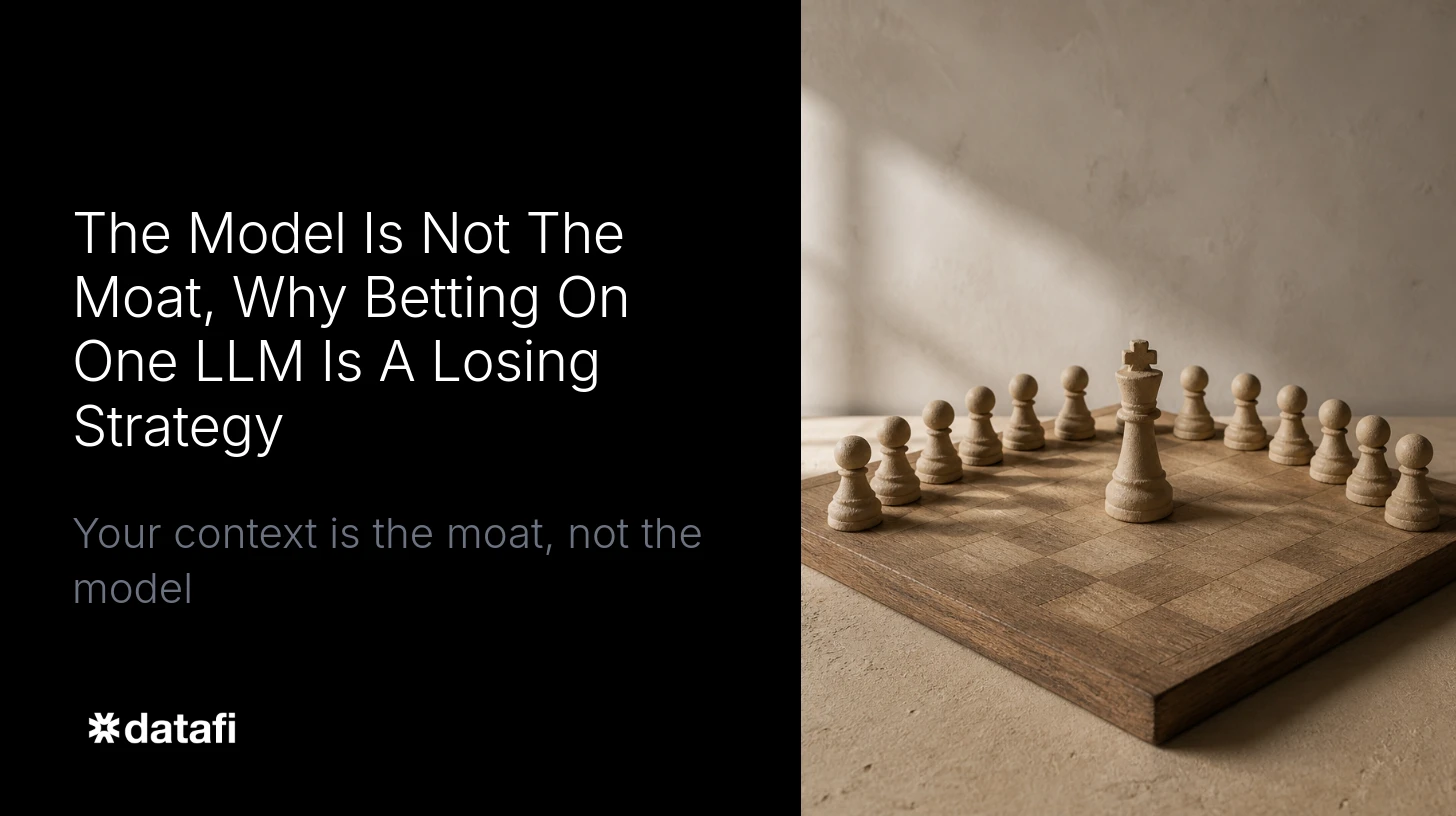
Post 3: The Model Is Not the Moat, Why Betting on One LLM Is a Losing Strategy
Post 4: Governance You Cannot Take With You Is Not Governance
Post 5: Build, Buy, or Get Locked In, The False Choice in Enterprise AI
Part 3, The Path: A Pragmatic Roadmap
Post 6: Owning Your AI Future, The Case for an Open Contextual Layer