


The All-In-One Trap - Post 1 of 6
Ask ten enterprise technology leaders why they chose a single AI platform to run their whole stack, and most will give you some version of the same answer: one vendor is simpler. One contract, one integration, one number to call when something breaks. It de-risks the program. It gets us to value faster.
Then ask them what it would take to leave.
The answers get quieter. They describe context and embeddings stored in formats that do not travel. Orchestration logic written against a runtime that means nothing anywhere else. Governance rules locked inside a framework they do not own and cannot export. Egress terms that make extraction expensive by design. And underneath all of it, a dawning recognition that the platform they adopted for speed has become the platform they cannot afford to reconsider.
The gap between what the all-in-one platform promises and what it eventually costs is not usually a gap in execution. Well-run organizations with capable vendors fall into it just as often as anyone else. It is a gap in the premise, and the premise is the part almost no one stops to question.
The all-in-one AI platform trap is not a failure of execution. It is a failure of premise. You are not locked in at purchase; you are locked in a little more with everything that works, until reconsidering the vendor is no longer a decision the organization can practically make.
The assumption that drives the cost
The conventional case for the single-vendor AI platform rests on an assumption so reasonable it rarely gets stated out loud: that consolidating everything with one vendor reduces risk, and that the path to enterprise AI runs through handing the whole problem to a partner who will absorb it.
It is worth pausing on that, because it is doing an enormous amount of work. If one vendor owning everything reduces risk, then consolidation is the safe choice, and every dependency that follows - the proprietary formats, the locked governance, the switching cost - is simply the price of simplicity. The premise makes the dependency feel prudent.
But consolidation and risk reduction are not the same thing. A vendor absorbing your complexity is not the same as a vendor owning it, and the all-in-one model quietly converts one into the other. When a single platform owns your model endpoints, your orchestration, your governance, and the format your context lives in, it has not just spared you the work of building those things. It has made itself the only place those things can exist.
That is not a broken arrangement. It works, often impressively, on day one. But it is an arrangement that has accumulated something the business case never priced: a dependency that deepens with every success, until reconsidering the vendor is no longer a decision the organization can practically make.
What consolidation actually buys, and what it actually costs
When an organization commits to a single AI platform, the case is built around convenience. One throat to choke. One roadmap to follow. Faster time-to-value because nothing has to be integrated by hand. These are real benefits, and for the right situation a consolidated platform is genuinely the correct decision. We will treat that case fairly later in this series, because it exists and it matters.
What the business case tends to understate is the shape of the cost. The cost of the all-in-one platform is not the license. The cost is deferred, and it arrives later, when conditions change - and conditions always change.
A better model ships, and you cannot adopt it without re-architecting, because your logic was written against one vendor’s runtime. The vendor revises its pricing, deprecates a capability you depend on, or reorders its roadmap around priorities that are not yours, and you have no leverage, because the switching cost is now prohibitive. A compliance requirement shifts and your governance controls cannot move with it, because they were never yours to move. Each of these is survivable alone. Together, over time, they describe an organization whose AI strategy is no longer its own.
Here is the uncomfortable arithmetic. The dependency does not appear on the day you sign. It compounds. Every new agent, every connected source, every workflow you build on top of the platform deepens the commitment and raises the cost of leaving. You are not locked in at purchase. You are locked in a little more with everything that works.
The integration problem is real. The conclusion is wrong.
None of this is an argument for tool sprawl. The pressure driving consolidation is legitimate. Enterprises genuinely cannot run AI on a pile of disconnected point tools stitched together by hand, with governance renegotiated for every use case and context scattered across a dozen systems. The pain that sends organizations toward a single vendor is real, and it is widening.
The error is not in feeling the pressure. The error is in the inference.
The conventional logic runs: disconnected tools create chaos, therefore we must consolidate everything with one vendor. That inference only holds if integration and ownership are inseparable - if the only way to get a unified platform is to surrender the freedom to swap the pieces inside it.
That used to be closer to true. It is no longer true. And the entire premise of the all-in-one trap depends on no one noticing that it has stopped being true.
A different question
What changes everything is asking a more precise question. Not “which vendor should own our entire AI stack,” but “what do we actually need a unified platform to give us that a pile of point tools cannot.”
Asked that way, the answer is almost never “a single owner for everything.” The answer is that the business needs its data connected once, its governance defined once and enforced everywhere, and a usable experience on top - while retaining the freedom to swap the models, tools, and infrastructure underneath as the market moves.
Notice that none of those requirements demand surrendering ownership of your data, your context, or your governance to a vendor. They demand integration, not captivity. The unification is the thing you want. The lock-in is the thing the all-in-one model smuggles in alongside it, and they are separable.
You do not need to surrender ownership to escape fragmentation. In many cases, surrendering it is what fragmentation’s loudest cure quietly costs you.
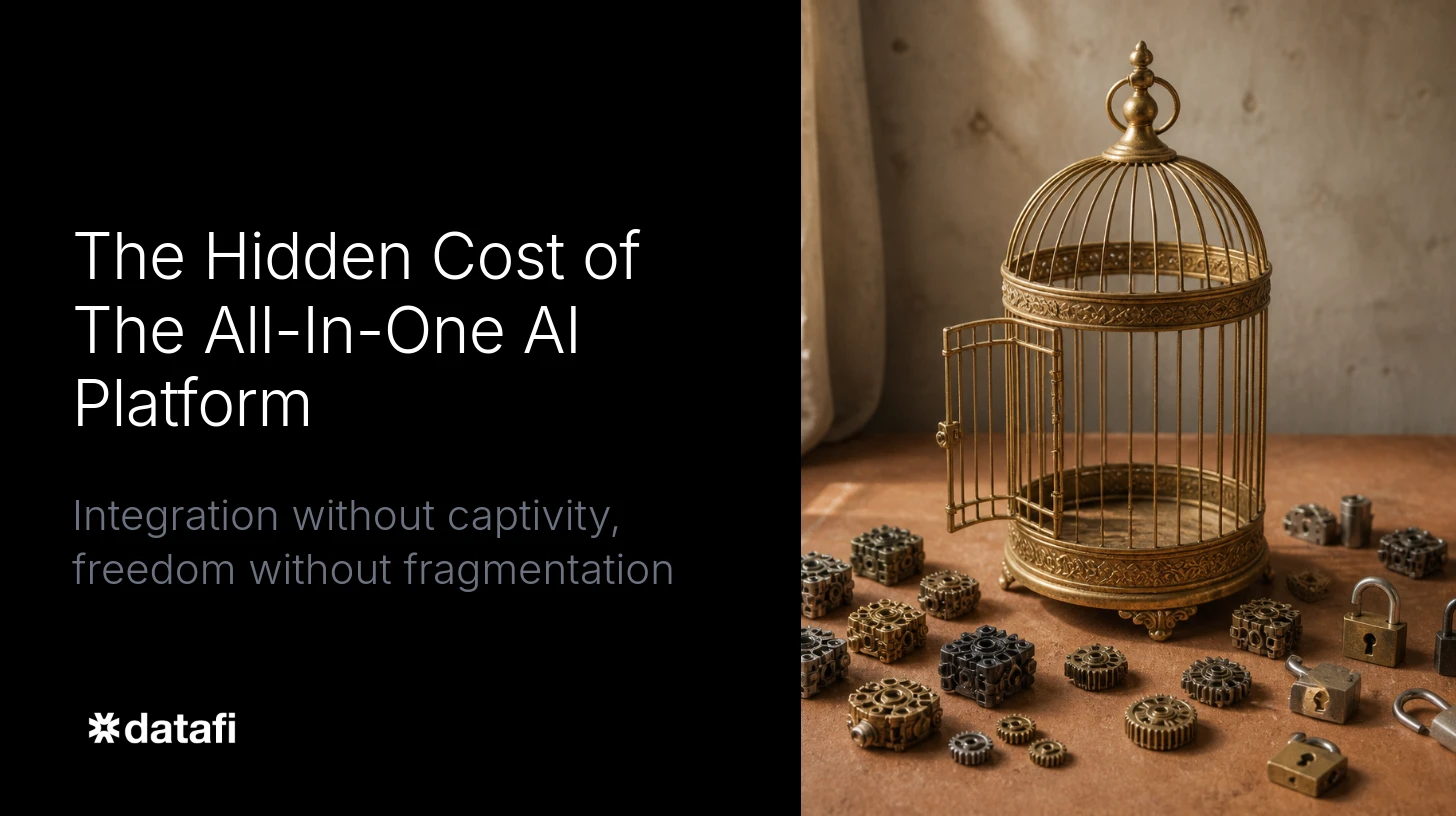
This is the distinction that runs through everything Datafi builds, and through the rest of this series. The objective of enterprise AI is not a tidier vendor relationship. It is AI that solves problems by acting on your data, on a foundation you control. A consolidation program that trades fragmentation for dependency has, at considerable cost, bought itself a more comfortable cage. That is not freedom. Freedom is integration without captivity - a unified foundation whose components remain interchangeable.
You do not need to surrender ownership to escape fragmentation. In many cases, surrendering it is what fragmentation’s loudest cure quietly costs you.
Integrate the platform, own the architecture
Datafi was designed from the start around this premise. The Business AI Operating System is not a walled garden you move into and cannot leave. It is vertically integrated infrastructure that connects your complete data ecosystem, governs it consistently, and delivers governed, agentic AI on top - while keeping the layers underneath open and interchangeable.
The integration is real. Datafi connects directly to the systems where your business runs, unifies the data across them, and delivers a chat experience built for non-technical users, so the organization gets the coherence of a single platform rather than the chaos of stitched-together tools. That is the benefit the all-in-one pitch promises.
The difference is what stays yours. The global business contextual layer - the entity relationships, operational definitions, and domain rules that let AI act correctly in your specific business - accrues as your asset, not the vendor’s. It is the most valuable thing the whole arrangement produces, and it does not live somewhere you cannot reach it. Models remain interchangeable, because durable advantage was never supposed to live in whichever LLM is briefly ahead.
Sentinel, the governance framework, is not a proprietary control plane you would have to rebuild from zero to leave. It enforces access, policy, and lineage across your ecosystem as architecture that travels with your data, so governance scales with adoption without becoming the mechanism that traps you.
The result is a different theory of consolidation. You get the unified platform you actually needed. You keep the freedom the all-in-one model asks you to trade away. Integration arrives in weeks, on a foundation you own, rather than as a dependency you spend years unable to reconsider.
What this series will argue
Over the next five posts, we will build out the alternative in full.
We will map the precise ways lock-in shows up in your data layer, where it hides until you try to move. We will look honestly at why betting on a single model is a strategy with an expiration date - and just as honestly at when consolidation remains the right call. We will return repeatedly to the distinction between AI that answers and AI that acts, because durable ownership and real action depend on the same open foundation. We will examine why governance has to travel with your data rather than live in a vendor’s framework for any of this to be safe at enterprise scale. And we will close on the affirmative case: what it looks like to own your AI future on an open contextual layer, rather than rent it from a roadmap that is not yours.
The thesis underneath all of it is simple. A single AI vendor is not the enemy of speed. Surrendering ownership in exchange for it is. The enterprises that adopt AI fastest in the next few years will not be the ones that handed the whole stack to one vendor and hoped the roadmap stayed aligned. They will be the ones that got the integration they needed without giving up the freedom they will need later.
The all-in-one trap is avoidable. The first step out of it is refusing the premise that got you in.
Post 2 in this series gets specific about the trap itself: the five places AI vendor lock-in actually accumulates in your data layer, why the model is the least of it, and what it costs you the day you finally try to leave.
Datafi is a Business AI Operating System designed for mid-enterprise organizations that need the full power of an integrated AI platform without surrendering ownership of the data, context, and governance that make AI worth adopting. Learn more at datafi.co.
Series: Owning Your AI Future
Part 1 - The Trap: Rethinking the Premise
Post 1: The Hidden Cost of The All-In-One AI Platform
Post 2: Five Ways AI Vendor Lock-In Shows Up in Your Data Layer
Part 2 - The Tradeoffs: An Honest Accounting
Post 3: The Model Is Not the Moat - Why Betting on One LLM Is a Losing Strategy
Post 4: Governance You Cannot Take With You Is Not Governance
Post 5: Build, Buy, or Get Locked In - The False Choice in Enterprise AI
Part 3 - The Path: A Pragmatic Roadmap
Post 6: Owning Your AI Future - The Case for an Open Contextual Layer