




Turning AI’s Promise into Performance in Health Systems | Post 1 of 3
Between 1998 and today, nearly every service industry in the American economy learned to do more with less. Insurance grew real output per full-time employee by 83 percent. Retail grew by 70. Banking grew by 34. Education, legal services, professional services, real estate, transportation, and warehousing all climbed together in a broad band above 50 percent.
Clinical care delivery went the other way. Over that same quarter century, real gross output per full-time employee in US clinical care organizations declined by one percent. Not grew slowly. Declined.
That single line on the chart, drawn from McKinsey’s June 2026 report on the health system CEO imperative, is the most important fact in American healthcare operations. Twenty-five years of technology investment, of electronic health record implementations that consumed hundreds of millions of dollars apiece, of consolidation and scale and process improvement, and the productivity curve for clinical care is flat at best.
The obvious inference is that healthcare is simply different. That care cannot be industrialized, that patients are not widgets, that the labor is irreducibly human. There is real truth in that. But the same report contains a second fact that complicates the story considerably.
In the Q4 2025 McKinsey US Gen AI Healthcare Survey, half of healthcare leaders reported that their organizations had already implemented generative AI. Of that group, fewer than half had quantified any return on the investment.
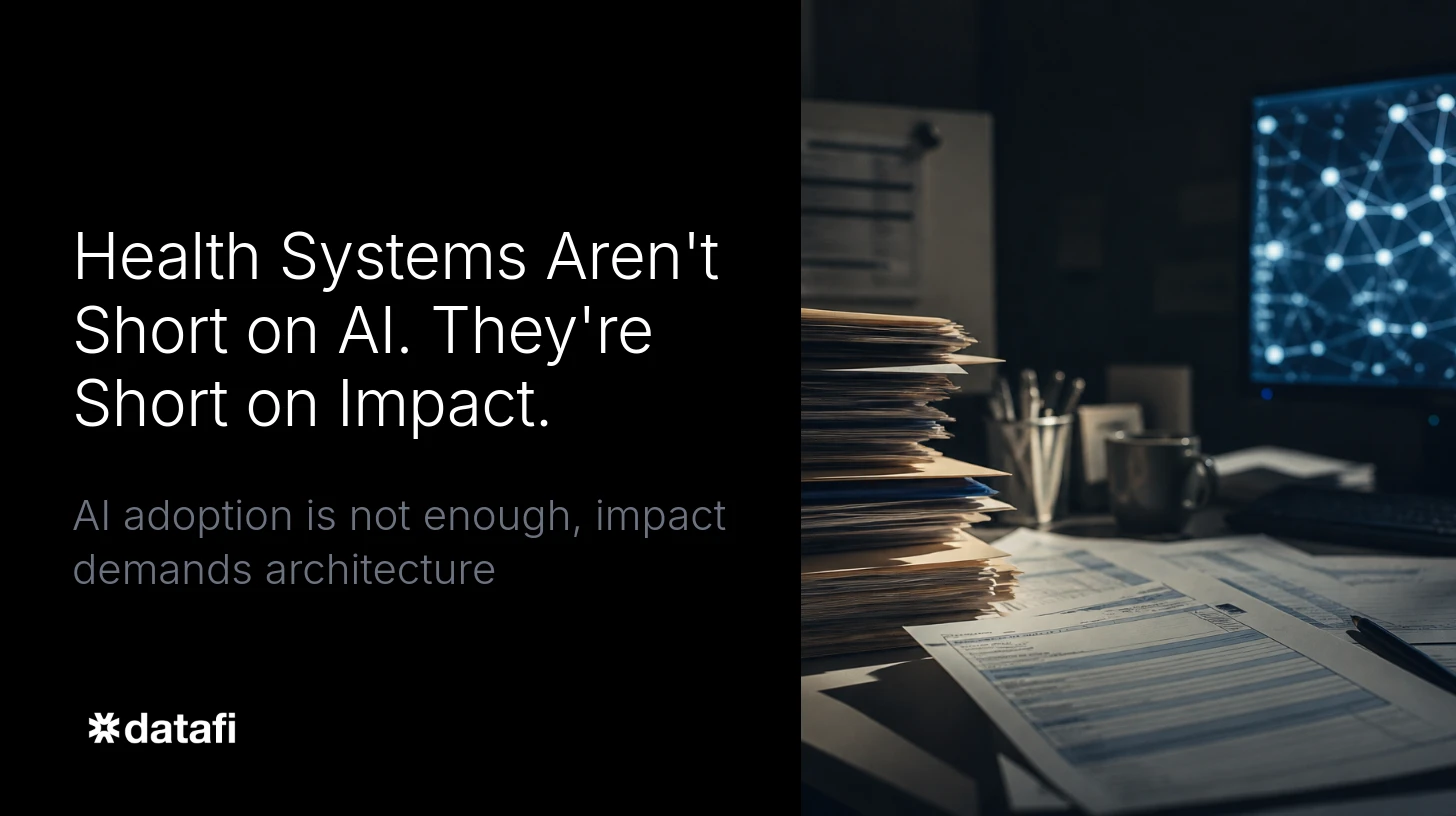
So the problem is not that health systems have failed to adopt AI. They have adopted it. The problem is that adoption and impact have come apart from each other, and almost nobody can say by how much.
Health systems do not have an AI adoption problem. They have an AI architecture problem. Fifty disconnected pilots do not add up to a transformed operating model, because each one is blind to everything happening outside its own narrow slice of the organization. Value compounds only when the same business context is available across the entire chain of work.
The Premise Worth Questioning
The premise running underneath most health system AI strategy today is a simple one: more AI deployment produces more AI value. Get the tools in front of more clinicians, more coders, more schedulers, and the returns will accumulate.
It is an intuitive premise. It is also the reason so many health systems now find themselves with a portfolio of pilots, a growing vendor roster, an AI governance committee that meets monthly, and no defensible answer when the board asks what any of it has produced.
Before taking that premise apart, it is worth giving the other side its due, because the people who built those portfolios were not being careless.
The Case for Point Solutions
Health systems operate under constraints that most enterprises never face. Margins in the low single digits. A workforce in genuine crisis. Regulatory exposure where a mistake is not a bad quarter but a front page story and an investigation. Capital committees that have watched a decade of large technology programs run long and land short.
In that environment, the point solution is not a failure of imagination. It is a rational allocation of scarce risk budget.
And the returns have been real. Ambient documentation genuinely gives clinicians time back, and in a period of severe burnout that value is not only financial. Autonomous and assisted coding genuinely improves capture and reduces rework. Appeal letter generation genuinely compresses a task that used to consume hours of skilled staff time per case. These tools work. Health systems that deployed them were right to do so, and the leaders who championed them were often the first people in the building to demonstrate that any of this was more than a slide deck.
The case for starting narrow is strong. Small blast radius. Clear owner. Measurable before and after. Fast enough that momentum survives the budget cycle. If your goal is to prove that AI can do something useful in a hospital, the point solution is the correct instrument.
The trouble is that proving AI can do something useful and changing what a health system is capable of are two different projects, and the second one does not arrive by accumulating enough of the first.
Why Fifty Pilots Never Become One Capability
Consider what a denial actually is.
A claim comes back denied. Somewhere in the back office, a person opens a work queue, reads the denial code, pulls the chart, checks the payer’s policy, finds the documentation gap, drafts an appeal, and submits it. If a health system has deployed generative AI for appeal letters, that person now drafts faster. Twenty minutes saved per letter, which is a real number and worth having.
But look at where that denial came from. The coverage was never verified against the patient’s current benefit details. The prior authorization requirement was missed at scheduling, or caught late and pursued through a fax and a phone tree. A required clinical document was never retrieved from the referring physician’s system. The payer changed a policy rule eleven weeks ago and the update propagated to a PDF on a shared drive that nobody reads.
Every one of those failures happened before the claim was ever submitted, in a different department, in a different system, owned by a different leader. The appeal letter tool cannot see any of them. It was never going to see them. It was scoped to the letter.
This is what I mean when I say the tools answer questions rather than solve problems. A model that drafts an excellent appeal is answering the question it was asked. The actual problem is that the denial should not have occurred, and solving that problem requires seeing across scheduling, eligibility, prior authorization, clinical documentation, payer policy, and claims at the same time, in real time, with the authority to act at each point.
I have spent years working inside enterprise data ecosystems, and this pattern is not unique to healthcare. It is simply more expensive in healthcare, because the number of handoffs is higher and the systems of record are more entrenched. But the failure mode is identical across every industry I have worked in. An organization buys ten AI tools that are each individually correct and collectively incoherent, because no two of them share an understanding of what the business is or how its parts relate.
McKinsey’s language for this is precise. Health systems have approached AI with what the report calls a bolt-on mindset rather than a transformation mindset, and the consequence is a proliferation of pilots without the integration or scale that would create enterprise value.
I would put it slightly differently. The pilots are not the problem. The absence of anything underneath them is the problem.
What Is Actually Missing
When McKinsey sizes the opportunity, the numbers are not small. Clinical workforce management alone represents somewhere between 2.0 and 3.6 percent of net patient service revenue in potential margin contribution. Specialty outpatient operations, between 1.6 and 2.8 percent. Revenue cycle management, between 1.0 and 2.5 percent. Inpatient operations, operating room operations, supply chain, pricing and contracting, and corporate services each land in the range of one to two percent.
For a health system running on a two percent operating margin, any single one of those is transformative. But the report is explicit that capturing that level of impact requires transforming those domains end to end, not retrofitting AI into the processes that already exist.
End to end is the operative phrase, and it has a technical prerequisite that most strategy conversations skip past. You cannot rewire a domain end to end if your AI can only see one station on the line.
What is missing is a layer that sits between the systems of record and the AI, holding a live, unified representation of what the business actually is. Once that layer exists, the second use case costs a fraction of the first, because the expensive part was never the model. It was the context.
What is missing is a layer that sits between the systems of record and the AI, holding a live, unified representation of what the business actually is. Not a data warehouse, which is a copy of yesterday’s numbers arranged for reporting. Not a vector store of documents, which is a pile of text with no notion of how anything relates to anything else. A working model of the organization: that this patient has this coverage under this plan with these authorization requirements, that this payer changed this rule on this date, that this scheduled case depends on this implant which depends on this purchase order, that this documentation gap is the same gap that produced forty denials last quarter.
Once that layer exists, the appeal letter tool stops being a point solution and becomes one behavior of a system that understands denials. Once it exists, the second use case costs a fraction of the first, because the expensive part was never the model. It was the context.
What This Requires Architecturally
At Datafi, this is the problem we built the platform to solve, and the architecture reflects a specific conviction: the integration is the product.
The global business contextual layer is the foundation. It builds a live representation of business meaning and relationships from across the data ecosystem, federating to source systems in place rather than requiring ingestion, replication, or migration. For a health system, that distinction matters enormously. Your EHR, your ERP, your scheduling system, your claims platform, and your supply chain tools stay exactly where they are. Nothing moves. The context layer reaches them.
Business Chat puts that context in front of every employee in plain language, technical or not, which is what turns AI from a project the informatics team runs into something a revenue cycle manager or a perioperative director actually uses.
Studio lets those same people build agents and workflows without writing code or waiting in an engineering queue, which is the only realistic path for organizations that do not have a data science org standing by.
Runtime coordinates multiple agents across a single piece of multi-step work, so a denial is handled from eligibility check through submission through reconciliation rather than at one station.
Control Tower and Cyber make the whole thing governable, with policy, access control, and audit built into the architecture rather than layered on after the fact. In healthcare that is not a nice-to-have. It is the precondition for deploying anything autonomous at all.
Each layer depends on the others. Business Chat without a context layer is a novelty. A context layer without federated access to live systems is a fiction. Agents without governance are a liability that no health system compliance officer will ever sign off on.
The CEO Question Has Changed
The report frames the shift well. The question for health system leadership is no longer where to deploy AI. It is where to change the operating model, and how to mobilize an organization to actually do it.
That reframe has an uncomfortable implication for anyone currently managing an AI portfolio. Counting pilots is not a measure of progress. Neither is counting vendors, or use cases, or seats. The only measure that matters is whether a domain of the business now runs differently than it did before, and whether the difference shows up in a number the CFO recognizes.
Most health systems cannot answer that question today. The ones that can are the ones that stopped buying tools and started building the layer underneath them.
In the next post in this series, I look at McKinsey’s most actionable recommendation: pick one or two domains and rewire them end to end rather than retrofitting AI into the workflows you already have. I examine why back-end revenue cycle and supply chain are the right places to start, and what it actually takes technically to coordinate work across a domain instead of automating tasks within it.
Datafi is the operating system for business AI. We help mid-enterprise organizations unify their data, deploy governed AI agents, and deliver measurable outcomes in weeks rather than years, without migrating off the systems that already run the business.
Turning AI’s Promise into Performance in Health Systems
Part 1: Health Systems Aren’t Short on AI. They’re Short on Impact.
Part 2: Rewire the Domain, Not the Task
Part 3: Guardrails First, Foundations As You Go
Written by Vaughan Emery, Co-Founder & Chief Product Officer at Datafi
Source: “The health system CEO imperative: Turning AI’s promise into performance,” McKinsey & Company Healthcare Practice, June 2026.