


Owning Your AI Future — Post 4 of 6
Of all the places AI vendor lock-in hides, the one that should worry compliance and risk leaders most is also the one that arrives wearing the friendliest face. It does not look like a trap. It looks like safety.
When an organization adopts an AI platform, governance is usually the part that earns the most trust the fastest. The access controls work. The audit trails are thorough. The policy engine does exactly what the demo promised. Risk and compliance teams, who are paid to be skeptical, sign off — because on its own terms, the governance is good. That sign-off is the moment the trap closes, and almost no one notices, because everything visible about the arrangement is reassuring.
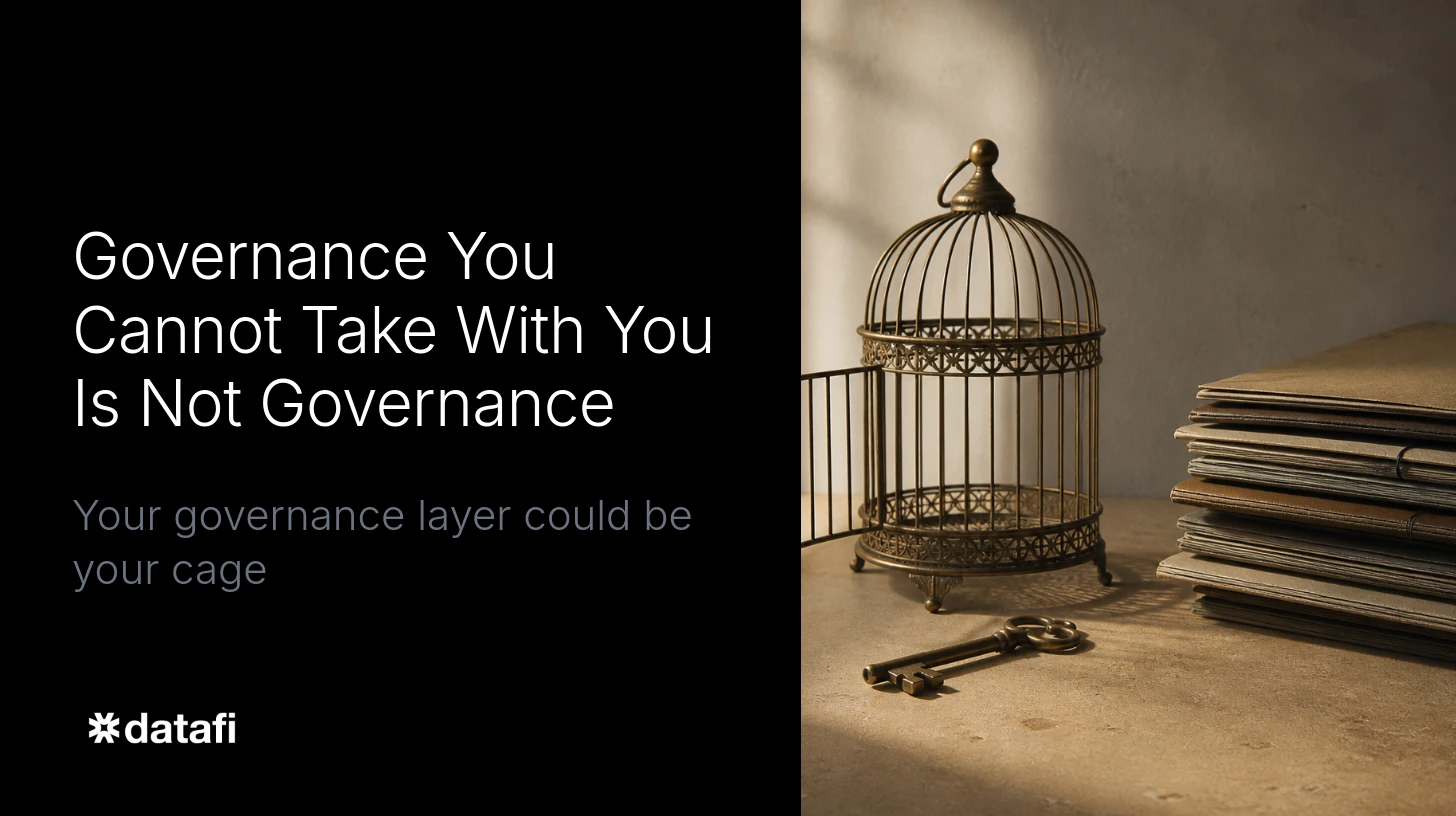
The problem is not whether the governance works. The problem is whether you can take it with you. And governance you cannot take with you, it turns out, is not really governance at all. It is a control plane the vendor lets you operate, on the condition that you never leave.
Governance implemented inside a vendor’s proprietary framework gives you operational control while quietly taking architectural control. When leaving means rebuilding every policy, audit trail, and access rule from zero, the control layer that was meant to keep you safe is what keeps you captive.
The premise that makes it feel safe
The conventional logic runs: governance is about control, the platform gives us control, therefore the platform’s governance makes us safer. Each step sounds obviously true, and that is exactly why the conclusion goes unexamined.
It is worth pausing on what “control” means here, because the word is doing something slippery. There are two kinds of control at stake, and the platform delivers one while quietly costing you the other. The first is operational control — the ability to define who can access what, under which conditions, and to prove it after the fact. A good platform gives you this in abundance, and it is real.
The second is architectural control — the ability to own the control layer itself, to move it, to change it, to carry it with you if the platform no longer serves you. This is the one the proprietary framework takes away, and it takes it away precisely by being good at the first kind. The better the operational control, the deeper you build into it, and the more completely the architectural control slips to the vendor. You end up with more authority over your data and less authority over your own ability to leave. The governance that made you feel safe made you dependent, and it did so through its strengths, not its weaknesses.
What “you cannot take it with you” actually costs
Picture the moment of leaving, because the cost only becomes legible there. Suppose the platform’s pricing drifts, or its roadmap diverges from yours, or a better foundation emerges, and you decide to move. What, exactly, moves with you?
Not the policies. They were defined inside the vendor’s framework, in the vendor’s model of what a policy is, and they do not export to anything else. Not the audit trails — the years of accumulated record that prove, to regulators and to yourselves, who accessed what and when. Not the access logic, the escalation paths, the approval workflows, the lineage tracking. All of it was built inside a system you do not own, and leaving means rebuilding every piece of it from zero, on the new foundation, before you can safely operate there at all.
For most organizations, that prospect is not a hurdle. It is a wall. The cost of reconstructing an entire governance and compliance posture from scratch is high enough, and risky enough, that the rational decision is simply to stay — even when staying is no longer the best decision on any other axis. That is the moment to recognize for what it is. When rebuilding your governance is the thing keeping you with a vendor you have otherwise outgrown, the governance is no longer protecting the enterprise. It is protecting the vendor’s renewal.
When rebuilding your governance is the thing keeping you with a vendor you have otherwise outgrown, the governance is no longer protecting the enterprise. It is protecting the vendor’s renewal.
Governance as bolt-on versus governance as architecture
There is a deeper reason proprietary governance becomes a trap, and it has to do with where the governance sits in the first place.
In most platforms, governance is a bolt-on. The system was built to connect data and run models, and the controls were added around that — a layer applied at ingestion, or a policy engine wrapped around the outputs, or a set of permissions inherited from an adjacent system. Bolt-on governance has a structural weakness that has nothing to do with portability: because it sits beside the system rather than inside it, there are always seams. Places where the data moves and the policy does not follow. Workflows the controls were not designed to cover. Gaps that widen as AI access expands into more sensitive territory.
Governance as architecture is a different proposition entirely. When control is woven through the platform rather than wrapped around it — enforced dynamically at query time, based on the identity of the user, the sensitivity of the data, the jurisdiction of the question, and the context of the workflow — there are no seams, because the governance is not a layer the data passes through. It is a property of the system the data lives in. An agent cannot access what it was not authorized to access, regardless of how the request is framed or which workflow triggered it, because the authorization is not a checkpoint. It is the architecture.
This distinction is what separates governance that scales with AI adoption from governance that quietly breaks as adoption grows. And it is also, not coincidentally, what makes governance portable. Governance built as architecture is governance you own, which means it is governance that can move.
What portable governance looks like
This is the principle Sentinel was built around. Governance in the Datafi operating system is not a compliance module added after the platform was designed. It is foundational architecture — the mechanism that makes autonomous AI permissible in the first place by enforcing access, policy, and lineage across the complete data ecosystem, dynamically and at query time.
Because that governance is woven into a foundation the enterprise owns rather than a vendor’s proprietary framework, it does not hold the organization hostage. The policies, the audit trails, the access logic, the lineage — these accrue as the enterprise’s own assets, defined once and enforced everywhere agents and workflows run, on infrastructure the organization controls. The control layer is genuinely a control layer, in both senses of control: operational authority over the data, and architectural authority over the governance itself.
That is the test worth applying to any AI platform’s governance, and it is a simple one. Not “is the governance good,” because the answer is almost always yes, and the answer is almost always beside the point. The question is: if we left tomorrow, what would we have to rebuild? If the honest answer is “all of it,” then what you have is not governance you own. It is governance you rent, and the rent is your freedom to leave.
The freedom underneath the safety
Real governance and real freedom are not in tension. They are the same architecture seen from two angles.
When governance is woven into a foundation you own, it gives you exactly the control that compliance teams require — and it gives you the freedom to take that control wherever you go, because it was yours all along. When governance is a proprietary framework you operate by permission, it offers the same operational control on the surface while quietly converting it into the deepest lock-in in the stack. The two look identical in the demo. They could not be more different the day you decide to leave.
The enterprises that deploy AI most confidently in the next few years will be the ones that refused to accept that tradeoff. They will have governance good enough to satisfy the most skeptical risk officer, and portable enough that the skeptical risk officer is never the reason they cannot leave. Safety and sovereignty, in the same architecture, because they were never supposed to be separate.
Governance you cannot take with you is not governance. It is a beautifully built reason to stay.
Post 5 in this series takes on the decision that sits underneath all of this: the choice between building your AI capability in-house and buying a platform, and the hidden third option both framings ignore — buying an open foundation that preserves the freedom to swap models, tools, and infrastructure as the market shifts.
Datafi is a Business AI Operating System designed for mid-enterprise organizations that need the full power of an integrated AI platform without surrendering ownership of the data, context, and governance that make AI worth adopting. Learn more at datafi.co.
Series: Owning Your AI Future
Part 1 — The Trap: Rethinking the Premise
Post 1: The Hidden Cost of The All-In-One AI Platform
Post 2: Five Ways AI Vendor Lock-In Shows Up in Your Data Layer
Part 2 — The Tradeoffs: An Honest Accounting
Post 3: The Model Is Not the Moat — Why Betting on One LLM Is a Losing Strategy
Post 4: Governance You Cannot Take With You Is Not Governance
Post 5: Build, Buy, or Get Locked In — The False Choice in Enterprise AI
Part 3 — The Path: A Pragmatic Roadmap
Post 6: Owning Your AI Future — The Case for an Open Contextual Layer