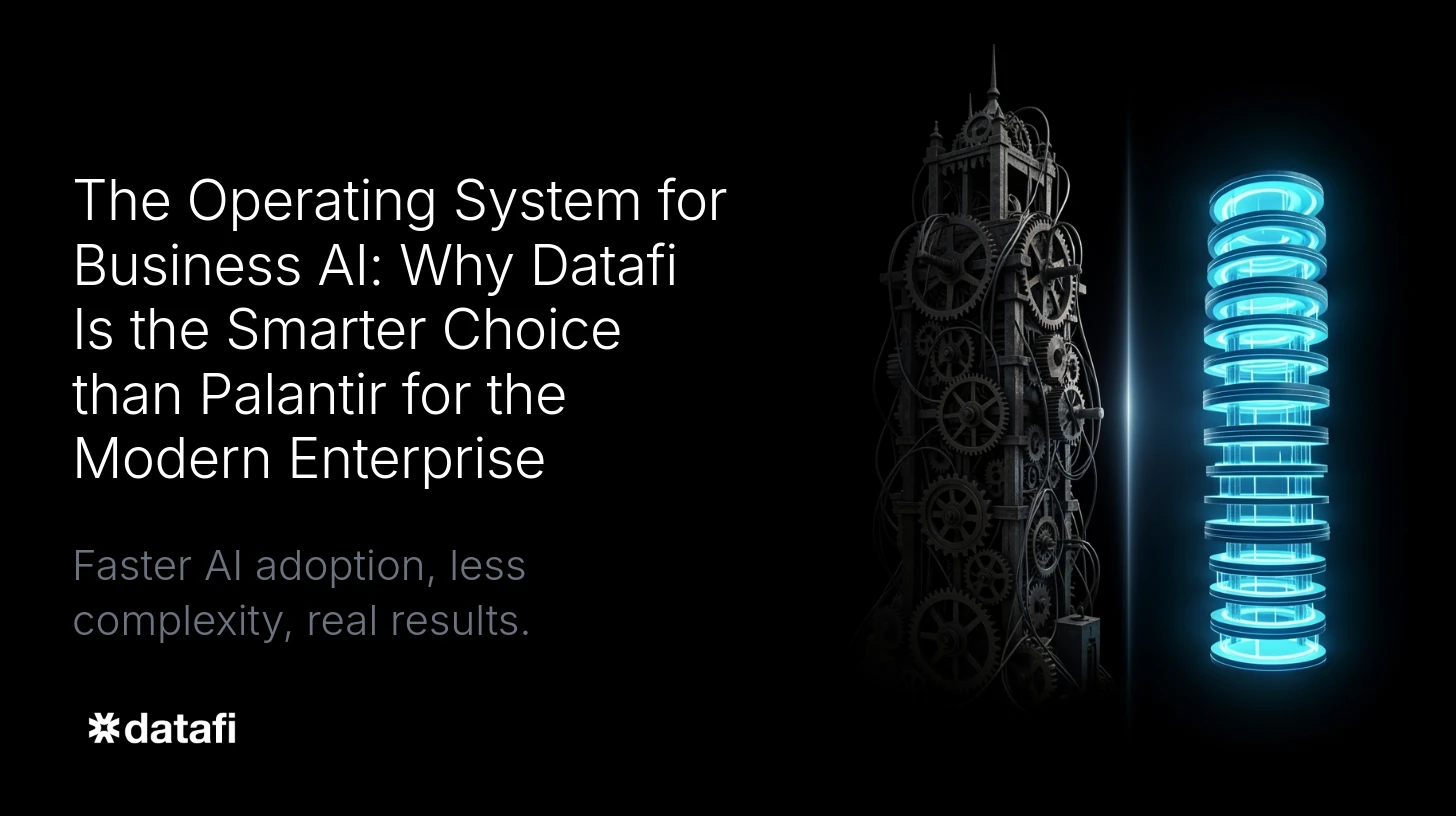


AI that answers questions is useful. AI that solves problems is transformative. The difference lies in the architecture behind it.
The organizations that will achieve the greatest competitive advantage from AI are not the ones that deploy the most expensive platform. They are the ones that deploy AI that actually works, at scale, for every employee, in the workflows where it can create genuine value.
For more than a decade, Palantir Technologies has occupied a unique and well-documented position in the enterprise software landscape: a powerful, highly customized platform built for some of the world’s most complex data problems, originally designed for intelligence agencies and large defense contractors, and later expanded to commercial enterprise. The brand carries weight. The case studies are impressive. And the price tag and implementation complexity match both.
But the enterprise technology landscape has fundamentally shifted. Organizations across every sector are not just asking whether they can afford to deploy AI at scale. They are asking whether the model of AI deployment they choose will actually work for their employees, their workflows, and their data realities. For a growing number of mid-sized and enterprise organizations, the answer increasingly points away from the custom-build, high-overhead model that Palantir represents, and toward a vertically integrated, accessible, and operationally agile alternative.
That alternative is Datafi.
Two Fundamentally Different Philosophies

Palantir’s architecture is built around a foundational premise: that complex data problems require deeply custom, bespoke platforms engineered by specialized teams over extended timelines. Palantir Foundry and AIP are powerful, but they demand significant investments in professional services, data engineering, and organizational change management before value can be extracted. For government agencies managing national security infrastructure or global pharmaceuticals companies running billion-dollar clinical trials, that investment may be justified.
But most organizations, even large enterprises, are not operating at that level of complexity or with that level of resource availability. They need AI that works with their existing data ecosystems, can be deployed at organizational scale quickly, and can be used by every employee, not just a data science team or a dedicated Palantir implementation squad.
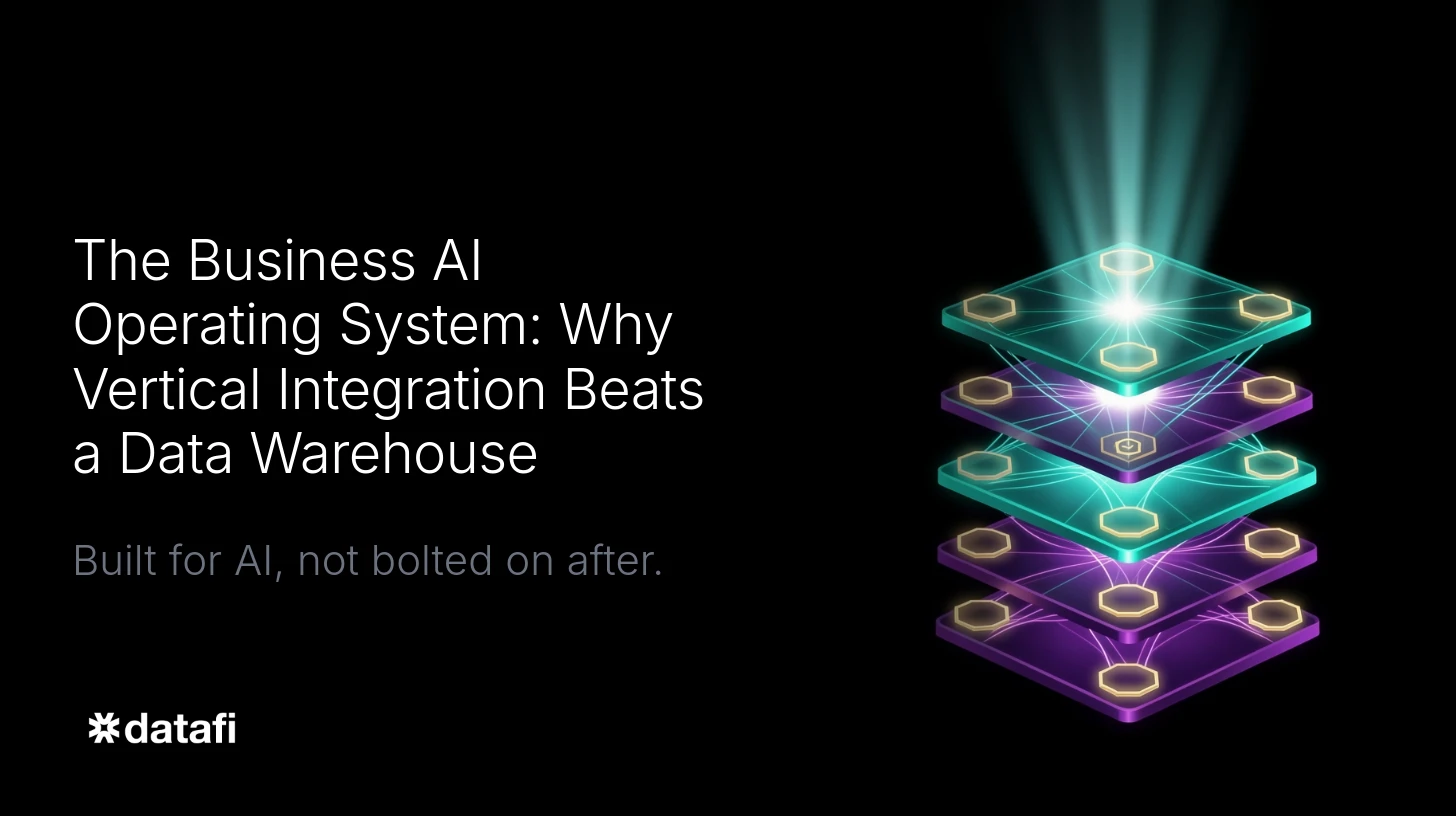
Datafi is built on a fundamentally different premise. Rather than assuming that AI deployment is a multi-year engineering project, Datafi provides a vertically integrated data and AI technology stack that connects directly to an organization’s existing data ecosystem, enforces governance and compliance policies natively, and delivers a Chat UI explicitly designed for non-technical users. This is not a simplified version of something more powerful. It is a complete rethinking of where AI value actually gets created in an organization.
The distinction matters because the unit of value in business AI is not the model. It is the workflow. It is the employee who, for the first time, can ask a meaningful business question and receive a contextually grounded, actionable answer without submitting a ticket to IT or waiting for a data analyst to build a report. It is the operations manager who can trigger a predictive maintenance workflow through a natural language interface and receive a recommendation that reflects the actual state of assets, not a static dashboard built six months ago.
The Contextual Layer: Why Full Data Access Changes Everything
One of the most consequential and least discussed limitations of enterprise AI deployments today is the fragmentation of context. Most AI tools in the market, regardless of the sophistication of the underlying model, operate on a narrow slice of organizational data. They answer the question that was asked, with the data that was made available, without the broader business context that would make the answer genuinely useful.
Datafi’s architecture is built around closing that gap. We call this the contextual layer.
LLMs will only reach their full potential in business environments when they have access to the complete data ecosystem of the organization, understand the policies and governance rules that govern how that data can be used, and are enabled to function in fully autonomous roles where they can learn, iterate, and solve hard problems over time. This is not a future state aspiration. It is an architectural requirement that must be designed in from the beginning.
Palantir’s approach addresses this through its Ontology model, which creates a structured representation of an organization’s data. The challenge is that building and maintaining that Ontology is a significant ongoing engineering effort, requiring specialized expertise and continuous investment. For many organizations, particularly those without large internal data engineering teams, the Ontology becomes a bottleneck rather than an accelerant.
Datafi takes a different approach by integrating directly with the data ecosystem an organization already has, enforcing governance through a native policy and control layer, and making the contextual layer available to AI agents and workflows without requiring organizations to rebuild their data architecture from scratch. The result is that AI agents operating on the Datafi platform have access to the full context of the business, not a curated subset, from day one.
Agents That Work, Not Just Assistants That Answer
The distinction between AI that answers questions and AI that solves problems is not semantic. It reflects a fundamental difference in what AI can accomplish in an operational context.
An AI assistant that can answer questions is useful for knowledge work. It reduces the time it takes to retrieve information, summarize documents, or generate first drafts of routine communications. These are real productivity gains, and they have value.
But the organizations that are achieving transformative outcomes from AI are deploying it in roles that go beyond retrieval and summarization. They are using AI agents in critical thinking, workflow automation, and analytical roles where the agent is not just responding to a prompt, but actively participating in a multistep process, accessing live data, applying domain-specific logic, and producing outputs that drive real operational decisions.
An agent operating in a predictive maintenance workflow needs access to asset sensor data, maintenance history, parts inventory, supplier lead times, and crew scheduling, all in real time, all governed by the appropriate access controls.
This is where the requirements change dramatically. An agent supporting passenger experience optimization in a transportation context needs to understand schedule data, customer feedback signals, operational constraints, and service recovery protocols simultaneously.
Palantir has invested heavily in building agent capabilities through AIP, and for organizations that have already built out their Palantir infrastructure, those capabilities are meaningful. But the barrier to reaching that state is substantial. Organizations without existing Palantir implementations are looking at multi-year, multi-million-dollar projects before agents can operate at this level.
Datafi’s vertically integrated stack is designed to make this accessible to organizations of any size. Because the data connectivity, governance layer, and agentic infrastructure are built as a coherent system rather than assembled through custom integrations, the path from data ecosystem to operational AI agent is measurably shorter. Organizations can deploy AI agents capable of operating in genuinely autonomous roles, with access to the full business context they need, without the operational overhead that has historically made this kind of deployment feasible only for the largest and most technically sophisticated enterprises.
Where Datafi Creates Value Across the Enterprise

The breadth of application is one of Datafi’s defining advantages. Because the platform is not purpose-built for a single function or department, AI agents and workflows can be deployed across the full range of business operations. Consider a few illustrative examples.
In predictive maintenance and asset management, Datafi agents can continuously monitor equipment telemetry against historical failure patterns, trigger maintenance workflows before failures occur, optimize parts ordering against actual demand signals, and surface recommendations to maintenance teams through the Chat UI in plain language. The agent is not generating a report. It is actively managing the process.
In operations optimization, the same platform that supports maintenance workflows can analyze operational throughput, identify scheduling inefficiencies, model capacity scenarios, and recommend adjustments in real time. Because the agent has access to the complete operational data ecosystem, its recommendations reflect the actual state of the organization, not a model trained on historical data that no longer reflects current conditions.
In passenger experience, agents can correlate service performance data with customer feedback signals, identify systemic issues before they escalate, and recommend service recovery actions that are consistent with policy constraints and resource availability. This is precisely the kind of cross-functional, multi-data-source reasoning that requires the contextual layer to function effectively.
In strategic planning, Datafi enables executives and analysts to interact with the organization’s full data ecosystem through a natural language interface, exploring scenarios, testing assumptions, and generating analyses that would previously have required significant data analyst time. The Chat UI designed for non-technical users means that the value of the platform is not confined to the data team. It is available to every employee who needs to make informed decisions.
Governance Without Friction
One of the dimensions of enterprise AI deployment that often receives insufficient attention in capability comparisons is governance. The question is not only whether an AI platform can do something. It is whether it can do it in a way that respects data access controls, regulatory requirements, and organizational policies.
Datafi’s native policy and control layer means that governance is not an afterthought applied on top of an AI capability. It is embedded in the architecture. Every agent, every workflow, and every user interaction operates within the governance framework the organization has defined. This is essential for compliance-sensitive industries, but it is also simply good operational practice for any organization that takes its data responsibilities seriously.
Palantir offers governance capabilities, but they are implemented through the same high-overhead model that characterizes the rest of the platform. Organizations must invest in defining and maintaining their governance structures within Palantir’s framework, which adds to the implementation burden and the ongoing cost of operation.
The Right Tool for the Moment
The enterprise AI market is at an inflection point. The organizations that will achieve the greatest competitive advantage from AI over the next five years are not the ones that deploy the most expensive platform. They are the ones that deploy AI that actually works, at scale, for every employee, in the workflows where it can create genuine value.
Palantir built an extraordinary platform for an extraordinary set of problems. For defense agencies, intelligence organizations, and the largest global enterprises with the resources to build and maintain custom data infrastructure over years, it remains a relevant choice.
But for the mid-sized and enterprise organizations that make up the majority of the market, the choice is no longer between Palantir and nothing. The choice is between an approach that requires years of investment before value materializes and an approach that delivers unified data experiences, governed AI agents, and workflow automation from a vertically integrated stack that is designed to work with the data ecosystem organizations already have.
Datafi is that approach. And the organizations that choose it are not settling for less. They are choosing an architecture built for how AI actually creates value in the enterprise: not through custom-built complexity, but through contextual depth, operational accessibility, and the ability to deploy AI not just as an assistant that answers questions, but as an active participant in solving the problems that matter most.
Datafi is an applied AI software company building the operating system for business AI. Our vertically integrated data and AI technology stack enables organizations of any size to achieve unified data experiences, governed agentic workflows, and transformative operational outcomes for every employee.