


How Datafi’s approach to governed, agentic AI unlocks transformative outcomes that platforms like Snowflake were never designed to deliver
There is a version of enterprise AI that most organizations are living with right now. It answers questions. It summarizes documents. It generates first drafts. It is useful, occasionally impressive, and fundamentally limited. It operates at the surface of the business, disconnected from the full context of how work actually gets done, how decisions actually get made, and how problems actually get solved.
Then there is another version of enterprise AI. One that knows the business. One that can move through data ecosystems, apply policies intelligently, act autonomously on what it learns, and participate in the critical thinking workflows that create real competitive advantage. One that works for every employee, not just the technically fluent few.
The gap between these two versions of AI is not a model problem. It is an architecture problem. And understanding that architecture gap is the key to understanding why organizations are choosing Datafi as their operating system for business AI rather than trying to build AI capabilities on top of a data warehouse platform like Snowflake.
The difference between AI that answers questions and AI that solves hard business problems is not a model problem. It is an architecture problem. Organizations that recognize this distinction early will be the ones whose AI investments compound while others’ plateau.
What Snowflake Was Built to Do

Snowflake is an exceptionally capable cloud data platform. It has earned its position in the enterprise technology landscape by solving real problems around data storage, compute scalability, and cross-cloud data sharing. For organizations that need a performant, governed repository for structured data at scale, Snowflake delivers genuine value.
But a data warehouse is not an AI operating system. The distinction matters enormously when the objective shifts from storing and querying data to enabling AI that can understand the full context of a business, operate across its complete data ecosystem, and take meaningful action in the workflows that drive outcomes.
Snowflake’s Cortex AI features layer language model capabilities onto the warehouse, which sounds appealing until you examine what it actually means. The AI is bounded by what lives in the warehouse. It operates within the schema of structured tables. It is accessible primarily to data engineers and analysts who understand SQL, the Snowflake environment, and the underlying data architecture. It does not natively reach the unstructured content in document repositories, the operational data in ERP and CRM systems, the real-time signals from industrial sensors, or the business logic encoded in the policies and workflows that govern how the organization actually functions.
For organizations that want AI to answer questions about data that is already in the warehouse, this is workable. For organizations that want AI to solve hard business problems, it is a ceiling rather than a foundation.
The Architecture a Business AI Operating System Requires
At Datafi, we have spent considerable time understanding what separates AI that answers questions from AI that solves problems. The answer consistently points to three requirements that most enterprise AI architectures do not fully address.
The first is access to the complete data ecosystem. Business problems do not live in a single system. Predictive maintenance decisions require sensor telemetry, maintenance history, parts inventory, vendor lead times, and workforce schedules. Operations optimization requires understanding not just what the numbers say but what the policies, exceptions, and real-world constraints mean for how those numbers translate into action. Strategic planning requires synthesizing structured data, unstructured documents, market signals, and institutional knowledge that has never been formally captured at all. An AI that can only see what is in a warehouse is an AI working with a partial picture of the business.
The second is full business context. Large language models are capable of extraordinary reasoning, but that reasoning is only as good as the context it operates within. An LLM that does not know the organization’s policies, its data governance rules, its operational logic, its terminology, and the relationships between its systems and processes will produce outputs that are technically coherent but practically disconnected from how the business actually works. Giving an LLM access to data is not the same as giving it context. Context is the richer, more structured understanding of what that data means, how it connects, and what the organization cares about when it acts on it.
The third is the capacity to function in autonomous roles. The workflows where AI creates the most transformative value are not the workflows where a human asks a question and reads the answer. They are the workflows where AI participates as a reasoning agent: monitoring systems, identifying patterns, generating recommendations, triggering downstream actions, and continuously learning from outcomes. This requires an AI architecture that supports agentic behavior, not just inference.
What Datafi Delivers
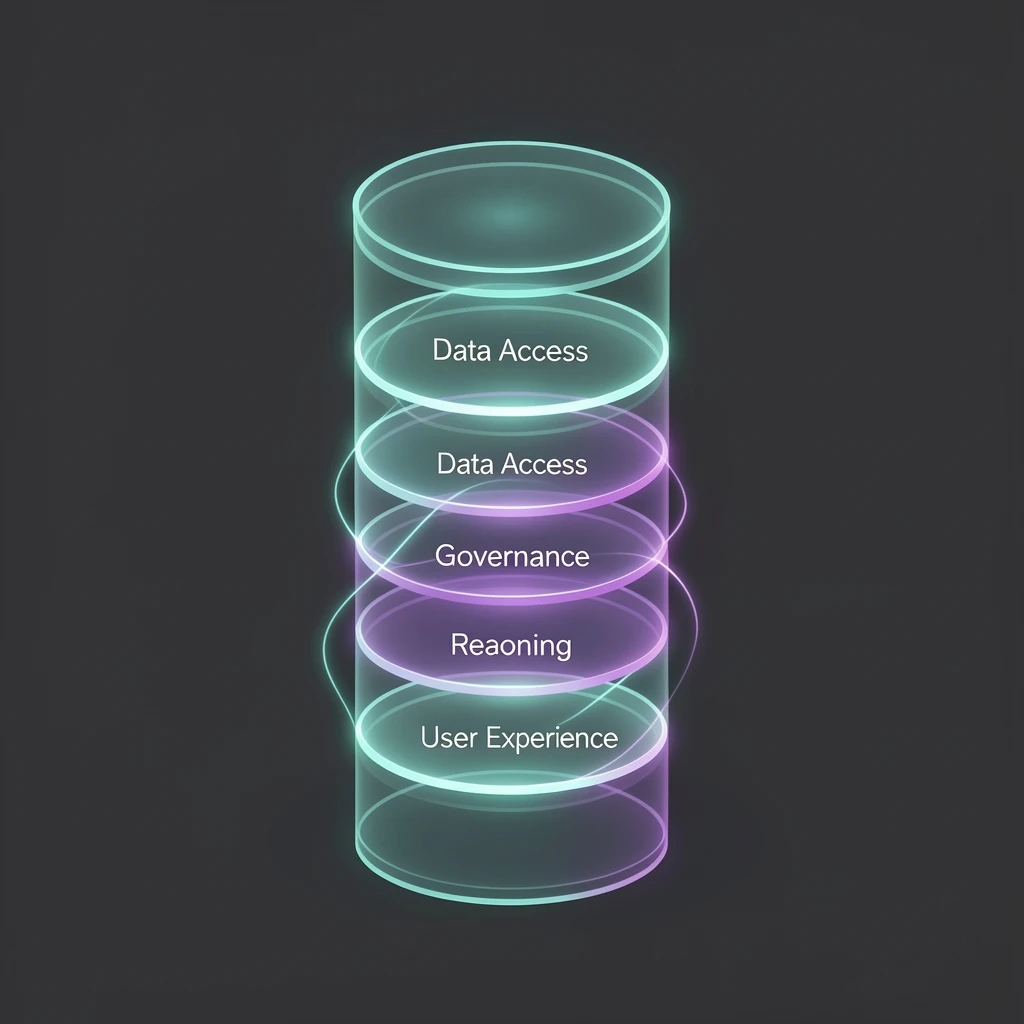
Datafi was built from the ground up as a vertically integrated data and AI technology stack, designed to satisfy all three of these requirements simultaneously and to make the result accessible to every employee in the organization, not just the technically fluent few.
The vertical integration is what makes the difference. Rather than layering AI capabilities onto an existing data infrastructure that was not designed for it, Datafi treats the full data ecosystem, the policy and governance layer, the AI reasoning capacity, and the user experience as a unified system. These components are designed to work together, to share context with each other, and to enable AI that can move fluidly across the complete information environment of the business.
The data ecosystem access that Datafi provides spans structured and unstructured sources, operational systems, real-time data streams, and the document repositories where critical business knowledge actually lives. This is not a middleware integration tax that every customer must pay separately. It is foundational to how the platform works.
The policy and governance layer is equally foundational. AI operating across a complete data ecosystem without appropriate controls is not an enterprise solution. It is a liability. Datafi’s approach to governed AI means that the same platform that expands what AI can access also ensures that access is appropriate, auditable, and aligned with the organization’s compliance requirements. This is the difference between AI that the enterprise can trust and AI that creates risk every time it is used.
The Chat UI designed for non-technical users is not an interface decision. It is a strategic commitment. The organizations that will extract the most value from AI are the ones that put it in the hands of every employee who has a decision to make, a problem to solve, or a process to improve. Requiring technical intermediaries to access AI creates a bottleneck that defeats the purpose of the technology. When a frontline operations manager can interact naturally with an AI that understands the full context of their environment and can take meaningful action on what it learns, the value creation is no longer confined to the data team.
Where This Changes Everything
Consider the operational domains where organizations are telling us they most want to deploy AI in critical, high-value roles.
In predictive maintenance and asset management, the gap between AI that answers questions and AI that solves problems is the difference between a report that says a component is likely to fail and an autonomous workflow that has already checked parts availability, evaluated maintenance crew capacity, flagged the priority relative to operational schedules, and generated the work order. Datafi’s agentic architecture makes the second version possible. Snowflake’s warehouse-centric model makes the first version the practical ceiling.
In operations optimization, the challenge is rarely that organizations lack data. It is that the data exists across too many systems, in too many formats, with too much complexity for human analysts to synthesize in the time frames that operational decisions require. Datafi’s access to the complete data ecosystem, combined with AI that understands the business context needed to translate data into operationally relevant recommendations, compresses the cycle from observation to action in ways that change how operations teams function.
In passenger and customer experience, the expectation that organizations can respond to individual needs in real time, at scale, requires AI that can reason across transactional history, behavioral signals, operational constraints, and policy rules simultaneously. The contextual layer that Datafi develops through its integrated approach to data access and LLM context is precisely what makes this kind of personalized, policy-compliant real-time reasoning achievable.
In strategic planning, the value of AI is in its ability to synthesize information across a breadth of sources and time horizons that exceeds what any individual analyst can hold in their head simultaneously. But that synthesis is only trustworthy when the AI has access to the complete picture, understands what the organization cares about, and can be interrogated about its reasoning. Datafi’s approach to full business context is what makes AI a credible participant in strategic conversations rather than a novelty that produces impressive-sounding outputs that cannot be relied upon.
The Scale Advantage Every Organization Can Access

One of the persistent misconceptions about enterprise AI is that transformative capability is the exclusive domain of organizations with large data engineering teams, eight-figure technology budgets, and years of data infrastructure investment behind them.
Datafi rejects that assumption. The vertically integrated architecture that makes Datafi powerful also makes it accessible. Organizations do not need to assemble their own stack of data warehousing, vector databases, LLM infrastructure, governance tools, and user experience layers to achieve unified data experience and workflow efficiency. Datafi provides that as an integrated operating system. The sophistication is in the platform, not in the prerequisite infrastructure investment.
This means that a regional transit authority can deploy the same quality of agentic AI for maintenance optimization that a global airline is using. A mid-sized manufacturer can achieve the same operational AI capability as a Fortune 500 competitor. The leveling effect of a purpose-built AI operating system is one of its most consequential attributes.
The leveling effect of a purpose-built AI operating system means a regional transit authority can deploy the same quality of agentic AI as a global airline. The sophistication is in the platform, not in the prerequisite infrastructure investment.
The Difference That Defines the Outcome
The enterprise technology market has a pattern of adopting platforms that are excellent at what they were originally designed to do and then stretching them into adjacent use cases where they were never intended to operate. The results are typically expensive, complex, and disappointing.
Snowflake was designed to be a cloud data warehouse. It is very good at that. It is not an AI operating system. The distinction is not a criticism. It is a recognition that different architectural objectives produce different capabilities, and that organizations building AI strategies deserve clarity about what each approach can actually deliver.
Datafi was designed from first principles as the operating system for business AI. Every architectural decision, from data ecosystem access to the governance layer to the agentic workflow capacity to the Chat UI that makes it usable by every employee, reflects that singular objective. When the goal is AI that solves hard business problems rather than AI that answers questions, the architecture that was built for that goal produces fundamentally different outcomes than the architecture that was retrofitted for it.
The organizations that recognize this distinction early will be the ones that look back in three years and understand why their AI investments compounded while others’ plateaued. The operating system for the AI era of enterprise software is not a data warehouse with a language model bolted on. It is a vertically integrated platform where every component was built to make AI genuinely capable, genuinely trustworthy, and genuinely useful for every person in the business.
That is what Datafi is. And that is why the comparison to Snowflake, while understandable, ultimately misses the point. This is not a data platform competition. It is a fundamental reimagining of how organizations use information to make decisions, take action, and solve the problems that matter most.
Datafi is the operating system for business AI, purpose-built to give organizations of every size access to governed, agentic, context-aware AI across their complete data ecosystem. To learn more, visit datafi.us.