


The architecture you choose for enterprise AI is not a technology decision. It is a strategic commitment that will shape how your organization operates, competes, and adapts for the next decade.
There is a moment in every enterprise AI evaluation where the conversation shifts. It starts with questions about models, capabilities, and integration timelines. But at some point, a more fundamental question surfaces: what kind of AI company do we want to build a relationship with, and what does that relationship actually look like five years from now?
That question is not about features. It is about philosophy. And in the enterprise AI market today, no two platforms reflect more divergent philosophies than Palantir and Datafi.
Both companies describe themselves as operating systems for AI. Both are building toward a future where AI agents operate autonomously inside the enterprise, executing operational workflows, surfacing insights, and driving operational decisions. But the path each company has chosen to get there, the assumptions each makes about how enterprises work, and the model of engagement each asks of its customers could not be more different.
Understanding those differences is not an academic exercise. It is the prerequisite for making a platform decision that holds up. Choosing the right enterprise AI platform is one of the most important infrastructure decisions an organization will make.
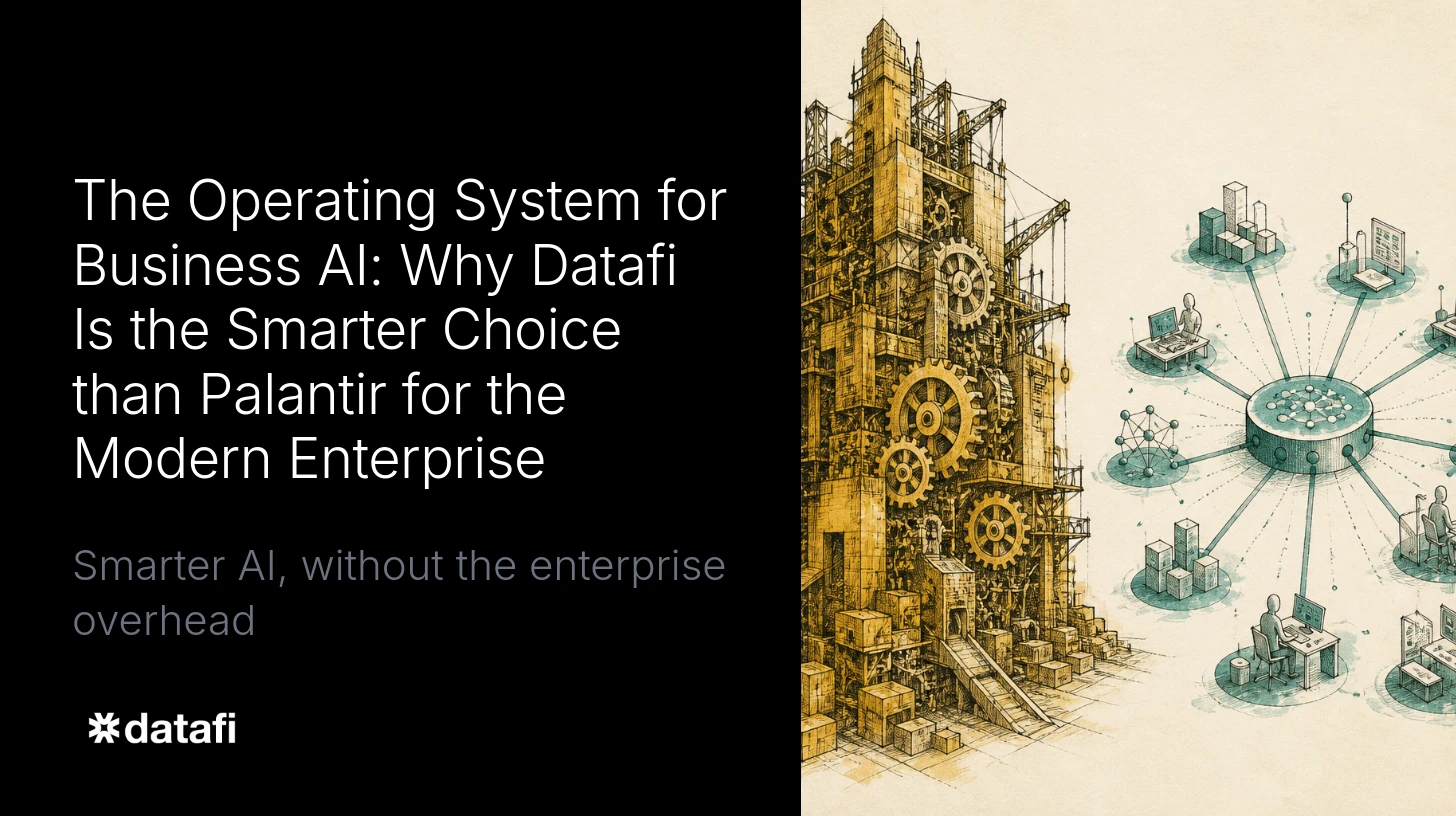
Palantir and Datafi both call themselves AI operating systems, but their philosophies diverge at the foundation: Palantir optimizes for depth and customization in complex environments, while Datafi is built for breadth, speed, and organizational autonomy across the entire enterprise workforce.
Where Palantir Came From, and Why It Matters
Palantir’s founding context is inseparable from its product architecture. The company was built to solve intelligence problems at a scale and complexity that virtually no commercial organization will ever face: integrating fragmented data across federal agencies, surfacing patterns in adversarial environments, and supporting operational decisions where the stakes were measured in lives and national security outcomes.
That origin shaped everything. Palantir’s Foundry platform assumes that the data problem is extraordinarily complex, that the right answer requires deep customization, and that the path to value runs through a significant investment of specialized engineering talent. The company’s forward-deployed engineer model, in which Palantir’s own staff embed with the customer to build and maintain the enterprise AI platform, is not a sales tactic. It is a structural reflection of the assumption that these deployments require ongoing expert intervention to function.
For the customers Palantir was originally designed to serve, that model made complete sense. When the cost of getting the data wrong is catastrophic, and the budget to get it right is essentially unlimited, a bespoke, heavily engineered platform with dedicated support is exactly what you want.
The challenge is that most enterprises are not intelligence agencies. They are manufacturers trying to reduce unplanned downtime. They are insurance companies trying to accelerate claims processing. They are supply chain organizations trying to respond to demand volatility faster than their competitors. The data problems are real and consequential, but they are not of a different species. They are not problems that require a decade of specialized AI architecture development, heavy data engineering investment, or a team of embedded engineers to solve.
Palantir’s commercial pivot over the past several years has been genuine and impressive. The AIP platform, the Agentic Foundry, and the Bootcamp sales model represent a sincere effort to bring the company’s capabilities to a broader enterprise market. But the foundational architecture, and the foundational assumptions about complexity and customization that produced it, remain largely intact. The commercial enterprise is buying a platform originally designed for a very different customer, not a business AI OS built for that enterprise.
What Datafi Was Built to Solve
Datafi starts from a different observation. The core problem of enterprise AI is not that the data problems are too complex to model. The core problem is that AI cannot function effectively in a business environment without full business context, and the AI architecture of most enterprise AI platform deployments actively prevents that context from being available.
Most enterprise AI tools today, regardless of how sophisticated the underlying model is, operate on a narrow slice of organizational data. They can answer questions about what they have been given access to. They cannot reason across the full data ecosystem of the business. They cannot apply the data governance and compliance rules that govern how organizational data should be used. And they cannot function in genuinely autonomous roles because they lack the business context that autonomous decision-making requires.
This is not a model problem. The models are capable. It is an architectural problem. And solving it requires building from the ground up with a vertically integrated stack that connects directly to the complete data ecosystem, enforces data governance natively as a design principle rather than a compliance add-on, and provides a contextual layer that gives AI agents the business context they need to function as genuine operational participants rather than sophisticated search tools.
Datafi’s Business AI OS is built on that architectural premise. The contextual layer is not a feature. It is the foundation. Governance and policy controls are not bolted on after the fact. They are woven into the data access layer from the start. And the Chat UI designed for non-technical users is not a simplified interface on top of a technical platform. It is the primary delivery mechanism for AI value across the entire enterprise workforce, not just the data team.
The organizational implication of this AI architecture is significant. Rather than building an AI capability that serves a specialized team of analysts or data engineers, Datafi enables AI deployment that reaches every employee who makes decisions based on information. That is a fundamentally different model of what enterprise AI is for.
The Ontology Model vs. the Contextual Layer
The deepest architectural difference between Palantir and Datafi lies in how each platform conceptualizes the relationship between AI and the organization’s data.
Palantir’s Ontology creates a structured digital representation of an organization’s operations: assets, entities, relationships, and processes mapped into a formal model that AI agents can reason over. It is a powerful approach, and when it is built and maintained well, it enables a level of operational awareness that most AI deployments cannot match.
But building that Ontology is a substantial engineering undertaking. It requires expert data engineering resources, significant time investment, and ongoing maintenance as the organization’s data ecosystem and organizational data sources evolve. For organizations that have those resources and are willing to make that investment, the Ontology pays dividends. For the majority of enterprises that are operating with lean technical teams and real pressure to show AI value quickly, it is a prerequisite that delays deployment by months or years.
Datafi’s contextual layer operates on a different AI architecture principle. Rather than requiring organizations to rebuild their data representation from scratch into a new formal model, the contextual layer integrates directly with the data ecosystem as it already exists, federating access across systems, enforcing governance at the policy layer, and making the full business context available to AI agents through real time data access. The organization does not need to have its data in a perfect state before AI can function. It needs the architecture that enables AI to work with data in its current state, governed appropriately, with the business context that makes responses genuinely useful.
This distinction has practical consequences that are easy to understate. Organizations that deploy on Palantir frequently find that the Ontology becomes a bottleneck, a technical dependency that must be updated before new data sources can be leveraged, new AI agents can be deployed, or new use cases can be pursued. Organizations that deploy Datafi’s business AI OS can extend the contextual layer incrementally as their data ecosystem evolves, without returning to a foundational rebuild each time the business changes.
Deployment Models That Reflect Different Assumptions About Your Organization
The deployment model a platform uses is one of the most honest signals of what the vendor actually believes about its customers.
Palantir’s Bootcamp model, which compresses the initial sales and onboarding cycle into intensive multi-day workshops, represents a genuine and creative attempt to reduce time-to-value. And it works, relative to the traditional enterprise software sales cycle. But the Bootcamp is an onboarding mechanism. It is not the same as a deployment architecture that enables an organization to go from evaluation to full operational deployment in thirty days without a team of embedded engineers.
Datafi’s deployment architecture is built on the premise that AI should be deployable at the speed of business, not at the speed of a professional services engagement. The vertically integrated stack means that the components organizations need, data connectivity, governance controls, the contextual layer, agentic workflows, and the Chat UI, are not separate implementations that must be assembled by a services team. They are integrated by design, which means deployment is a configuration process rather than a construction project.
The practical consequence is not just speed. It is organizational autonomy. An enterprise that deploys Datafi owns its AI environment. It can extend it, adapt it, and govern it without dependency on vendor-provided engineering resources. That autonomy compounds over time in ways that the initial cost comparison between platforms completely fails to capture.
Two Models of What Enterprise AI Is For
At the deepest level, the difference between Palantir and Datafi is a difference in the theory of change each company holds about how AI creates value in an enterprise.
Palantir’s theory of change, rooted in its intelligence agency origins, is that AI creates value through depth: deep data integration, deep operational modeling, deep analytical capability applied to the hardest problems in the most complex environments. For a specific class of organization facing a specific class of problem, that theory is correct.
Datafi’s theory of change is different. AI creates the most transformative value not through depth alone, but through breadth combined with depth: reaching every employee who makes information-dependent decisions, giving each of them access to AI that understands the full context of the business, and enabling that AI to function in autonomous roles where it does not just surface insights but participates in the workflows that translate insight into action.
The organizations that will define the competitive landscape over the next decade are not those that deploy AI for a specialist team. They are those that make AI a genuine operational capability across the entire enterprise.
That outcome requires a platform built with that specific goal in mind, not a platform adapted from a different context to serve it.
That is the philosophical difference. And it is the one that makes every other comparison in this series worth having.
Datafi is the Business AI Operating System built for the modern enterprise: vertically integrated, contextually grounded, and designed for deployment at organizational scale. Learn more at datafi.co.
Part 1 of 10, next in the series: Palantir’s Deployment Model: The True Cost of AI Implementation