


The threat landscape has changed permanently. Artificial intelligence has not only transformed how organizations extract value from data, it has simultaneously transformed how attackers exploit it. Prompt injection, model poisoning, unauthorized data exfiltration through AI interfaces, shadow AI usage, and lateral movement by autonomous agents have introduced an entirely new class of risk that the enterprise security stack was simply never designed to address.
AI risk is contextual and systemic. Securing the AI era requires a governance layer built into the same stack where data has meaning, models have context, and agents have autonomy, not another point solution bolted onto the perimeter.
Traditional cybersecurity point solutions, endpoint detection, SIEM platforms, DLP tools, identity access management products stitched together through integrations, were built for a world where humans controlled every consequential action and data flowed through predictable, observable channels. That world is gone. In its place is one where AI agents query databases, synthesize confidential records, execute multi-step workflows, and make decisions with real business consequences, often in milliseconds and without human review. Protecting the enterprise in this environment requires something fundamentally different from another point solution bolted onto the perimeter.
This is the design logic behind Datafi Cyber, an integrated AI cybersecurity and governance layer built natively into the Datafi Operating System for AI. And it is why the integration is not a feature, it is the architecture.
The Threat Is Not Arriving. It Is Already Inside.

To understand why integration matters, you first need to understand what has actually changed about AI risk.
When a non-technical employee, a line-of-business analyst, or an autonomous agent accesses enterprise data through an AI interface, several things happen simultaneously that traditional security tools cannot see. The query may traverse multiple data systems. The AI model synthesizes information across those systems into a response that the user would never have been able to construct manually. That synthesized response may contain confidential pricing, personnel records, intellectual property, or strategic plans, delivered in plain language through a chat interface with no audit trail in any of the connected source systems.
There is no firewall rule for “an AI just synthesized our competitive playbook and delivered it to a user whose role does not authorize that level of synthesis.” There is no DLP policy for “the model was given context it should not have been given.” There is no SIEM alert for “an agent completed a three-step workflow that individually crossed three authorization boundaries that would each have been caught separately.”
This is the core problem: AI risk is contextual and systemic. Point solutions are neither.
What Makes Cyber Different: Governance at the Layer That Matters
Datafi Cyber is not a security tool that integrates with Datafi. It is a foundational layer of the Datafi platform, built into the same stack that governs data access, model orchestration, workflow execution, and the Chat UI that non-technical users interact with daily.
This architectural decision is consequential for several reasons.
First, Cyber operates at the point of data federation, not at the perimeter. When an employee or agent makes a request through Datafi’s Chat UI, the platform evaluates that request before data is retrieved, before the model is given context, and before a response is formulated. It enforces policies at the semantic layer, where data has meaning, rather than at the network layer, where data is just packets. This means the platform can distinguish between a marketing analyst querying approved customer segments and the same analyst, on the same network, at the same terminal, querying executive compensation data. Traditional DLP tools would see two identical network events. Datafi Cyber sees two fundamentally different authorization scenarios.
Second, Cyber shares context with the full business intelligence layer. This is where integration delivers a capability that no point solution can replicate. Datafi’s contextual layer, the semantic model that gives the AI an understanding of the organization’s data relationships, governance domains, entity definitions, and business logic, also informs the platform’s policy enforcement. Security decisions are not made in isolation from what the data means. When Cyber evaluates whether a data retrieval is appropriate, it has access to the same business context that makes the AI useful: who is asking, what role they occupy, what they are trying to accomplish, how sensitive the data involved is, and whether the intended use aligns with defined policies.
This is not a correlation that happens after the fact in a SIEM. It is real-time, pre-response governance baked into the request pipeline.
Third, Cyber governs agents and autonomous workflows with the same rigor it applies to human users. This is perhaps the most forward-looking aspect of the design. As organizations mature their AI deployments, the ratio of agent-initiated data requests to human-initiated requests will invert. An autonomous agent executing a predictive maintenance workflow may query dozens of data sources, synthesize findings across operational, financial, and supplier data, and produce recommendations or take direct action, all without a human reviewing each step. Cyber applies policy to each step of that workflow, not just to the endpoint. If an agent’s execution path requires data that falls outside the scope of its defined operational mandate, the platform blocks that access and logs the event, even when no human is present to catch the deviation.
Full Business Context as a Security Primitive
One of the most underappreciated insights in enterprise AI security is this: you cannot govern what you do not understand. And most security tools do not understand the business.
At Datafi, we have built the position that transformative AI requires full business context. This is not simply a product philosophy, it is an operational requirement. For AI to solve hard problems rather than answer narrow questions, it needs to understand the relationships between data, the policies that govern its use, the organizational structures that define authorization, and the workflows that give data retrieval a purpose. Without that context, AI is guessing. And so is any security system trying to govern it.
Cyber inherits the full business context layer that Datafi builds and maintains as the foundation of its AI operating system. Every entity, every data domain, every policy rule, and every governance classification that powers Datafi’s analytical and agentic capabilities is simultaneously available to it for security decision-making. This creates a security layer that is semantically aware, not merely syntactically aware.
Consider what this means in practice. A traditional DLP solution might flag any query containing the word “salary” as potentially sensitive. Datafi Cyber knows that the HR analytics team lead is authorized to query salary banding data within her region, that the same query from a sales operations analyst falls outside policy, and that an autonomous compensation benchmarking agent has a defined scope that includes aggregate salary data but excludes individual records. Three different security responses for three queries that look identical to a perimeter tool. The platform sees the difference because it shares context with the layer that makes those differences meaningful.
The Cost of the Point Solution Approach in an AI-First World
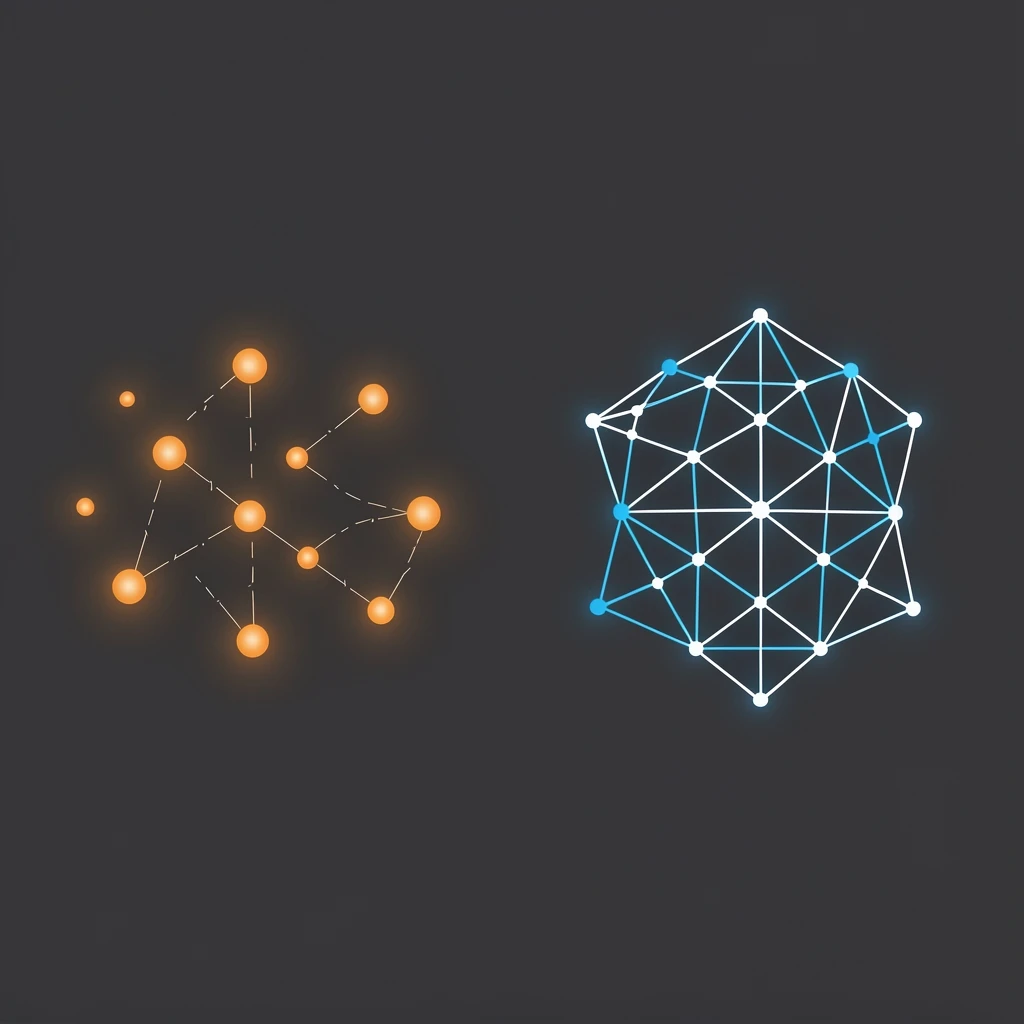
Organizations that attempt to secure AI deployments by integrating additional point solutions into an existing security stack are solving the wrong problem with the wrong tool. The costs are real and compounding.
Coverage gaps are structural. Point solutions that were not designed to understand AI request pipelines cannot close the gaps those pipelines introduce. You can add monitoring on top of a system you do not understand. You cannot govern it.
Alert fatigue displaces genuine signal. When security teams receive high volumes of alerts from tools that cannot distinguish between a sensitive data event and a benign AI synthesis, genuine threat signals get buried. The mean time to detect real incidents grows. The mean time to respond to false positives consumes analyst capacity that could be deployed elsewhere.
Compliance posture degrades as AI usage scales. Regulatory requirements around data handling, privacy, and AI governance are tightening globally. An audit trail assembled from disparate point solution logs, none of which share a common understanding of what data was retrieved, why, by whom, or in what context, is not a defensible compliance posture. Datafi Cyber generates a unified audit record that reflects the full business context of every data access event, whether initiated by a human or an agent.
Shadow AI proliferates in high-friction environments. When employees find that AI tools are difficult to access through approved channels, they route around the controls. The result is shadow AI usage on personal accounts, unauthorized third-party integrations, and data leaving the organization through channels that are completely invisible to the security stack. Datafi’s Chat UI, governed by Cyber at every layer, is designed to be the frictionless, approved path that removes the incentive to go around it.
Security That Enables Rather Than Restricts
There is a persistent and unfortunate pattern in enterprise security: the more rigorous the control, the more friction it introduces, and the more pressure mounts to find workarounds. This is not a failure of security teams. It is a failure of architecture. Security tools designed purely to restrict, without any understanding of what legitimate use looks like, inevitably become obstacles to legitimate use.
Cyber is designed from the ground up to enable AI-powered work at enterprise scale, not to block it. Because it shares context with the business intelligence layer, it can enforce policy with precision rather than bluntness. Employees are not presented with blanket restrictions. They are given access to what they are authorized to access, guided by AI that understands their role, their purpose, and the data ecosystem they need to work effectively. Agents are not constrained to the point of uselessness. They are scoped precisely to their operational mandate and monitored continuously to ensure they operate within it.
This is the distinction between security as friction and security as governance. Governance enables productive work within defined boundaries. Friction resists all work indiscriminately. Datafi Cyber is a governance layer, and the depth of integration that makes it effective is the same integration that makes Datafi productive.
Built for the AI Era Across Every Industry
The organizations deploying Datafi today are using AI in increasingly consequential roles: operational analytics, predictive asset management, autonomous customer engagement, strategic planning support, and supply chain optimization. These are not experimental use cases. They involve real data, real decisions, and real regulatory exposure.
Whether the deployment context is manufacturing, financial services, logistics, energy, or retail, the security requirements share a common structure. Who can access what data, under what circumstances, for what purposes, and with what audit trail? Cyber answers all four questions at the layer where they can actually be enforced, the layer where data, AI, governance, and workflow converge in the Datafi OS for AI.
Organizations of any size can achieve this level of security maturity. The Datafi platform is designed to scale from mid-market to global enterprise, with Cyber providing the same depth of contextual governance at every scale. The integrated architecture means there is no point at which adding AI capability means subtracting security rigor.
The Architecture Is the Advantage
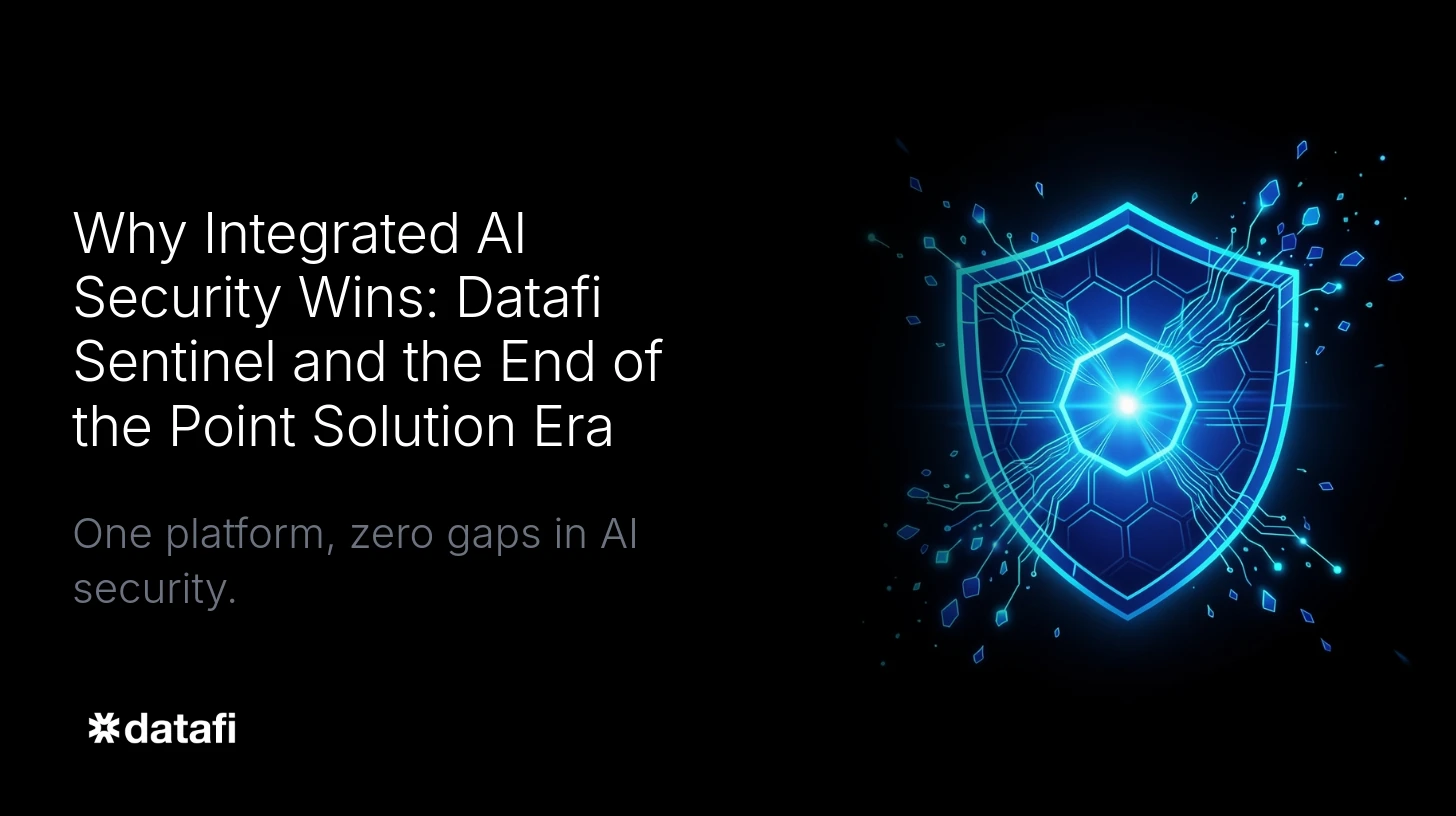
The era of assembling enterprise AI security from point solutions is ending. It is ending not because security vendors are failing, but because the threat has become architectural. AI introduces risk at the layer where data has meaning, where models have context, where agents have autonomy. Securing that layer requires a solution that lives there, not one that observes from the perimeter.
Datafi Cyber does not monitor AI from the outside. It governs AI from within the same stack that makes AI effective.
The full business context layer that gives Datafi’s AI the knowledge to solve hard problems is the same layer that gives Cyber the knowledge to enforce governance with precision.
That integration is not a product decision. It is a conviction about what it actually takes to use AI responsibly at scale, a conviction built from years of working directly with data, AI systems, and the organizational realities that determine whether technology transforms a business or merely complicates it.
The question for every AI-forward organization is not whether to take AI security seriously. That question is settled. The question is whether to address it with a layer of additional point solutions, or to build on a foundation that was designed for this challenge from the start.
Datafi is an applied AI software company building the Operating System for AI: a vertically integrated data and AI technology stack that gives every employee, analyst, and autonomous agent access to the full business context they need to work effectively, governed end-to-end by Datafi Cyber. Learn more at datafi.co.