


The gap between what organizations report about AI and what is actually happening inside their operations has never been wider. Understanding why requires a fundamental rethink of what enterprise AI adoption actually means.
Most enterprise AI deployments are solving for interaction convenience, not business outcome. Real adoption means AI is embedded in decisions, connected to the full data ecosystem, and capable of executing workflows autonomously, not just generating suggestions for a human to accept or reject.
Every quarter, a new wave of surveys arrives with headlines declaring that AI adoption is accelerating at historic speed. Boards are satisfied. Investors are excited. Press releases proliferate. And yet, when you talk to the people running data and AI programs inside large and mid-sized enterprises, a very different picture emerges. Productivity is up slightly in pockets. A few analysts are using a chatbot to summarize reports faster. The help desk has a new front end. But the transformative outcomes that justified the investment, the ones promised in the business case, remain frustratingly out of reach.
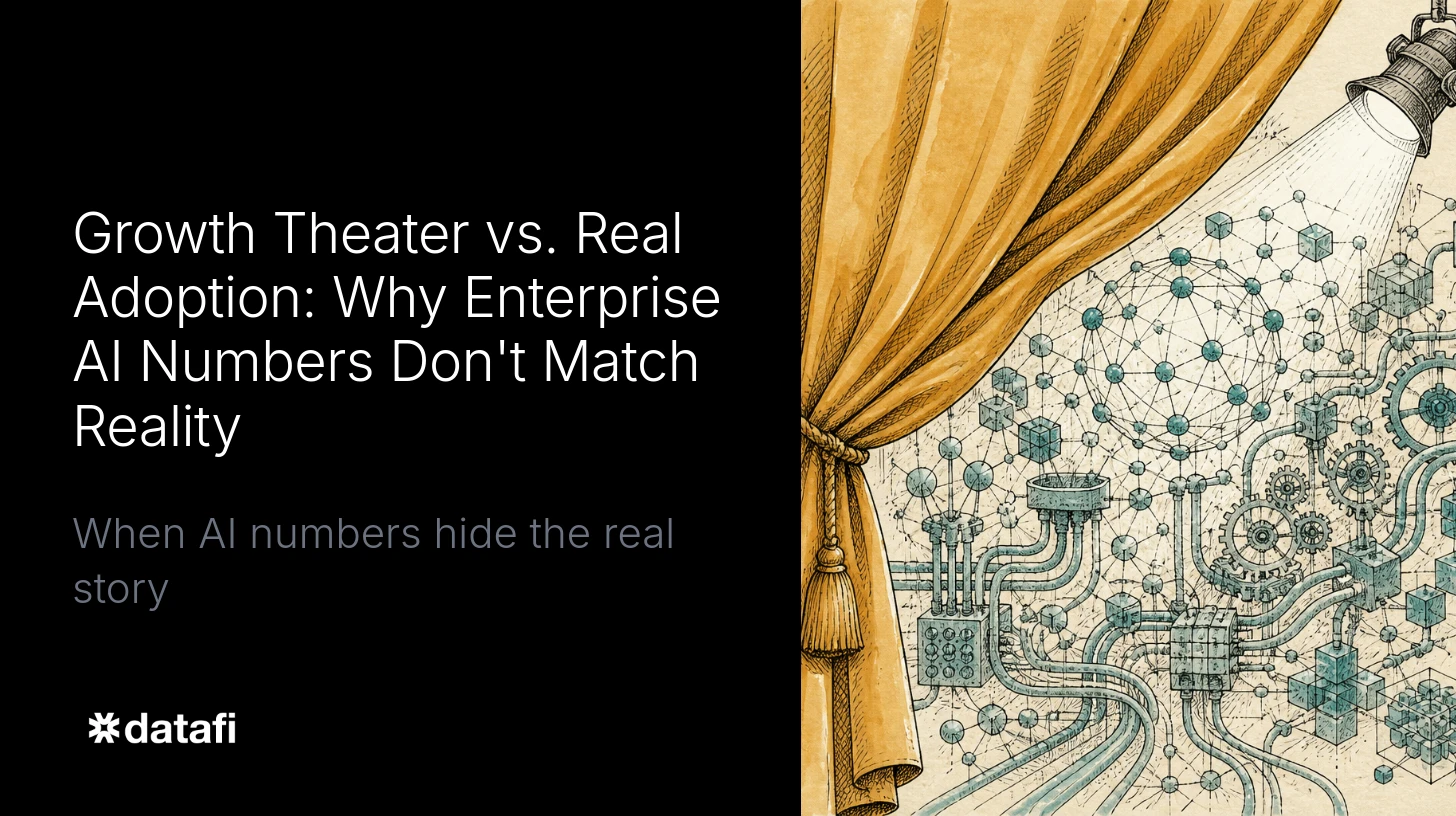
This is Growth Theater: the performance of AI adoption without the substance of it.
Understanding the gap between reported adoption and realized value is not an academic exercise. For any organization serious about competing in the next decade, it is the most important strategic question they can ask.
The Metrics Are Measuring the Wrong Thing
When enterprises say they have “deployed AI,” what they typically mean is that they have purchased access to one or more AI tools, enabled those tools for some portion of their workforce, and observed some measurable level of usage. By that definition, adoption is indeed widespread. Licensing agreements are signed. Seats are provisioned. Usage logs show activity.
But usage is not transformation. A workforce that uses AI to draft emails faster is not the same as a workforce whose decision-making is meaningfully faster, better informed, or structurally more capable. The distinction matters enormously when the goal is competitive differentiation or cost-reduction at scale.
The fundamental problem is that most enterprise AI deployments are solving for interaction convenience, not business outcome. They answer questions. They accelerate tasks that were already being done. They reduce friction in workflows that were already running. This is genuine value, and it should not be dismissed, but it is not the category of value that justifies the strategic narrative most organizations are building around AI.
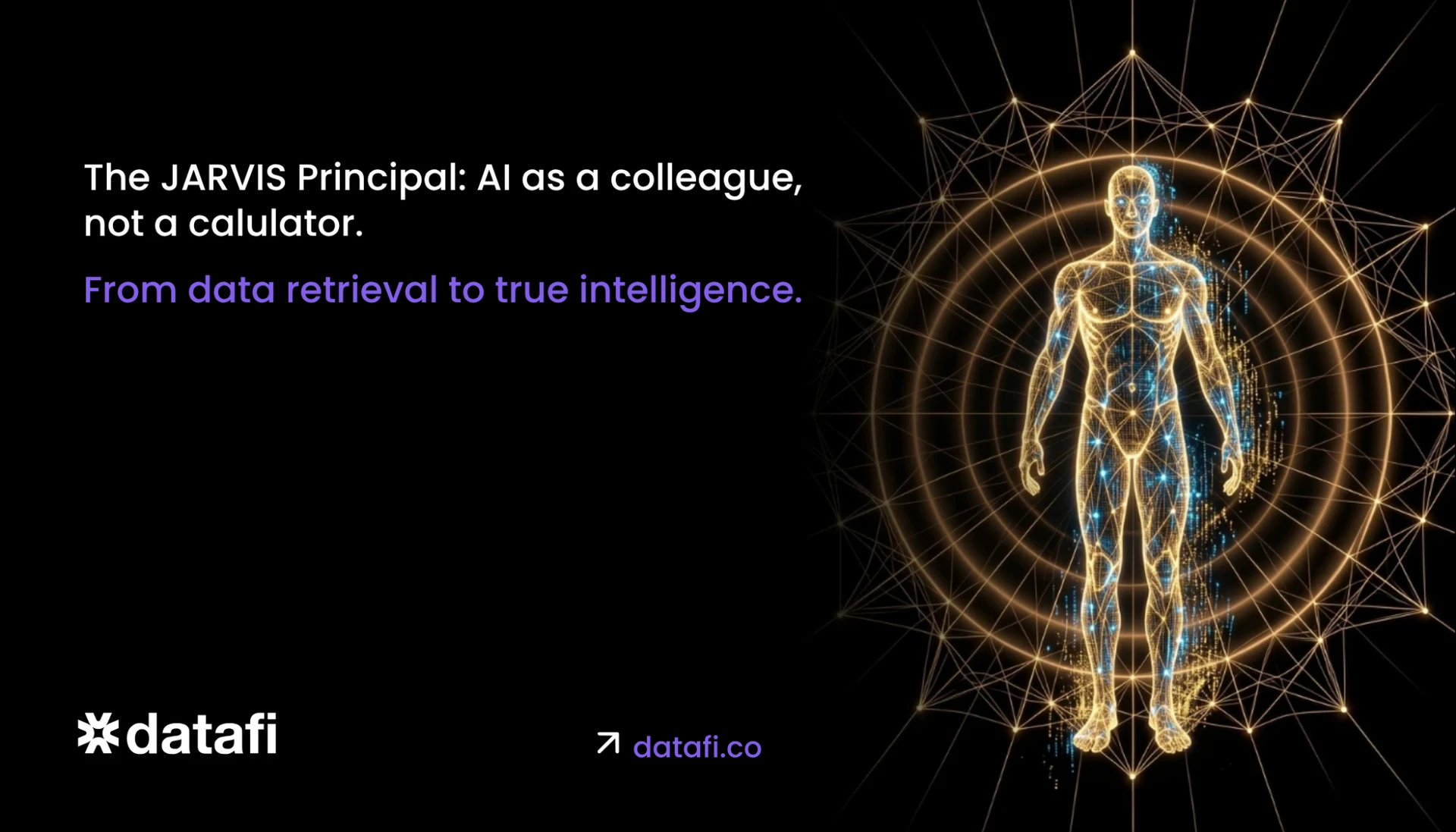
Real adoption means AI is embedded in decisions, not just adjacent to them. It means autonomous agents are executing workflows, not just generating suggestions for a human to accept or reject.
Very few organizations are there yet. Most are not even on the right path.
Why the Gap Exists: The Context Problem
The single most underappreciated barrier to genuine enterprise AI adoption is the context problem. Large language models are remarkably capable, but their capability is bounded by what they know. In a general deployment, they know what they were trained on. In a typical enterprise deployment, they also know what the user types into the prompt. Neither is sufficient to solve hard business problems.
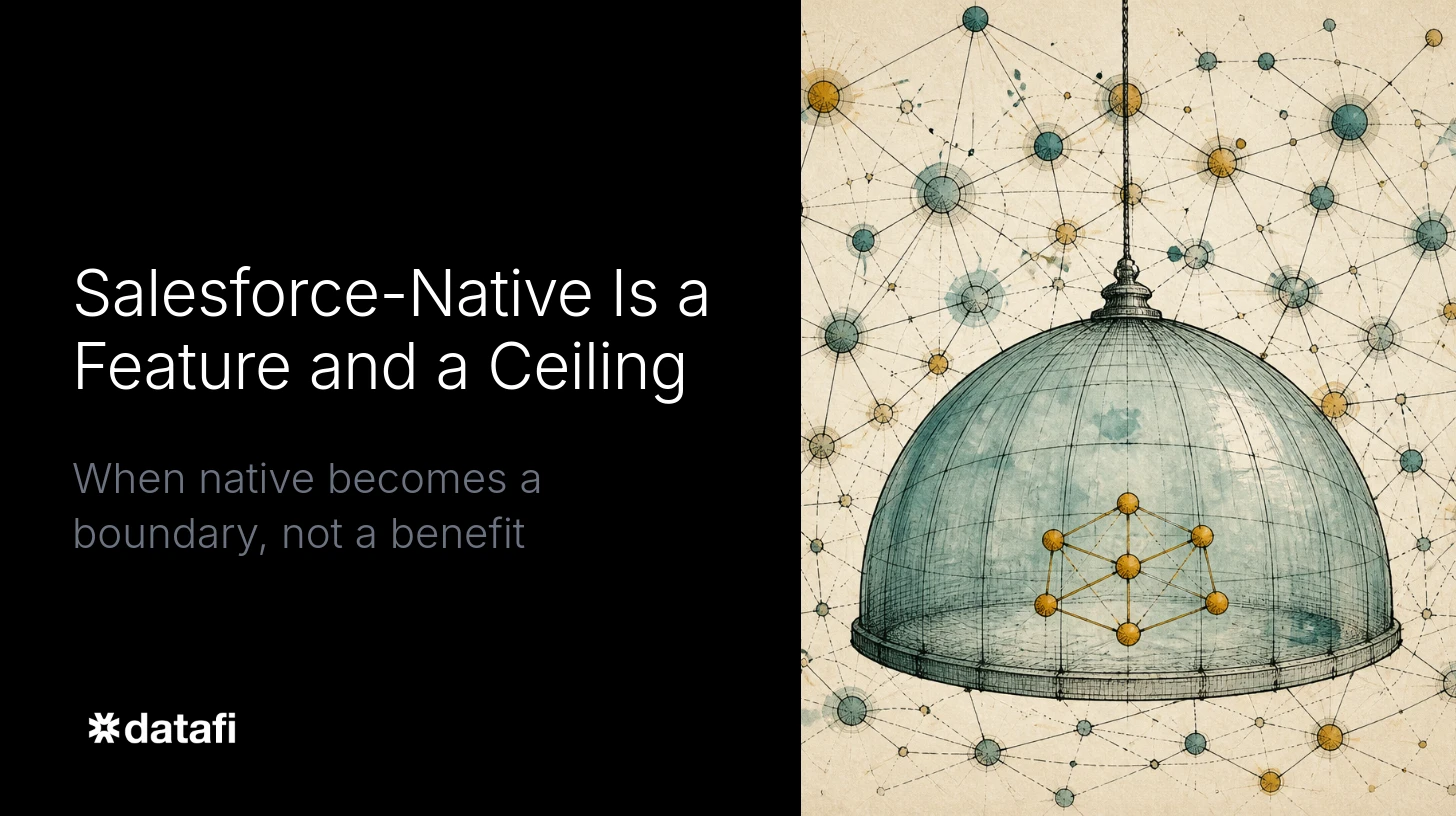
Real business problems live in data. They live in operational histories, customer records, maintenance logs, financial systems, supply chain data, and the thousands of micro-decisions embedded in how an organization actually runs. An AI that cannot access this data is not operating in the business. It is operating next to the business, answering questions about a world it can only partially see.
This is why the majority of enterprise AI deployments plateau. The tools are capable. The intent is genuine. But the models lack the full business context required to move from answering questions to solving problems. They can tell you what the data says when you show it to them. They cannot observe, learn, and reason across your entire data ecosystem autonomously.
The organizations that close the gap between reported adoption and real adoption are the ones that solve the context problem first. That means connecting AI to the complete data ecosystem, not just the data that is easy to surface. It means building a contextual layer that gives models the institutional memory, the domain knowledge, and the operational awareness to function as genuine problem-solvers rather than sophisticated search engines.
The Architecture of Real Adoption
At Datafi, we work with enterprises across insurance, logistics, manufacturing, life sciences, financial services, and energy. What we observe consistently is that the organizations making the most progress share a common architectural orientation. They are not deploying point solutions. They are building integrated platforms where data, AI, governance, and user experience function as a single system.
This matters because the failure modes of Growth Theater are almost always architectural. An organization deploys a general-purpose AI assistant on top of a fragmented data environment. Non-technical users cannot access the data they need without help from technical teams. Governance and policy controls are external to the AI layer, which means they are either bypassed in practice or so restrictive they prevent useful work. The result is a tool that works well in demos and fails in daily operations.
The architecture required for real adoption has four essential properties.
First, it must be vertically integrated. Data infrastructure, AI models, agent orchestration, governance controls, and the user interface must be designed to work together, not assembled from independently optimized components. Integration gaps are where value evaporates. Every handoff between systems that were not designed for each other is a place where context is lost, latency accumulates, and failure modes multiply.
Second, it must give AI access to the complete data ecosystem. This is not just a question of connecting more data sources, though that is necessary. It is a question of building a contextual layer that makes the data meaningful to the model. Business context includes not just raw data but the policies, hierarchies, definitions, and relationships that give that data operational meaning. Without this layer, AI agents are perpetually working with incomplete information, which produces perpetually incomplete outcomes.
Third, governance and policy controls must be embedded in the platform, not bolted on externally. Enterprise AI that operates without embedded governance is not enterprise-ready, regardless of what the vendor claims. The ability to define who can access what data, under what conditions, and with what constraints is not a compliance checkbox. It is a prerequisite for deploying AI in critical workflows where the consequences of error are material.
Fourth, the interface must be designed for non-technical users. This point is consistently underweighted in enterprise AI strategy. If the only people who can effectively use an AI platform are data scientists and engineers, the platform has not solved the adoption problem. It has relocated it. The promise of enterprise AI is workforce-wide capability amplification. Delivering on that promise requires a chat-based interface that allows any employee to interact with AI agents and workflows without requiring technical expertise, and to trust the results because the governance layer has already handled the constraints they cannot see.
Agents and the Autonomous Frontier
The conversation in enterprise AI is moving, rightly, toward agentic AI. The ability to deploy AI not just as a responsive tool but as an autonomous agent capable of executing multi-step workflows, monitoring conditions, and taking action without continuous human instruction is where the most significant operational value will be created.
The use cases are substantive and cross-industry. Predictive maintenance and asset management become genuinely proactive when an AI agent can monitor equipment telemetry continuously, correlate patterns across historical failure data, and initiate service requests before failure occurs rather than after. Operations optimization reaches a different level of effectiveness when an agent can observe production data, identify inefficiencies, model interventions, and recommend or execute changes in near real-time. Strategic planning becomes more responsive when AI agents are continuously synthesizing market signals, internal performance data, and scenario models rather than waiting for a quarterly review cycle.
But none of these outcomes are achievable with the fragmented, context-limited deployments that characterize most of today’s enterprise AI landscape. Autonomous agents require the same things that good human decision-makers require: access to relevant information, understanding of constraints and objectives, and the authority to act within defined boundaries. Building that foundation is the work that separates organizations that will achieve transformative outcomes from those that will continue producing Growth Theater indefinitely.
The organizations that will win are those that understand AI adoption is not a procurement event. It is an architectural commitment. It requires building the conditions under which AI can genuinely operate as a problem-solver: connected to the full data ecosystem, governed by embedded policy controls, accessible to every employee through an interface designed for human use, and capable of functioning in fully autonomous roles where the business context demands it.
What Real Adoption Actually Looks Like
Organizations that have moved beyond Growth Theater tend to share a set of observable characteristics that go beyond usage metrics.
They have unified the data experience across the enterprise so that every employee, regardless of technical background, can access relevant information and AI-assisted analysis through a consistent interface. The friction of finding data, formatting it, and interpreting it has been largely removed from the daily workflow.
They have deployed AI agents in operational roles, not just advisory ones. The AI is not suggesting what to do. In defined domains with appropriate governance, it is doing it, and human oversight is focused on exceptions and edge cases rather than routine execution.
They have built governance into the platform layer, which means AI can be trusted with sensitive data and critical workflows because the policies that govern access and action are intrinsic to how the system operates.
And perhaps most importantly, they have made the shift in organizational mindset from thinking about AI as a tool that answers questions to thinking about AI as a capability that solves problems. That shift is not primarily technical. It is strategic. It requires leadership to define what problems they actually want to solve and to build the infrastructure that makes solving those problems possible.
The Cost of Staying in Theater
The enterprise AI market is experiencing a period in which the gap between performance and substance is unusually large. That gap will close, as it always does in technology cycles. The organizations that have invested in the architectural foundations of real adoption will be positioned to extend their advantage significantly when it does. The organizations that have settled for Growth Theater will face a more difficult transition, because the habits, architectures, and organizational behaviors that produce theater are not simply replaced by better tools. They have to be rebuilt.
The cost of inaction is not the cost of missing out on efficiency gains in the short term. It is the cost of entering the next phase of the AI curve without the data infrastructure, contextual foundations, and organizational capabilities that genuine adoption requires.
The numbers reported in industry surveys will continue to improve. Adoption, by most definitions, will continue to grow. The question for enterprise leaders is not whether they are contributing to those numbers. It is whether the investment is producing outcomes that could not have been achieved without it.
That is the only measure of adoption that ultimately matters.
Datafi is building the Business AI Operating System for the enterprise: a vertically integrated data and AI platform with embedded governance, autonomous AI agents, and a Chat UI designed for every employee. Learn more at datafi.co.