


Series: Salesforce Agentforce vs. Datafi | Part 3 of 6
The phrase ‘Salesforce-native’ is used as a selling point. And fairly so. When AI capabilities are built natively into a platform your teams already use, the adoption curve flattens, the integration overhead is minimal, and the time to initial value is short. These are real advantages, and they matter to enterprise buyers who have been burned by long, expensive AI deployments that delivered little before their sponsors lost patience.
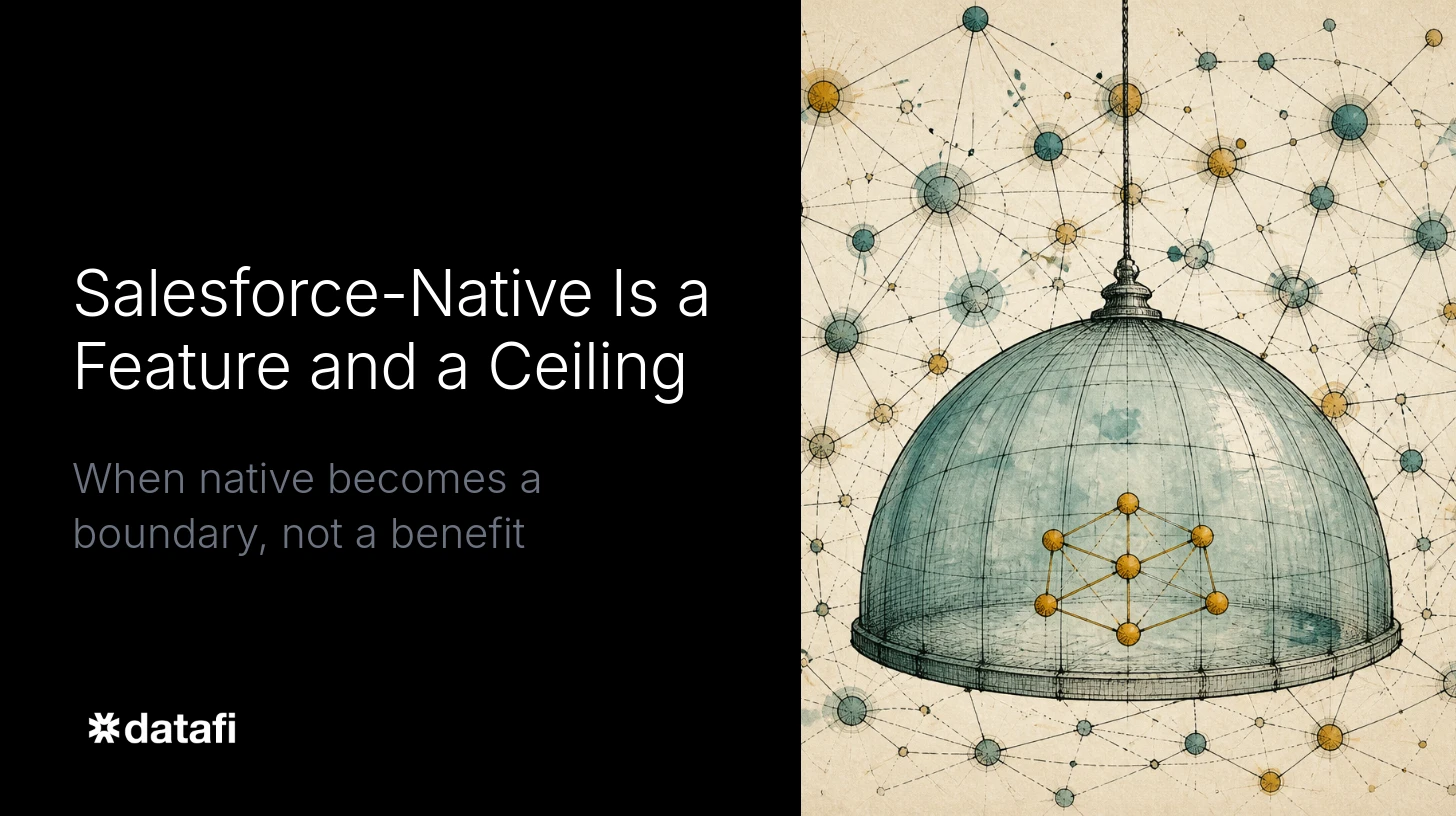
But native also means something else. It means bounded. And the boundary of a platform-native AI is precisely the boundary of the platform it was designed for.
Understanding where that boundary sits, and what lies on the other side of it, is essential to making a sound decision about enterprise AI architecture.
Platform-native AI delivers fast time-to-value, but the same boundaries that make it easy to adopt will eventually constrain the scope of business problems it can solve. The ceiling is the platform itself.
What Salesforce Is Actually Doing
Salesforce’s recent moves with Agentforce reflect a genuine attempt to push beyond CRM boundaries. Headless 360, announced at TDX 2026, separates Salesforce capabilities from the traditional Salesforce interface, enabling programmatic access via APIs, MCP tools, and CLI commands. Developers can build custom frontends on top of Salesforce data and create coordinated agent systems that execute tasks across Salesforce and some external systems.
This is meaningful progress. It signals that Salesforce understands the limitation of a purely interface-bound platform and is working to make the underlying capabilities more composable and accessible.
But the operative phrase remains: on top of Salesforce data. The composability and API flexibility of Headless 360 make it easier for technical teams to build with Salesforce. What they are building with, and what they are building on, still originates from within the Salesforce data ecosystem.
“Headless Salesforce is still Salesforce. The flexibility is real. The data boundary is still there.”
The Vendor Lock-In That Does Not Announce Itself
Traditional vendor lock-in is easy to identify. You are locked in when switching costs are prohibitive, when your data cannot be exported in useful formats, or when proprietary standards make interoperability impossible.
Platform-native AI creates a subtler form of lock-in. It is not that you cannot leave. It is that as your AI capabilities deepen and your workflows become more tightly integrated with Salesforce’s intelligence layer, the organizational cost of operating outside that layer grows. The more you invest in Agentforce-native agents, Slack-based workflows, and Salesforce-originated intelligence, the more your AI strategy becomes coextensive with your Salesforce strategy.
This has consequences that extend beyond technology choice. It affects budget negotiations, contract renewals, and the relative leverage between your organization and your vendor. It affects your ability to respond when a better AI capability emerges from outside the Salesforce ecosystem. And it affects your ability to build AI workflows that serve the parts of your organization that do not and should not live in a CRM.
Data Gravity and the Intelligence Layer
There is a concept in enterprise architecture called data gravity: the tendency of applications, services, and compute resources to accumulate around data because moving data is expensive. The larger and more established a data store, the stronger its gravitational pull on the systems built to interact with it.
Platform-native AI creates intelligence gravity. When your AI reasoning capability is built into a specific platform, the intelligence it can apply is subject to the same gravitational pull as the data the platform holds. The AI becomes most powerful precisely where the most data already lives. Everywhere else, it becomes less capable, less contextual, and less useful.
For most enterprises, the data in Salesforce represents a substantial but minority share of total enterprise data. Customer relationship records, pipeline data, service case histories: these are important. They are not the operational reality of the business. Manufacturing output data, financial system records, logistics tracking, HR systems, regulatory compliance documents, engineering records: this is where the majority of enterprise data actually lives.
Building intelligence gravity into Salesforce means concentrating AI capability in one corner of the enterprise data landscape.
“The most powerful AI in your business should sit above all your data, not inside the system that holds a fraction of it.”
The Composability Argument and Its Limits
The response to this line of reasoning is typically to invoke composability. Modern platforms are open. APIs exist. MCP connectors are available. You can pull data from external systems and make it accessible to Salesforce agents.
This is true in a technical sense. But composability through integration is not the same as a unified architecture, and the difference matters at enterprise scale.
When you integrate external data into a Salesforce-native AI through APIs and connectors, you are solving a specific problem: making a specific dataset accessible to a specific workflow. Each integration is a point solution. Each one requires maintenance. Each one creates a dependency that must be managed. And each one still delivers external data into a Salesforce-centric reasoning environment, where the governance model, the access control framework, and the intelligence layer were designed for a different kind of data.
A unified architecture, by contrast, starts with the premise that all enterprise data sources are peers. No source is native and no source is an add-on. Governance is enforced consistently across all of them. Intelligence is built on the complete data foundation, not on a primary platform supplemented by integrations.
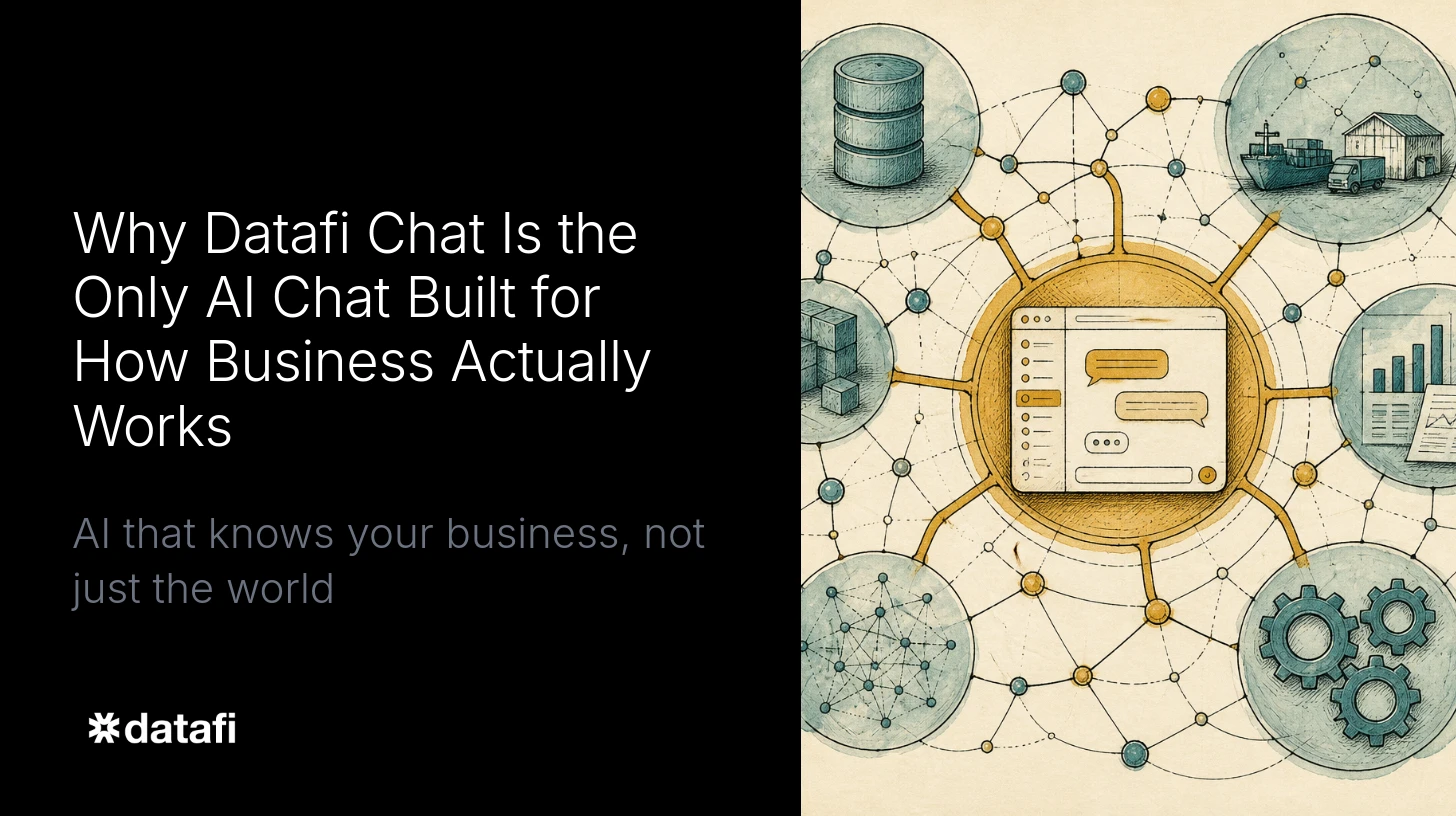
Datafi was designed on the unified architecture premise. The platform connects to every data source your organization uses, treats them as equals in the intelligence layer, and enforces governance consistently across all of them. There is no primary platform and no secondary integrations. There is an operating system, and beneath it is the complete data reality of your business.
What This Means for Organizations Already Running Salesforce
None of this suggests that organizations running Salesforce should displace it. Salesforce remains one of the most capable CRM platforms available, and for customer-facing operations, Agentforce delivers real value within its domain.
The architectural question is separate from the platform question. An organization can run Salesforce for CRM and run Datafi as the intelligence layer across its complete data ecosystem. These are not mutually exclusive choices. What they represent is a decision about where enterprise AI strategy lives: inside a single platform, or above all platforms.
Organizations that build their AI strategy inside Salesforce will develop deep capability within the CRM domain and encounter hard limits outside it. Organizations that build their AI strategy on a unified data operating system will develop capability across the entire business, with Salesforce as one of many connected sources rather than the center of the intelligence architecture.
The Ceiling Question
Every enterprise AI deployment eventually hits a ceiling. The ceiling for platform-native AI is the platform boundary. When users start asking questions that require context from outside that boundary, or when workflows need to execute actions across systems that are not natively connected, or when compliance requirements demand governance controls that the platform was not designed to enforce at the data layer, the ceiling becomes visible.
The ceiling question is not whether Salesforce-native AI is good. It is whether it is sufficient. Whether the boundary of the platform is narrower than the scope of the business problems you are trying to solve.
For organizations that have defined their AI ambition broadly, that want AI that can see and act across the full operational reality of their business, the Salesforce-native ceiling will arrive. The question is whether you encounter it before or after you have built your entire AI strategy around the platform that created it.
“Salesforce-native is a feature when you are inside the ecosystem. It becomes a ceiling the moment your hardest business problems require more.”
Building Above the Ceiling
The organizations that will achieve the most consequential AI outcomes over the next several years are not those that find the best platform-native AI. They are those that build their intelligence layer above all platforms, with access to the complete data reality of the business, governance enforced at the foundation rather than the surface, and the ability to deploy autonomous agents that can act across the entire enterprise ecosystem.
That is what an operating system for business AI makes possible. Not AI that is good within a platform, but AI that is powerful because it operates above all of them.
Datafi operates above your entire data ecosystem, connecting every source, enforcing governance at the foundation, and delivering AI intelligence that is not bounded by any single platform. Learn more at datafi.co
Next in this series: Answering Questions vs. Solving Problems: The Autonomy Gap