

Series: Salesforce Agentforce vs. Datafi | Part 4 of 6
The phrase ‘move beyond insight to action’ has become the defining aspiration of enterprise AI marketing. Almost every major platform uses it. Salesforce uses it to describe Agentforce. It is a meaningful distinction, and credit is due to platforms that take it seriously.
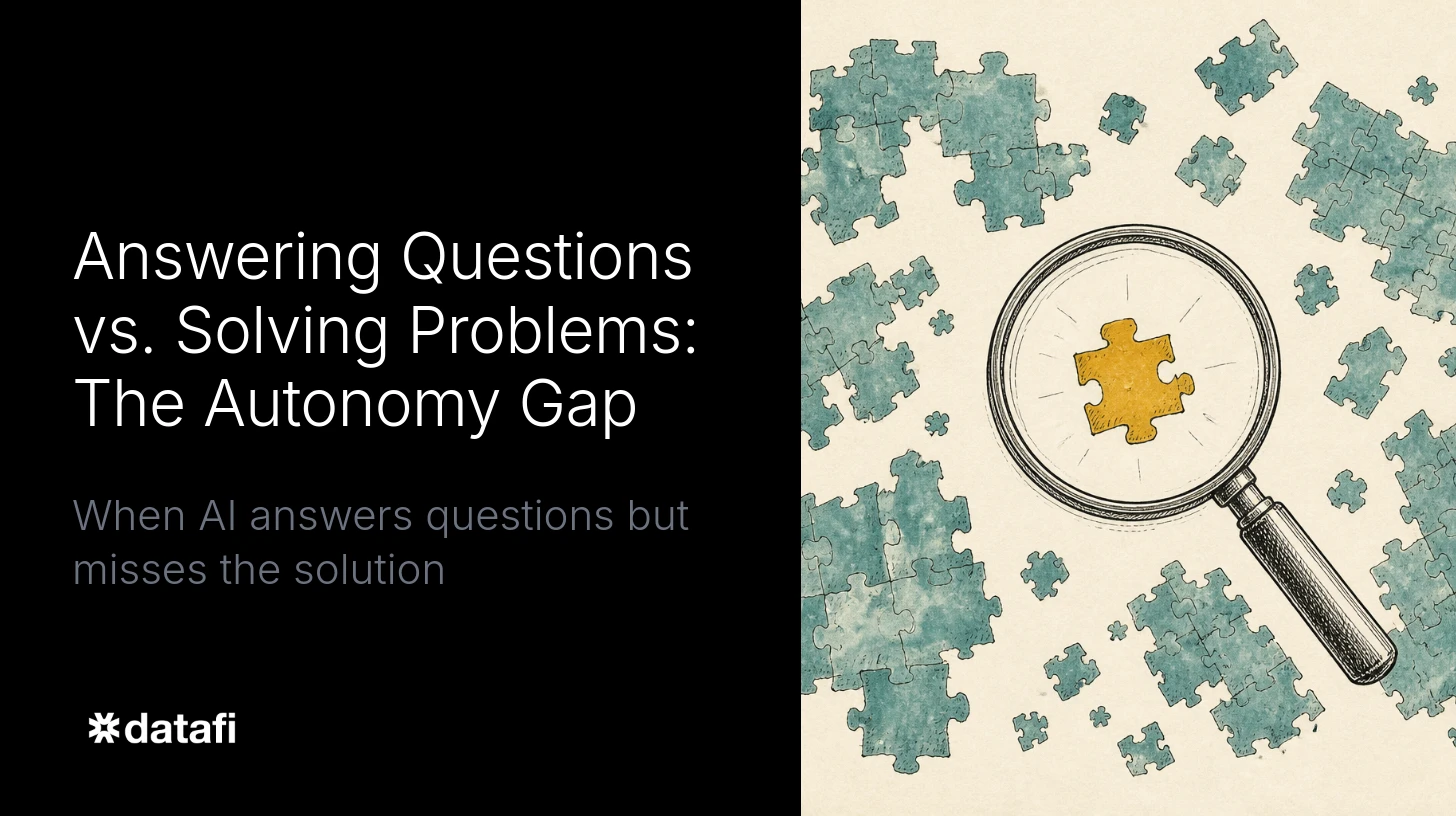
But moving beyond insight to action is not the same as solving problems. Action without complete context is not progress. It is a faster way to execute on partial information. And the gap between answering questions and genuinely solving hard business problems is not a gap in agent sophistication. It is a gap in the information substrate the agent operates on.
This is the autonomy gap. And it is where the architectural difference between Agentforce and Datafi becomes most consequential.
The ceiling of autonomous AI capability is not set by the model or the agent. It is set by the completeness of the data foundation the model is allowed to reason over. Without full business context, autonomous AI answers questions about part of the problem rather than solving the whole.
What Autonomy Actually Requires
Autonomous AI capability rests on three conditions. The agent must be able to reason across the complete context relevant to the problem. It must be able to act across the systems required to execute the solution. And it must operate within the governance and policy framework of the organization at every step.
All three conditions must be met simultaneously. An agent that reasons well but cannot act is a sophisticated advisory tool. An agent that can act but lacks complete context will execute on partial understanding, which is frequently worse than doing nothing. An agent that reasons and acts without consistent governance creates compliance exposure that will eventually end the deployment.
Agentforce is a capable platform for the first condition within the Salesforce data domain. It reasons well over CRM data, service records, pipeline history, and the other information that lives natively in Salesforce. For the second and third conditions, the limitations explored in the earlier articles in this series begin to compound.
“Autonomy without complete context is not intelligence. It is confidence without comprehension.”
The Partial Context Problem in Practice
Consider the anatomy of a genuinely hard business problem. A regional vice president wants to understand why one territory is underperforming relative to plan and what should be done about it.
Answering this question autonomously requires reasoning across multiple data domains simultaneously: pipeline and quota attainment from CRM, pricing and discount history from the ERP, product availability and fulfillment rates from supply chain, competitive win/loss data from wherever it is captured, customer satisfaction data from service systems, and compensation and territory assignment data from HR. It then requires synthesizing that analysis into a recommended course of action and, ideally, initiating the workflows required to execute it.
Agentforce can contribute meaningfully to the CRM portion of this analysis. It can surface pipeline metrics, flag anomalies in deal progression, and pull service history for key accounts. What it cannot do is reason across the non-Salesforce data domains that are often where the real answer lives. The fulfillment problem that is eroding customer confidence. The pricing inconsistency that is making the territory uncompetitive. The territory boundary that was drawn in a way that systematically disadvantages the rep.
Why the Data Foundation Determines the Autonomy Ceiling
There is a direct relationship between the completeness of the data foundation an AI operates on and the ceiling of autonomous capability it can achieve.
When an agent has access to 30 percent of the relevant data for a given problem, it can answer questions about that 30 percent. It cannot autonomously solve the problem, because solving the problem requires understanding the full system. The agent’s autonomy is bounded by its information horizon.
When an agent has access to the complete data ecosystem, the information horizon expands to match the scope of the problem. Autonomous reasoning becomes possible because the agent can examine every relevant variable. Autonomous action becomes trustworthy because the recommendations emerge from a complete understanding rather than an extrapolation from partial data.
Datafi was designed around this relationship. The platform’s contextual layer assembles full business context across every connected data source before the AI begins to reason. Structured data, unstructured documents, operational systems, real-time feeds, and historical records are all part of the information substrate. The agent does not reason over what Salesforce knows. It reasons over what the business knows.
“The ceiling of autonomous AI capability is not set by the model. It is set by the data the model is allowed to see.”
The Governance Dimension of Autonomous Action
The third condition for genuine autonomy, consistent governance at every step, is where many enterprise AI deployments stall in production.
The challenge is that governance requirements do not stay constant as AI capability scales. An agent that answers questions about pipeline data has a limited governance surface. An agent that autonomously initiates workflows across multiple systems, updates records, triggers financial approvals, and executes cross-functional processes has a governance surface that spans the entire enterprise.
Agent-layer governance, which constrains what specific agents are permitted to do, cannot scale to cover this surface reliably. The number of possible action sequences, data access patterns, and workflow combinations grows combinatorially as agent autonomy expands. Designing guardrails for every possible scenario becomes an impossibility.
Data-layer governance scales differently. When governance is enforced at the point of data access, the rules travel with the data regardless of which agent queries it, which workflow it enters, or which action it ultimately informs. The governance surface does not expand as agent capability expands. The rules are structural, not behavioral, and structural controls do not have an enumeration problem.
This is why Datafi Sentinel is positioned at the data layer rather than the agent layer. As Datafi agents become more autonomous, the governance framework does not become less reliable. The two scale together because the enforcement mechanism is architectural.
From Answering to Solving: What the Difference Looks Like
The practical distinction between answering questions and solving problems becomes visible in how AI-generated outputs translate into organizational outcomes.
Answering questions looks like: ‘The territory is underperforming because pipeline coverage is below 3x.’ The AI has identified a metric. Someone still needs to understand why, decide what to do, and execute across multiple systems to address it.
Solving problems looks like: ‘Territory 7 is underperforming for three compounding reasons: fulfillment delays on the two highest-volume SKUs are causing renewal friction with 14 accounts, the territory boundary includes a competitor stronghold that requires a different pricing approach, and two enterprise opportunities have been stalled for over 60 days without a stakeholder engagement. Recommended actions are: escalate the fulfillment issue to supply chain with affected account list, adjust the territory boundary at the next planning cycle, and schedule executive engagement for the two stalled opportunities.’ The AI has diagnosed the system, proposed a solution, and is ready to initiate the workflows.
The second scenario requires access to fulfillment data, competitive intelligence, territory planning data, and opportunity history simultaneously. It requires the ability to reason across all of them in a single analytical pass. And it requires the ability to act across supply chain, sales operations, and executive scheduling systems as a coordinated set of outputs.
This is not a capability the AI brings to the problem. It is a capability the information architecture enables.
The Autonomy Gap Is Closable
The autonomy gap between what enterprise AI currently delivers and what organizations actually need is not permanent. It is a function of architectural choices. Organizations that build AI on a unified data operating system, with complete context, coordinated action capability, and structural governance, are closing it today.
Those that build AI as a feature of a single platform, however capable that platform is within its domain, will continue to encounter the ceiling described throughout this series: capable AI that can answer questions about part of the business but cannot solve problems that require understanding the whole.
The question every enterprise should be asking is not whether their AI can act autonomously. It is whether the data foundation beneath that autonomy is complete enough for the action to be right.
“The hardest business problems do not live inside any single platform. Neither should the AI that solves them.”
Datafi provides the complete data foundation that autonomous AI requires: full business context across every data source, structural governance at the data layer, and coordinated action capability across the entire enterprise ecosystem. Learn more at datafi.co
Next in this series: Who Is This Actually Built For? Salesforce Admins vs. Business Users