


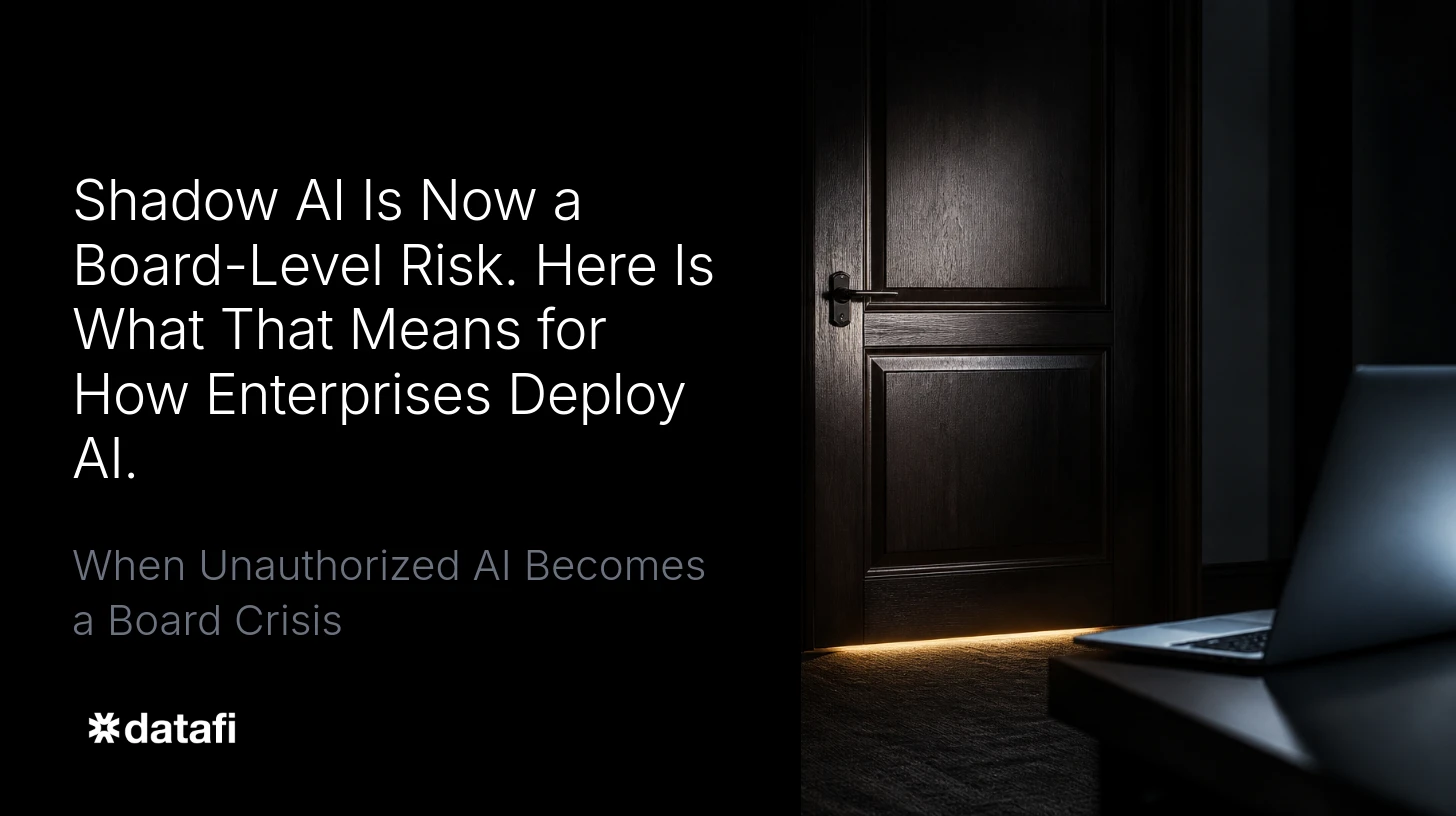
The first SEC disclosure triggered by unauthorized AI use just rewrote the rules for every organization building an AI strategy.
On May 5, 2026, a Pennsylvania-based regional bank made history in the worst possible way. Community Bank, a wholly owned subsidiary of CB Financial Services, Inc., became the subject of the first SEC Form 8-K filing under Item 1.05 triggered not by an external cyberattack, but by an employee using an unauthorized AI tool to process sensitive customer information. Names, social security numbers, and dates of birth were exposed. Two days after detection, CB determined the incident to be material and filed with the SEC. Class action investigations followed within weeks.
This is the moment Shadow AI stopped being a compliance footnote and became an enterprise crisis.
As Wilson Sonsini noted in their May 28, 2026 alert on the incident, the regulatory exposure here was notable precisely because the bank determined materiality based on the sensitivity and volume of data involved, even though there was no operational disruption, no confirmed misuse of the exposed information, and no expected material impact on financial results. The data touched an unauthorized AI platform. That alone was enough.
For anyone building or deploying enterprise AI today, this is the signal that changes strategy.
Shadow AI is no longer a compliance footnote. A single employee using an unauthorized AI tool to process sensitive customer data was enough to trigger a material SEC cybersecurity disclosure, setting a precedent that every enterprise must now factor into its AI strategy.
What Shadow AI Actually Is (and Why It Is Already Everywhere)
Shadow AI is not a fringe behavior. It is the predictable outcome of a gap between what employees need to do their jobs well and what their organizations have made officially available to them.
When a loan officer copies customer records into a public AI chatbot to draft a summary faster, they are not trying to create a compliance incident. They are trying to be good at their job. When an analyst pastes financial projections into an AI tool to build a slide faster, same thing. When a customer service rep uses an unapproved AI assistant to draft responses more quickly, same thing.
The behavior is rational. The risk is real. And the gap between the two is where Shadow AI lives.
What makes this moment different from prior waves of unauthorized technology use, like shadow IT in the cloud era, is the data surface area involved. AI tools do not just run code or store files. They process, interpret, and in many cases retain the data fed into them. When that data includes personally identifiable information, financial records, or trade secrets, the exposure is not theoretical. It is structural.
The Wilson Sonsini alert frames this precisely: Shadow AI creates unmonitored data flows, inconsistent privacy protections, and a fundamental lack of visibility into how sensitive information is being processed, retained, or shared. The compliance risks extend well beyond financial services to any organization operating in a regulated industry, and increasingly, to any organization that handles data of consequence.
The Regulatory Landscape Just Got More Complex
The CB Financial incident layers across multiple regulatory frameworks simultaneously, and the complexity only compounds for organizations operating at scale.
Public companies now face a clear precedent: unauthorized AI use by employees can constitute a material cybersecurity incident under SEC Item 1.05, triggering a four-business-day disclosure clock from the point of materiality determination, not from the point of detection. That distinction matters enormously for how incident response programs are designed.
Financial institutions face additional exposure through the GLBA Safeguards Rule, federal banking agency guidance from the OCC, FDIC, and Federal Reserve, and state-level cybersecurity frameworks like the NYDFS 23 NYCRR 500 regulation. State data breach notification laws add another layer, with deadlines typically ranging from 30 to 90 days following discovery, plus notification to attorneys general in many jurisdictions.
And then there is the litigation dimension. The novelty of Shadow AI as a vulnerability is already generating new theories of liability, centered on whether organizations maintained reasonable policies governing employee AI use, whether those policies were actually enforced, and whether the absence of technical controls constituted a failure to implement reasonable security measures. Shareholder litigation based on board-level failure to supervise is also in scope.
The legal alert from Wilson Sonsini puts it plainly: this is not a theoretical risk. It is happening now, and the Community Bank incident is among the first to have public regulatory consequences.
Why the Traditional Response Is Not Enough
The instinct in most organizations will be to respond to this moment with policy. Write an AI acceptable use policy. Add AI to the security awareness training. Put up a list of approved tools. Remind employees not to use unauthorized AI.
That instinct is understandable and necessary. It is also insufficient.
Policy without technical enforcement is not a control. It is documentation of intent.
An employee who needs to process customer data quickly will not be stopped by a policy if the tools that make that processing safe and compliant are not the ones sitting in front of them.
The deeper problem is structural. Most organizations have adopted AI tools in a fragmented, opportunistic way. A chatbot here. A co-pilot there. An analytics AI on one team, a document generation tool on another. None of these tools have access to the full operational context of the business. None of them are integrated into the governance and compliance frameworks that define how data should be handled. None of them are visible to the security operations team in any meaningful way.
And because the official AI tooling does not actually meet employees where they are, in their workflows, with the context they need, at the speed they require, employees go outside it. That is not a failure of employee discipline. It is a failure of enterprise AI architecture.
The Datafi Perspective: Governance Is Not a Layer. It Is the Foundation.
At Datafi, we have built our platform from a specific conviction about what makes enterprise AI work at scale: governance cannot be retrofitted onto AI after the fact. It has to be the foundation that the entire system is built on.
This conviction comes from direct experience working with data and AI in production environments, where the difference between AI that answers questions and AI that solves business problems is not the model. It is the context. The access. The controls. The ability to act, not just respond.
Shadow AI proliferates when employees have access to powerful AI tools but those tools lack business context. A general-purpose AI assistant can help draft an email. It cannot tell a loan officer what this customer’s full account history looks like, flag the compliance risk in a proposed exception, and route the decision to the right approver in the same workflow. The assistant lives outside the data ecosystem. It has no governance layer. It has no operational integration. And so the employee copies the data into it because that is the only way to make it useful.
The Datafi Business AI Operating System is built to close exactly this gap.
What a Governed AI Operating System Actually Looks Like
The Datafi platform is a vertically integrated data and AI technology stack designed to make governed, compliant AI the path of least resistance for every employee, technical and non-technical alike.
That means several things in practice.
Full data ecosystem access. LLMs need to know the full context of the business to operate in meaningful roles. That requires access to operational data, not summaries or samples or manually assembled datasets. The Datafi contextual data layer connects AI to the complete data ecosystem: structured, unstructured, operational, and analytical. The AI has context. The employee does not need to copy anything into a public tool to get useful output.
Embedded governance and compliance controls. Every query, every agent action, every workflow output moves through a governance layer that enforces data classification, access controls, audit logging, and policy compliance. This is the Datafi Control Tower, the governance and control layer of the platform. It is not an add-on. It is embedded into every AI interaction from the start. When an employee uses Datafi, the system knows what data they are allowed to access, how that data can be used, and what outputs are permissible. That context travels with every action.
A Chat UI designed for non-technical users. The reason employees go outside official AI tools is often that the official tools require technical knowledge to use effectively. Datafi’s Chat UI is built to give every employee in the organization access to the full power of the platform without needing to know how to write a query, configure a model, or understand the underlying data architecture. The AI meets the user where they are.
Autonomous agent and workflow capability. The CB Financial incident is a preview of a much larger challenge: as AI becomes more capable, employees will want to use it in increasingly critical roles, not just for drafting assistance but for analysis, decision support, exception handling, and workflow automation. That is already happening. The question is whether those use cases are running inside a governed system or outside it. Datafi Runtime enables AI agents and automated workflows that operate with full business context, within defined governance boundaries, with complete auditability.
The goal is not to prevent employees from using AI in powerful ways. It is to make the powerful and governed path the same path.
What Shadow AI Tells Us About Where Enterprise AI Is Heading
The Wilson Sonsini alert recommends that organizations treat AI governance and cybersecurity as one program, not two. That is exactly right, and it points toward a broader truth about where enterprise AI strategy needs to go.
The organizations that will navigate this moment well are not the ones that lock down AI the hardest. They are the ones that build the infrastructure to make governed AI genuinely useful, genuinely accessible, and genuinely integrated into the way work gets done.
Shadow AI is a symptom of a demand that is not being met through official channels. Employees want AI in their workflows. They want it to have context. They want it to make them faster and better at hard problems, not just at drafting emails. When that demand is met by a governed, integrated platform, the incentive to go outside the system disappears.
This is the architecture problem at the center of enterprise AI right now. Fragmented tools with no shared context, no shared governance, and no meaningful integration into operational data create both the compliance gaps that Shadow AI exposes and the user experience failures that drive employees to find alternatives.
The path forward is a vertically integrated data and AI operating system with access to the full data ecosystem, embedded policy and control at every layer, and an interface that every employee can use without needing to be a data engineer. That is not a feature set. It is an architectural commitment.
At Datafi, that commitment is the product. The CB Financial incident is a sharp reminder of why it matters, and why it matters now.
Datafi is the Business AI Operating System for enterprises that need AI to do more than answer questions. Learn more at datafi.co.