

Every serious enterprise AI platform claims to have solved governance. The pitch is consistent: enterprise-grade security, enforced permissions, data residency controls, zero-retention model agreements, and a growing partner ecosystem of data protection vendors ready to be plugged in.
These claims are not wrong. They describe real capabilities. And for the specific problem they are designed to solve, which is controlling who can see what information through an AI interface, they represent genuine engineering investment.
But they describe half of the governance problem. The half that most enterprise buyers are asking about because it is legible, auditable, and maps cleanly onto existing compliance frameworks. The other half, governance over what AI can do with what it sees, is harder to see, harder to audit, and rarely addressed in the same breath.
The organizations that are deploying AI beyond search and retrieval, into autonomous agents and operational workflows, are discovering that these two halves of governance require fundamentally different architectural approaches. And the gap between them is where the most consequential enterprise AI risk lives.
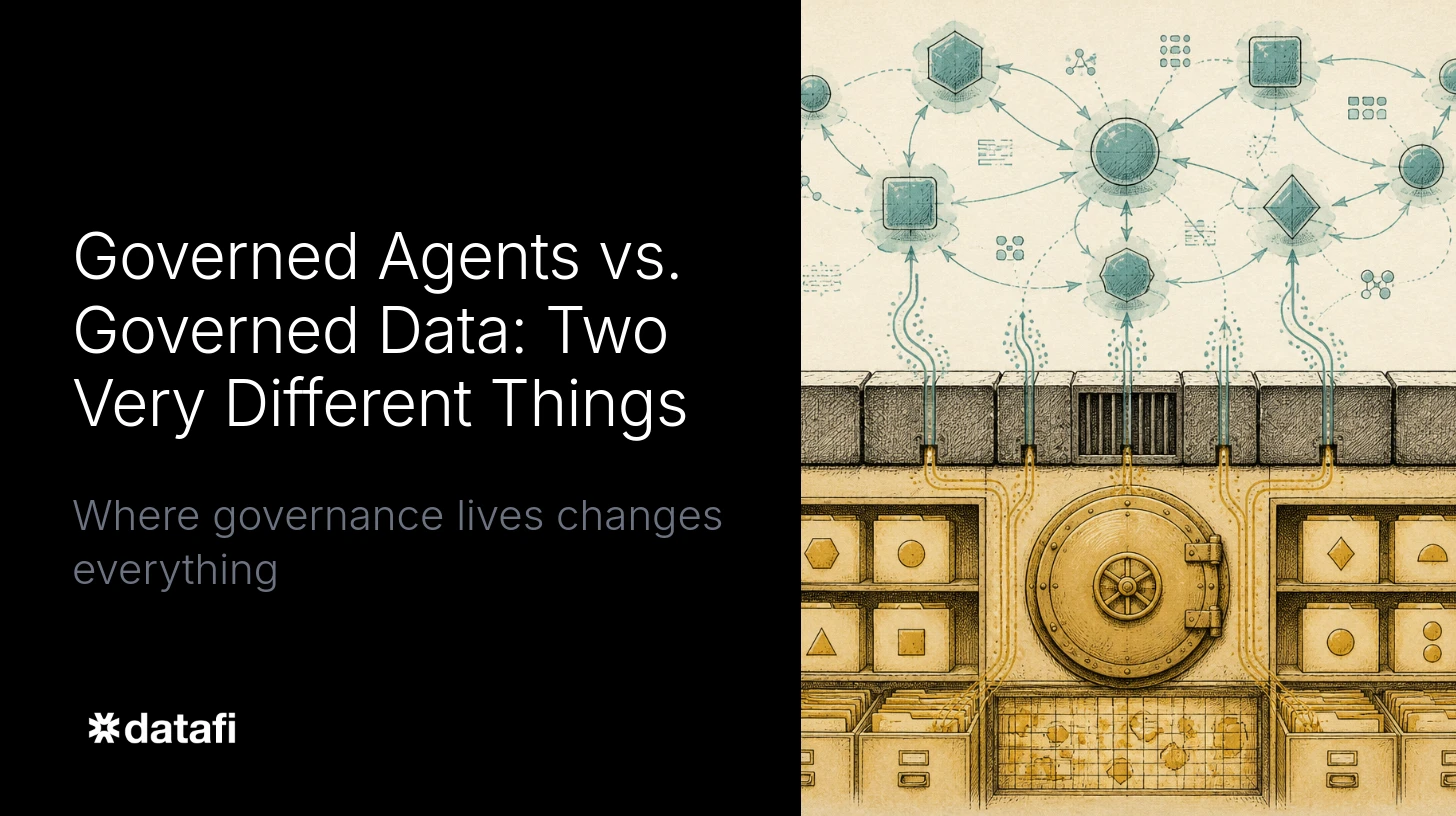
Governing who can see data is only half the problem. As AI moves from search to action, enterprises need governance over what AI can do, not just what it can access, and that requires a fundamentally different architectural approach.
The Governance That Gets Built First
The first generation of enterprise AI governance is, appropriately, focused on access control.
The fundamental concern is this: AI systems trained on or accessing sensitive enterprise data might expose that data to the wrong people. An employee who would not be permitted to access a particular file should not be able to surface that file’s contents through an AI search interface. An AI agent that can read across the organization should not be able to synthesize and present information that crosses permission boundaries.
This is a serious and legitimate concern. The history of enterprise software is littered with permission models that worked correctly until an AI system with broad read access was introduced, at which point the fine-grained access controls that governed direct human interaction with data became irrelevant. A system that can read everything and synthesize it into a natural language answer is effectively a permission bypass if it is not governed correctly.
The leading enterprise search platforms have invested heavily in solving this problem. Permissions-aware indexing, single-tenant architectures, zero-retention agreements with model providers, continuous scanning for overshared sensitive data, regional data residency options. The architecture of data access governance for AI search has matured substantially, and the best implementations are genuinely robust.
For AI systems that retrieve and present information, this is the right frame for governance. But it is not the right frame for AI systems that act.
What Changes When AI Starts Acting
An AI system that can search, retrieve, and present information poses a data exposure risk. That risk is real, and governing it correctly is important. But the risk profile of an AI system that can initiate workflows, update records, trigger processes, escalate exceptions, and execute decisions is categorically different.
The question is no longer: could this AI show someone information they should not see? The question becomes: could this AI do something that should not be done, in a system where the consequences of that action are real and potentially irreversible?
Consider the difference in concrete terms. An AI search system that incorrectly surfaces a confidential document to an unauthorized user has created a compliance event. That event is serious, auditable, and can often be remediated.
An AI agent that incorrectly modifies a claim decision, triggers an unauthorized payment, or updates a production schedule based on misread operational data has created an operational error with real financial and legal consequences. In regulated industries, it may have created a regulatory exposure. In operational settings, it may have initiated a cascade of downstream consequences that are difficult or impossible to unwind.
Permission controls on data access are not sufficient governance for this class of risk. What is needed is governance over the agent’s reasoning, the actions it is authorized to take, the conditions under which it can take them, and the audit trail that makes its decisions reviewable and accountable.
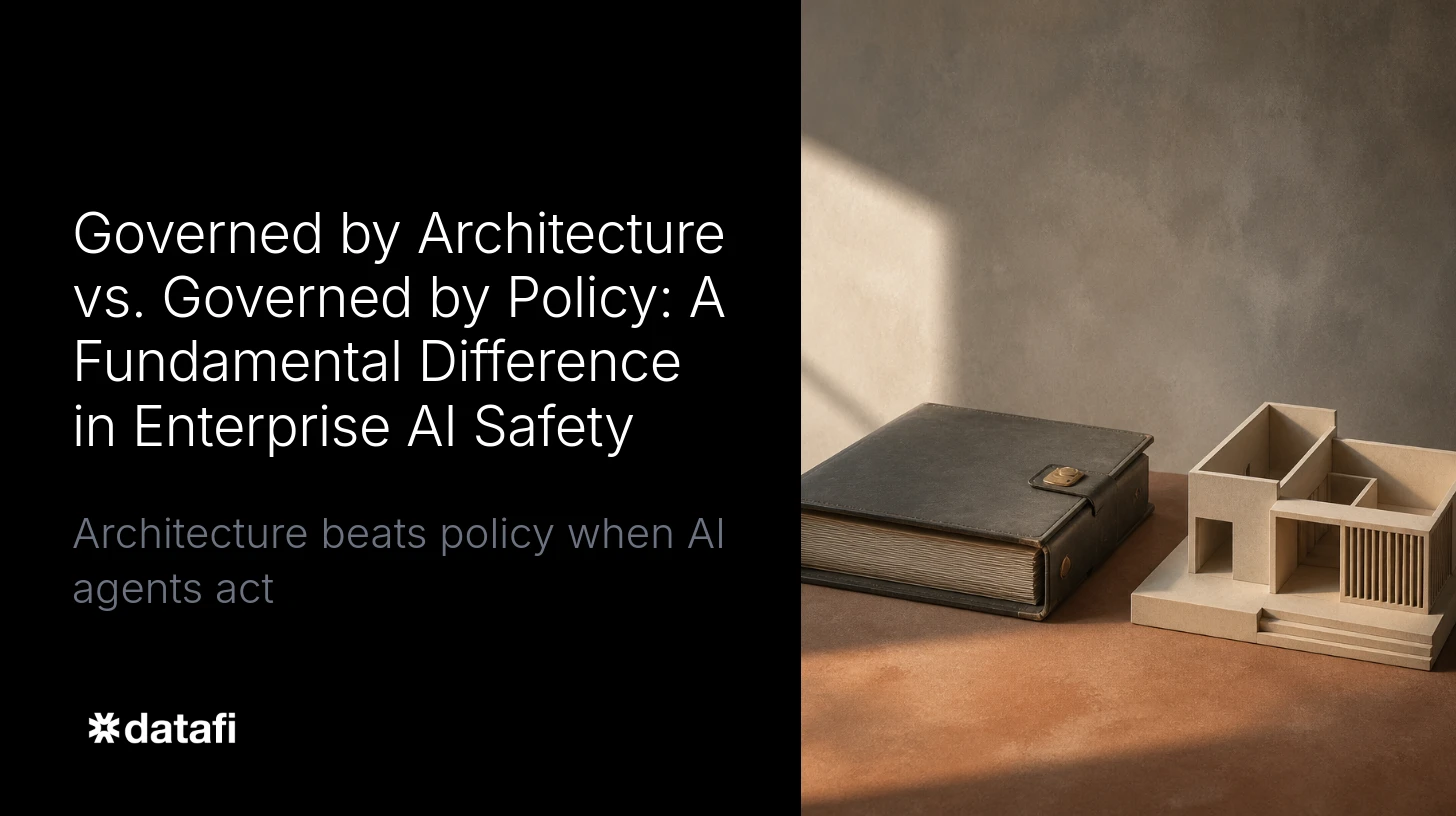
Governance as Architecture vs. Governance as Policy
This distinction maps onto a deeper architectural choice that organizations evaluating AI platforms should understand clearly.
Governance as policy is the model that most enterprise software has operated on for decades. Define the rules. Enforce them through access controls, approval workflows, and audit logging. When something violates the rules, the violation is detected and remediated. This model is well-understood, integrates with existing compliance frameworks, and works well for systems where humans are the actors and AI is the interface.
Governance as architecture is the model required when AI is the actor. In this model, governance is not a policy layer applied to an AI system. It is the structural foundation within which the AI system was built to operate. The boundaries of what an agent can do are not enforced by a policy that checks each action against a rule set after the reasoning has already happened. They are the native operating constraints of the agent itself, defined at the level of what the agent has the capability to do, what data it can access in live operational context, and what workflows it is structurally connected to.
A policy layer can be circumvented by a reasoning path that was not anticipated when the policy was written. An architectural constraint cannot be circumvented because the capability it constrains does not exist outside of the architecture.
In the Datafi platform, this principle is embedded at every layer of the stack. Agents do not have broad access to the operational environment that is then constrained by a policy layer. They have precisely the access that their function requires, defined within the governance architecture of the platform, auditable at the level of every data access and every action, and subject to escalation logic that routes the decisions requiring human judgment to the right person with the right context attached.
This is not a philosophical distinction. It is the difference between a governance model that works in a demo environment, where the AI is doing what was expected, and a governance model that works in production, where the AI is doing things that were not fully anticipated.
The CISO Conversation Most Vendors Are Not Having
Enterprise CISOs are sophisticated buyers. They understand that the governance conversation has moved beyond “can the AI see things it should not see” to “what can the AI do and how do we know it did the right thing?”
The questions that define this conversation are worth examining directly, because they reveal the architectural requirements that governance-by-policy struggles to satisfy.
Auditability at the reasoning level. When an AI agent makes a decision or takes an action, can you reconstruct not just what it did, but why? Can you show a regulator or an auditor the complete chain of reasoning from data access through analysis to action? An audit log of API calls is not sufficient for regulated industries. What is required is a complete, human-readable record of the agent’s reasoning, the data it drew on, the policies it applied, and the action it took.
Bounded authority without constant human oversight. The governance model that requires a human to approve every agent action is not governance at scale. It is a manual process with an AI interface. What regulated enterprises need is a governance model that allows agents to operate autonomously within precisely defined authority boundaries, escalating only the exceptions that genuinely require human judgment.
Governance that travels with data across systems. When an agent operates across multiple connected systems, the governance model needs to be consistent across all of them. A permission model that works within a search index but does not extend to the operational systems where the agent is taking action is not enterprise governance. It is a partial solution that creates gaps exactly where the risk is highest.
Interpretability of AI reasoning in business terms. Governance in regulated industries is not just about preventing errors. It is about being able to explain decisions in terms that are meaningful to regulators, auditors, and affected parties. AI systems that produce correct outputs through reasoning that cannot be interpreted or explained are not governable in the regulatory sense, regardless of how robust their access controls are.
The Compound Risk of Getting This Wrong
The governance gap between search-centric AI and action-capable AI is not a theoretical risk. It is an accumulating operational exposure that compounds as AI systems become more capable and more deeply integrated into operational workflows.
Organizations that deploy AI agents with governance models designed for retrieval systems are building technical debt in the most dangerous possible location: the intersection of AI reasoning and consequential action. The debt may be invisible for months or years, until an agent takes an action that the policy layer did not anticipate, in a context that the permission model did not cover, with consequences that the audit trail cannot fully reconstruct.
The organizations that will deploy AI at scale with confidence in regulated industries are the ones that treat governance not as a compliance checkbox applied to an AI system, but as the architectural foundation within which their AI systems were built. The difference shows up not in the pitch, where both models can sound equally robust, but in production, where architectural governance scales with the system and policy governance struggles to keep pace.
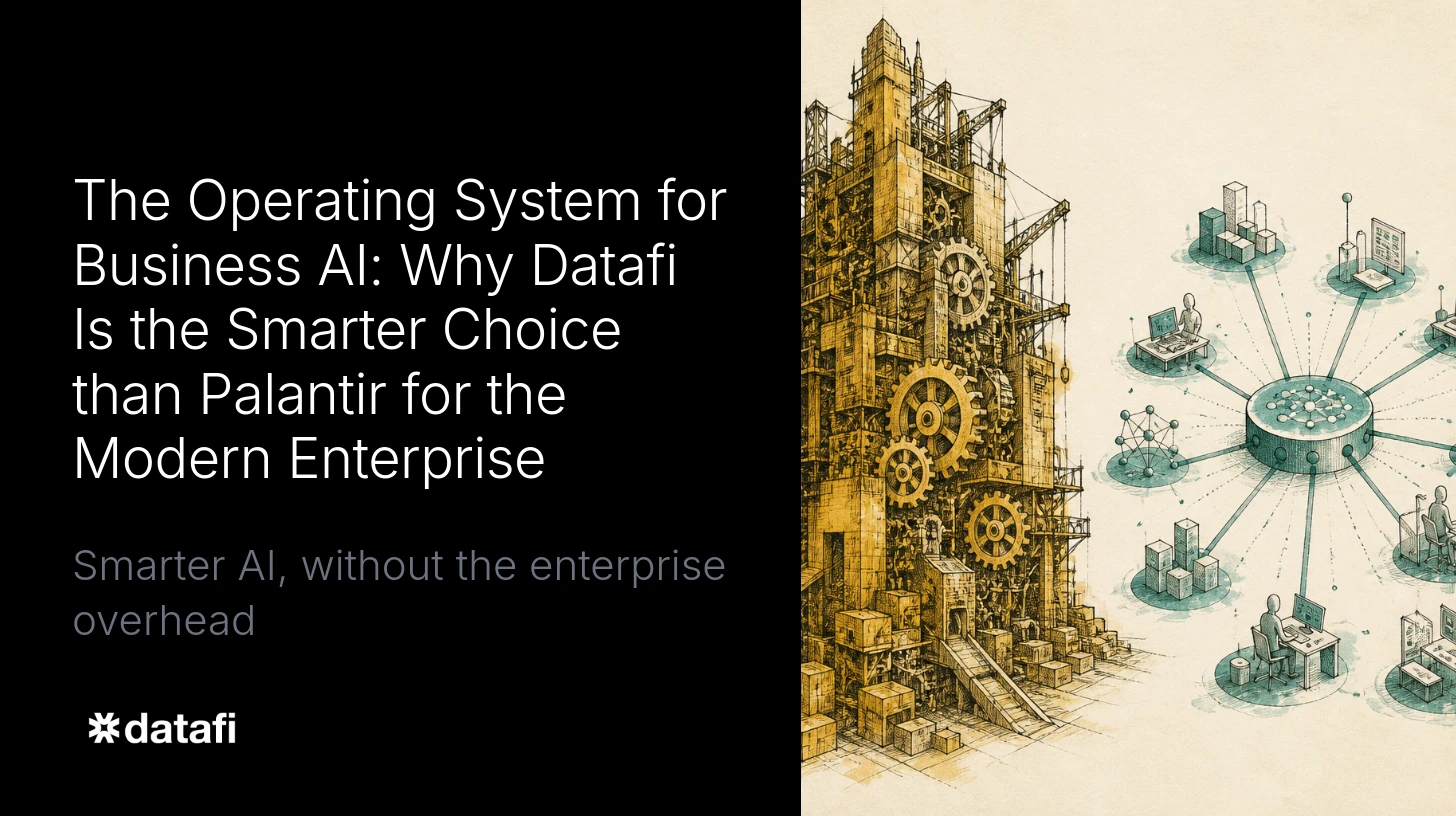
Datafi is the Business AI Operating System for the modern enterprise. To learn how governance-by-architecture enables secure, scalable AI deployment across regulated industries, visit datafi.co or schedule a demo.
Next in the Series: SaaS Sprawl Is the Symptom. Fragmented AI Is the Disease.