



Every enterprise AI conversation eventually arrives at the same inflection point. A leadership team is energized by the possibilities. The business case is compelling. The urgency is real. And then someone in the room says it: “We need to get our data in order first.”
The meeting slows. Timelines stretch. A data readiness initiative is scoped. Months become quarters. The AI transformation that felt imminent recedes into the horizon, replaced by a long preparatory campaign that, by the time it concludes, has consumed enormous organizational energy and delivered zero competitive advantage.
This is the data readiness dilemma. And it is one of the most consequential strategic mistakes an organization can make in the current era of business AI.
Waiting for perfect data before deploying AI is not a responsible strategy; it is a deferral. In a competitive environment where AI capability is rapidly becoming a structural differentiator, every quarter spent preparing instead of deploying compounds the disadvantage.
The Myth of the Clean Slate
The argument for data readiness has an intuitive logic. AI systems need data. Better data produces better outputs. Therefore, improving data quality before deploying AI should improve outcomes. It seems reasonable, even responsible.
But this reasoning rests on a flawed premise: that data readiness is an achievable end state, a destination you can reach and then hold while you build AI applications on top of it. The reality of enterprise data does not work this way.
Data is not a project. It is a living byproduct of business operations, continuously generated by systems, processes, people, and transactions across every function of the organization. It is messy because business is messy. It is inconsistent because people are inconsistent. It is fragmented because enterprises accumulate technology over decades, not quarters. The silos, gaps, quality issues, and governance challenges that characterize real-world enterprise data are not aberrations to be corrected before the real work begins. They are permanent features of operating at scale.
Organizations that have invested heavily in data foundations, spending years on data warehouses, data lakes, data quality programs, and master data management initiatives, consistently discover the same uncomfortable truth: the moment you declare your data ready, new systems come online, new use cases emerge, and new gaps appear. The work never finishes because the business never stops.
Waiting for data readiness is not a strategy. It is a deferral. And in a competitive environment where AI capability is rapidly becoming a structural differentiator, deferral has a compounding cost.

What the Readiness Framing Gets Wrong About AI
There is a deeper conceptual problem with the data readiness approach, and it has to do with how we think about what AI actually does.
The readiness argument assumes that AI is fundamentally a retrieval and reporting function. Feed it clean, structured, well-governed data, and it will produce accurate answers. In this framing, AI is a sophisticated query engine, and data quality is the input constraint that determines output quality.
This framing was never entirely accurate, and it is increasingly obsolete.
The real transformative potential of AI in the enterprise is not in answering questions. It is in solving problems. There is a profound difference between a system that surfaces information when asked and one that understands the full operational context of a business, identifies where that context reveals risk or opportunity, initiates workflows to address it, and learns from the outcomes to become more capable over time.
This distinction, between AI that answers and AI that acts, changes everything about how you think about data readiness. A question-answering system needs clean, structured inputs to produce reliable outputs. But an AI operating system designed to solve business problems needs something different: access to the complete data ecosystem, in whatever state it exists, combined with the contextual intelligence to understand what that data means and the governed capacity to act on it.
Real business problems do not wait for clean data. Neither should the AI systems designed to solve them.
The Real-World Data Landscape
Consider what the data ecosystem of a mid-sized enterprise actually looks like. There are ERP systems carrying years of transactional history, some of it meticulously maintained, some of it reflecting workarounds and exceptions accumulated across business cycles. There are CRM platforms holding customer records that were entered by dozens of different people with varying levels of rigor. There are spreadsheets, still, everywhere, serving as the connective tissue between systems that were never built to talk to each other. There are data warehouses built on schemas designed for yesterday’s reporting needs. There are SaaS applications generating data in formats that were never intended to interoperate with anything else in the stack.
This is not a description of a poorly run organization. This is a description of every organization operating at any meaningful scale. The heterogeneity is not a failure. It is the natural result of building a business over time, making pragmatic technology decisions in response to evolving needs, and operating in a world where no two business functions have exactly the same information requirements.
The question is not how to make this landscape uniform and clean before deploying AI. The question is how to deploy AI in a way that can operate effectively within this landscape as it actually exists, while continuously improving the quality and coherence of the data environment over time.
A Different Architecture for a Different Premise
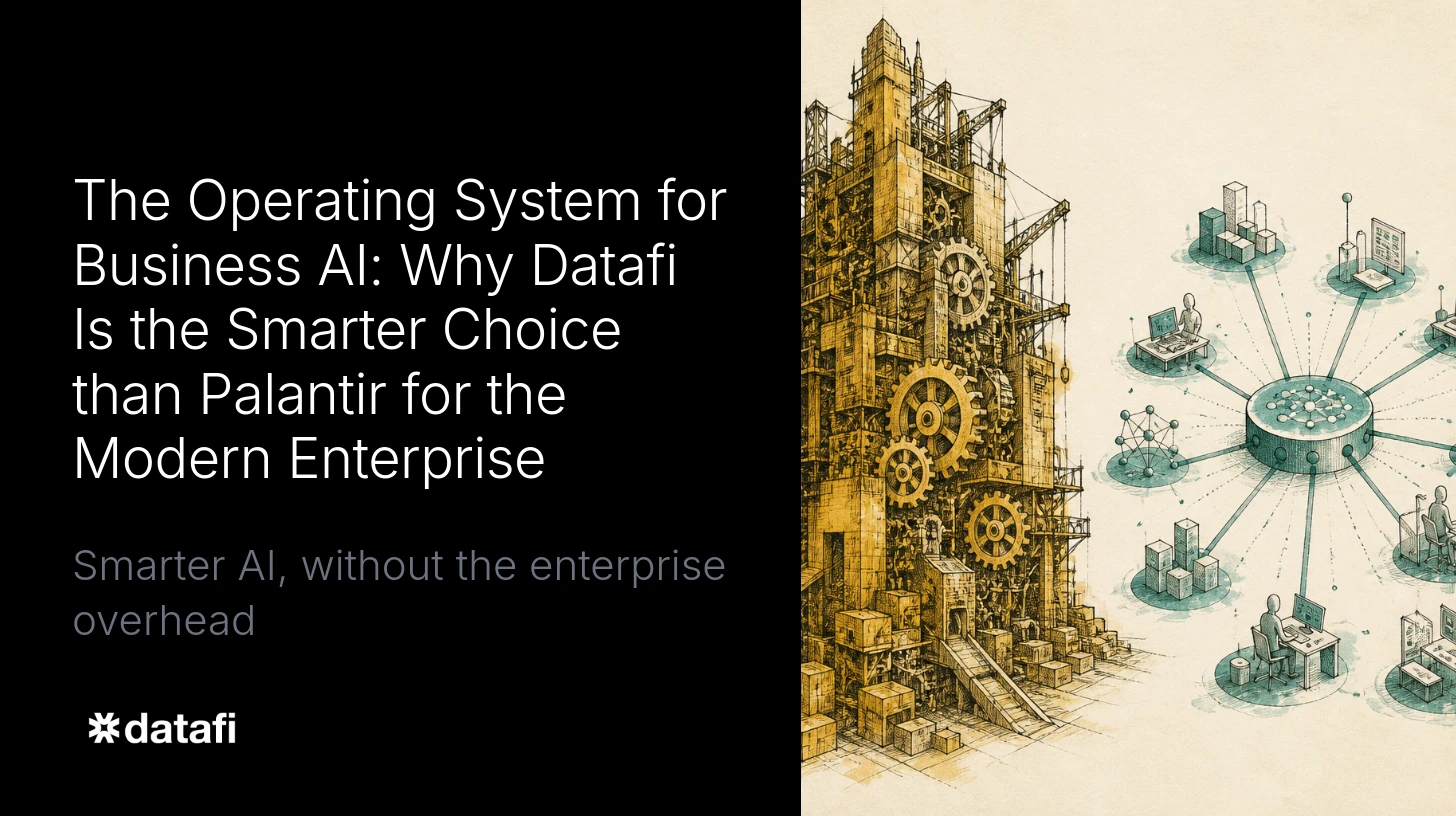
At Datafi, we built the Business AI Operating System from a different premise than the one embedded in the data readiness argument.
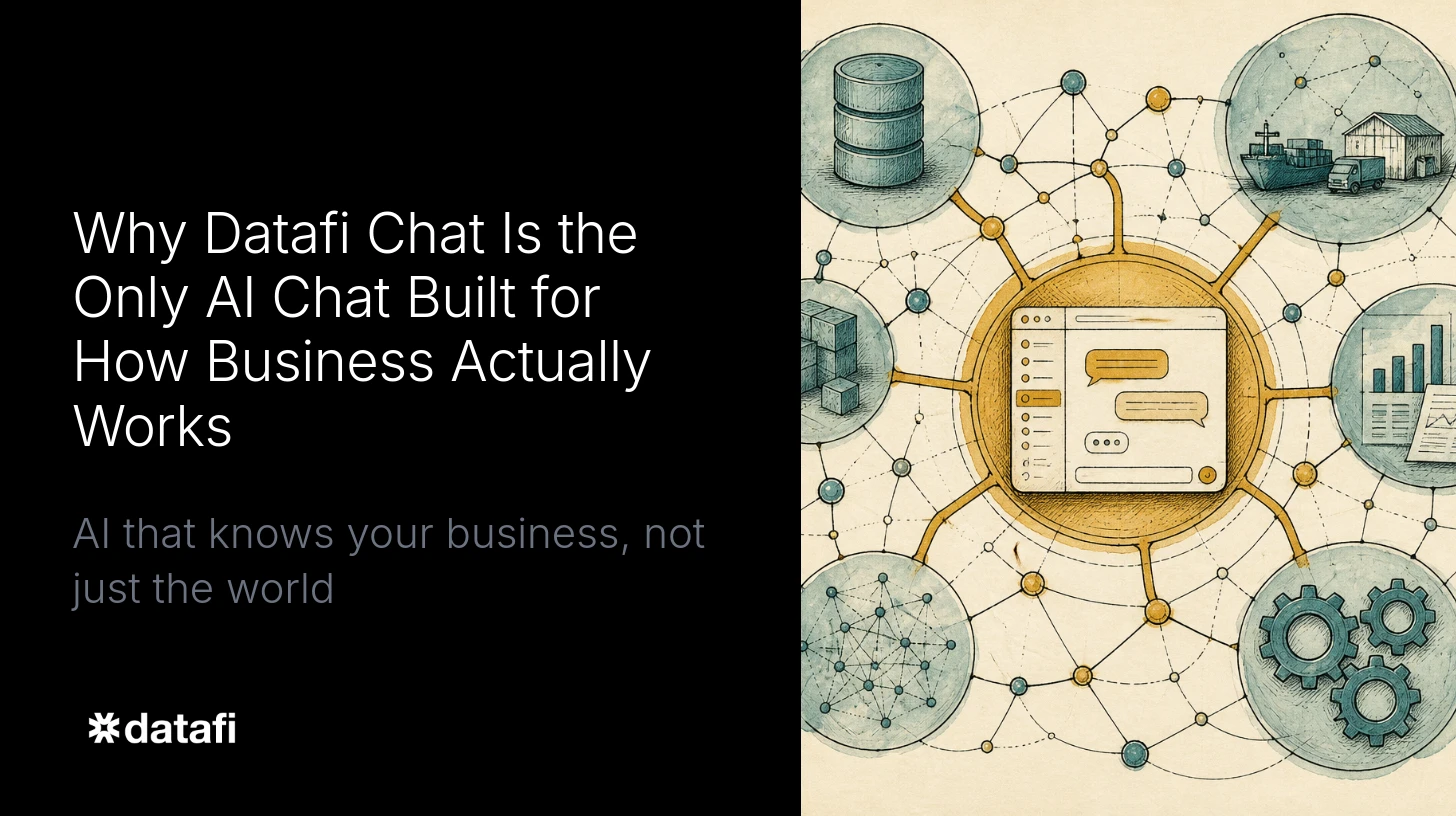
We started from the observation that AI transformation at the enterprise level requires something more than a model and a dataset. It requires a vertically integrated stack that gives AI systems full access to the data ecosystem, the policy and governance controls to operate safely across that ecosystem, a Chat UI designed for non-technical users who need to interact with AI without writing queries or prompts, and the agentic capacity to function autonomously in complex, multi-step workflows.
This architecture was designed specifically to work with real-world data at any level of readiness. Not because we were willing to accept lower quality outcomes, but because we recognized that the path to higher quality outcomes runs through deployment and use, not through preparation and delay.
When AI systems are actively engaged with the data ecosystem, they begin generating something that no pre-deployment data project can produce: contextual understanding of how data relates to actual business operations. The system learns which data sources are reliable for which purposes. It identifies where gaps create decision risks. It surfaces inconsistencies that manual audits would never find. It builds, over time, the contextual layer that is essential for complex agents and workflows to function effectively.
This is not a workaround for messy data. It is the correct approach to building AI systems that get progressively more capable as they engage with the full complexity of the business.

Governance Without the Gating Function
One of the legitimate concerns embedded in the data readiness argument is governance. If we deploy AI before we have proper data controls in place, we risk exposing sensitive information, violating compliance requirements, or generating outputs that reflect the biases and errors in our underlying data. These are real risks, and they deserve serious treatment.
But governance does not require readiness. It requires architecture.
The Datafi Business AI Operating System includes policy and governance controls as a foundational layer, not an afterthought. This means that AI systems can operate across the full data ecosystem with defined access permissions, data classification rules, and compliance guardrails applied at the infrastructure level rather than managed case-by-case at the application layer.
The result is governed, compliance-ready AI that can work with data in whatever state it exists, enforcing appropriate controls without requiring the underlying data to be fully standardized or cleansed before access is granted. Governance becomes a property of the system architecture rather than a prerequisite for system deployment.
This is a critical shift. It means that organizations can begin capturing value from AI across real operational workflows without waiting for a data governance program to reach maturity. The two initiatives run in parallel, each reinforcing the other, rather than the governance work gating the AI work indefinitely.
The Unified Data Experience as an Outcome, Not a Prerequisite
A related misconception is that unified data experience, the ability for employees across functions to access and act on coherent, consistent information, must be achieved before AI can be deployed meaningfully. In this view, AI sits on top of a unified data layer, and building that layer is the prior work.
Datafi inverts this relationship. The unified data experience is something the Business AI Operating System creates for employees as they work, not something that must be assembled in advance as infrastructure. When an employee interacts with the Datafi Chat UI to address a business problem, the system draws on the full data ecosystem, applies contextual intelligence to assemble a coherent picture from heterogeneous sources, and delivers a response that reflects the actual state of the business.
The employee does not need to know which systems were queried, how the data was reconciled, or where the gaps are. The system handles that complexity, presenting a unified experience regardless of the underlying data architecture’s current state.
This matters enormously for workforce-wide AI adoption. Non-technical employees, which is to say the vast majority of the workforce, cannot wait for a multi-year data platform project to complete before they begin benefiting from AI assistance. They need AI that works with the information environment as it exists today, delivering faster and better operational decisions across every function.
The Compounding Advantage of Early Deployment
There is a strategic argument for moving now that goes beyond avoiding the costs of delay. It is about what early deployment produces.
Organizations that deploy AI in active operational roles begin building something invaluable: the contextual layer that makes complex agents and workflows possible. Every interaction, every decision supported, every workflow automated contributes to a deepening model of how the business actually operates. The AI systems learn the patterns, the exceptions, the relationships between data elements and business outcomes that cannot be captured in any schema or data dictionary.
This contextual intelligence is a compounding asset. Organizations that start building it now will have AI systems that are meaningfully more capable in two years than organizations that spent those two years preparing their data. The preparation-first approach does not reduce the gap. It widens it.
LLMs operating with full business context, access to the complete data ecosystem, and the capacity to function in autonomous roles are not just more productive tools. They are a different category of competitive capability. They can engage with hard problems, the kind that require synthesizing information across multiple systems, reasoning through complex constraints, and initiating multi-step actions in response to what they find. This is the capability that transforms how work gets done, not incremental improvement in query accuracy.
Starting Where You Are
The practical implication of this argument is straightforward: organizations should start their AI transformation where they are, with the data they have, within the governance structures they can implement today.
This does not mean accepting poor outcomes or ignoring data quality. It means deploying AI in an architecture that can work effectively with imperfect data while creating the conditions, through use, through learning, through the operational feedback that comes from real deployment, for continuous improvement.
The Datafi Business AI Operating System was built for exactly this reality. It meets organizations at any level of data readiness and delivers unified data experience and workflow efficiencies across the enterprise, regardless of where the underlying data infrastructure sits today. It gives every employee, technical and non-technical alike, access to AI that can engage with real business problems in real operational contexts.
The data readiness dilemma is real. But the resolution is not to solve readiness before starting. It is to start with an architecture that turns readiness into a journey rather than a prerequisite, and that begins delivering value from the first deployment rather than the final one.
Your data is ready enough. The question is whether your architecture is.