

Every enterprise AI initiative eventually hits the same invisible wall. The model is capable. The data exists. The use case is real. And yet the AI cannot act. It answers questions that were never asked, misses the nuance that every veteran employee carries implicitly, and produces outputs that require human judgment to interpret before they can be used. The technology is sophisticated. The problem is structural.
What is missing is not intelligence. What is missing is context.
Datafi was built on a specific conviction: that large language models are not yet failing enterprises because of reasoning limitations. They are failing because they have been deployed without the business context required to reason well. Context is not a prompt. It is not a document uploaded to a chat window. It is the complete, living, governed understanding of how a business actually works, what its data means, what its rules require, and what a good decision looks like in a specific operational moment. Without that layer, AI in the enterprise is performing impressively in a vacuum.
Enterprise AI fails not because of reasoning limitations, but because models lack the complete, governed business context required to reason well. The business context layer is the foundational infrastructure that makes AI operational rather than merely impressive.
What Business Context Actually Means

Business context is the connective tissue between raw data and meaningful action. It is the difference between knowing that a customer’s order volume declined 34 percent last quarter and understanding that this decline occurred after a pricing change that affected only one product category, that the customer had flagged concerns in a previous service interaction, and that the account sits two months from renewal. Each of those facts exists somewhere in the enterprise data ecosystem. Separately, they produce reports. Together, they produce understanding. Understanding produces action.
For a human employee with years of experience, this kind of synthesis happens naturally. They have been embedded in the business long enough to know which signals matter, how different systems connect, and what the unwritten rules of good judgment look like in their domain. For an AI agent to operate at the same level, it needs equivalent access, equivalently organized, with the same policy and governance guardrails that govern human decision-making.
Datafi defines business context as the structured, governed, continuously updated layer that gives AI models full situational awareness of the enterprise. It includes data relationships across operational, transactional, and analytical systems. It includes business rules, approval hierarchies, compliance constraints, and risk thresholds. It includes terminology standards, domain-specific definitions, and the semantic layer that turns raw database fields into business-meaningful entities. And critically, it includes the access policies that determine which context any given user or agent can see, when, and for what purpose.
Why a Vertically Integrated Stack Is Required
The market is populated with tools that solve parts of this problem. Data platforms manage storage and compute. Governance tools manage policies. Chat interfaces give users a natural language front-end. AI platforms run models. Each of these categories has strong standalone players.
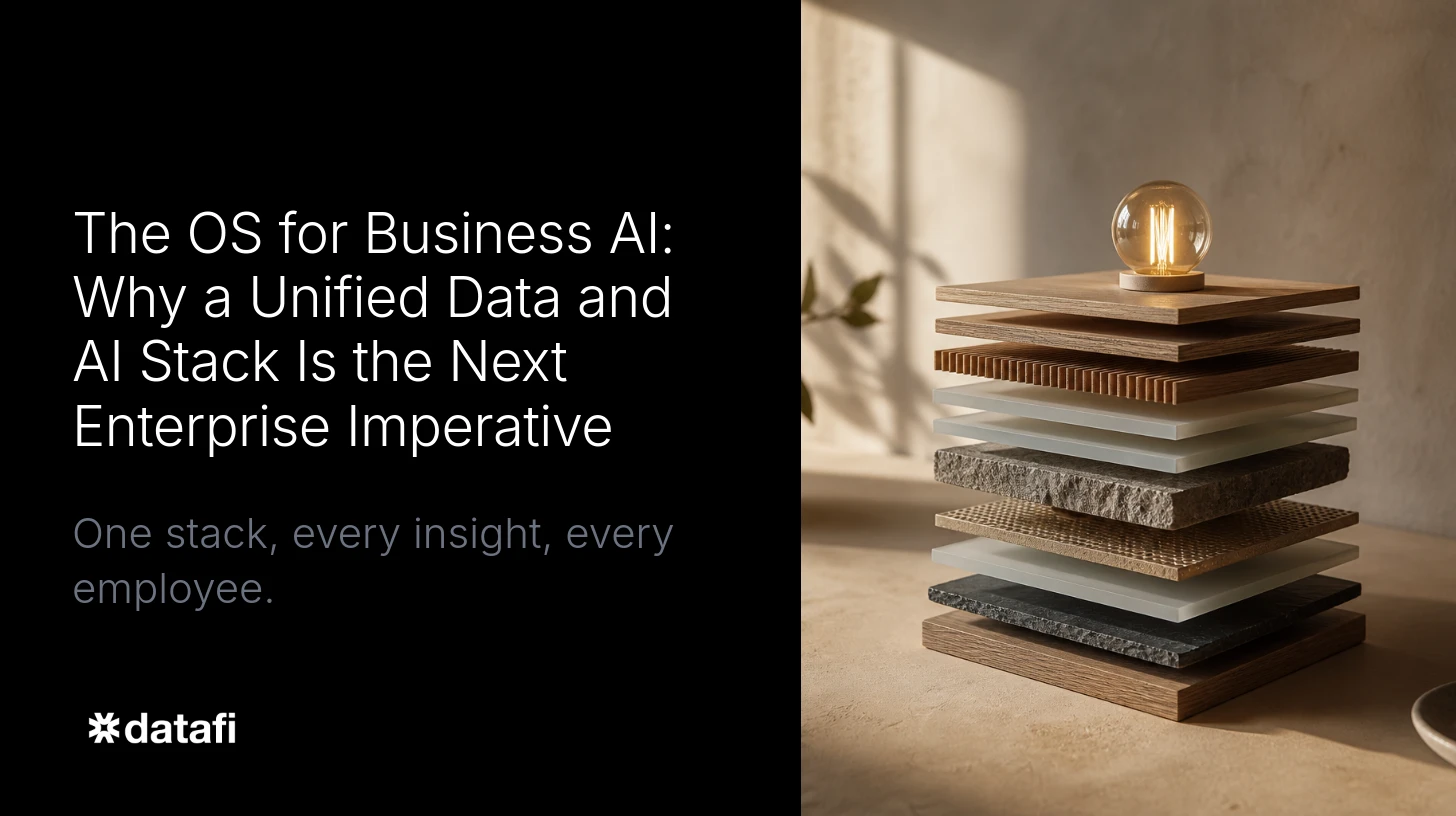
The problem is that a business context layer cannot be assembled from parts. It must be grown from a unified foundation where every layer is aware of every other layer. When data access, governance policy, semantic modeling, user experience, and agent execution are managed by separate tools from separate vendors, context is always fragmentary. The data platform does not know what the governance tool has approved. The chat interface does not know what the semantic model has defined. The agent execution layer does not know what any of the above has established. Every handoff is a context loss.
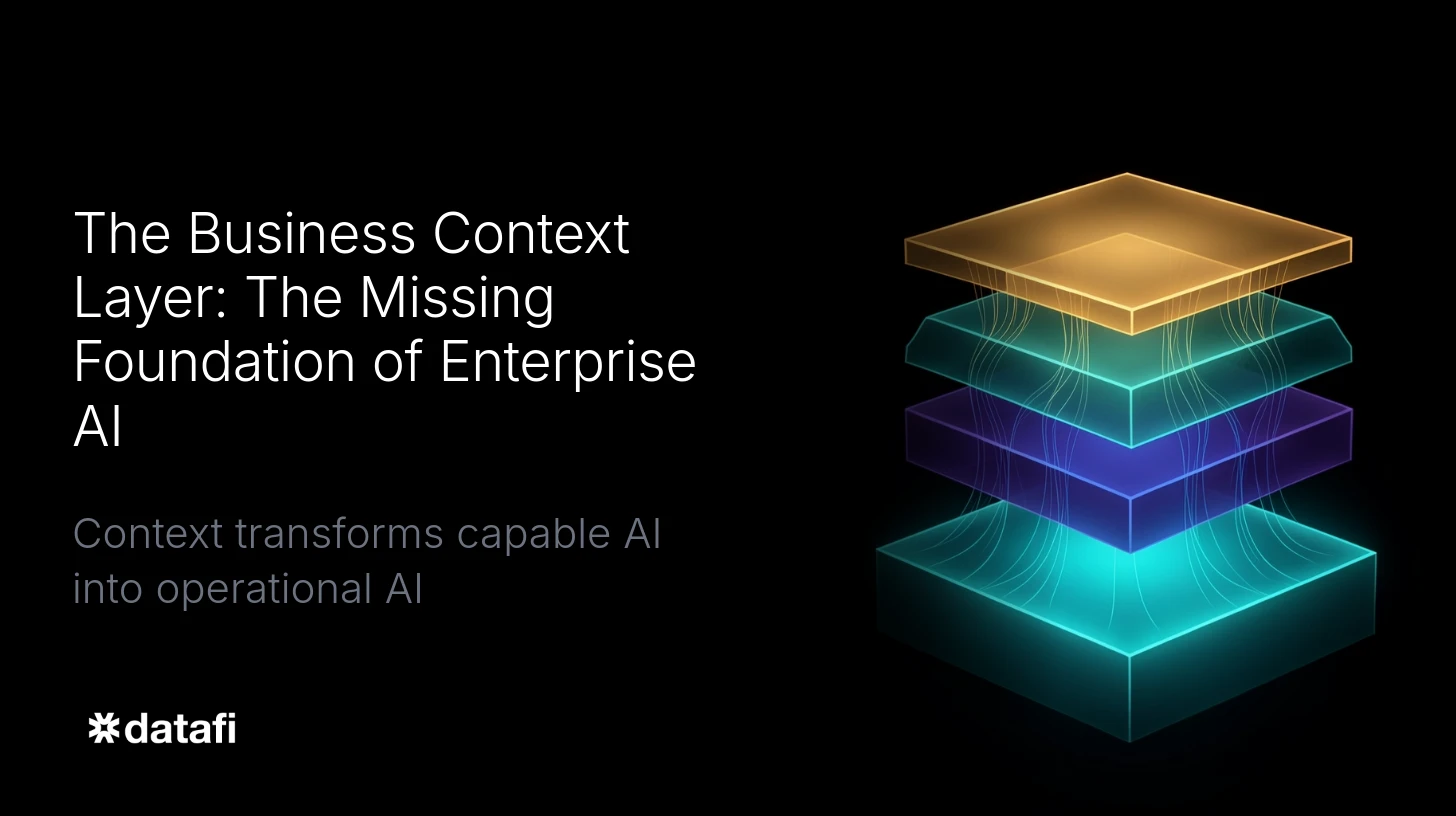
Datafi’s vertically integrated architecture eliminates those handoffs. From the data connectors that bring operational systems into the ecosystem, to the semantic layer that gives data business meaning, to the policy engine that governs what can be accessed by whom, to the Chat UI that makes AI accessible to non-technical users, to the agent framework that enables autonomous execution, every capability is aware of every other. Context does not degrade between layers. It compounds.
This is not an architectural preference. It is a practical requirement for the kinds of AI deployments that actually move business outcomes. When an agent is executing a multi-step workflow, resolving a supplier risk scenario, or synthesizing cross-functional data for an executive decision, it cannot pause to negotiate between disconnected systems. The full context must be immediately available, consistently understood, and appropriately governed across every step of the process.
The Context Layer as the Foundation for Agentic AI
The industry conversation about AI has largely been structured around two capabilities: question answering and code generation. Both are useful. Neither is sufficient for enterprise transformation. The frontier that Datafi is building toward, and that the most ambitious enterprise customers are beginning to demand, is AI that operates in fully autonomous roles, learning from the business environment it is embedded in and taking actions rather than simply producing outputs.
This is the agentic frontier. And the business context layer is its prerequisite.
An agent operating without full business context is dangerous in a specific way. It is confident. It will execute. But it will execute on a partial understanding of the situation, making choices that look reasonable in isolation but are wrong in the full context of the business. The answer to this risk is not to constrain agents more tightly. It is to give them better context so they can be trusted with broader autonomy.
Datafi’s approach to agentic AI is grounded in this principle. Agents are not deployed in isolation. They operate within the business context layer, which means they have access to the complete data ecosystem, they understand the semantic meaning of what they are seeing, they operate within the governance policies that apply to their role and the task at hand, and they have the ability to learn as they execute. The context layer is not a static reference. It is a dynamic environment that the agent inhabits and that the agent’s actions can update, within appropriate controls.
This architecture supports the kinds of complex, multi-step workflows that represent real business value. An agent managing supplier risk does not just retrieve a risk score. It monitors incoming shipment data, cross-references against contract terms and supplier performance history, evaluates alternatives using procurement policies, surfaces a recommended action to the appropriate decision-maker, and executes the approved response. Each step is context-dependent. Each step requires the full picture.
Governed AI at Enterprise Scale

No serious enterprise will deploy AI that operates outside its compliance framework. This is not excessive caution. It is organizational reality. Regulated industries, fiduciary responsibilities, data residency requirements, and internal audit standards all create constraints that AI must operate within rather than around. Any architecture that treats governance as a layer added on top of AI capability, rather than as a foundational element of AI deployment, will fail at the point where compliance matters most.
Datafi’s policy and governance engine is not a wrapper around AI. It is part of the same integrated stack as the AI itself. This means governance is not enforced by restricting what the AI can see and do in ways that break its ability to reason. Governance is enforced by ensuring that the AI’s access to context is itself contextually appropriate. A finance AI agent has the context appropriate to finance decisions, subject to the policies that govern finance data access. A customer success agent operates within the context relevant to customer relationships, without inappropriate access to unrelated operational data.
This approach makes compliance not a constraint on AI value but a feature of AI trustworthiness. Audit trails, access logs, policy documentation, and explainable decision records are generated as a natural output of the governed context layer. Compliance teams gain visibility into AI behavior that they have never had with human decision-making processes. The AI is, in a meaningful sense, more auditable than the humans it is supporting.
Unified Data Experience Across Every Role
One of the persistent failures of enterprise data strategy has been the creation of two classes of employee: those with access to analytical capability and those without. Technical users can query data warehouses, build dashboards, and run ad hoc analyses. Everyone else submits requests and waits. This asymmetry has real costs. Decisions are made by people who have the authority but not the data. Insights are created by people who have the data but not the authority. The gap is structural, and traditional tooling has not closed it.
Datafi’s Chat UI, built specifically for non-technical users, is designed to close this gap at scale. The interface is not a simplified query tool. It is a conversational interface into the full business context layer, which means non-technical users can ask the kinds of questions they actually have, receive answers that reflect the full complexity of the business data environment, and take actions through the same governed framework that governs every other form of data access. The AI knows who is asking, what they are authorized to see, what their role context implies, and what a useful response looks like for their specific situation.
This creates a genuinely unified data experience, not in the sense that everyone sees the same interface, but in the sense that everyone has access to the same depth of business understanding, appropriately governed for their role and context. An operations manager asking about delivery performance gets the same quality of insight as an analyst who would have taken hours to produce it. A sales representative asking about a customer’s product usage history gets immediate context that would previously have required a data pull from a technical colleague.
Every employee, regardless of technical skill, deserves access to the same depth of business understanding. The business context layer makes this possible by ensuring that insight quality is governed by role, not limited by technical ability.
The Operating System Frame
Datafi describes its architecture as a business operating system for AI, and that framing is precise rather than aspirational. An operating system does not perform the applications running on it. It provides the foundational capabilities, resources, and governance structures that enable applications to run reliably, securely, and in coordination with each other.
The business context layer is the kernel of that operating system. It is what enables any AI application, agent, or workflow to access the resources it needs, operate within the rules that govern its execution, and communicate with the other components of the enterprise AI environment in a coherent way. Without it, enterprise AI is a collection of disconnected applications. With it, enterprise AI becomes a coordinated system that learns, adapts, and compounds value over time.
Organizations that build this layer once, build it well, and build it in a governed way are not just deploying AI tools. They are creating the infrastructure for a fundamentally different kind of enterprise capability: one where AI does not answer questions that humans have already framed, but participates as a full actor in the business, capable of recognizing problems, formulating responses, coordinating execution, and learning from outcomes.
This is what Datafi exists to make possible. Not AI that is impressive in demonstrations. AI that is operational in the real, complex, governed, data-rich environment of a running enterprise, solving the problems that matter, at the speed and scale that modern business demands.