


Microsoft Copilot answered an important question: can AI be embedded in enterprise software? The more important question is whether embedded AI can actually transform how organizations operate. That question has a different answer, and a different kind of platform.
There is a version of enterprise AI that looks impressive in a demo and delivers marginal value in practice. It surfaces a summary here, drafts an email there, generates a chart on demand. It fits neatly inside the tools employees already use and requires almost no change to how work actually gets done. For organizations just beginning to explore what AI can do, that frictionless entry point has genuine appeal.
Microsoft Copilot is the most visible expression of this approach. Embedded across Microsoft 365, it brings AI assistance into Word, Excel, Teams, Outlook, and the broader Microsoft ecosystem. For organizations already deeply invested in that stack, it is a natural and relatively low-effort upgrade. And for knowledge workers whose primary workflow lives inside those applications, it delivers real convenience.
But convenience is not transformation. And the organizations that will look back on this decade as the moment they fundamentally changed how they compete are not the ones that made their existing workflows slightly faster. They are the ones that reimagined those workflows entirely, with AI operating not as a productivity assistant but as an intelligent, autonomous participant in the work itself.
That is the distinction Datafi was built around. And it is the distinction that matters most as enterprise AI matures from novelty to necessity.
The organizations that will lead their industries are not the ones that made existing workflows slightly faster. They are the ones that reimagined those workflows entirely, with AI operating as an intelligent, autonomous participant, not just a productivity assistant.
The Architectural Difference That Changes Everything

Microsoft Copilot is, at its core, an AI layer applied to an existing application ecosystem. It is designed to work within Microsoft’s products and, through integrations, to extend into adjacent platforms. That design philosophy makes it accessible and familiar. It also makes it fundamentally constrained.
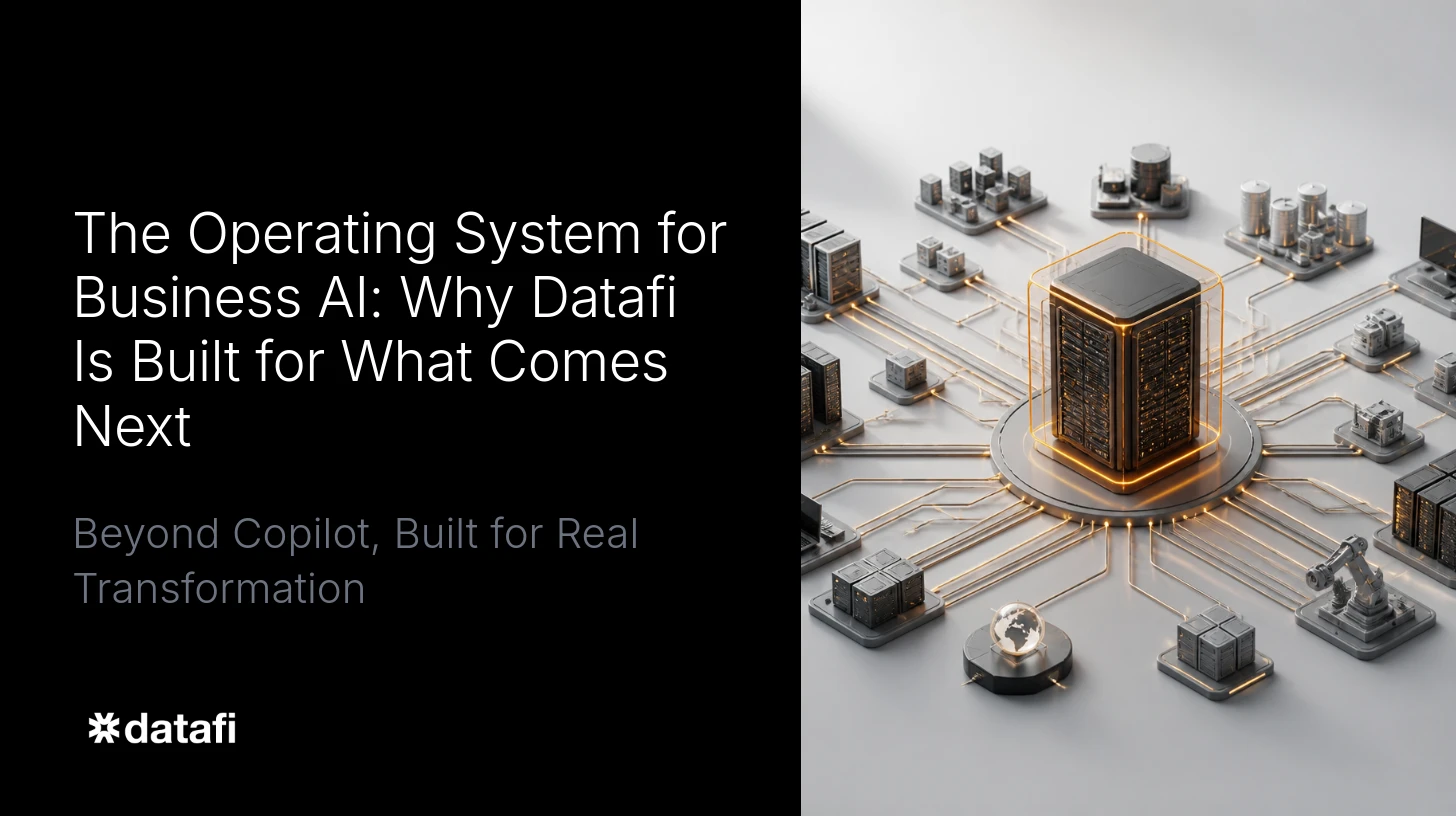
Datafi takes a different architectural position. Rather than applying an AI layer to existing tools, Datafi functions as an operating system for business AI: a vertically integrated data and AI technology stack that connects an organization’s complete data ecosystem, enforces governance and compliance policies, and delivers an AI-powered experience through a Chat UI designed specifically for non-technical users.
This is not a marginal difference in feature sets. It is a foundational difference in what AI can actually do.
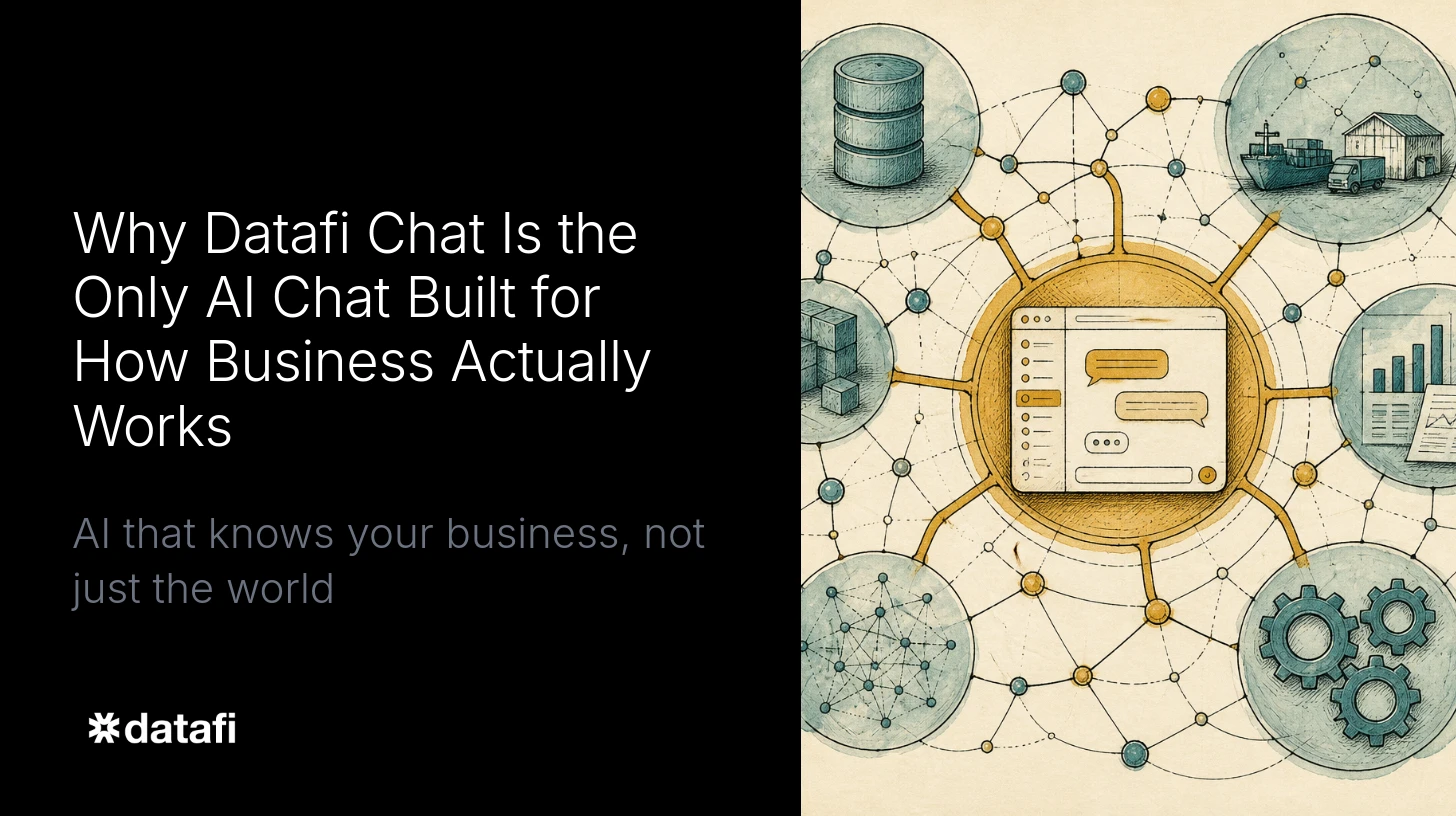
When an LLM has access only to the documents and communications stored in a productivity suite, it has a partial view of the business. It can help draft, summarize, and retrieve. It cannot reason about the full operational picture, because the full operational picture does not live in email threads and slide decks. It lives in transactional data, operational systems, sensor outputs, financial records, customer histories, and the dozens of other data sources that together constitute how a business actually functions.
Datafi gives AI access to all of it.
Full Context Is Not Optional for AI That Solves Problems
There is a practical ceiling on what AI can accomplish when it operates with partial context. It can answer questions based on what it knows. It cannot solve problems that require reasoning across what it does not know, or what it cannot access.
Organizations across every industry are discovering this ceiling in real time. A manufacturer trying to use AI for predictive maintenance cannot get meaningful insight from an AI that has access to maintenance logs stored in SharePoint but not to the sensor data streaming from the shop floor. A transit authority hoping to optimize passenger experience cannot benefit from AI that can summarize meeting notes but cannot connect that context to ridership patterns, service delays, and operational data. A strategic planning team cannot rely on AI to model future scenarios when the AI is reasoning from presentation decks rather than the underlying financial, market, and operational data those presentations summarize.
The problem is not the AI itself. The problem is the context available to it.
Datafi’s vertically integrated stack is built specifically to close this gap. By connecting to the complete data ecosystem, including structured and unstructured data, internal and external sources, real-time and historical records, Datafi enables LLMs to develop the kind of full business context that is a prerequisite for genuine problem solving. Not question answering. Problem solving.
This is what it means to build the contextual layer that complex agents and workflows require. Without it, AI remains impressive in demonstration and limited in impact. With it, AI becomes capable of operating in the analytical, autonomous, and critical-thinking roles that actually move the needle.
Governance, Policy, and Control: The Non-Negotiable Foundation
One of the most important and most underappreciated requirements for enterprise AI is governance. As AI moves from productivity assistance into decision support, workflow automation, and autonomous operation, the question of what AI can access, what it can act on, and how its behavior is controlled becomes critically important.
Microsoft Copilot inherits governance from the Microsoft 365 permission model. For organizations whose data and workflows live primarily within that ecosystem, this provides a baseline of control. But it is a governance model designed around user access to applications and documents, not around the nuanced policy requirements of AI operating across a full enterprise data environment.
Datafi’s approach to governance is architecturally distinct. Policies and controls are embedded within the platform, not inherited from adjacent systems. This means organizations can define precisely what AI can see, what it can do, and under what conditions, across every data source and workflow the platform touches. For industries with stringent compliance requirements, including financial services, healthcare, utilities, and transportation, this is not a nice-to-have. It is a condition of deployment.
It also means that AI can be expanded into more sensitive and consequential roles without compromising the control frameworks that risk and compliance functions require. The path from AI as a productivity tool to AI as a strategic asset runs directly through governance, and Datafi is built with that path in mind from the start.
Designed for the Whole Organization, Not Just Power Users
Enterprise AI that only serves technically sophisticated users is not enterprise AI. It is a specialized capability that creates new divisions within organizations rather than creating shared capacity across them.
Microsoft Copilot assumes a baseline of familiarity with Microsoft applications. For the majority of knowledge workers in large enterprises, that assumption holds. But enterprise AI that can only serve knowledge workers inside a productivity suite leaves out substantial portions of every organization, including frontline staff, field operations teams, finance analysts working in specialized systems, and executives who need strategic insight rather than document assistance.
Datafi’s Chat UI is designed for the full spectrum of users, not the technically comfortable subset. A warehouse manager, a field technician, a customer service representative, and a CFO all interact with the same AI through the same accessible interface, each receiving responses and capabilities shaped by their role, their data access, and the workflows relevant to their function.
This has meaningful organizational implications. When AI is genuinely accessible to every employee, the benefits of AI compound across the business rather than accumulating at particular functions or seniority levels. Organizations of any size can achieve unified data experience and workflow efficiencies that extend to everyone, not just the departments or teams that happen to be most comfortable with complex technology tools.
Agents and Workflows That Actually Change How Work Gets Done
The most significant frontier in enterprise AI is not better chat responses. It is autonomous agents and intelligent workflows that reduce the labor cost of complex, repeating analytical and operational tasks.
This is where the architectural difference between a productivity layer and an operating system becomes most consequential.

Predictive maintenance and asset management require AI that can continuously monitor equipment data, identify deviation patterns, correlate those patterns with historical failure data, and trigger appropriate responses, from alerts to work orders to procurement actions, without waiting for a human to ask a question. That is not a Copilot capability. It requires an AI system with continuous data access, defined action authority, and the contextual depth to reason about asset health in operational terms.
Operations optimization across logistics, manufacturing, transit, and utilities requires AI that can hold a dynamic model of an entire operational environment, update that model as conditions change, and propose or execute adjustments that optimize for defined outcomes. Again, this requires not a productivity assistant but an autonomous agent operating within a governed, fully contextualized data environment.
Passenger experience, customer journey optimization, and service personalization require AI that can synthesize behavioral data, service data, operational data, and policy constraints in real time to make contextually appropriate decisions. The same architectural requirements apply.
Strategic planning support requires AI that can model scenarios across financial, operational, market, and risk dimensions simultaneously, which means it needs access to the data that populates each of those dimensions, and the reasoning capacity to synthesize them into coherent forward-looking analysis.
In every one of these use cases, Datafi’s vertically integrated stack and full ecosystem access are the enabling infrastructure. Microsoft Copilot, however well it serves its intended purpose, is not designed for this kind of work.
The Strategic Choice Organizations Are Making Right Now
Organizations evaluating enterprise AI platforms are, whether they frame it this way or not, making a decision about what they believe AI will become in their operations over the next three to five years.
If the answer is “a helpful layer on top of our existing productivity tools,” then a Copilot-style solution is a reasonable fit. It meets today’s expectations efficiently and integrates without disruption.
If the answer is “an operating intelligence that transforms how we run our business,” then the platform choice needs to be made with that future in mind. Because the architectural foundation of AI matters enormously: it determines what AI can access, what it can reason about, what actions it can take, and how far it can grow into the consequential roles that will define competitive differentiation in the years ahead.
Datafi was built with that future in mind. Not because the productivity use cases do not matter, but because they are the beginning of a much longer journey, and the platform you start on shapes where you can go.
What Datafi Makes Possible
Datafi’s operating system for business AI delivers capabilities that extend well beyond what a productivity-embedded AI layer can provide:
A unified data experience that connects every relevant data source across the organization, giving AI the full context it needs to reason about real business problems rather than document-level questions. Workflow automation built on agentic AI that can operate in autonomous roles across predictive maintenance, operations, customer experience, and strategic functions, reducing costs and improving efficiency in areas that matter most to the bottom line. Governance and policy controls that enable AI to be deployed in sensitive and consequential environments without compromising compliance requirements. A Chat UI that serves every employee, technical and non-technical alike, ensuring that the benefits of AI compound across the whole organization rather than concentrating in particular teams. And a vertically integrated architecture that grows with the organization’s ambitions, from initial deployment through full autonomous operation.
Organizations of any size can access this. Datafi’s model is not designed for enterprises with the resources to build custom AI infrastructure. It is designed for any organization that wants to use AI in the roles that actually transform outcomes.
The difference between AI that answers questions and AI that solves problems is not a difference in underlying model capability. It is a difference in platform architecture, data access, governance design, and the intentionality with which a solution is built for the full complexity of enterprise operation.
Microsoft Copilot is a capable tool for what it is designed to do. Datafi is something different: the operating system for business AI in an era when the full potential of that technology is just beginning to come into view.
The organizations that will lead their industries through that era are already making the decision about which kind of platform they need. Datafi exists for the ones who have decided the answer is transformation.