


Why companies like Pero Family Farms are moving beyond data tools and building a unified intelligence layer that spans every corner of the enterprise.
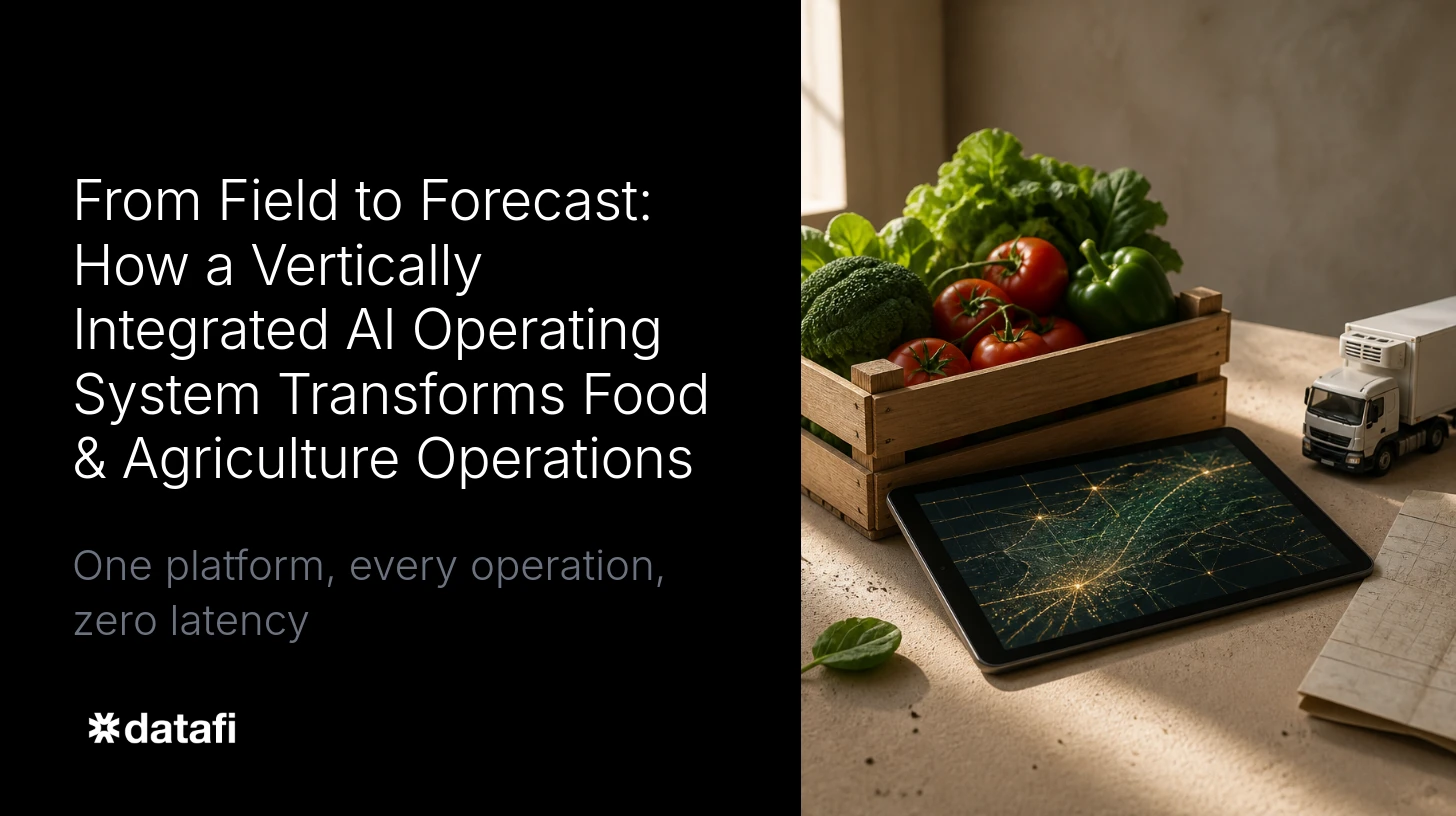
Agriculture and food companies operate at the intersection of extraordinary complexity and extraordinarily thin margins. Inbound receiving, cold chain management, yield variance, logistics coordination, demand forecasting, and compliance documentation all happen simultaneously, across dozens of systems, and on timelines that do not forgive latency. The enterprise that solves this coordination problem with speed and precision wins. The one that relies on fragmented dashboards and reactive human decision cycles falls behind.
The question is no longer whether artificial intelligence belongs in food operations. It clearly does. The question is whether the AI you deploy is capable of solving problems or merely answering questions.
There is a profound difference between an AI system that retrieves an answer and one that takes action. The gap between those two outcomes is entirely architectural.
The Control Tower Vision Requires a Foundation That Matches Its Ambition
When operations leaders in agriculture and food talk about a control tower, they are describing something much deeper than a unified dashboard. They want a living system that ingests data from every operational layer, understands the relationships between those layers, and surfaces decisions or executes actions before a human has to ask. That is a fundamentally different ask than any traditional business intelligence platform can fulfill.
Delivering on that vision requires a vertically integrated architecture, meaning a single platform that manages data connectivity, governance, the contextual model of your business, AI agents, and the user experience in a unified stack. When those layers are stitched together from separate vendors, the integration overhead alone consumes the efficiency gains. More critically, agents operating across disconnected systems lack the coherent context required to reason about tradeoffs, exceptions, and edge cases, the scenarios that constitute most of the value.
At Datafi, this is the core design principle behind the Business AI Operating System. Every layer, from multi-cloud data connectivity with no prerequisite data lake, through the governance and policy engine, through the contextual and ontology layer, through the agentic workflow runtime, and into the Chat UI accessible to non-technical users, is built and maintained as a single coherent system. That coherence is what makes autonomous AI action possible at enterprise scale.
Context Is the Competitive Moat
Large language models are powerful reasoning engines, but they are only as useful as the context they can access. A model with no knowledge of your specific supplier relationships, contract terms, historical yield patterns, or logistics constraints cannot make a meaningful operational recommendation. It can only generate plausible-sounding text.
Building the contextual and ontology layer that maps the relationships, hierarchies, and business rules of an enterprise like Pero Family Farms is not a data science project that gets handed off to a vendor. It is an ongoing strategic asset, one that gets richer every time an agent executes a workflow, every time a decision is logged, every time an exception is resolved. The organizations that invest in this layer now are building a moat that compounds over time.
This is also where governance becomes a strategic function rather than a compliance checkbox. Field-level data policies, role-based access controls, and data quality rules are not constraints on what AI can do. They are the scaffolding that allows AI to act with confidence in environments where intellectual property, operational IP, and regulatory sensitivity are non-negotiable. For a family-owned company with decades of proprietary operational knowledge, the ability to deploy AI without exposing that knowledge to any vendor, cloud provider, or third-party model is foundational.
Where Vertically Integrated AI Delivers in Food & Agriculture
- Predictive maintenance and asset management across processing and cold chain equipment
- Inbound receiving automation, yield variance detection, and quality exception routing
- Logistics coordination agents that optimize carrier selection, routing, and BOL management
- Demand and sales order intelligence that connects forecast signals to operational planning
- Strategic planning workflows that synthesize market, operational, and financial context for leadership
AI Designed for Every Employee, Not Just Data Teams
One of the persistent failures of enterprise AI adoption is the assumption that AI tools are for analysts. The workflows with the greatest operational leverage are not the ones that help a data team run queries faster. They are the ones that put the right information and the right action into the hands of a warehouse supervisor, a logistics coordinator, a sales rep, or a plant manager at the exact moment it is needed.
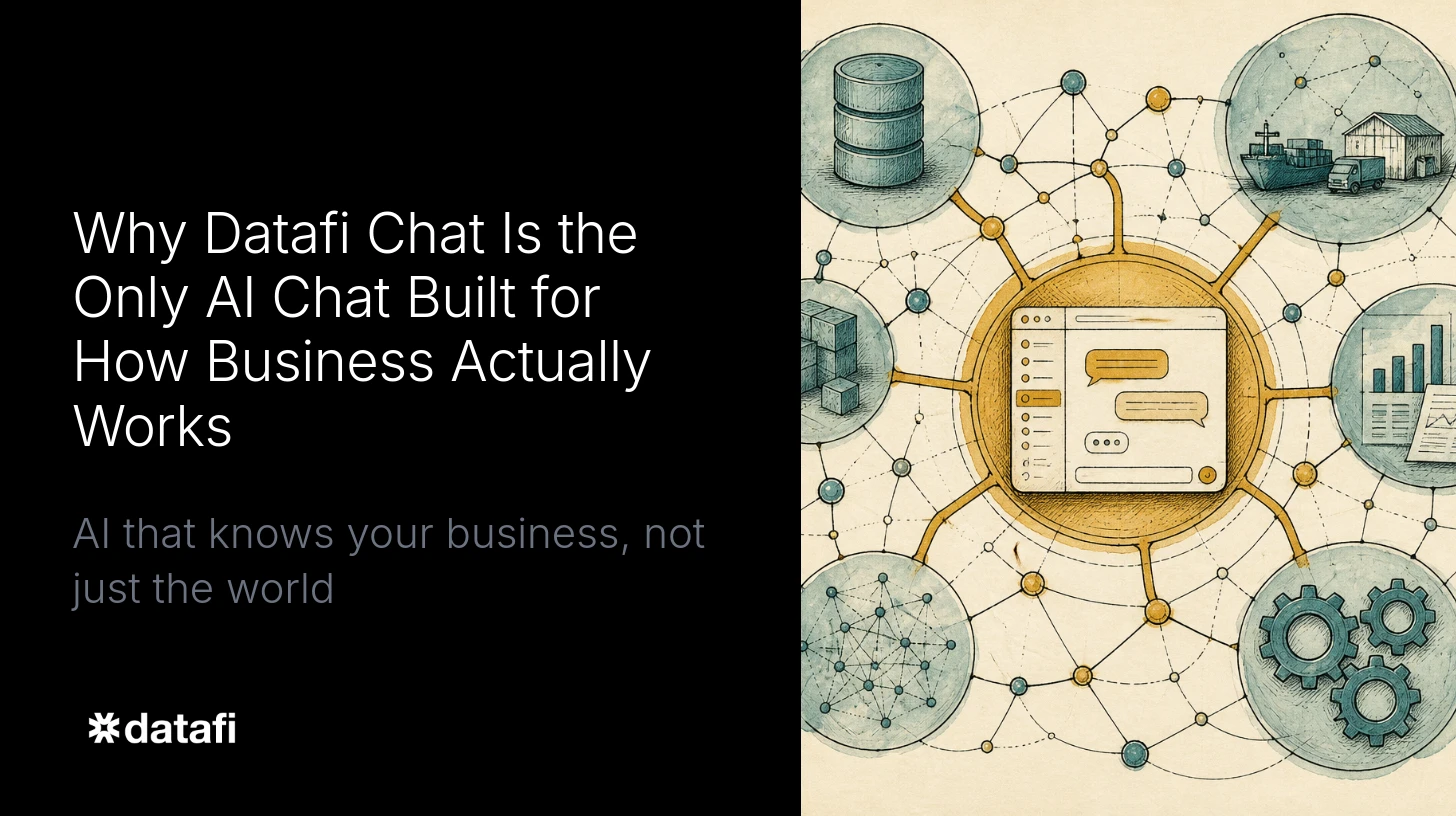
Achieving that requires a Chat UI designed explicitly for non-technical users, one that translates natural language into governed, contextually grounded AI action without requiring the user to understand the underlying infrastructure. When a logistics manager asks which shipments are at risk of missing their delivery window today, the answer should not require a ticket to IT. It should return a precise, actionable response drawn from live operational data, filtered by the user’s access policies, and optionally trigger a workflow to notify the carrier or reroute the load.
The real efficiency and margin gains live not in organizations where AI augments a few technical specialists, but in ones where AI operates as a broadly deployed capability across every function.
LLM Agnosticism Is an Enterprise Prerequisite
The model landscape is evolving faster than any enterprise procurement cycle. Tying your AI operating layer to a single cloud provider or a single LLM is the equivalent of building your logistics strategy around one carrier. The flexibility to run the best available model for a given task, whether that is a frontier commercial model, an open-source alternative like DeepSeek or Llama hosted within your own VPC, or a fine-tuned model trained on your first-party operational data, is not a nice-to-have. It is an architectural requirement for any platform you intend to use seriously over a five-year horizon.
Datafi is built on this principle from the ground up. The platform does not make the model decision for you. It gives your enterprise the infrastructure to make that decision intelligently and change it as the landscape evolves.
The Organizations That Act Now Will Build Durable Advantage
Every month that passes without a coherent AI operating layer is a month in which operational data sits unstructured, contextual knowledge goes uncaptured, and autonomous workflow capability goes unrealized. The companies that build this foundation now, starting with the data connectivity and governance layer, developing the contextual model of their business, and deploying agents into well-defined operational workflows, are not just becoming more efficient. They are building a version of their enterprise that compounds intelligence over time.
Pero Family Farms’ vision of an end-to-end operational control tower is exactly the kind of initiative that a vertically integrated AI operating system is designed to enable. Not in years. Now.
The platform is ready. The question is how quickly the context layer gets built, and who builds it first.