


For Chief Underwriting Officers, CROs, and heads of commercial lines, the competitive question is no longer whether to use AI in underwriting. It is whether the AI you deploy can actually see enough to reason well.
There is a specific kind of frustration that experienced underwriters know well. You are evaluating a complex commercial risk, a large manufacturer with operations across multiple states, a specialty contractor with a decade of loss history across three carriers, a mid-market logistics company with fleet, property, and workers’ comp exposure all tangled together. You know, with professional certainty, that the right answer exists somewhere in the data. But the data is distributed across systems that do not talk to each other. The loss runs live in one place, the financial statements in another, the inspection reports in a third, the external hazard scores in a fourth. Your team spends days assembling a coherent picture before the actual underwriting judgment even begins.
This is not a speed problem. It is a context problem. And it is the problem that defines the outer boundary of how good underwriting decisions can actually be.
The arrival of AI in insurance has, until now, done remarkably little to address this boundary. Most deployments amount to faster data analysis tools: they accelerated the retrieval of individual data points, automated the ingestion of structured submissions, or generated summaries of documents that underwriters were going to read anyway. These are genuine efficiencies. But they do not change the fundamental epistemological constraint that limits underwriting quality: decisions are only as good as the context that informs them, and context has been fragmented by default.
What changes the quality of underwriting decisions is not faster retrieval. It is AI data analysis that can reason across the complete information environment of a risk, in real time, with the full weight of your organization’s institutional knowledge, data assets, and decision logic applied simultaneously.
That is a categorically different capability. And it requires a categorically different kind of AI infrastructure to deliver it.
The underwriting edge belongs to organizations that solve the context problem, not just the speed problem. AI that can see everything, governed appropriately and grounded in institutional knowledge, is the architecture of a better underwriting organization.
The Context Gap in Commercial Underwriting
To understand why most AI deployments fall short of their promise in underwriting, it helps to be precise about what underwriting actually requires.
A sound underwriting decision on a complex commercial account is not the output of a single data query. It is the synthesis of dozens of intersecting signals, each of which gains meaning in relation to the others. A loss ratio that looks elevated becomes interpretable only when set against exposure growth, line of business mix, and industry benchmarks from comparable books. A favorable financial profile becomes more complicated when paired with an unfamiliar jurisdiction, a new product line, or a management team with limited tenure. A clean loss history earns more weight when it comes from a stable operation with mature safety programs and less weight when the account has simply never had a large enough exposure to produce a recordable event.
Experienced underwriters perform this synthesis intuitively, through pattern recognition built over years of exposure to risk. What they cannot do is perform it at scale, across every account simultaneously, drawing on every available data source, without fatigue or inconsistency.
AI can do that, but only if it has access to everything those experienced underwriters would draw on, and more. The moment you limit AI systems to a single system, a single data type, or a single document set, you have recreated the same context gap that limits human throughput, just faster.
The result is AI that answers questions but does not solve underwriting problems.
What It Means for AI to See Everything
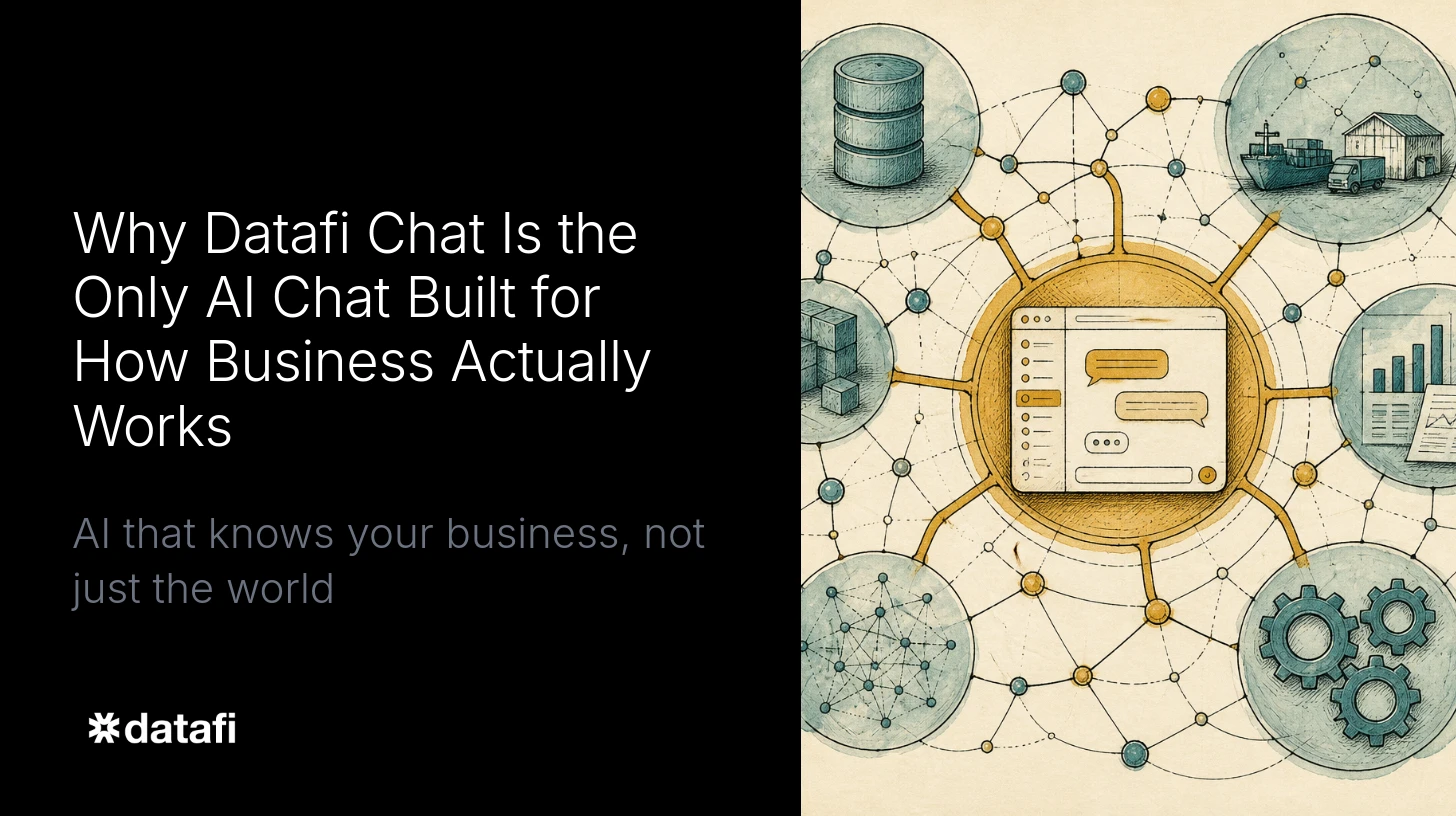
The Datafi operating system for AI is built around a foundational conviction: LLMs must have access to the complete data ecosystem of the enterprise, not a curated subset of it, to function in genuinely critical roles.
In an underwriting context, that means AI that can simultaneously access and reason across structured loss data in core systems of record, unstructured documents including submissions, inspection reports, financial statements, and loss runs, external data feeds covering hazard scores, geocoded risk data, industry loss trends, and public records, internal pricing models and appetite guidelines, historical decision logs and book-of-business analytics, and regulatory and compliance data relevant to the lines in question.
None of these data sources is individually sufficient. None of them, retrieved in isolation, produces underwriting insight. The insight emerges from the relationship between them, from the pattern that only becomes visible when you can see all of it at once.
This is what underwriters mean when they describe good judgment. It is not that they know more facts than others. It is that they can hold more context simultaneously and recognize the patterns that matter. AI systems that can see everything can do this at enterprise scale, across every account in the pipeline, with consistency that no team of humans can match.
But access alone is not sufficient. Seeing everything only produces better decisions when the AI can reason about what it sees with the right analytical and institutional framework applied.
From Data Access to Contextual Reasoning
The architecture that enables contextual reasoning in underwriting is not simply a matter of connecting more data sources. It requires three capabilities working in concert.
The first is a governed data ecosystem. AI that can see everything must also see everything appropriately. In underwriting, that means data access controls that enforce line of business boundaries, account-level confidentiality, regulatory compliance requirements, and the internal governance policies that determine who can see what at each stage of the underwriting workflow. The Datafi platform applies policy and governance at the data layer, which means AI agents inherit the same access controls that govern human users. This is not a secondary consideration. It is the condition that makes broad AI deployment in regulated environments viable.
The second is full business context. Underwriting AI that is limited to external data or submission documents cannot apply your organization’s specific appetite, your pricing philosophy, your catastrophe accumulation constraints, or your historical experience with a given industry class. The AI that changes the quality of decisions is the one that has been given the institutional knowledge of your underwriting organization, not just access to generic insurance data. This requires integrating your internal systems, your model outputs, your guidelines, and your decision history into the context that the AI reasons from.
The third is agentic capacity. The most significant decisions in commercial underwriting are not answerable with a single query. They require iterative investigation, the kind of process where one finding reshapes the questions you ask next. An underwriting agent that can autonomously pursue a line of inquiry, pulling additional data when an initial signal warrants it, re-evaluating its working hypothesis as new information arrives, and surfacing a coherent risk narrative rather than a list of data points, is doing something qualitatively different from a retrieval tool. It is functioning as an analytical collaborator in the underwriting process.
The Decision Quality Advantage
When these three capabilities are operating together, the improvement in underwriting is not incremental. It represents a different standard of decision quality than was previously achievable.
Consider what becomes possible in a commercial property submission for a mid-market manufacturer. An AI agent with full context access can simultaneously evaluate the account’s loss history against industry class benchmarks, flag geocoded natural hazard exposure for each of the account’s locations, cross-reference the financial statements against credit signals and industry trend data, apply your organization’s specific appetite rules for the class and jurisdiction, surface comparable accounts from your historical book and their ultimate profitability, and identify any concentration or accumulation concerns relative to your current portfolio position.
That synthesis, done well by an experienced underwriter, takes days. With AI data analysis that has complete context access, it is available at submission intake. The underwriter who reviews it is not being replaced. They are being elevated to a role that was previously impossible: applying professional judgment to a fully assembled picture of the risk, rather than spending most of their time assembling the picture.
Underwriting AI designed to automate steps in a process captures efficiency. Underwriting AI designed to enrich the quality of judgment captures something more durable: a structural advantage in the accuracy of risk selection, pricing, and portfolio management.
Portfolio Intelligence as a Continuous Capability
The underwriting edge that AI delivers is not only present at the point of individual account decisions. It extends to the portfolio level, where the most consequential risk management decisions are made.
A Datafi-powered AI operating system can maintain continuous portfolio intelligence across your book, identifying accumulation patterns as they develop, flagging deteriorating segments before they appear in quarterly loss reports, modeling the portfolio impact of appetite shifts before they are implemented, and surfacing the accounts where current pricing is inconsistent with the risk profile your data actually supports.
For CROs, this means moving from periodic portfolio reviews based on lagging indicators to a continuous, data-grounded view of where the book stands and where it is heading. For heads of commercial lines, it means the ability to manage appetite dynamically, with real evidence rather than intuition, and to capture opportunities in segments where your data shows favorable experience that your current pricing does not yet reflect.
This kind of portfolio intelligence has always been theoretically possible. The reason it has not been consistently achieved is that the data required to sustain it has lived in too many places, updated on too many different cadences, and required too much manual assembly to support genuine real-time visibility. The Datafi platform’s vertically integrated data and AI stack is designed to eliminate that assembly cost and make portfolio intelligence a continuous operational capability rather than a periodic project.
Why Vertical Integration Is the Prerequisite
There is a reason that point solutions and standalone AI systems, however sophisticated, have not delivered the underwriting transformation that was expected of them. Individual tools that address one part of the problem, document ingestion here, hazard scoring there, submission triage at the front door, cannot produce contextual reasoning because context is the relationship between the parts. A tool that sees one part cannot reason about the whole.
The Datafi operating system is vertically integrated by design, connecting the data ecosystem, the governance and policy layer, the AI reasoning capability, and the workflow interface into a single operating environment. This is not an architectural preference. It is the technical requirement for AI that can actually function in critical underwriting roles rather than assistive ones.
For organizations of any size, this means that the capability to deploy genuinely contextual underwriting AI is not reserved for carriers with the resources to build bespoke data platforms. It is available as an operating system that can be applied to your existing data environment, your existing systems of record, and your existing workflows, without requiring you to replace the infrastructure you have already built.
The Decision Before the Decision
For Chief Underwriting Officers and CROs who are evaluating where AI fits in their strategic roadmap, there is a prior question that determines whether that investment will produce competitive differentiation or incremental efficiency: Does the AI you are deploying have access to everything it would need to reason well?
If the answer is a partial data environment, a narrow document set, or a single system of record, the AI will produce faster answers to narrower questions. It will not change the quality of your risk decisions. It will not surface the patterns that your experienced underwriters would catch if they had time to look everywhere. It will not give you portfolio intelligence that is genuinely continuous or risk selection that is genuinely better.
The underwriting edge belongs to organizations that solve the context problem, not just the speed problem. AI that can see everything, governed appropriately, grounded in your institutional knowledge, and capable of reasoning autonomously across the full complexity of a risk, is not a feature of a more capable workflow. It is the architecture of a better underwriting organization.
That is the transformation Datafi makes available. Not AI that helps underwriters work faster. AI that enables underwriters to decide better, at every account, across every line, for every segment of the portfolio that depends on the quality of the judgment behind it.
Datafi is the AI operating system for enterprises that need AI to do more than answer questions. Built for organizations where data is distributed, decisions are consequential, and the quality of AI reasoning is the competitive variable that matters most. Contact us today.