


The promise of AI at work has never been more compelling, or more frequently misunderstood. Across industries, organizations are deploying AI tools with genuine enthusiasm, only to discover that what they have built is a better search engine rather than a smarter organization. The distinction matters enormously, and it is at the center of how Datafi thinks about what business AI should actually do.
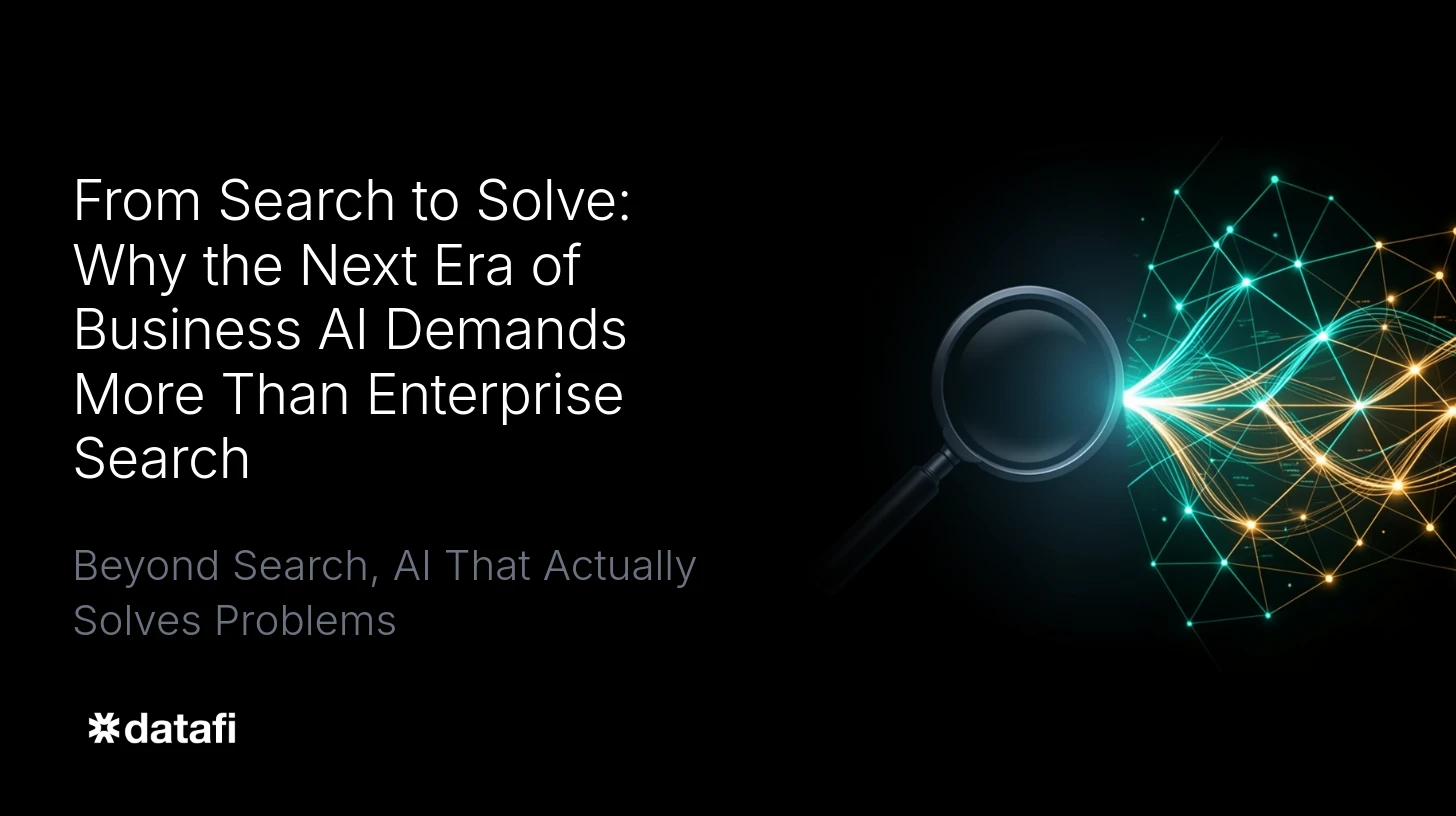
Enterprise search surfaces what is already known. Business AI that solves problems must access the complete data ecosystem, understand full organizational context, and take autonomous action within defined governance boundaries. These are not enhancements to search; they require a fundamentally different architecture.
Platforms like Glean have made a genuine contribution to enterprise productivity. By connecting siloed knowledge sources and enabling natural language search across documents, emails, wikis, and communication tools, they give employees faster access to information that already exists somewhere inside the organization. That is useful. But it is not transformation. And as enterprise expectations for AI mature, the gap between what search-centric platforms can deliver and what organizations actually need is becoming impossible to ignore.
The Search Ceiling

Glean’s core value proposition is knowledge retrieval. It surfaces what is already known, already documented, and already stored. It excels when the answer exists somewhere in your organization’s corpus of content and the challenge is simply finding it. For knowledge workers who spend significant time hunting through shared drives or Slack threads, that friction reduction is real.
But consider what that model cannot do. It cannot reason across structured and unstructured data simultaneously. It cannot take action on what it finds. It cannot execute a workflow, trigger a business process, or synthesize insight from live operational data. It cannot learn the specific context of your business, your customer relationships, your asset performance trends, or your supply chain dynamics, and bring that context to bear on a complex decision. It answers questions. It does not solve problems.
This is not a critique of Glean’s execution. It is a critique of the category. Enterprise search, however sophisticated, is architecturally limited in what it can achieve. The moment an organization wants AI to do more than surface information, the foundation needs to change.
What Solving Problems Actually Requires
Here is the hard truth that experience working with enterprise data and AI makes clear: for AI to move from answering questions to solving problems, three things must be true simultaneously.
First, the AI must have access to the complete data ecosystem, not just documents and communications, but structured operational data, real-time feeds, transactional records, external data sources, and the full constellation of systems that actually run the business. Most enterprise knowledge lives not in documents but in databases, in sensor streams, in ERP systems, in CRM records. Any AI platform that cannot reach this layer is working with an incomplete picture of reality.
Second, the AI must understand the full context of the business. Context is not just knowing what the company sells or who its customers are. It is understanding the relationships between data points, the policies and constraints that govern decisions, the historical patterns that define what normal looks like, and the strategic priorities that determine what good outcomes mean. This contextual layer is the foundation on which meaningful AI reasoning is built. Without it, AI is pattern matching against fragments.
Third, the AI must be capable of autonomous action. This is where the conversation shifts from AI as a retrieval tool to AI as an operating capability. Autonomous agents and workflows that can observe conditions, reason about implications, formulate responses, and take action, within defined governance boundaries, represent a fundamentally different class of capability. This is not a feature. It is an architectural requirement.
The Datafi Operating System for Business AI
Datafi was built from the ground up with these requirements as the design premise, not as aspirational additions to a search product. The result is a vertically integrated data and AI technology stack that connects every layer of what business AI needs to be genuinely useful.
At the data layer, Datafi provides governed access to the complete data ecosystem. This means structured and unstructured data, internal and external sources, real-time operational feeds and historical records. The platform is designed so that the LLMs operating within it have visibility into the actual information landscape of the business, not a curated subset of documents. This is the difference between giving an analyst a filing cabinet and giving them access to every system in the organization, with the context to use it responsibly.
At the governance layer, Datafi embeds policies and controls that make enterprise-grade AI deployment possible at scale. Regulated industries and large organizations cannot deploy AI that operates without boundaries. Datafi’s approach treats governance not as a constraint bolted on after the fact, but as a foundational design principle. Role-based access, data classification, audit trails, and compliance controls are built into how the platform operates, making it possible to extend AI capability across the enterprise without sacrificing oversight.
At the experience layer, Datafi’s Chat UI is designed specifically for non-technical users. This is a detail that deserves more attention than it typically gets. Enterprise AI that requires technical sophistication to operate is enterprise AI that will not be adopted broadly. Datafi’s interface makes it possible for every employee, regardless of technical background, to access the power of a fully contextualized AI. The democratization of data experience is not a tagline. It is a design commitment that determines whether AI creates value for the whole organization or only for a technical minority.
Agentic AI Across the Enterprise

The use cases that matter most to organizations today are not search problems. They are operational, strategic, and analytical problems that require AI to reason, decide, and act.
Predictive maintenance and asset management offer one of the clearest examples. An organization managing a large fleet of physical assets, whether aircraft, rail equipment, industrial machinery, or facilities infrastructure, cannot afford to rely on reactive maintenance schedules. The data required to predict failure before it occurs exists in sensor telemetry, maintenance logs, usage patterns, environmental conditions, and vendor service records. An AI agent with access to this full data ecosystem and the contextual understanding of asset criticality, maintenance windows, and operational constraints can identify failure signatures early, prioritize intervention, and reduce unplanned downtime. Glean can tell you where the maintenance manual is. Datafi’s agentic layer can tell you which asset is likely to fail next week and initiate the service workflow.
Operations optimization presents a similar profile. Complex logistics, scheduling, routing, and resource allocation problems involve tradeoffs across multiple variables in near real time. AI that can continuously monitor operational conditions, reason about constraints, and adjust recommendations as conditions change is a fundamentally different capability from AI that retrieves a document about best practices. Datafi’s ability to connect to live operational data and reason across it with full business context is what makes this class of application possible.
Passenger and customer experience is another domain where the difference between search and solve becomes consequential. AI that can synthesize a customer’s interaction history, real-time situational data, available resolution options, and policy constraints to proactively resolve a problem before the customer escalates it requires exactly the kind of integrated, contextually aware AI architecture that Datafi provides. Retrieval alone cannot close this loop.
Strategic planning and analytical applications represent perhaps the most ambitious frontier. Organizations that want to use AI in critical thinking roles, to synthesize market signals with internal performance data, to model scenarios under uncertainty, to identify strategic inflection points before they become obvious, need AI that can reason at depth across complex, heterogeneous information. The contextual layer that Datafi builds, grounded in the complete data ecosystem and the organization’s operating reality, is what makes AI useful at this level of abstraction.
Not Just for the Enterprise Giants
One of the most important dimensions of Datafi’s positioning is that this capability is not reserved for organizations with the resources of a Fortune 100 company. The prevailing assumption in enterprise AI has been that sophisticated, integrated AI capability requires massive investment in data infrastructure, specialized talent, and long implementation timelines. That assumption has locked smaller and mid-sized organizations out of AI that actually works.
Datafi rejects that assumption. Organizations of any size can achieve a unified data experience and deploy AI agents and workflows that deliver real operational value. The platform is designed to meet organizations where they are in their data maturity and grow with them, rather than demanding a prerequisite level of data infrastructure sophistication before delivering value. This is a meaningful departure from how most enterprise AI platforms approach the market, and it reflects a conviction that the benefits of AI should be broadly accessible, not concentrated at the top of the market.
The Contextual Layer Is the Competitive Moat
For LLMs to function in genuinely autonomous roles, they need what might be called the contextual layer: a deep, structured understanding of the organization’s data, processes, policies, history, and priorities. This layer does not come out of the box with any AI model. It has to be built, and it has to be continuously maintained as the business evolves.
Building this layer is one of Datafi’s core commitments. By connecting to the complete data ecosystem, embedding governance and policy logic, and operating across both structured and unstructured information, Datafi creates the foundation that AI agents need to reason well and act responsibly. This is not something that can be retrofitted onto a search product. It requires a different architecture from the start.
The organizations that invest in building this contextual layer now will have a compounding advantage as AI capability continues to advance. Every workflow automated, every agent deployed, every problem solved adds to the organizational intelligence that makes the next application easier and more powerful. AI that merely searches does not build this advantage. AI that solves problems does.
A Different Question
The question organizations should be asking is not which tool helps employees find information faster. That is a valuable problem, but it is a solved problem. The question that determines competitive position over the next decade is which platform can enable AI to operate in genuine partnership with human judgment across the full complexity of the business.
Datafi was built to answer that question. The vertically integrated stack, the access to the complete data ecosystem, the governance and control framework, the Chat UI designed for everyone, the agentic capacity, they are all expressions of a single conviction: that AI which solves problems is categorically different from AI that answers questions, and that the architecture required to deliver one is fundamentally different from the architecture required to deliver the other.
The era of enterprise search was a meaningful step forward. The era of business AI that actually works is what comes next.
Datafi provides the operating system for business AI, purpose-built for organizations that want AI to solve problems, not just answer questions.