


Owning Your AI Future — Post 5 of 6
Every enterprise AI decision eventually gets framed as a choice between two options, and the framing is where the trouble starts.
Do we build it ourselves or buy a platform? It is the question every technology leader is handed, by their board, their vendors, their own instinct to reduce a hard decision to a clean fork. Build means control and capability owned in-house. Buy means speed and a vendor who has solved the hard parts already. The whole conversation organizes itself around that axis, and the team argues back and forth along it until one side wins.
The argument is sincere, and it is also a trap, because the axis is incomplete. Build versus buy measures the decision along one dimension — control versus speed — and quietly ignores the dimension that determines whether the decision ages well. That hidden dimension is optionality: how much future freedom each path preserves or surrenders. Measured only on control and speed, both build and buy look like reasonable choices. Measured on optionality, both of the usual answers can quietly cost you the thing that matters most.
Build versus buy measures the decision on control versus speed and ignores optionality — how much future freedom each path preserves. Build overspends scarce engineering on undifferentiated infrastructure. The all-in-one buy mortgages your freedom to adapt. The real choice was never just two options.
The premise worth questioning
The conventional framing rests on an assumption that feels too obvious to state: that build and buy are the two options, and the decision is choosing between them. Pick the one whose tradeoffs you prefer.
It is worth pausing there, because the assumption smuggles in a constraint that is not actually true. It treats “buy” as a single thing — adopt a platform, inherit its architecture, accept its dependencies — and “build” as the only alternative for anyone who wants to stay in control of their own future. Framed that way, a leader who values optionality is pushed toward building, because buying appears to mean surrendering control by definition.
That used to be closer to true. The platforms available to buy were largely all-in-one propositions, and adopting one did mean accepting its lock-in as the price of its speed. But the binary was always a description of the market at a moment, not a law of nature. The reason build versus buy feels exhaustive is that the third option was missing from the menu, and a menu’s silence is easy to mistake for the limits of the possible.
What each of the two usual answers actually costs
Take the two familiar paths seriously, because each is genuinely reasonable, and each carries a cost the framing tends to understate.
Building in-house buys you control, and the cost is everything that control consumes. Enterprise AI is hard to assemble — data connectivity, governance, orchestration, a usable experience for non-technical staff — and building it yourself means committing scarce, expensive engineering capacity to constructing infrastructure rather than to the outcomes the infrastructure was supposed to enable. Worse, much of what you build is undifferentiated. The connectors and the policy engine and the agent runtime are not where your competitive advantage lives, yet they absorb the talent that might have built the things that are. Build gives you control over a great deal you would have been better off not having to control.
Buying an all-in-one platform buys you speed, and the cost is the optionality you spend to get it. This is the lock-in this entire series has mapped — the embeddings, the orchestration, the governance, the context, all accruing inside a vendor’s environment, all deepening with every success until reconsidering the platform is no longer a decision you can practically make. Buy gives you fast time-to-value and mortgages the freedom to adapt when the market moves, which in AI it does every quarter.
Here is the symmetry the framing hides. Build overspends on control you do not need. Buy overspends on optionality you will wish you had kept. Both bills come due later, and both are larger than the build-versus-buy conversation ever puts on the table, because that conversation was only ever measuring control against speed.
The third path the binary hides
Once optionality is on the table as its own axis, a third path appears that the binary had no room for. You can buy a foundation without buying a cage.
The distinction is between buying an all-in-one platform and buying an open one. An all-in-one platform asks you to adopt its entire architecture and accept its dependencies as the price of its integration. An open platform gives you the integration — the connected data, the consistent governance, the usable experience, the speed — while keeping the layers underneath interchangeable, so the freedom to swap models, tools, and infrastructure as the market shifts stays yours. You get the time-to-value of buying and the optionality that used to require building. The tradeoff the binary insisted was unavoidable turns out to have been an artifact of the products on offer, not a property of the decision.
This reframes the build-versus-buy question entirely. The right question was never “do we control everything or move fast.” It was “what do we actually need to own, and what can we safely let a platform provide.” The answer, for most enterprises, is that you need to own your data, your context, and your governance — the assets that compound and differentiate — and you can let an open foundation provide the undifferentiated infrastructure underneath, as long as that foundation does not hold the assets hostage. Own what makes you you. Buy the rest, from someone who lets you keep owning it.
The tradeoff the binary insisted was unavoidable turns out to have been an artifact of the products on offer, not a property of the decision.
What buying without surrendering looks like
This is the path Datafi was built to offer. The Business AI Operating System is a platform you buy for speed — vertically integrated infrastructure that connects your complete data ecosystem, governs it, and delivers agentic AI through an experience built for non-technical users, live in weeks rather than the years a build would take.
What makes it the third path rather than the all-in-one trap is what stays yours. The global business contextual layer accrues as your asset, not the vendor’s — the accumulated understanding of how your enterprise runs, owned by the enterprise. Governance, through Sentinel, is architecture you own and could carry with you, not a proprietary control plane you would rebuild from zero to leave. And models remain interchangeable by design, because the durable value was never supposed to live in whichever LLM is briefly ahead. You buy the integration. You keep the optionality. The two were only ever in tension because the market had not offered them together.
That is the resolution to a question that was malformed from the start. Build versus buy forced a choice between control and speed and hid the cost of optionality in the fine print of both answers. The third path refuses the premise: integration without captivity, speed without surrender, a foundation you bought and an architecture you still own.
The decision worth making instead
The leaders who navigate enterprise AI best in the next few years will not be the ones who argued build versus buy most rigorously. They will be the ones who noticed the argument was measuring the wrong thing.
The decision worth making is not control versus speed. It is this: which assets must we own outright, and which can we let an open platform provide without ever losing the freedom to leave. Answer that, and build versus buy dissolves into something more useful — a clear line between the data, context, and governance you keep, and the undifferentiated infrastructure you are happy to let someone else run, on the condition that they let you keep owning what matters.
Build or get locked in was never the real choice. The real choice is whether to insist on owning your future while still moving at the speed the market demands. You can have both. The only thing standing in the way is a question framed to convince you that you cannot.
The final post in this series brings the whole argument together into the affirmative case: what it actually looks like to own your AI future on an open contextual layer — a vendor-neutral foundation that sits above interchangeable models and tools, and turns everything this series has diagnosed into a single, coherent alternative.
Datafi is a Business AI Operating System designed for mid-enterprise organizations that need the full power of an integrated AI platform without surrendering ownership of the data, context, and governance that make AI worth adopting. Learn more at datafi.co.
Series: Owning Your AI Future
Part 1 — The Trap: Rethinking the Premise
Post 1: The Hidden Cost of The All-In-One AI Platform
Post 2: Five Ways AI Vendor Lock-In Shows Up in Your Data Layer
Part 2 — The Tradeoffs: An Honest Accounting
Post 3: The Model Is Not the Moat — Why Betting on One LLM Is a Losing Strategy
Post 4: Governance You Cannot Take With You Is Not Governance
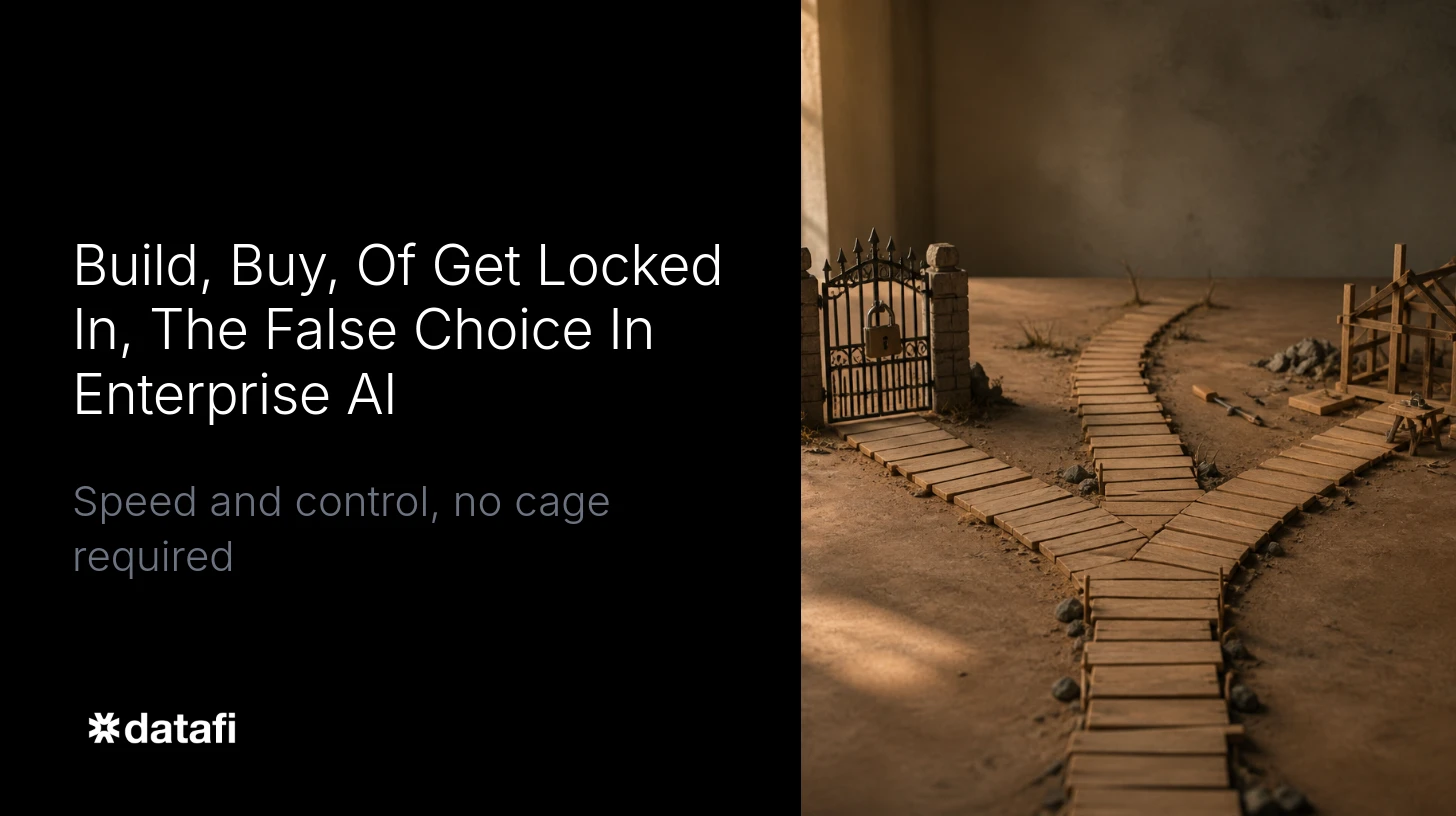
Post 5: Build, Buy, or Get Locked In — The False Choice in Enterprise AI
Part 3 — The Path: A Pragmatic Roadmap
Post 6: Owning Your AI Future — The Case for an Open Contextual Layer