


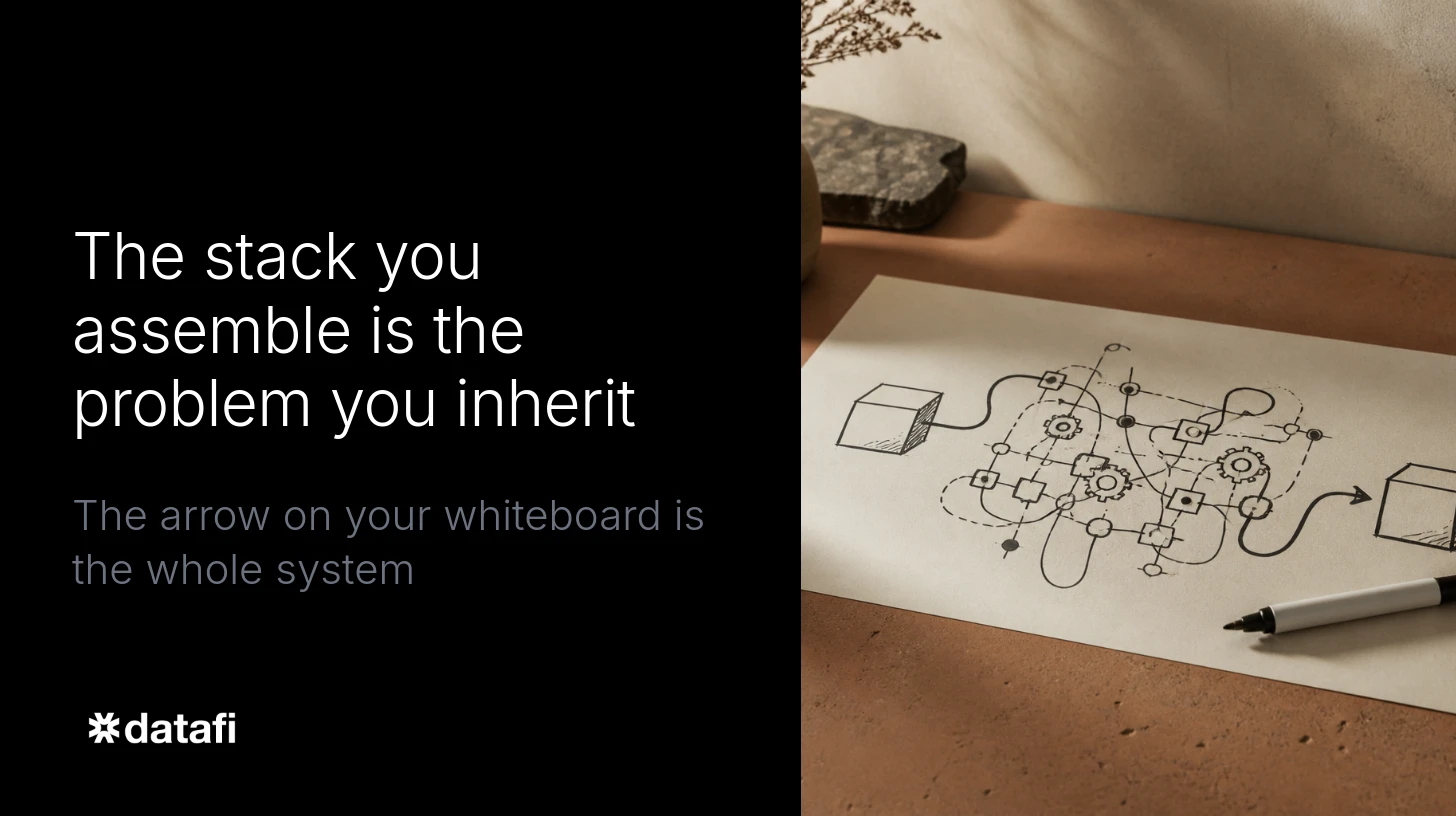
There is a particular kind of optimism that takes hold when a technology leader sketches an AI architecture on a whiteboard. The boxes connect cleanly. Databricks holds the data. ChatGPT supplies the intelligence. An arrow runs between them, and in that arrow lives an entire assumption: that the hard part is having the pieces, and the connecting is a detail.
The connecting is not a detail. It is the work. And it is the part that quietly determines whether an organization ends up with AI that answers questions or AI that solves problems.
The difference between a build stack and an integrated operating system is not the quality of the components. The context, governance, orchestration, and semantics that turn data and a model into a working business capability do not exist until your team builds them, maintains them, and rebuilds them every time either vendor changes. Treating that connective tissue as the product, not the project, is the decision that actually matters.
The premise worth questioning
The build case is genuinely attractive, and it deserves to be stated at its strongest before anyone turns against it.
Databricks is a formidable platform. It unifies data engineering, warehousing, and machine learning on an open lakehouse foundation. It handles scale that would have been unthinkable a decade ago, and it gives sophisticated teams precise control over how data is stored, transformed, and governed. Pairing it with a frontier model like ChatGPT seems to complete the picture: you own your data layer, you rent the best available reasoning, and you keep the freedom to swap either component as the market moves. No vendor holds you hostage. Your most capable engineers get to build exactly what the business needs.
For an organization with deep platform engineering talent, a tolerance for long timelines, and a use case narrow enough to specify completely, this can work. It has worked. Dismissing the build path outright would be dishonest, and honesty about the alternative is the only credible starting point for arguing against it.
So here is the fair version of the question: if you have the data platform and you have the model, what exactly is missing?
The answer is everything that lives in the arrow.
What the arrow has to carry
When a business leader asks an AI system a real question, the question is almost never self-contained. “Which of our accounts are at risk this quarter?” depends on what “at risk” means in your business, which systems hold renewal dates, how your team defines an account versus a subscription, which signals have historically preceded churn, who is allowed to see revenue figures, and what the organization intends to do with the answer once it has it.
None of that lives in Databricks. None of it lives in ChatGPT. It lives in the space between them, and in a build architecture, that space is empty until your team fills it, by hand, one integration at a time.
Databricks stores the data beautifully, but it does not know what the data means to your business. It does not carry the policies that govern who may act on it. It does not maintain the semantic definitions that let a model reason about “revenue” or “customer” the way your finance team does. ChatGPT, for its part, is extraordinarily capable of reasoning, but it arrives knowing nothing about your company. It cannot see your data ecosystem. It cannot enforce your compliance rules. It cannot take an action inside your operational systems. It can only answer, in isolation, from whatever fragment of context you manage to paste into its window.
This is the gap between answering and solving, and it is not a gap you close with an API key.
To make the two pieces function as one, a build team has to construct the connective tissue themselves: a retrieval layer that pulls the right data at the right moment, a governance layer that ensures the model never exposes what a given user is not permitted to see, an orchestration layer that lets the model actually do things rather than merely describe them, an observability layer so the business can trust and audit what the AI is doing, and a semantic layer that gives the model a shared, business-accurate understanding of the organization’s information. Each of these is a serious engineering program in its own right. Assembled together, under a deadline, by a team that also has a day job, they become the thing that consumes the roadmap.
The context problem is not a one-time cost
The most expensive misunderstanding in the build path is treating integration as a project with an end date.
A frontier model has no memory of your business between conversations and no native access to your systems. So for every workflow you want to support, someone has to decide which data the model needs, retrieve it, shape it into context the model can use, and pipe it in, while ensuring that the same pipeline respects the permissions of whoever is asking. Do this for one use case and you have a demo. Do it for the fifty workflows that actually run a mid-enterprise business, across finance, operations, service, and sales, and you have a standing engineering commitment that never finishes.
Then the ground shifts. Databricks updates. ChatGPT ships a new model with different behavior. A regulation changes what you are allowed to do with a category of customer data. A team redefines a core metric. Every one of these ripples through the hand-built connective tissue, and because that tissue was assembled rather than architected, the ripples are hard to trace and harder to contain. The freedom to swap components, the very thing that made the build case attractive, turns out to be freedom that someone has to pay for continuously in maintenance.
This is why the whiteboard optimism fades. The boxes were never the problem. The organization owned the boxes on day one. What it did not own was the living, governed, business-aware layer that makes the boxes behave like a single system, and that layer does not stay built.
What an integrated operating system does differently
At Datafi we see customers reaching for AI in a specific and demanding place: not the shallow end of summarizing a document or drafting an email, but the deep end of critical-thinking workflow automation, the analytical and decision-heavy work that used to require a skilled person with full context. Serving that ambition is not a matter of a better model. It is a matter of giving the model the full context of the business, real access to the complete data ecosystem, and the ability to function in genuinely autonomous roles, so it can learn and work through hard problems rather than hand them back as suggestions.
That is what the Datafi Business AI Operating System is built to provide, and it is why we treat vertical integration not as a philosophy but as a requirement. To use AI in broad roles across an enterprise, you need the data ecosystem, the policies and controls, and an interface that non-technical people can actually use, working as one governed whole rather than as parts someone stitched together.
Concretely, the pieces a build team would have to construct are already present and already connected. A global business contextual layer gives agents and workflows a persistent, business-accurate understanding of what your data means, so the model reasons about your organization the way your best-informed employee would, rather than starting from nothing every time. Cyber, our governance framework, ensures that every AI interaction respects your policies and permissions, so the system is compliance-ready by design rather than compliance-checked after the fact. Runtime, our agent runtime, lets AI take real action inside your operational systems and run multi-step autonomous workflows, which is the difference between an assistant that describes what should happen and an agent that makes it happen. Control Tower provides the observability layer, so the business can see, trust, and audit what its AI is doing across every workflow. And a Chat UI designed for non-technical users means the people who do the operational work, not only the platform engineers, can put AI to work directly.
The architecture is deliberately LLM-agnostic. The freedom that the build case prizes, the ability to move to a better model as the market evolves, is preserved here without the tax of rebuilding your context and governance every time you exercise it. Integration and ownership are separable: you can own your data, own your policies, own your outcomes, and still not be the one hand-maintaining the plumbing that connects them.
The efficiency that only shows up at the workflow level
The case for an integrated operating system is easy to underrate if you evaluate it component by component, because component by component the build stack looks competitive. Databricks matches a data layer. ChatGPT matches a reasoning layer. The advantage of integration does not live in any single box; it lives in what happens when a real employee tries to get real work done.
Consider an operations manager who needs to understand why a set of shipments is running late, decide what to do about it, and act. In a build architecture, that manager is either dependent on an engineer to have anticipated and wired up this exact workflow, or dependent on their own ability to assemble context by hand and paste it into a model that cannot act on the conclusion anyway. In an integrated operating system, the agent already understands what a shipment is in your business, already has governed access to the systems that hold the answer, can reason across them, and can take the corrective action within the bounds your policies allow, with the whole sequence observable and auditable.
Multiply that by every employee and every recurring decision, and the unified data experience stops being an abstraction. It becomes the ordinary condition of work: every person, technical or not, able to ask hard questions of the whole business and act on the answers, with governance and compliance holding underneath rather than bolted on top. That is what unifying operational data through AI agents and workflows actually delivers, and it is what makes decisions faster and better at the scale of the entire organization rather than one carefully engineered use case at a time.
The decision underneath the decision
The build-versus-buy question is usually framed as a comparison of capabilities, and on capabilities the honest answer is that the components are peers. Databricks and ChatGPT are excellent tools, and an organization with the talent and patience to integrate them can build something real.
But that framing hides the decision that actually matters. Choosing the build path is choosing to make your organization responsible, permanently, for constructing and maintaining the contextual, governance, orchestration, and semantic layers that turn a data platform and a model into a system that solves problems. Choosing an integrated operating system is choosing to treat that layer as something you buy already built, already governed, already connected, and already designed for the non-technical majority of your workforce to use.
The whiteboard arrow was never a detail. It was the whole system in disguise. My own experience working with data and AI has taught me that actioning data to achieve transformative outcomes depends far less on which model or which platform you pick, and far more on whether the layer between them is built to let AI solve problems rather than merely answer questions. Organizations of any size can reach a unified data experience and workflow efficiency for every employee, but only when the connective tissue is treated as the product, not the project.
Next in this series: how the contextual layer is constructed, and why it is the foundation every complex agent and workflow depends on.
Datafi is the Business AI Operating System for mid-enterprise organizations, unifying your data ecosystem, governance, and autonomous agents so every employee can put AI to work on the problems that matter. Learn more at datafi.co.