


There is a version of the enterprise AI decision that looks entirely reasonable on a whiteboard. You already trust Snowflake to hold your data. You already admire Claude as a reasoning engine. So the plan writes itself: connect the two, wrap them in a bit of internal tooling, and you have built your own business AI platform from best-in-class parts. No single vendor owns your future. You control the architecture. You assemble exactly what you need.
It is a compelling picture. It is also, in most cases, a picture of a project that will consume far more time, money, and organizational attention than anyone budgeted for, and still leave the enterprise short of what it actually set out to build.
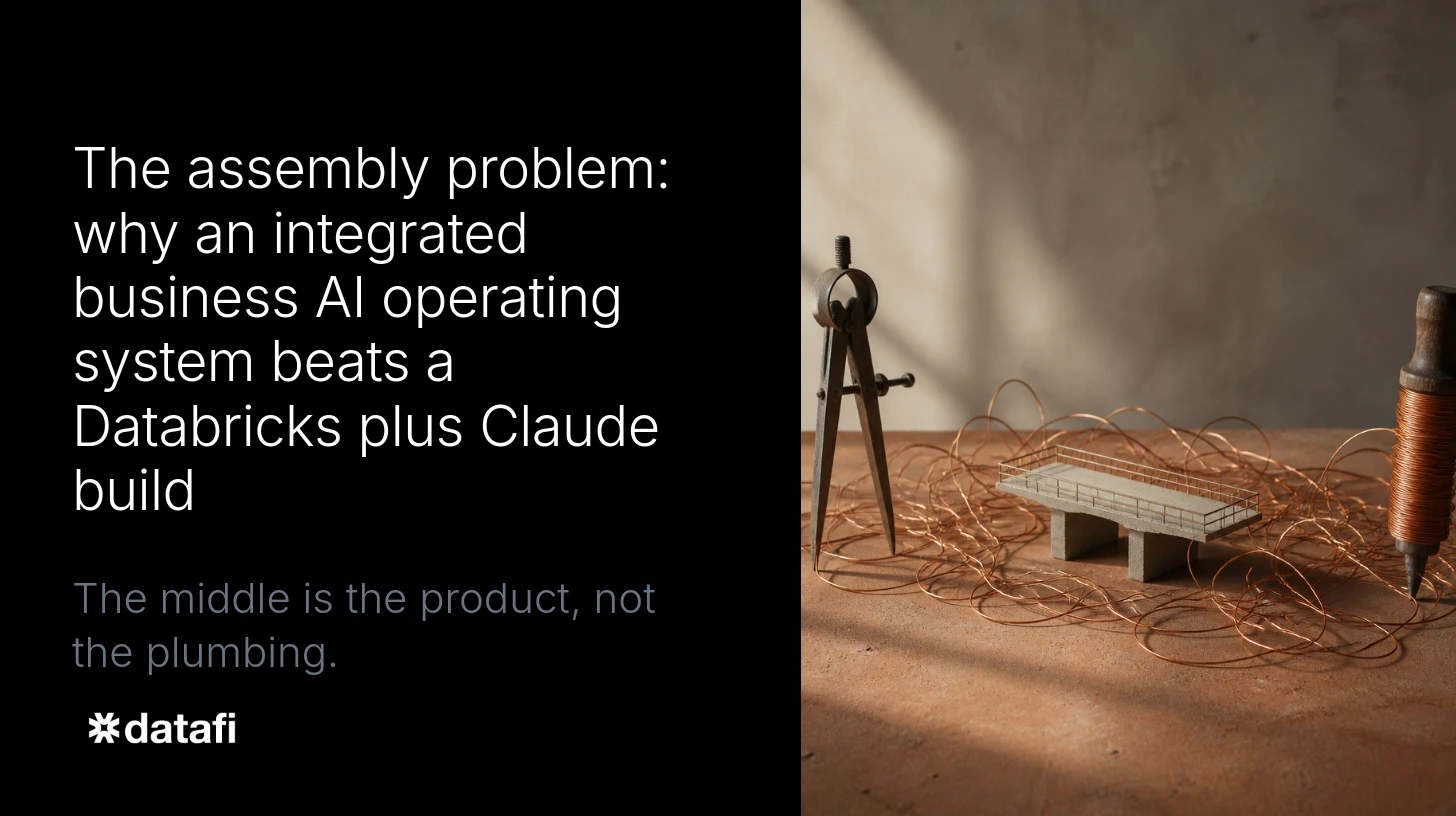
The reason has nothing to do with the quality of the components. Snowflake is an excellent data platform. Claude is an excellent model. The problem is that the thing an enterprise needs is not a data platform next to a model. It is an operating system for business AI, and an operating system is not something that emerges automatically when you place two good products beside each other and ask them to cooperate.
Snowflake plus Claude can produce an AI that answers questions over warehoused data for technical users. What enterprises actually want is an AI that solves problems across the whole business, for every employee, safely. The gap between those two outcomes is not a gap you close with more glue code. It is an architectural gap, and closing it means building an operating system, whether you meant to or not.
The premise worth questioning
The build case rests on a premise that sounds like common sense: that a business AI capability is the sum of a place to store data and a model to reason over it. Get those two right, add some glue, and the rest is engineering detail.
The premise deserves scrutiny, because the detail it waves away is precisely where enterprise AI initiatives succeed or fail.
Consider what the whiteboard diagram quietly assumes. It assumes that the data an AI needs to reason about lives in Snowflake. It assumes that connecting Claude to that data is a matter of a few well-formed queries. It assumes that governance is a layer you add later. It assumes that the people who will actually use the system are comfortable enough to prompt a model directly, or that someone will build them an interface. It assumes that once the model can read the warehouse, it can act on what it finds. And it assumes that all of this will hold together, remain secure, and stay maintainable as the number of use cases grows from one to fifty.
Every one of those assumptions is doing enormous work. And every one of them is where the real cost of the build alternative hides.
The honest case for building it yourself
It would be unfair to pretend the build path has no merits. It has several, and they are worth stating plainly.
Assembling Snowflake plus Claude gives you architectural transparency. You know exactly how each piece works because you wired it together. It gives you flexibility at the component level: if a better model arrives, you can swap it; if you outgrow a warehouse pattern, you can change it. It avoids introducing a new platform vendor into an environment where your teams already know Snowflake intimately. And for a narrow, well-scoped use case, one where the data genuinely does live in the warehouse, the users genuinely are technical, and the required action genuinely is just producing an answer, a competent engineering team can stand something up that works.
If your ambition for AI is bounded, if you want a smart analytical assistant for a data-literate team working over warehouse data, the build path can get you there. That is a real outcome and not a trivial one.
The difficulty is that this is almost never where enterprise ambition stops. It is where it starts.
Where the build path quietly expands
The moment you move past the narrow use case, the build project starts absorbing scope that was never on the original diagram.
The first expansion is data reach. Snowflake holds a great deal, but it does not hold everything, and it rarely holds the operational reality where work actually happens. The state of a business is distributed across ERP systems, CRMs, ticketing platforms, maintenance databases, sensor feeds, document repositories, and dozens of SaaS applications, much of it never landing in the warehouse, or landing there as a stale nightly copy. An AI that can read Snowflake can reason about your historical shadow. To reason about the business as it is right now, it needs live, bidirectional access to the systems where operations run. Building that access, connector by connector, keeping it current, and keeping it governed, is a substantial and permanent engineering commitment. It is not a phase of the project. It is the project.
The second expansion is action. A model reading data can produce a recommendation. But the value of enterprise AI is realized when a recommendation becomes an outcome: a work order created, a record updated, an exception escalated, a downstream workflow triggered. Snowflake plus Claude, in its default form, reads. It does not write back into operational systems, orchestrate multi-step workflows, or close the loop between insight and action. Every one of those capabilities is something your team builds and maintains, and each one carries its own reliability, error-handling, and rollback concerns.
The third expansion is governance, and this is the one that most often turns a promising pilot into a stalled program. The first time your assembled system touches customer data, financial records, or anything regulated, the requirements change entirely. Now you need access policies that mirror the permissions governing human users, so the AI can never surface data a given employee could not see themselves. You need data lineage, so you can explain where an answer came from. You need audit trails, so every agent action is traceable back through its reasoning and its sources. You need consistent policy enforcement across every use case, not a bespoke arrangement per project. Bolting this onto a two-component stack after the fact is expensive, fragile, and exactly the kind of work that invites the mistakes governance exists to prevent.
The fourth expansion is the interface, and it determines who benefits. If the AI is reachable only by people fluent enough to prompt a model or write a query, the value stays trapped with the team that built it. Extending it to the finance manager, the operations lead, the customer service representative, everyone whose work would improve if intelligent assistance were within reach, means building a chat experience designed for non-technical users, one that carries the full context and governance behind the scenes so those users never have to think about the plumbing. That interface is a product in its own right.
None of these four expansions is optional if the goal is genuine enterprise transformation. And once you have built all four, live governed data access, bidirectional action, structural governance, and an interface for everyone, you have not built an integration between Snowflake and Claude. You have built an operating system for business AI. You have simply built it slowly, at high cost, and with a small internal team maintaining it forever.
What an operating system actually does
This is the point at which it helps to be precise about what “operating system” means, because the term gets used loosely.
Just as a computer’s operating system created a unified environment where hardware, software, and user intent could work in concert, a business AI operating system creates the environment where AI can function not merely as a question-answering tool but as a decision-support engine and, ultimately, an autonomous problem-solver embedded in the operational fabric of the enterprise. An OS manages resources. It provides a common interface. It enforces rules and permissions. It lets different programs share context and operate coherently. Without it, every application rebuilds those capabilities from scratch, and the result is fragmentation, inefficiency, and fragility. That description of the do-it-yourself path is not a coincidence.
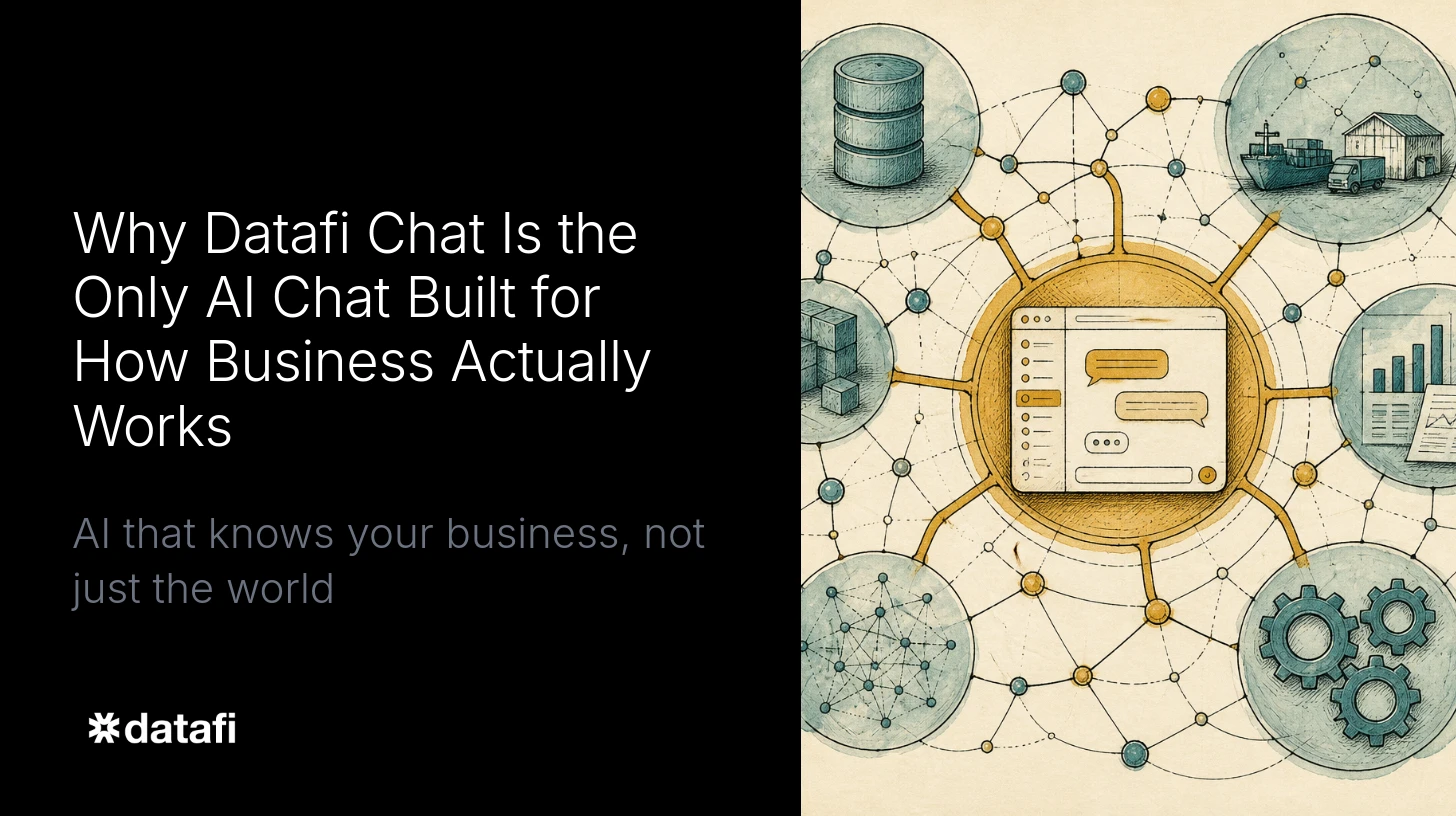
Datafi is built as that operating system from first principles rather than assembled toward it. It is a vertically integrated data and AI technology stack that connects an organization’s complete data ecosystem, enforces governance and compliance policies at every layer, and delivers the whole thing through a Chat UI designed specifically for non-technical users. The integration is the product, not an afterthought bolted on between two products that were never designed to be halves of a whole.
Underneath, the pieces are purpose-built to work together. Orchestrate serves as the agent runtime, running agents and multi-step workflows across the business. Sentinel secures the cyber layer with risk controls. Control Tower provides governance and observability, so organizations define guardrails once and enforce them everywhere agents and workflows run, monitoring and auditing every action rather than chasing logs across a stack of separately-owned tools. Because these layers are designed as one system, governance is reusable: instead of renegotiating security and compliance for every new agent, teams deploy within a shared framework. That is what shortens delivery from quarters to weeks, and it is exactly the reuse that a hand-assembled stack cannot offer, because in a hand-assembled stack every new use case is a new integration.
Crucially, Datafi is LLM-agnostic. Choosing the operating system does not mean giving up the model you admire. If Claude is the reasoning engine you want, Datafi runs it, and runs the next model too, without rebuilding the stack around it. This is the point the vendor-lock-in worry gets backwards. Integration and ownership are separable. You can have an integrated operating system and still own your data, your policies, and your choice of model. What you avoid is owning the permanent, invisible maintenance burden of the glue.
The contextual layer is the real prize
The deepest reason the build path underdelivers is that the hardest part of enterprise AI is not connecting a model to data. It is giving the model the full context of the business, so it can form hypotheses, test them against data, and refine its understanding over time.
An LLM connected to a warehouse sees a partial view: whatever historical records happen to have been loaded, shaped for the queries someone anticipated. To operate in the consequential roles enterprises now care about, critical-thinking workflow automation, analytical judgment, autonomous decision support, an AI needs more than a slice of history. It needs the complete data ecosystem, the policies that constrain action, the operational systems where work happens, and the ability to act within all of it. That combination is what forms the contextual layer that complex agents and workflows depend on. It is the intelligence backbone, and it is precisely the thing that does not emerge from wiring two components together.
At Datafi we see customers pushing AI into exactly these roles, where the system must evaluate options, apply business logic, respect policy constraints, and act inside real processes. That is not a model-and-a-prompt problem. It requires a vertically integrated stack with access to the data ecosystem, policy enforcement, control and observability, and a chat experience any employee can use. My own experience working with data and AI has convinced me that this is the real dividing line in enterprise AI: the difference between systems that answer questions and systems that solve problems is not a difference in model capability. It is a difference in architecture, data access, governance design, and the intentionality with which the whole is built.
The difference between systems that answer questions and systems that solve problems is not a difference in model capability. It is a difference in architecture, data access, governance design, and the intentionality with which the whole is built.
The decision, stated plainly
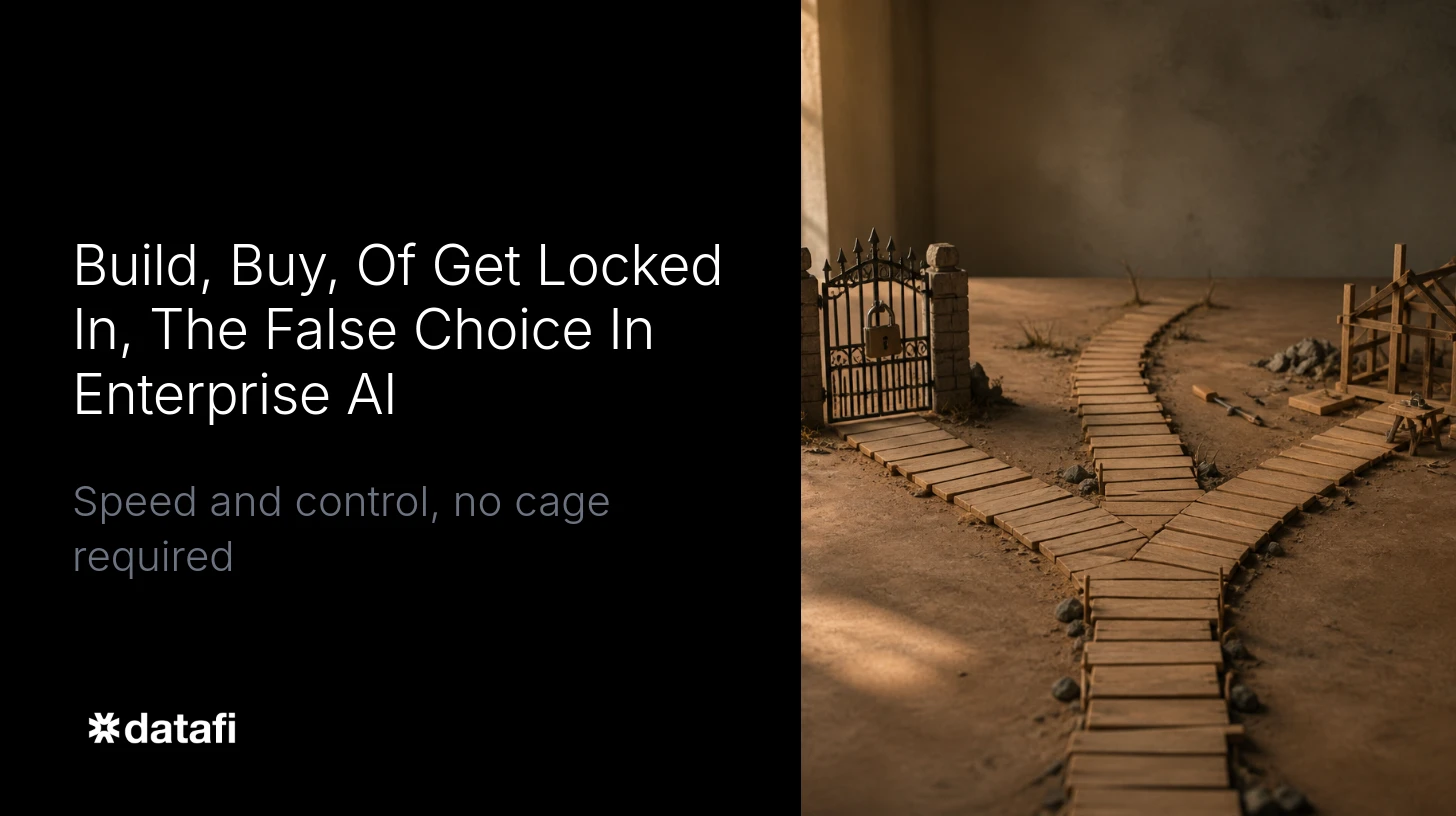
So the choice is not really Datafi versus Snowflake plus Claude in the way the whiteboard framed it. Snowflake remains a place your data can live. Claude remains a model you can reason with, inside Datafi if you choose. The real choice is whether you build the operating system yourself, one connector, one workflow, one governance control, one interface at a time, and maintain it indefinitely with internal resources, or whether you adopt one that was engineered as an integrated whole and start deploying use cases in weeks.
For a single narrow project with technical users and warehouse-bound data, building can make sense. For an organization that wants a unified data experience for every employee, governed and compliance-ready AI, faster and better operational decisions, and agents that act rather than merely answer, the assembled stack is a long road to a destination the operating system reaches directly.
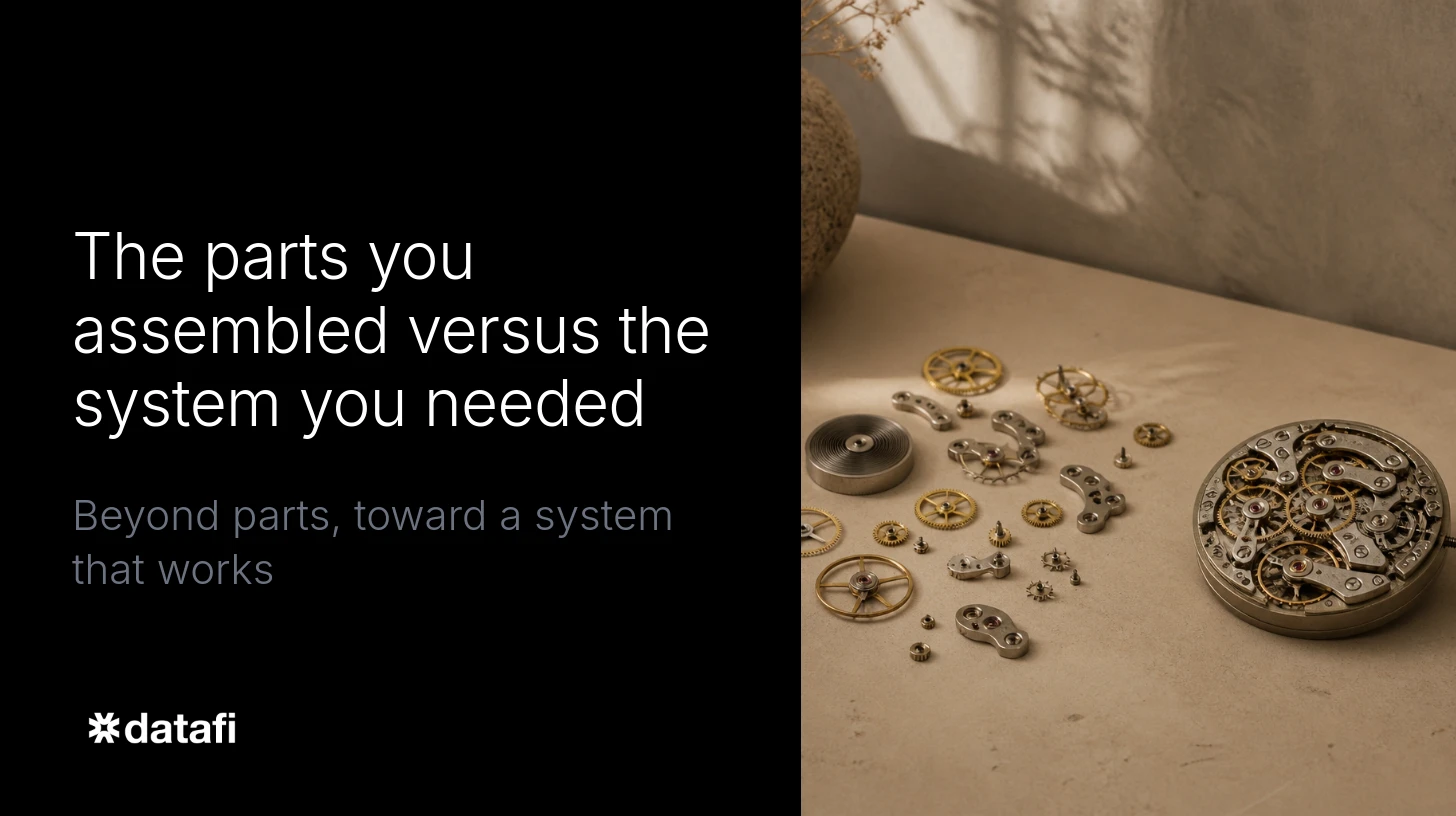
The parts are excellent. The enterprise does not need parts. It needs the whole, and the whole is the point.
In the next piece in this series, we will look at how the contextual layer is constructed in practice, and why full business context, not model choice, is the true determinant of what enterprise AI can achieve.
Datafi is the operating system for business AI: a vertically integrated data and AI technology stack that connects your complete data ecosystem, enforces governance and compliance at every layer, and delivers governed, context-aware intelligence to every employee through a Chat UI built for non-technical users. To learn more about how Datafi can accelerate your organization’s AI transformation, visit datafi.co.