


There is a quiet assumption buried in most enterprise AI plans, and it rarely gets said out loud. The assumption is that if you buy the best data warehouse and connect it to the best language model, you will end up with the best business AI. Take Snowflake, arguably the most capable cloud data platform available. Add ChatGPT, arguably the most recognized large language model on the market. Wire them together. Surely two category leaders, combined, produce a category-leading result.
It is a reasonable assumption. It is also, in practice, the wrong one. And the reason it is wrong tells you almost everything you need to know about what building enterprise AI actually requires.
The gap between an AI that answers questions and an AI that solves problems is not a gap in model quality. It is a gap in everything that surrounds the model: the contextual layer, the governance that spans the full data ecosystem, the runtime for autonomous work, and the observability to trust it.
The premise worth questioning
The build path looks compelling on a slide. Snowflake holds your governed data. ChatGPT provides the reasoning. A layer of glue code in between passes questions to the model, retrieves the relevant data, and returns answers. Many capable engineering teams have drawn exactly this diagram, and a fair number have shipped a working version of it. This is not a strawman. It is a legitimate architecture, and for a narrow class of problems it performs well.
So let us be fair to it before we turn. If your goal is a smart interface over a well-modeled dataset, this pairing can genuinely deliver. An analyst who wants to ask questions in natural language against a clean Snowflake schema, and receive a sensible answer with a chart, is well served. The retrieval-augmented pattern that underpins this is mature, widely documented, and increasingly easy to stand up. For question answering over data you already understand, the assembled stack works.
The trouble begins when the ambition grows past answering questions.
Because the customers we talk to are no longer content to have AI answer questions. They want AI to do the work. They want an agent that reconciles a discrepancy across three systems, decides what the discrepancy means, and takes the next action. They want a workflow that monitors operational conditions, reasons about what has changed, and intervenes before a human notices anything is wrong. They want AI in critical-thinking roles, in analytical roles, in the kind of autonomous operational work that used to belong exclusively to experienced employees. That is a different mountain, and the assembled stack was built to climb a smaller one.
What “solve the problem” actually demands
The gap between answering a question and solving a problem is not a gap in model quality. ChatGPT is an extraordinary reasoning engine. The gap is everything that surrounds the model.
To answer a question, a model needs the relevant slice of data and a good prompt. To solve a problem, a model needs the full context of the business. It needs to know not just what the data says but what the data means inside this specific organization. It needs to know the policies that govern who can see what, the relationships between systems that were never modeled in the warehouse, the operational rules that live in people’s heads rather than in tables. It needs access to the complete data ecosystem, not just the well-curated corner of it that made it into Snowflake. And it needs to act, which means it needs a runtime that can execute steps, call systems, check its own work, and be observed while it does so.
This is the contextual layer, and it is the thing the assembled stack has no place to put.
Consider what happens in the Snowflake-plus-ChatGPT build when you ask it to move beyond a single question. The model has no persistent understanding of your business, so every interaction starts from zero and you rebuild context in the prompt each time. Governance lives in Snowflake’s access controls, but the moment the model reaches beyond Snowflake toward the operational systems where most business data actually lives, those controls do not follow. The workflow logic lives in your glue code, which means every new capability is a new engineering project. And when something goes wrong, and in autonomous systems something eventually goes wrong, you have no unified view of what the agent did, why it did it, or what data it touched.
None of these are model problems. They are systems problems. And systems problems are not solved by pairing two excellent point products. They are solved by an operating system.
Where the build path quietly costs you
The honest case against the build approach is not that it fails to work. It is that the work never ends, and the parts that break are the parts that matter most in the enterprise.
The first cost is integration that you own forever. Connecting Snowflake to ChatGPT is the easy first step. Connecting the model to the dozen operational systems where the rest of your business lives, keeping those connections current as APIs change, handling the data that never made it into the warehouse because it was too operational or too fast-moving to model, is the work that consumes teams. Integration and ownership are separable. You can integrate deeply without committing your engineers to maintaining that integration as their permanent job. The build path conflates the two and quietly signs your team up for the second.
The second cost is governance that does not span the stack. Snowflake governs Snowflake beautifully. But an AI agent operating across the enterprise touches far more than the warehouse, and the assembled architecture has no single place where policy is defined and enforced across everything the agent can reach. You end up with governance in the warehouse, governance improvised in the glue code, and no governance at all in the gaps between. For an AI system meant to operate autonomously in a regulated business, that is not a rough edge. It is a liability.
The third cost is the absence of observability. When a model answers a question, a wrong answer is visible and correctable on the spot. When an agent runs a multi-step workflow autonomously, the failure modes are subtler and the stakes are higher. You need to see what the agent decided, what data informed the decision, and where it acted, not as an afterthought but as a first-class capability. Bolt-together architectures treat observability as logging you add later. In autonomous operation, that is the wrong order.
The fourth cost is the one that is easiest to miss on the slide and hardest to escape in production: LLM lock-in disguised as freedom. Building on ChatGPT feels like an open choice because you selected the model yourself. But once your prompts, your workflow logic, and your integration assumptions are all shaped around one provider’s model, moving to another becomes its own migration project. The freedom was in the first decision, not in the ones that follow.
What an integrated operating system does differently
At Datafi we started from the belief that AI in broad enterprise roles requires a vertically integrated data and AI stack, not a collection of parts. That belief shapes the architecture, and the architecture is where the difference becomes concrete.
The foundation is a global business contextual layer. Rather than rebuilding context in every prompt, the system maintains a persistent understanding of the business: what the data means, how systems relate, which policies apply, what the operational rules are. This is the thing that lets an agent solve a problem rather than answer a question, because it is the thing that gives the agent the full context of the business to reason with. It is also, not coincidentally, the piece the assembled stack has nowhere to store.
Around that layer sit the components that turn context into governed action. Sentinel is the governance framework, defining and enforcing policy across the entire data ecosystem the AI can reach, not just one warehouse. Because governance is defined once and applied everywhere, compliance is a property of the system rather than something reconstructed at each integration point. Orchestrate is the agent runtime, executing the multi-step, autonomous workflows that critical-thinking automation requires, with the reasoning and the acting handled as one coordinated system rather than model on one side and glue code on the other. Control Tower is the observability layer, giving you a unified view of what agents did, why, and against what data, which is exactly the visibility autonomous operation demands and the assembled stack defers.
Two design commitments matter especially here. The first is LLM agnosticism. The operating system is not built around one provider’s model. It orchestrates whichever model best fits the task and lets you change that decision later without unwinding your workflows, because the workflow logic lives in the platform’s contextual layer rather than in provider-specific prompts. The freedom stays available past the first decision. The second is a Chat UI designed for non-technical users. If AI is going to take on broad roles across the enterprise, the people who do that work cannot be limited to engineers. The interface has to meet operations staff, finance teams, and frontline decision-makers where they are, in plain language, without asking them to understand the machinery underneath.
The result is not a smarter question-answering tool. It is a system in which unifying operational data through agents and workflows, governing AI so that it is compliance-ready by construction, and reaching faster and better operational decisions are the ordinary output of the platform rather than the reward for a long integration project.
The decision, stated plainly
The Snowflake-plus-ChatGPT build and the integrated operating system are not competing on the same axis, and the most useful thing a technology leader can do is refuse to pretend they are.
If what you need is a natural-language interface over a governed dataset, and you have the engineering capacity to build and maintain the connective tissue, the assembled stack is a reasonable choice and it will serve you. That case is real, and no one is well served by pretending otherwise.
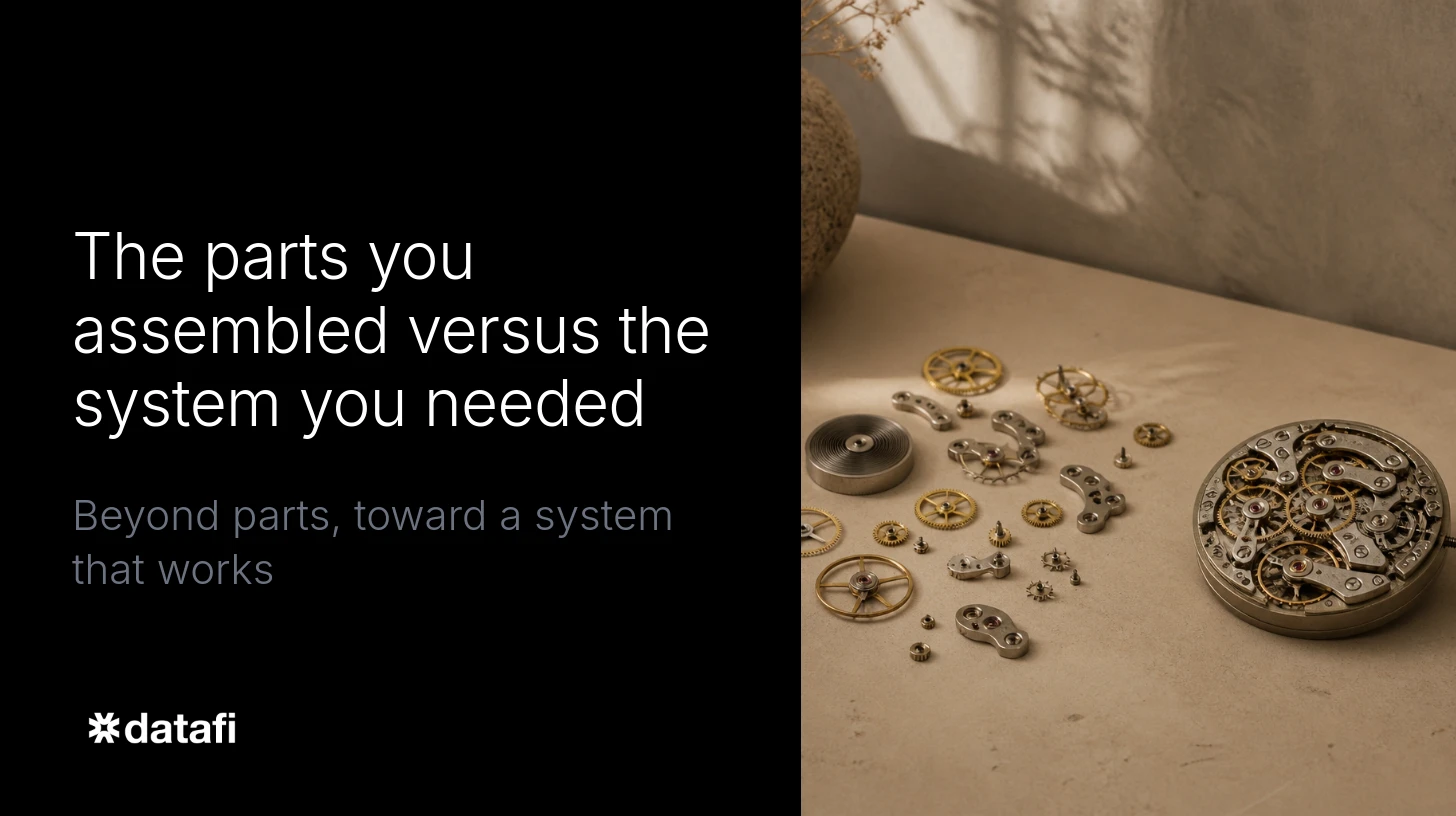
But if what you need is AI in the roles that matter most, autonomous, analytical, operating across the whole business under governance you can prove and observe, then the question is not which two products to pair. It is whether you are building a smart interface or standing up a system capable of solving problems. Those require different foundations. The contextual layer, the governance that spans the ecosystem, the runtime for autonomous work, and the observability to trust it are not features you add to a warehouse and a model. They are the operating system underneath, and they are difficult to retrofit onto an architecture that never had a place for them.
The difference between AI that answers questions and AI that solves problems is not the model you choose. It is the system you build it into.
Organizations of any size can reach a unified data experience and real workflow efficiency for every employee. What that outcome requires is not the best parts assembled with care. It is an integrated data and AI stack that was built, from the contextual layer up, to action data rather than merely describe it.
In the next piece in this series, we will look at how the contextual layer is constructed in practice, and why the order in which you build these capabilities determines what your AI can eventually do.
Datafi is the Business AI Operating System for mid-enterprise organizations, giving every employee governed, compliance-ready AI over a unified operational data ecosystem. Learn more at datafi.co.