


Part 3 of 3: The Business AI Operating System for Professional Sports
The numbers are striking. Survey after survey of sports industry executives tells the same story: nearly nine in ten believe AI will significantly impact their business operations within the next three years. The investment is following the conviction. Analytics budgets are growing. AI vendors are proliferating. Pilot programs are launching across every major league.
And yet, for every franchise that has genuinely transformed how it operates through AI, there are a dozen that have launched initiatives, spent money, generated enthusiasm, and arrived, a year or two later, at roughly the same place they started. The pilot worked. The deployment did not. The tool got used by the analytics team and no one else. The model was accurate but no one trusted it. The technology was deployed but the culture never changed.
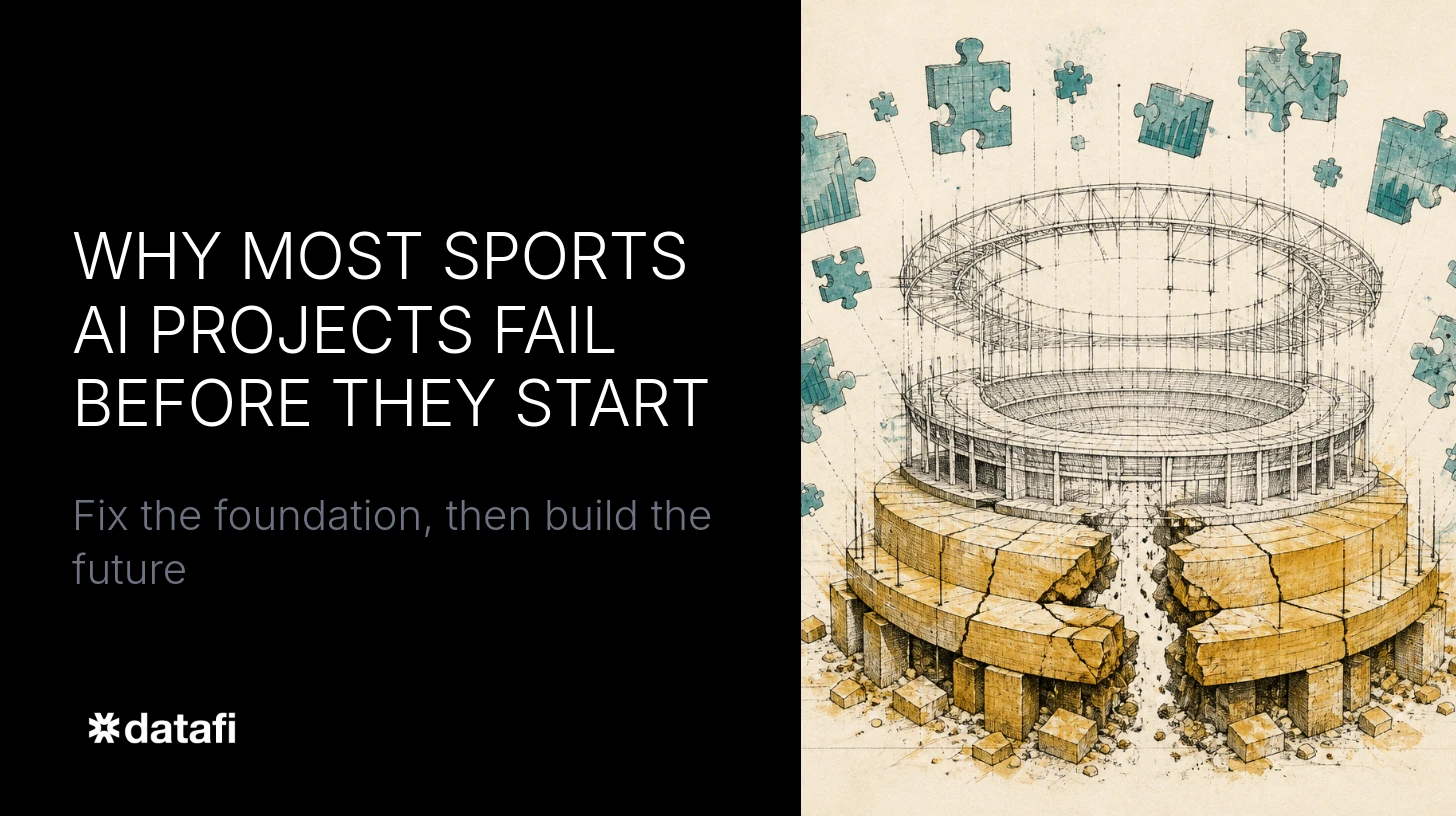
Most sports AI projects do not fail because the technology is bad. They fail before they even start, because of the architectural decisions made before a single line of AI code is written, and the cultural realities that no vendor’s sales pitch adequately addresses.
Understanding why is the first step toward doing it differently.
Most sports AI projects fail not because of bad technology, but because organizations skip the foundation work: solving data connectivity, enforcing governance, and ensuring accessibility before deploying a single AI tool.
The Wrong Diagnosis
When AI projects underperform in sports organizations, the instinct is to look for a technical explanation. The model was not accurate enough. The data was too noisy. The platform was not fast enough for real-time use. These are real issues, and they deserve real solutions, but they are almost never the root cause of failure.
The root cause is almost always one of two things: the organization tried to deploy AI before solving the connectivity problem, or it tried to deploy AI without addressing the cultural adoption problem. Often, it is both at once.
The connectivity problem we explored in the previous installment of this series: most sports organizations are running five, ten, or twenty disconnected systems that were never designed to share data. When AI is deployed on top of this fragmented foundation, it can only access a fraction of the organization’s intelligence. The outputs are narrow. The recommendations lack context. Users quickly learn that the system does not really understand the organization, and they stop trusting it.
The cultural problem is subtler, but equally disqualifying.
The Culture Problem No One Talks About
Professional sports is one of the most tradition-bound industries on earth. Coaching philosophies are passed down through decades of playing and coaching lineages. Front office evaluation methods reflect the accumulated experience of people who have spent their careers building expertise the hard way. Trust is earned slowly, skepticism is healthy, and the introduction of a machine that claims to know better is not a neutral event.
This is not irrationality. It is professionalism. A manager who has spent thirty years reading hitters and managing bullpens has a finely calibrated model in his head, one built from tens of thousands of data points his analytical system cannot fully capture. Player chemistry, competitive intensity, the way a veteran handles a slump, the subtle signs that a reliever’s mechanics are drifting toward injury: these things exist in the intelligence of experienced practitioners, not in any database.
The failure mode that has plagued AI deployments in sports is the assumption that better data plus better models equals better decisions, full stop. It does not. It equals better inputs to decisions that humans still have to make, in real time, under pressure, in a context that the model does not fully understand.
When AI is deployed as a replacement for human judgment rather than a complement to it, resistance is the rational response. And resistance, once established, is extraordinarily hard to overcome. The analytics team gets labeled as threats rather than partners. The tools get used minimally, ceremonially, or not at all. The investment calcifies into an expensive dashboard that three people look at on Monday mornings.
This is why the most analytically successful sports organizations, the ones that have built durable cultures of evidence-based decision making, have done it through what researchers call gradual integration: demonstrating value through controlled testing, building trust one decision at a time, and making it easier for experienced practitioners to incorporate data into their existing judgment rather than asking them to replace that judgment with an algorithm.
The Architecture Failure
The cultural problem is real, but it is downstream of an architectural failure that most organizations do not recognize until the damage is done.
Most sports AI deployments are point solutions. A pitching analytics platform here. A fan engagement AI there. A sponsorship performance tool for the business side. A player health monitoring system for the medical staff. Each tool is built to solve one problem, for one team within the organization, using one subset of available data.
Point solutions can answer questions within their domain. They cannot solve problems that span domains. And in a professional sports organization, almost every problem of consequence spans domains.
The decision about whether to extend a starting pitcher’s contract is not a pitching analytics problem. It is simultaneously a player performance problem, a health and durability problem, a financial modeling problem, a roster construction problem, and a competitive intelligence problem. Each of those problem types lives in a different tool. No single person in the organization has access to all of them simultaneously. And no AI built on a point solution architecture can reason across them.
The result is the most common failure pattern in sports AI: a proliferation of tools, a corresponding proliferation of siloed insights, and a front office that is somehow less coherent in its decision making than it was before the AI investment, because now there are six competing sources of intelligence instead of one.
What a Foundation Actually Requires
Building AI that works, that genuinely transforms how a sports organization operates rather than adding another tool to the stack, requires solving the foundation problem first.
The foundation has three requirements.
First, connectivity. The AI must have access to the full data ecosystem of the organization, not a curated subset, not a warehouse that is three days stale, but a live, governed connection to every source of organizational intelligence: player data, fan data, financial data, operational data, medical data, scouting data, sponsorship data. Without this, the AI is reasoning with incomplete information. Its recommendations will reflect the limits of its inputs, and experienced practitioners will be correct not to trust them.
Second, governance. In a professional sports organization, not everyone should see everything. Player medical records are private. Contract terms are sensitive. Scouting assessments can affect player relationships and competitive standing. An AI platform that unifies organizational data without enforcing granular access controls is not a solution, it is a liability. The governance layer is not a constraint on what AI can do; it is what makes AI safe to deploy at organizational scale.
Third, accessibility. The most important requirement, and the one most often underestimated, is that the AI must be usable by every person in the organization, not just the analytics team. This is the requirement that most point solutions fundamentally fail to meet. They are built by data scientists, for data scientists, with interfaces that assume technical fluency.
A manager in the dugout does not have technical fluency. A VP of sponsorship sales does not have technical fluency. A director of scouting who has spent twenty years developing expertise in player evaluation does not have, and should not need, technical fluency. If the AI platform requires technical expertise to use, it will be used by the analytics team and no one else. The democratization of intelligence, the thing that actually changes how an organization operates, never happens.
The Datafi Difference
Datafi’s Business AI Operating System was designed from first principles around these three requirements. Connectivity, governance, and accessibility are not features added to an existing architecture. They are the architecture.
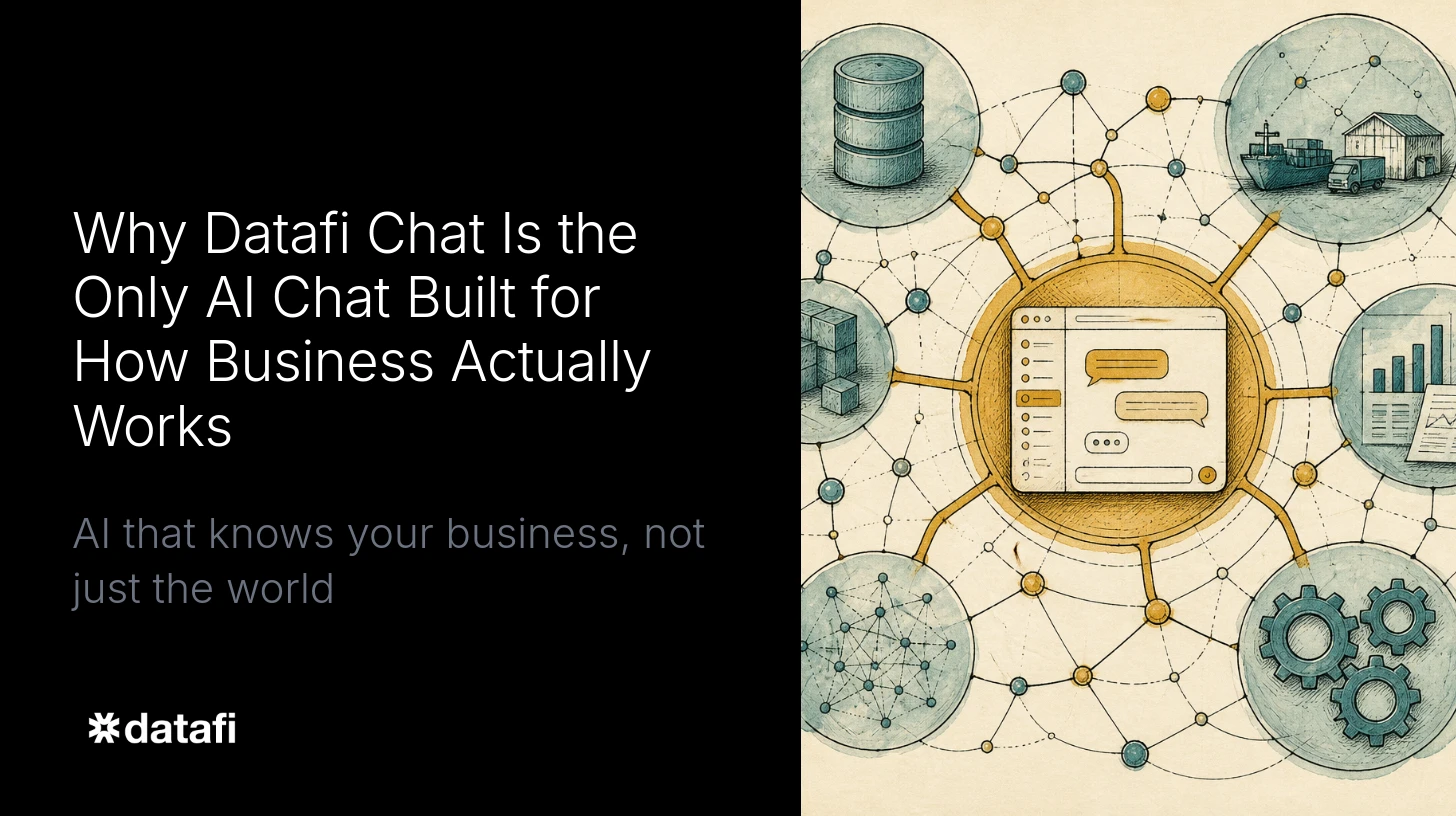
The platform connects to every data source the organization uses, without requiring migration or replacement of existing systems. It enforces granular, role-based governance across every connection, so that unified data access does not mean undifferentiated data access. And it delivers intelligence through a natural language interface, Datafi Chat, that every employee in the organization can use, from the front office to the coaching staff to the business operations team, regardless of their technical background.
This is what it means to build AI on a correct foundation. Not a smarter model. Not a faster dashboard. A platform that solves the connectivity problem, enforces the governance requirements, and makes the intelligence of the organization accessible to the people who need it, in the language they already speak, in the context of the decisions they actually face.
From Failure Patterns to Success
The sports organizations that have moved beyond the failure patterns described in this series share a common characteristic: they did not try to solve the AI problem with more AI. They solved it with architecture.
They started by mapping their data ecosystem, not just the data they were using, but all of it, including the systems that no one had connected because no one had ever had a reason to connect them. They established governance frameworks that defined who could access what, and under what conditions. They chose platforms that met users where they were, rather than requiring users to become technical in order to participate.
And then, with that foundation in place, they deployed AI, and watched it compound. Each new user who engaged with the platform made it smarter. Each cross-functional question that got answered built trust in the system and reduced the cultural resistance that had doomed previous initiatives. Each good decision that was informed by the platform’s intelligence reinforced the behavior and built the evidence base that changed the organizational culture from the inside.
This is not a fast process. But it is a durable one. And it is the only path from the AI pilot that impressed everyone at the demo to the AI-powered organization that operates differently every single day.
Conclusion
Most sports AI projects fail before they start because they skip the foundation work. They deploy intelligence on top of fragmented data. They build tools for analysts and hope the culture will follow. They solve individual problems without building the connective tissue that would allow those solutions to compound.
The franchise that gets this right will not just have better analytics. It will have a different kind of organization, one where every decision maker, from the dugout to the boardroom, is operating with the full intelligence of the enterprise behind them. Where AI does not answer questions for a small team of specialists, but solves problems for everyone.
That is the organization Datafi builds. And in an industry where the margin between winning and losing, on the field and in the business, is measured in fractions, it is the only kind of AI investment worth making.
Read the full series:
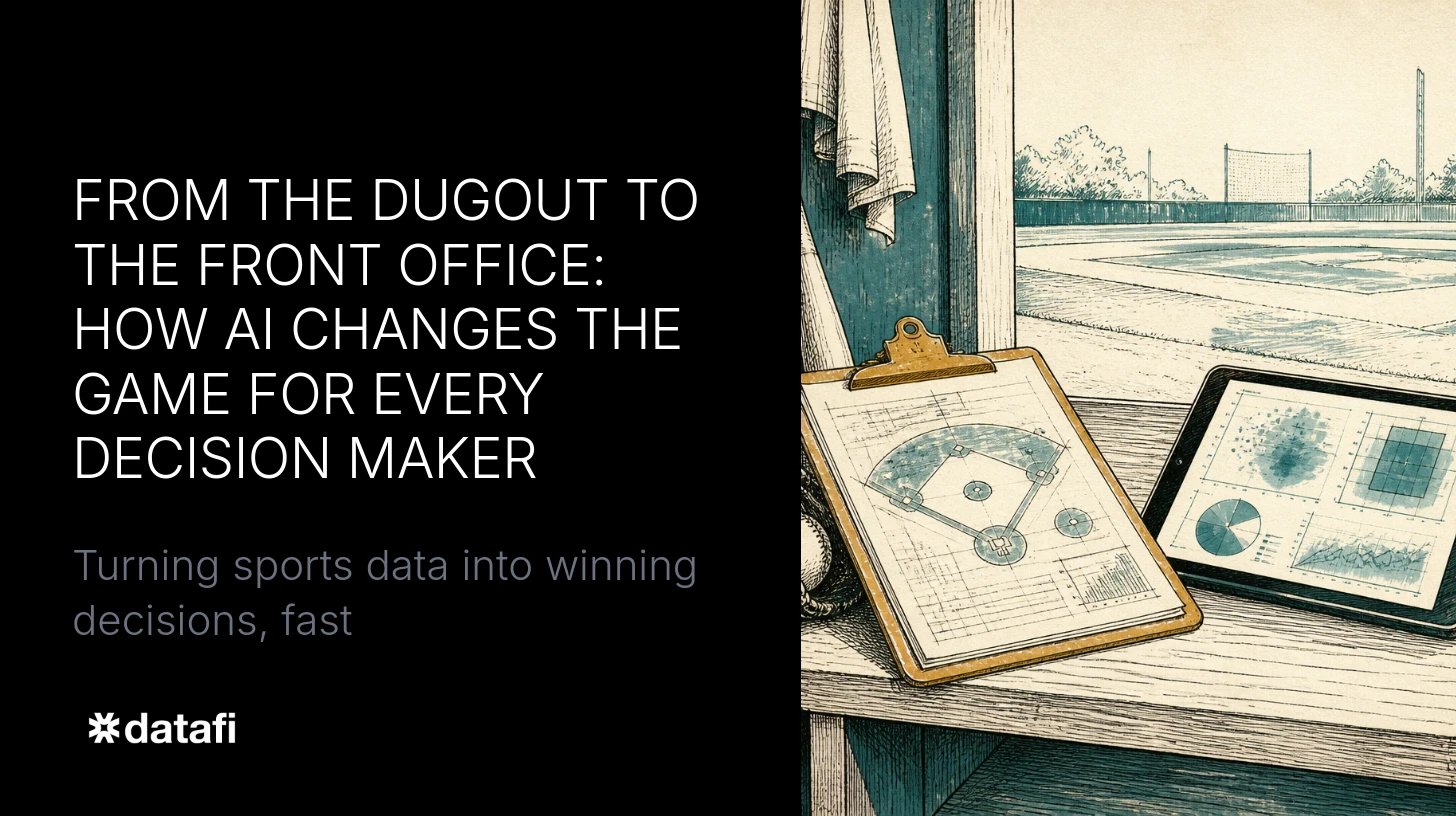
Part 1: From the Dugout to the Front Office: How AI Changes the Game for Every Decision Maker
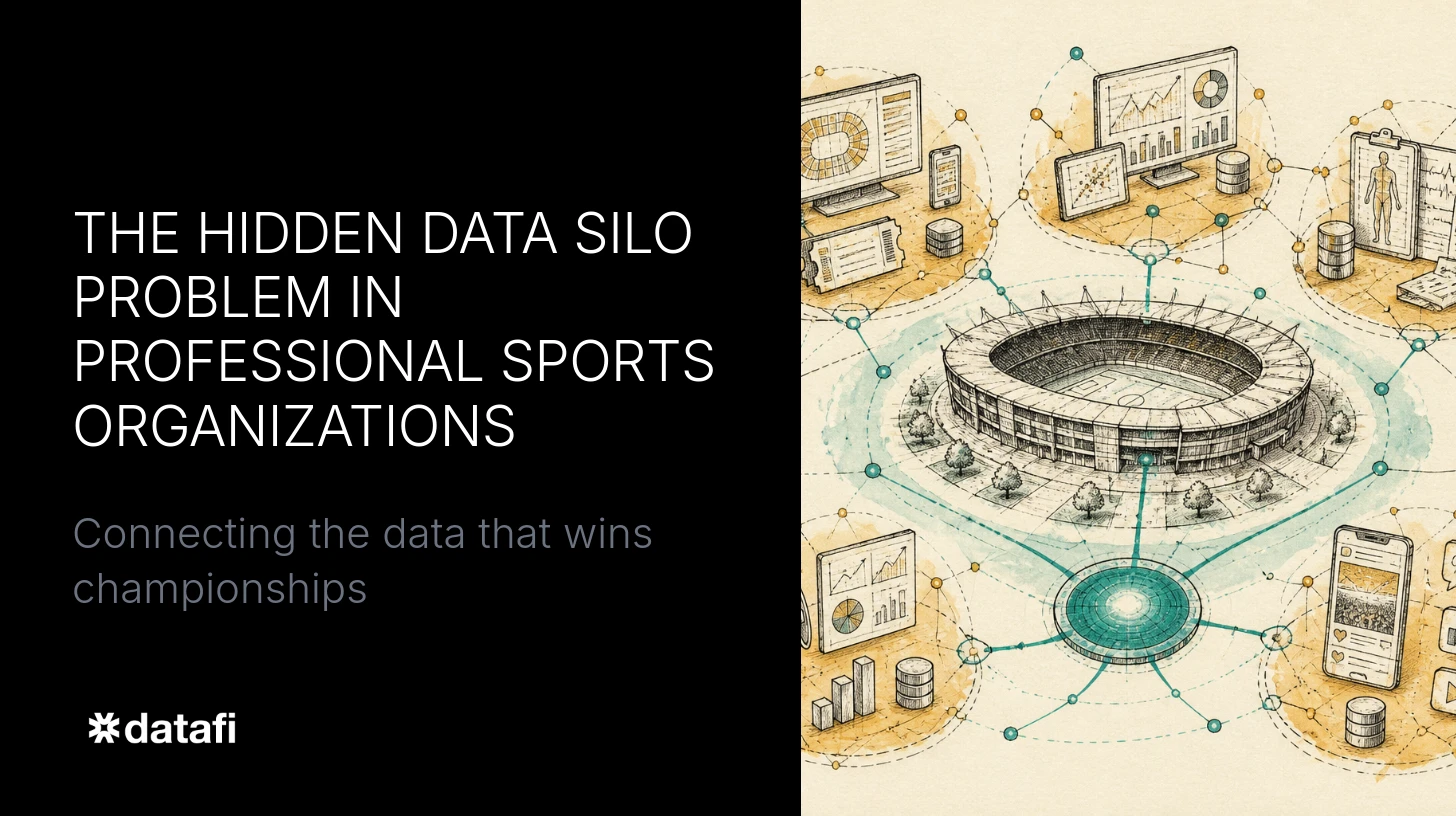
Part 2: The Hidden Data Silo Problem in Professional Sports Organizations
Part 3: Why Most Sports AI Projects Fail Before They Start
Learn more at datafi.co