



Part 2 of 3: The Business AI Operating System for Professional Sports
From the outside, a professional sports franchise looks like one of the most data-rich organizations in the world. Sensors on every player. Tracking systems covering every inch of the field. Fan data flowing in from ticketing apps, loyalty programs, mobile concessions, social platforms, and broadcast partnerships. Sponsorship performance metrics. Venue operations dashboards. Payroll and contract modeling tools.
The data is everywhere. The problem is that everywhere is exactly the issue.
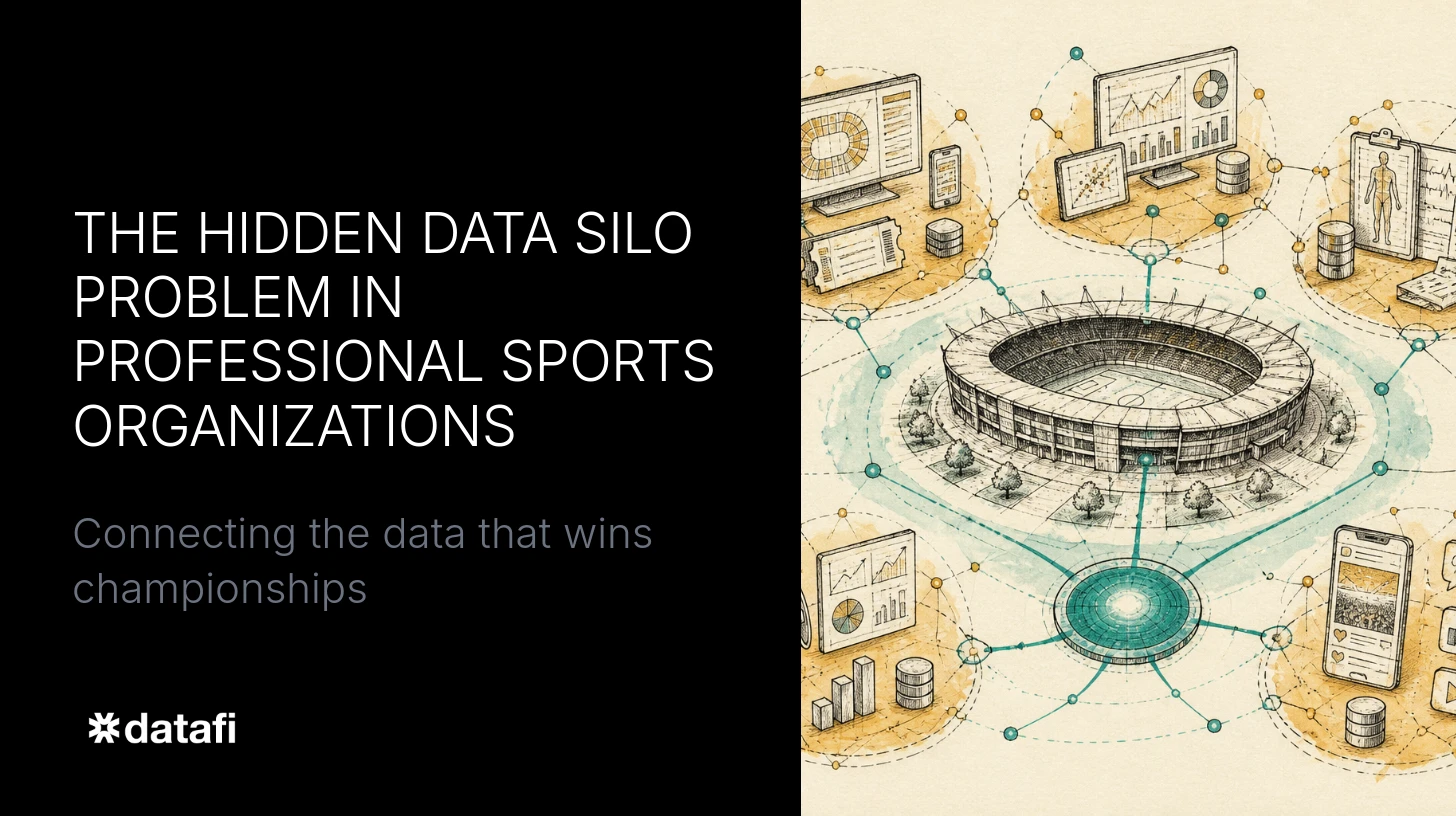
In organization after organization, across every major professional sport, the dirty secret of the analytics era is this: the data exists, but it does not connect. Each department runs its own systems. Each system speaks its own language. And the intelligence that could transform operations, from player performance to fan engagement to business strategy, remains fragmented, siloed, and out of reach for the people who need it most.
This is the hidden data silo problem in professional sports. And it is more expensive, more damaging, and more solvable than most sports organizations realize.
The core problem in professional sports analytics is not a lack of data; it is a lack of connectivity. Franchises that solve this architectural gap first will turn their existing data investments into a genuine competitive advantage.
A Franchise Seen From the Inside
Imagine a top-tier professional baseball franchise in a major market. On paper, they are analytically sophisticated. They have invested in player tracking infrastructure. They have a dedicated analytics department with real talent. Their front office talks openly about being a data-driven organization.
But inside the organization, the picture is more complicated.
The ticketing system holds years of fan purchase history, but it does not talk to the CRM platform where the marketing team manages fan relationships. The scouting database, meticulously maintained, is not connected to the financial modeling tools the front office uses for contract negotiations. The player performance data from the coaching staff’s analytics system is separate from the medical and training load data managed by the sports science team.
When the VP of Strategy and Analytics wants a unified view of a single fan, their ticket history, their merchandise purchases, their digital engagement, their concession behavior, their response to past marketing campaigns, she cannot get it from a single source. She has to request data pulls from three different teams, wait for someone to reconcile the formats, and by the time the picture is complete, the campaign window has passed.
This is not a hypothetical. It is the operating reality for the majority of professional sports franchises, including some of the most celebrated analytics programs in the industry. As one Major League front office acknowledged publicly, fan data had historically been spread across ticketing, marketing, and digital systems, making it difficult to analyze behavior and activate insights quickly.
The problem is not a lack of data. It is a lack of connectivity.
The Cost of Disconnection
The costs of this fragmentation are both visible and invisible. The visible costs are easy to document: duplicated technology investments, manual reconciliation work that consumes analyst time, delayed reporting cycles, and the constant friction of moving data between systems that were never designed to work together.
The invisible costs are harder to measure but far more consequential.
When player performance data is disconnected from training load data and medical history, the sports science team cannot build an integrated picture of player health and readiness. They are managing risk with incomplete information, and in a sport where a single soft-tissue injury can cost a franchise tens of millions of dollars and multiple wins, the stakes of that information gap are enormous.
When sponsorship data lives in a separate system from fan engagement data, the sponsorship sales team cannot make a compelling, data-backed case to a partner about audience reach and activation effectiveness. They are leaving revenue on the table because the evidence that would close the deal is locked in a system they cannot access.
When venue operations data is disconnected from event scheduling, ticketing trends, and weather data, the operations team cannot optimize staffing and concessions with any precision. They are guessing, and in a high-margin, high-volume business, guessing has a real cost.
Why Silos Persist
Understanding why data silos persist in sports organizations requires recognizing how they form in the first place. They are almost never the result of bad planning. They are the result of good solutions to specific problems, implemented over time, without a unifying architecture.
The ticketing system was the best solution available when the franchise needed to manage ticket sales a decade ago. The CRM platform was the right tool when the marketing team needed to manage fan relationships. The player analytics platform was state of the art when the front office decided to get serious about performance data. Each decision made sense in isolation. The cumulative effect was a technology landscape that no single person in the organization fully understands, and that no single team has the mandate or the resources to unify.
This is why the answer is not a data warehouse migration project or a years-long IT consolidation initiative. Those approaches are expensive, disruptive, and by the time they complete, the technology landscape has already shifted again.
The answer is a platform that connects to data where it lives, without requiring organizations to move it, transform it, or rebuild the systems that house it.
The Datafi Approach: Connect, Don’t Consolidate
Datafi’s Business AI Operating System is built on a foundational architectural principle: connect to existing data sources rather than replace them. The platform integrates with the full ecosystem of systems a sports organization already uses, ticketing platforms, CRM tools, player analytics databases, medical systems, financial modeling tools, sponsorship management software, and builds a unified intelligence layer on top of them.
This means that the VP of Strategy and Analytics gets her unified fan view without a data migration project. The sports science team can ask questions that span player performance and medical data without a new database integration initiative. The sponsorship sales team can pull cross-functional evidence for a partner presentation in minutes rather than weeks.
Critically, Datafi enforces governance and security controls across this unified layer. Every connection respects the access permissions of the underlying systems. Every query is governed by the organization’s data policies. The sports medicine team can access training load data without being able to see financial contract terms. The marketing team can work with fan engagement data without access to player medical records. The intelligence is unified, but the access is controlled.
From Connectivity to Intelligence
Connecting the data ecosystem is the foundation. But the real value of Datafi’s architecture is what becomes possible once that connectivity is established.
When every source of organizational intelligence is connected to a single governed layer, AI can operate on the full context of the organization rather than a fragment of it. Questions that were previously impossible, because they required data from multiple disconnected systems, become answerable in plain language, without technical expertise, in real time.
The coaching staff can ask: given everything we know about this pitcher’s workload over the last six weeks, his mechanics data from the last three starts, and the tendencies of tomorrow night’s opposing lineup, what does the evidence suggest about his optimal deployment? The front office can ask: across all the markets where we have fan data, which segments are showing the highest growth in engagement, and what is our current activation strategy for those segments? The business operations team can ask: looking at the last five years of venue data, what staffing model correlates most strongly with high fan satisfaction scores on days with late-afternoon weather uncertainty?
These are not hypothetical future capabilities. They are the natural output of a platform that has solved the connectivity problem that prevents most sports organizations from asking them today.
Conclusion
The data silo problem in professional sports is not a technology failure. It is an architectural gap, the space between the investments organizations have made in individual systems and the unified intelligence layer that would make those investments compound on each other.
Datafi closes that gap. Not by replacing what organizations have built, but by connecting it, and layering on top of it a governed, context-aware AI that makes the full intelligence of the organization accessible to every decision maker, in real time, in the language of their work.
The franchises that solve the connectivity problem first will not just have better data. They will have a fundamentally different operating capability, one that turns the investment they have already made in data and analytics infrastructure into the competitive advantage it was always supposed to be.
Next in this series: Part 3 — Why Most Sports AI Projects Fail Before They Start
Learn more at datafi.co